-
-
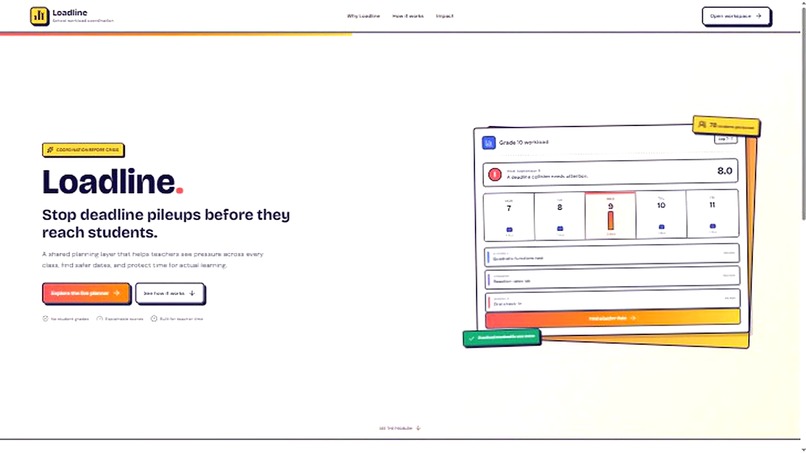
Landing Page
-
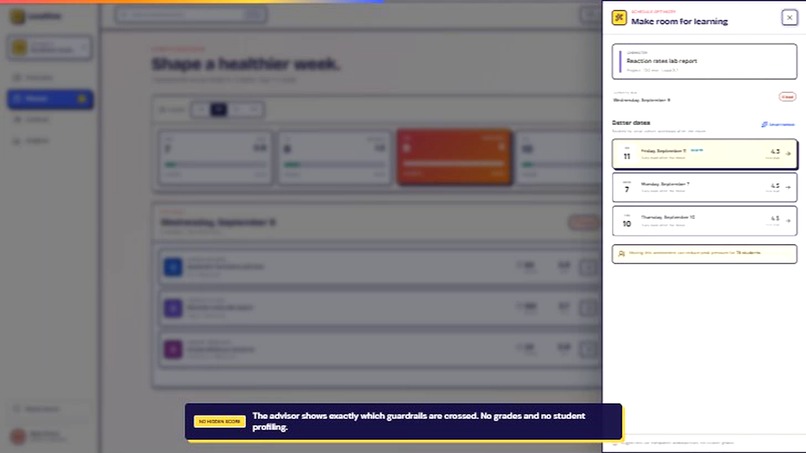
Planner
-
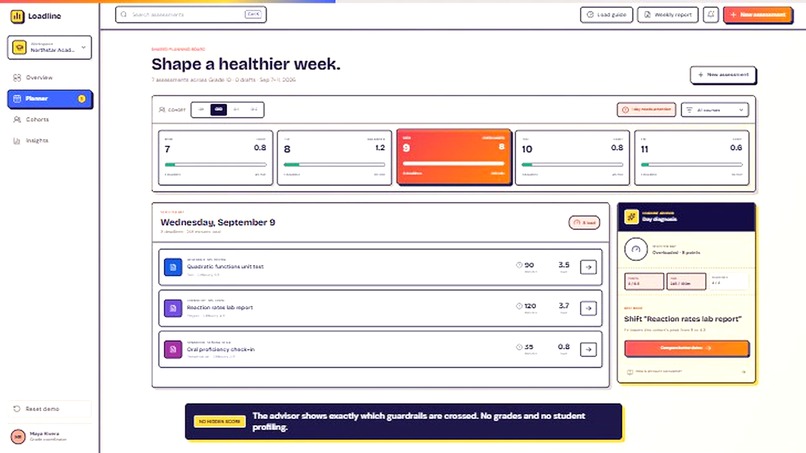
Optimizer
-
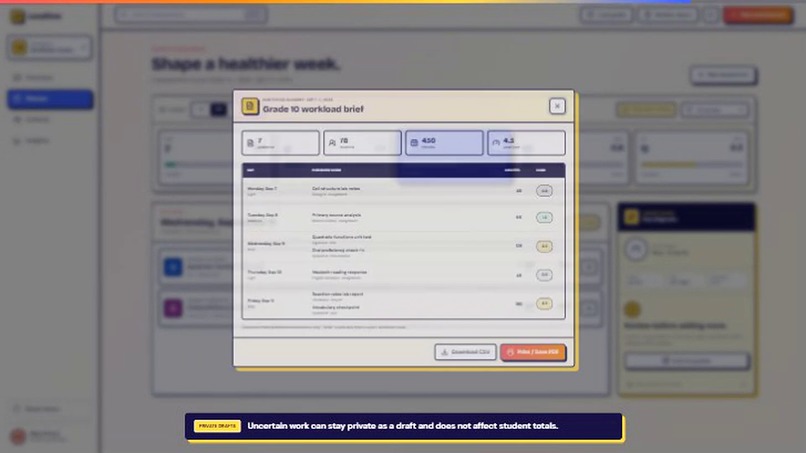
Insights
-
Report
-
Load-Guide
Loadline — Devpost Submission
Replace the four bracketed link/name fields before submitting.
Project name
Loadline
Tagline
Catch workload collisions before students have to carry them.
Short description
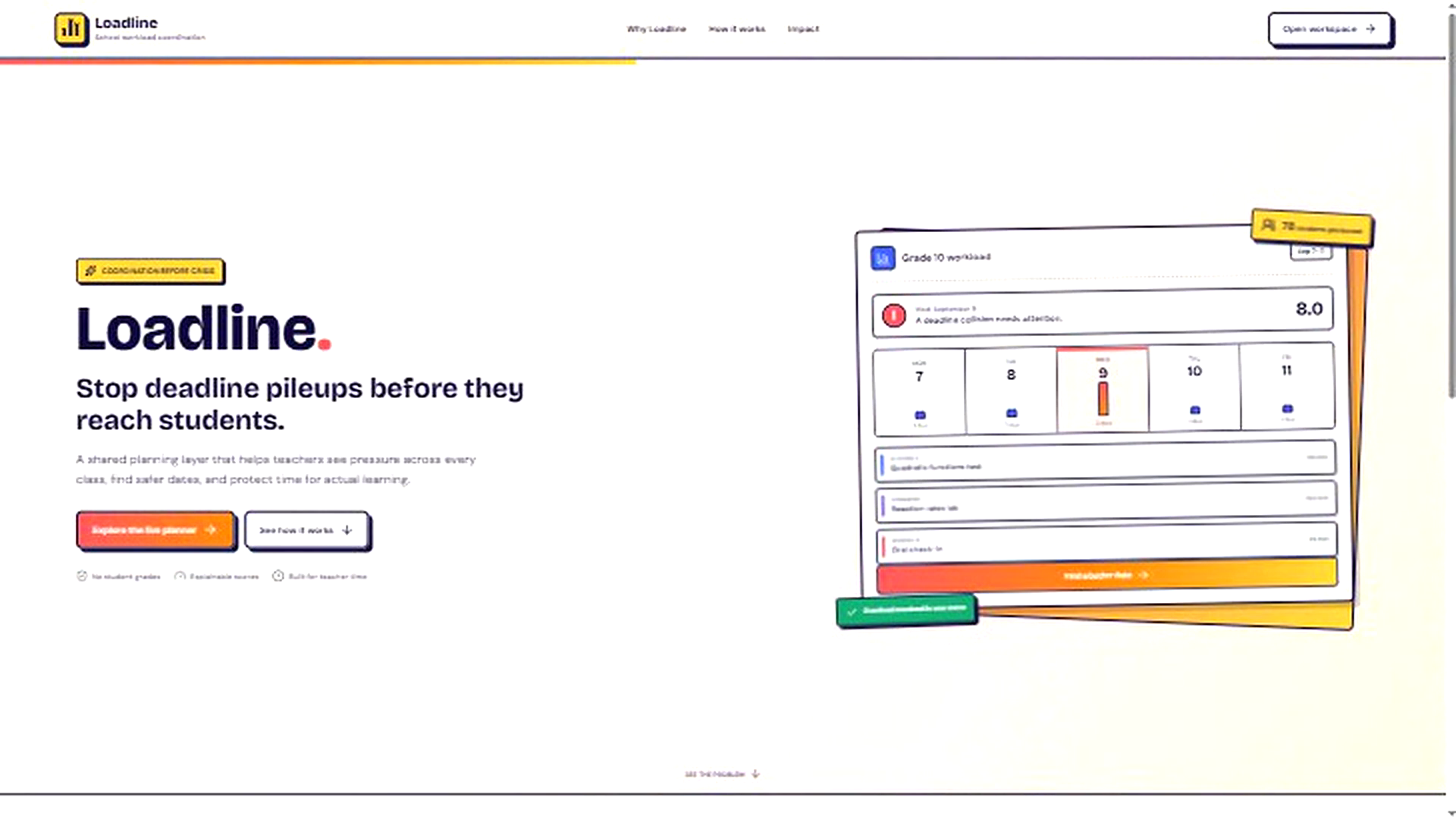
Loadline is a shared planning workspace that helps teachers detect and prevent cohort-wide deadline pileups before assessments are published.
The problem
Teachers usually plan inside separate classroom calendars. A reasonable test in one class can become an unreasonable day when it overlaps with a lab report, presentation, and homework from other classes. Traditional student planners document that overload after it happens. They do not help a school prevent it.
What Loadline does
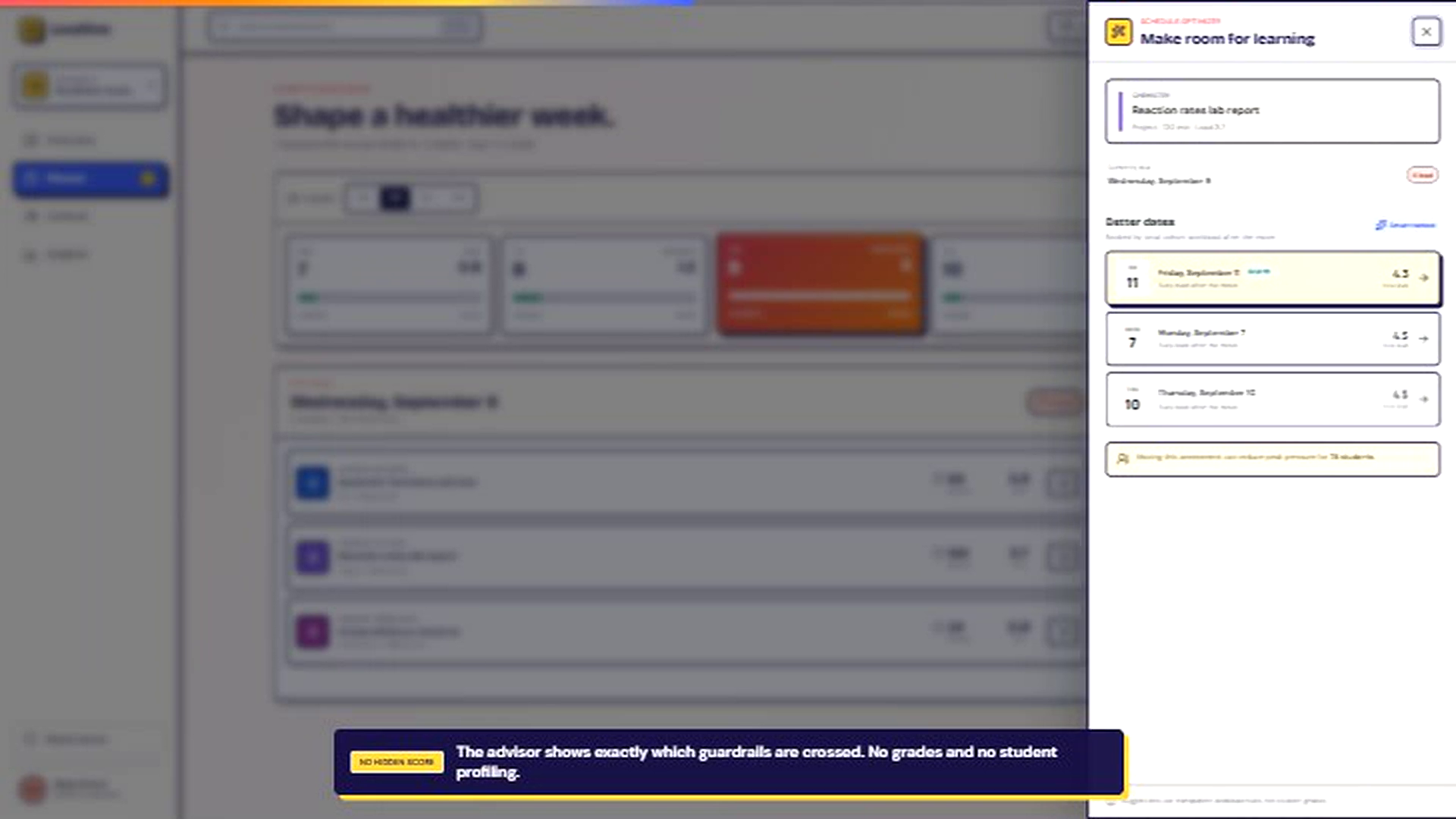
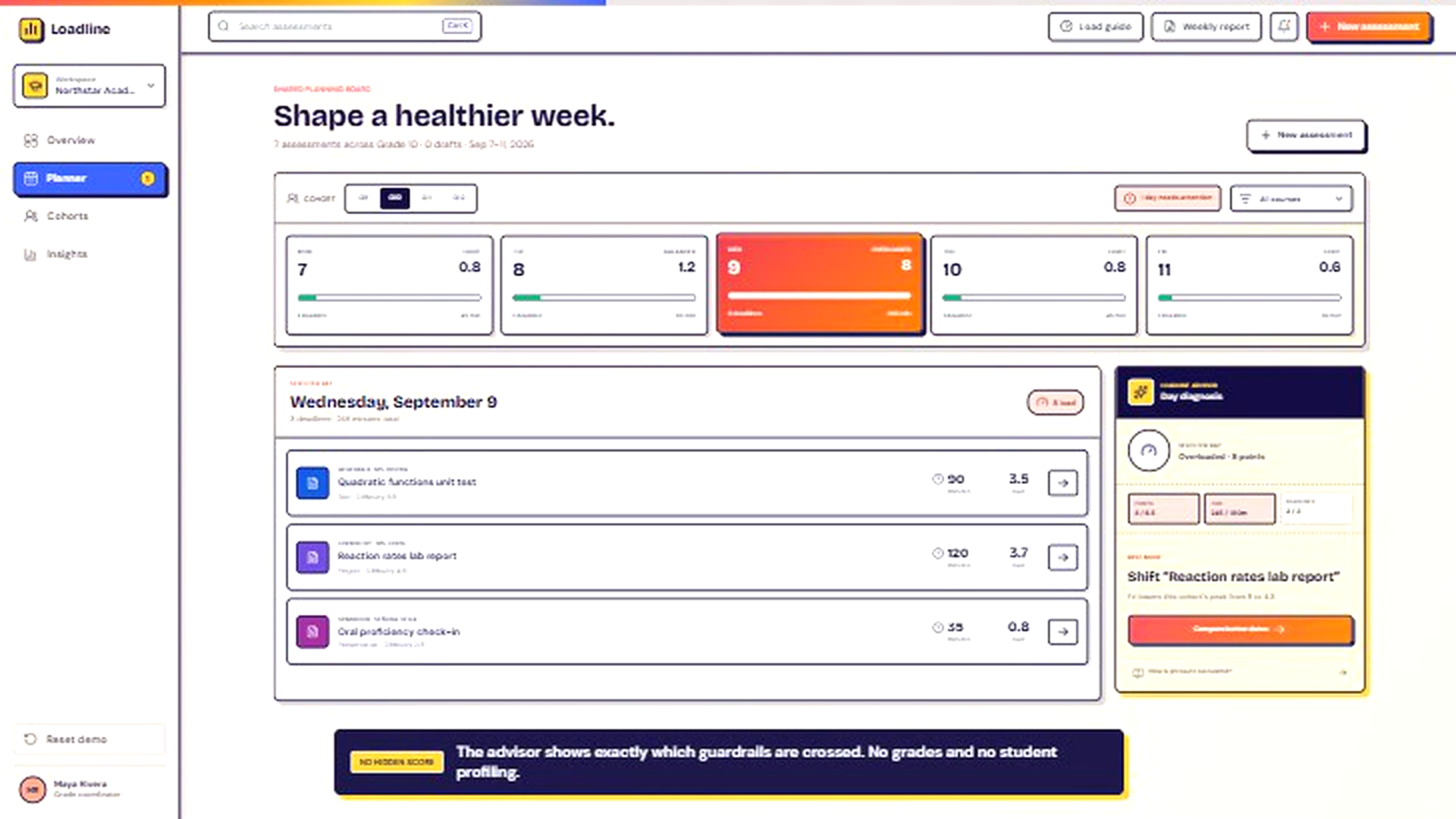
Loadline gives teachers one explainable view of a cohort's week. It combines estimated effort, difficulty, and assessment type into transparent load points, then checks daily points, total minutes, and deadline count. When any guardrail becomes overloaded, Loadline identifies the contributing assessments and ranks safer dates by their resulting cohort load.
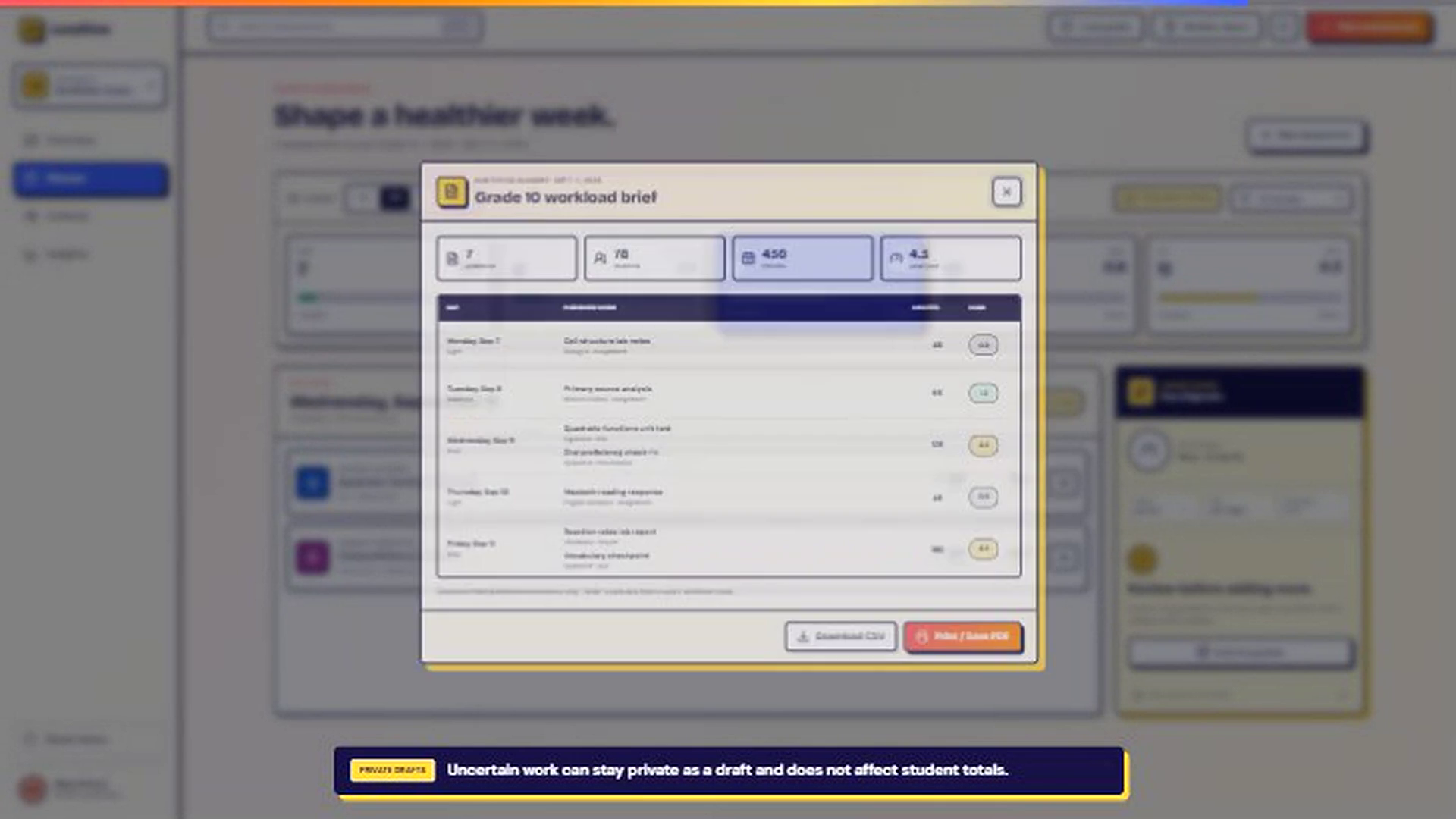
Before publishing new work, a teacher sees its projected impact. They can save it privately as a draft, where it remains visible to staff but does not affect student totals, or publish it to the shared schedule. Every connected view updates immediately.
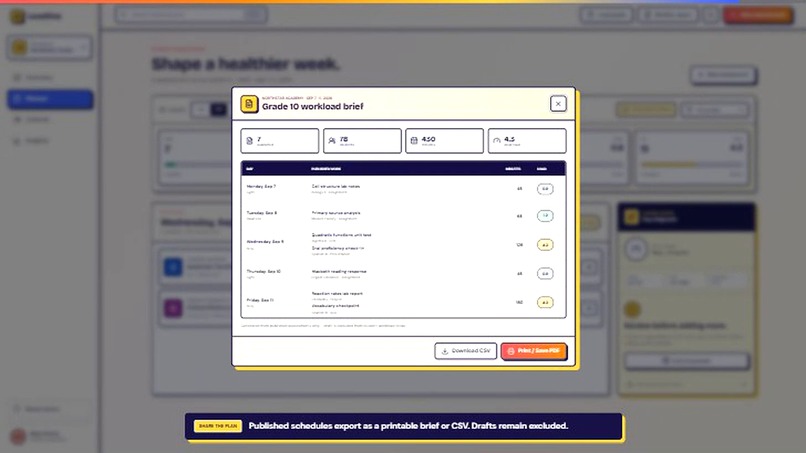
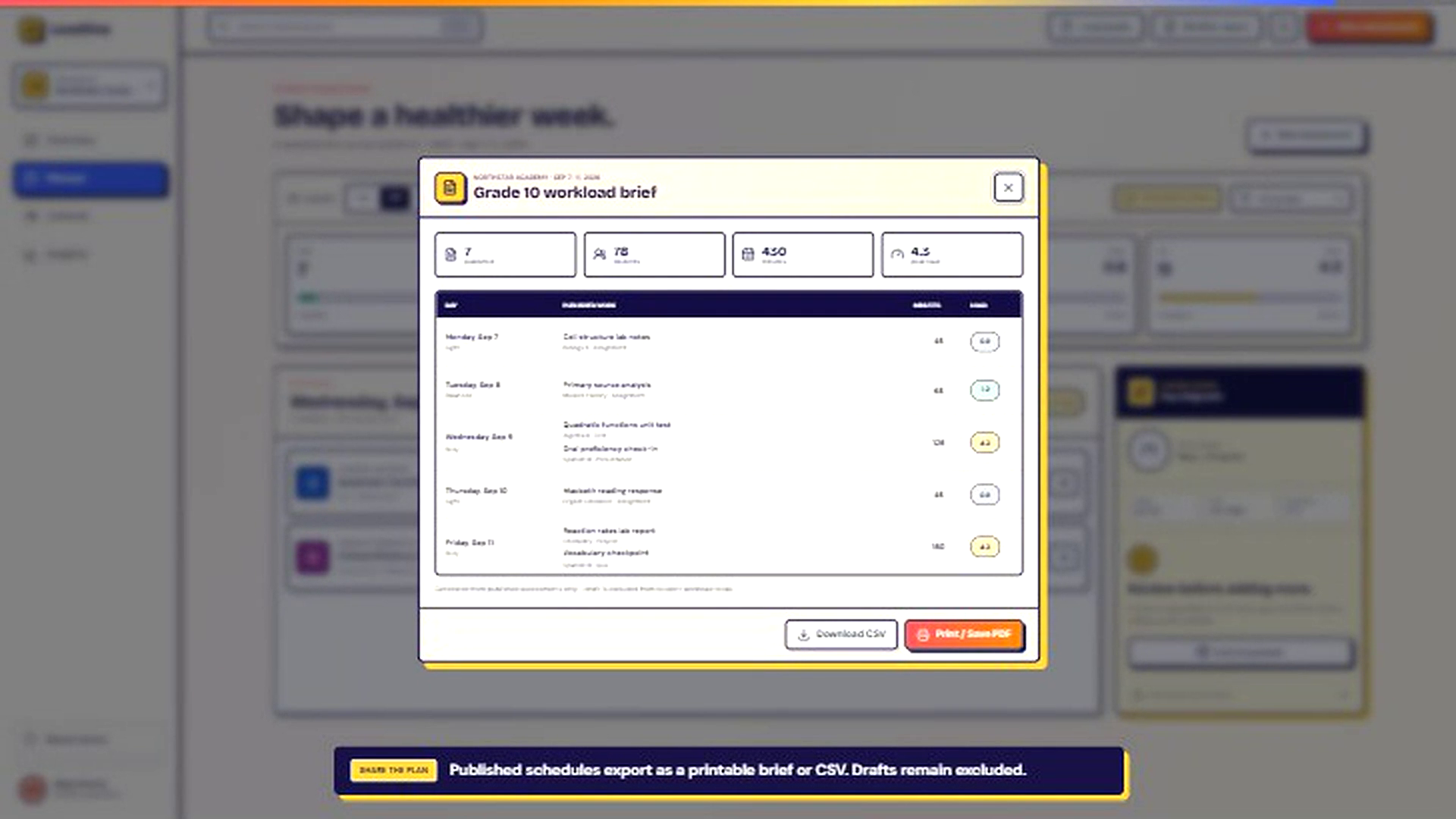
Schools can compare grade cohorts, inspect workload drivers, undo schedule changes, and export the published week as CSV or a printable report.
The prototype includes four distinct institution workspaces across the United States, India, Canada, and Kenya. Each has its own cohort sizes, teachers, courses, workload pattern, drafts, reports, and independently persisted schedule.
Why it is different
Most school productivity tools ask students to manage overload more efficiently. Loadline moves responsibility upstream: it helps teachers coordinate so that overload is not created in the first place.
The recommendation engine is deterministic and auditable. It does not use student grades, infer academic ability, or ask users to trust an unexplained AI score.
How we built it
- React 19 and TypeScript for the product interface
- Vite for development and production builds
- A deterministic workload and scheduling engine written in TypeScript
- LocalStorage for a persistent, account-free prototype
- Lucide for accessible interface icons
- CSS Grid and responsive layouts for desktop, tablet, and mobile
- Playwright and Chromium for interaction and responsive testing
- FFmpeg for the captioned 1080p demonstration video
Each assessment receives a score:
score = (estimated minutes / 45) × assessment-type weight × (0.8 + difficulty × 0.08)
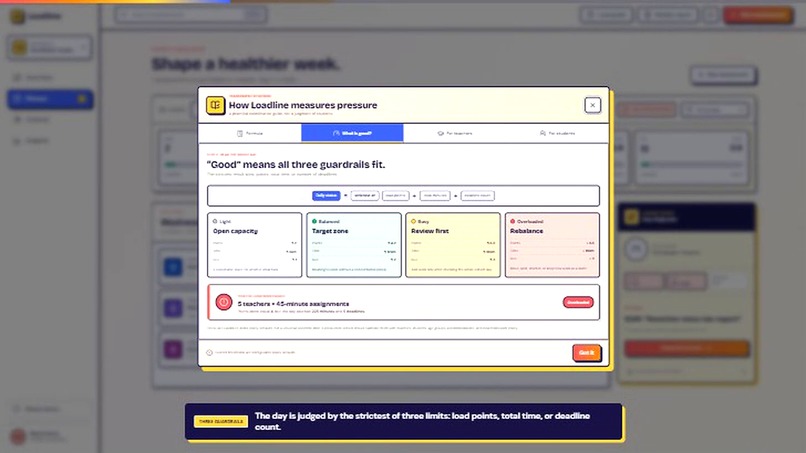
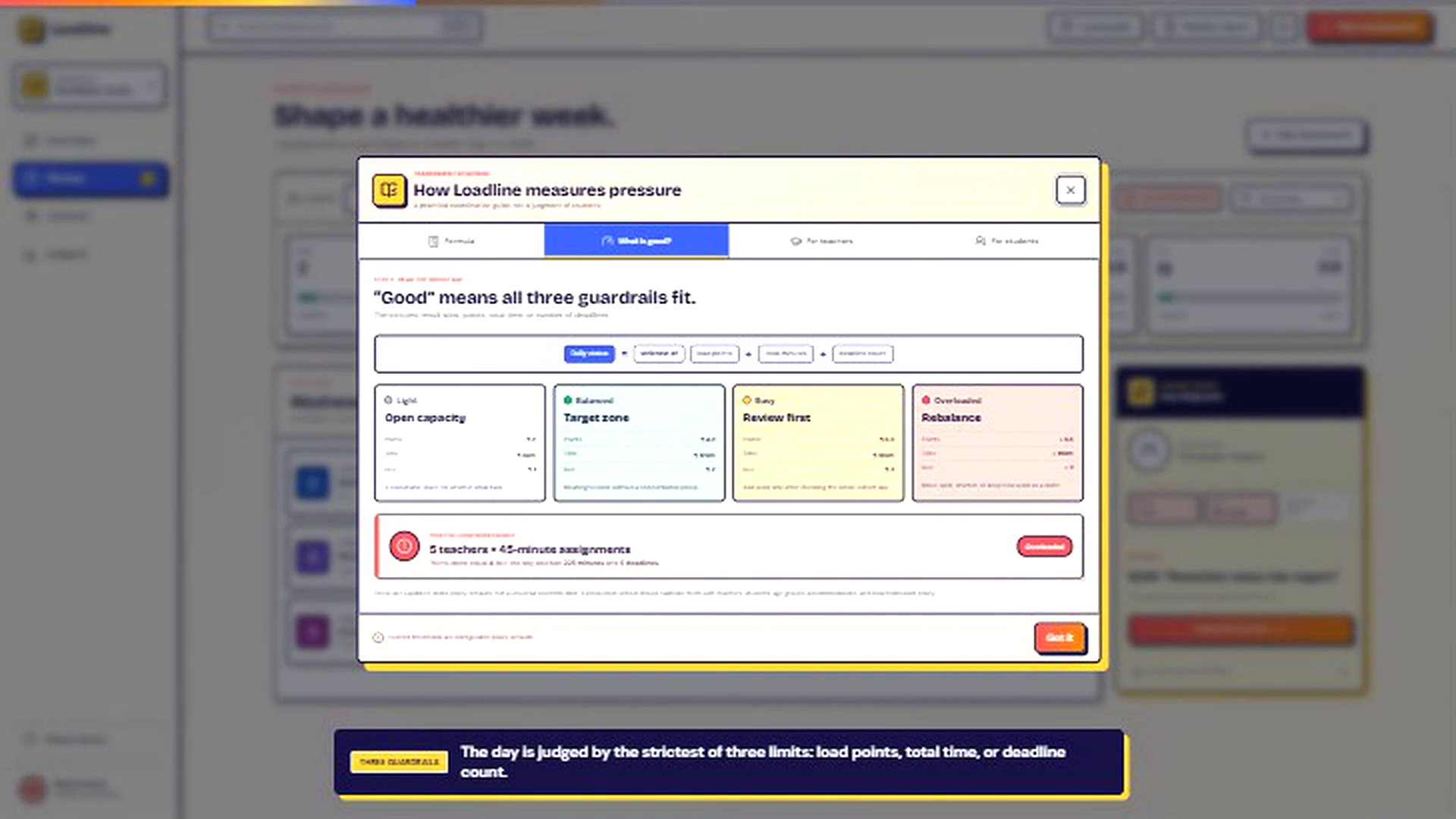
Daily points are the sum of published work for a cohort. The strictest of three policy guardrails determines status: above 6.5 points, above 180 estimated minutes, or more than 3 deadlines is Overloaded. Drafts are intentionally excluded until a teacher publishes them. These values are transparent prototype policy defaults that schools could configure after consultation with students and staff.
Key features
- Interactive landing-page product preview
- Four institution workspaces with isolated schedules and persistence
- Live Overview, Planner, Cohorts, and Insights views
- Five-day pressure ribbon and selected-day workspace
- Interactive formula calculator and teacher/student load guide
- Pre-publish impact forecast
- Private Draft and shared Published states
- Ranked lower-pressure date recommendations
- One-click rescheduling with Undo
- Search and course filters
- Persistent local demo data and Reset Demo
- Published-only CSV export and Print/Save PDF report
- Keyboard navigation, focus-managed dialogs, reduced-motion support, and responsive design
Challenges
The hardest product decision was defining a workload score that felt useful without pretending to measure a student's ability. We kept the model explicit and limited to teacher-provided planning inputs. Another challenge was presenting a dense school week without turning the interface into a cramped calendar, which led to the pressure ribbon and selected-day workflow.
What we learned
Responsible educational technology is often less about predicting students and more about improving the systems around them. A small, explainable coordination tool can be more trustworthy and actionable than a broad AI assistant.
What's next
- School-managed accounts and role-based permissions
- Google Classroom and Canvas calendar imports
- Configurable workload thresholds for each school
- Anonymous student effort feedback to improve estimates
- Multi-week trends and accommodation-aware planning
AI-use disclosure
GitHub Copilot was used as a collaborative assistant for ideation, interface implementation, debugging, testing, and documentation. The project owner directed the product decisions, reviewed the generated code, and can explain the workload formula, React state flow, recommendation logic, and interface behavior. The schedule recommendation engine itself is deterministic; it does not call a generative AI model.
Submission links
- Live demo: https://loadline-kappa.vercel.app/
- Source code: https://github.com/Mithuncoding/LoadLine
- Demo video: https://youtu.be/nxZLdj5makQ
- Team member: Mithun R
