
LOADLINE — Design It. Run It. Break It. Understand It.
The problem
Choosing between PostgreSQL and MongoDB, deciding whether to introduce Redis, or figuring out how many application servers a system needs are common engineering decisions. But choosing an architecture from diagrams and intuition alone doesn't tell you how it will behave under pressure.
What happens when traffic spikes? What if the cache fails? Does the database become the bottleneck? How do latency, reliability, scalability, and infrastructure costs change when you modify the design?
Testing these trade-offs in production can be expensive and risky. We wanted to make architecture experimentation more accessible.
What we built
LOADLINE is a system architecture simulation and validation platform.
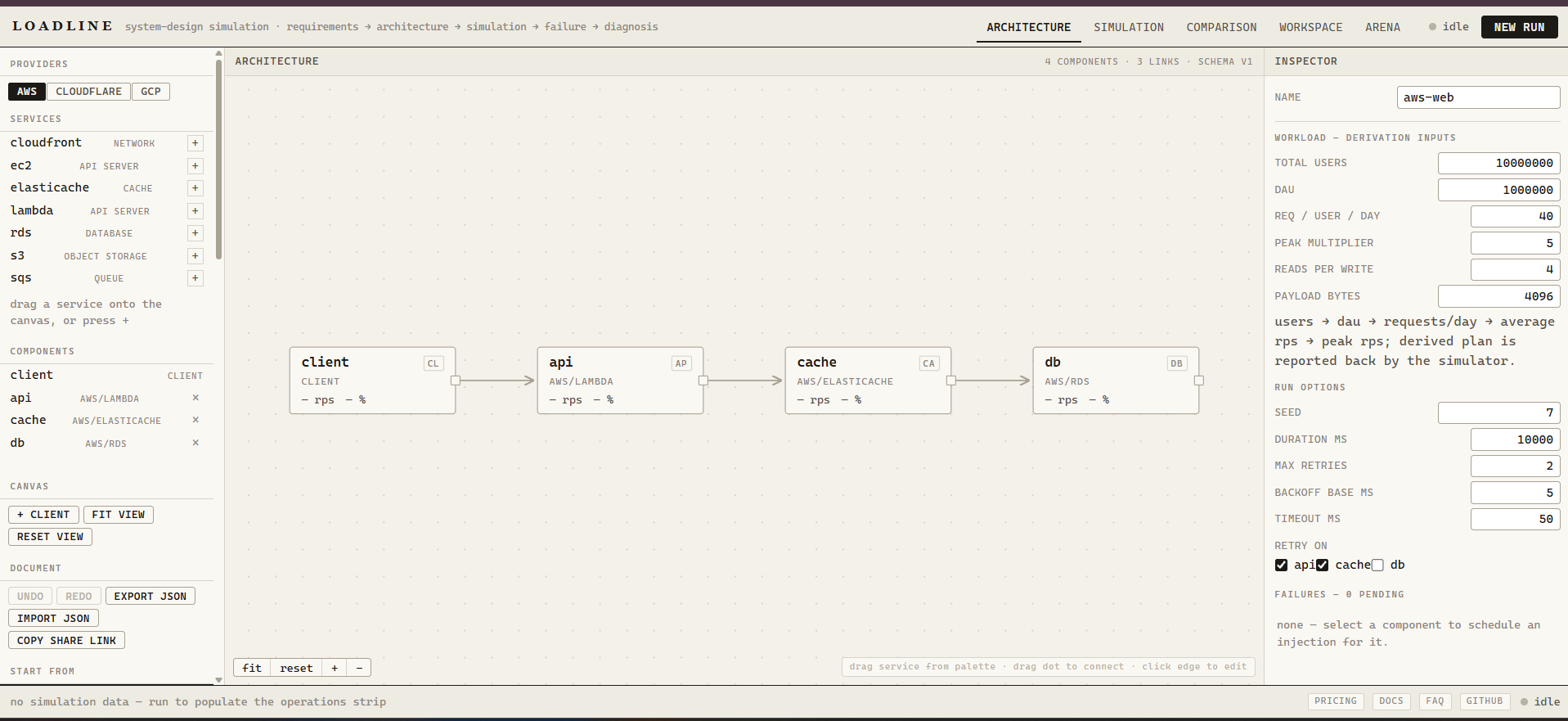
It lets developers design infrastructure, configure workloads, simulate system behavior, introduce failures, and inspect the resulting performance metrics.
With LOADLINE, you can:
- Design: Build architectures from connected infrastructure components.
- Simulate: Configure workloads and observe modeled system behavior.
- Break: Introduce component failures and latency spikes to explore failure propagation.
- Diagnose: Identify bottlenecks using simulation results, including latency, throughput, utilization, and queue depth.
- Compare: Evaluate alternative architectures and understand their performance and cost trade-offs.
- Explore: Learn from architecture examples and experiment with different system designs.
The goal isn't to declare one architecture universally best. It's to help engineers understand why an architecture performs differently under specific workloads and assumptions.
How we built it
LOADLINE uses a web-based architecture editor alongside a backend simulation engine.
Our technology stack includes:
- Frontend: Next.js, React, TypeScript, and Tailwind CSS.
- Architecture visualization: React Flow / XYFlow.
- Backend: Go.
- Simulation: A discrete-event simulation engine designed to model workloads, component behavior, and failures.
- Data layer: PostgreSQL for persistent project and simulation data.
- Visualization: Metrics and charts for inspecting simulation outcomes.
The simulation engine is designed to remain independent of the web interface and persistence layer. This separation makes it easier to test simulation logic, reproduce experiments, and extend the platform with additional infrastructure components.
What makes LOADLINE different?
Traditional architecture diagrams show how components connect. LOADLINE aims to show what happens when traffic flows through those components and when something goes wrong.
For example, a cache failure can increase database traffic, raise database utilization, build up queues, and increase latency. LOADLINE helps users investigate these effects through modeled scenarios rather than relying exclusively on static diagrams.
Capacity and cost outputs are estimates based on the simulation model and its assumptions; they are not guarantees of production performance.
Challenges we tackled
One of the biggest engineering challenges is modeling distributed-system behavior without running a real production infrastructure for every experiment.
The simulation must account for workload characteristics, component capacities, processing delays, queues, and failures while producing useful, reproducible results.
Another challenge is making the output understandable. Metrics alone are not enough: engineers need to connect observed bottlenecks to the architectural decisions that caused them.
We designed LOADLINE around that feedback loop: design, simulate, inspect, modify, and run again.
What we learned
Building LOADLINE reinforced an important lesson about system design: architectural decisions are trade-offs, not universal rules.
A cache may reduce database load but introduce operational complexity. More servers may increase capacity but also increase cost. A queue may absorb bursts but become a bottleneck if workers cannot keep up.
The right choice depends on the workload, failure assumptions, performance requirements, and budget.
We want LOADLINE to make these trade-offs easier to explore, measure, and explain.
What's next?
We want to expand the component library, improve simulation fidelity, develop more realistic failure scenarios, and make it easier to compare architectures under standardized workloads.
Our long-term vision is to give developers an interactive engineering environment where they can experiment with infrastructure decisions before committing to them.
LOADLINE — Design it. Run it. Break it. Understand it.
Built With
- go
- next.js
- postgresql
- react
- react-flow
- simulation
- system-design
- tailwind-css
- typescript

Log in or sign up for Devpost to join the conversation.