Inspiration In the multi-trillion dollar syndicated loan market, banks have a massive "blind spot." Currently, credit risk monitoring is reactive and manual. Banks wait up to 90 days for borrowers to email PDF compliance certificates. By the time a banker reads the report, the financial data is already three months old. If a borrower is in distress, the bank finds out too late.
We asked ourselves: Why are we managing billion-dollar loans with static PDFs?
We wanted to build a solution that transforms a loan agreement from a static document into a "Digital Twin"—a system that monitors risk in real-time and empowers bankers to act instantly.
What it does LMA Pulse is a desktop-based "Covenant Monitor" designed for the modern syndication desk. It automates the entire lifecycle of credit risk monitoring:
Real-Time Ingestion: Instead of waiting for PDFs, LMA Pulse mimics an API connection to a borrower’s ERP system (like SAP or Xero), ingesting key financial data (EBITDA, Cash Flow, Debt Service) in real-time.
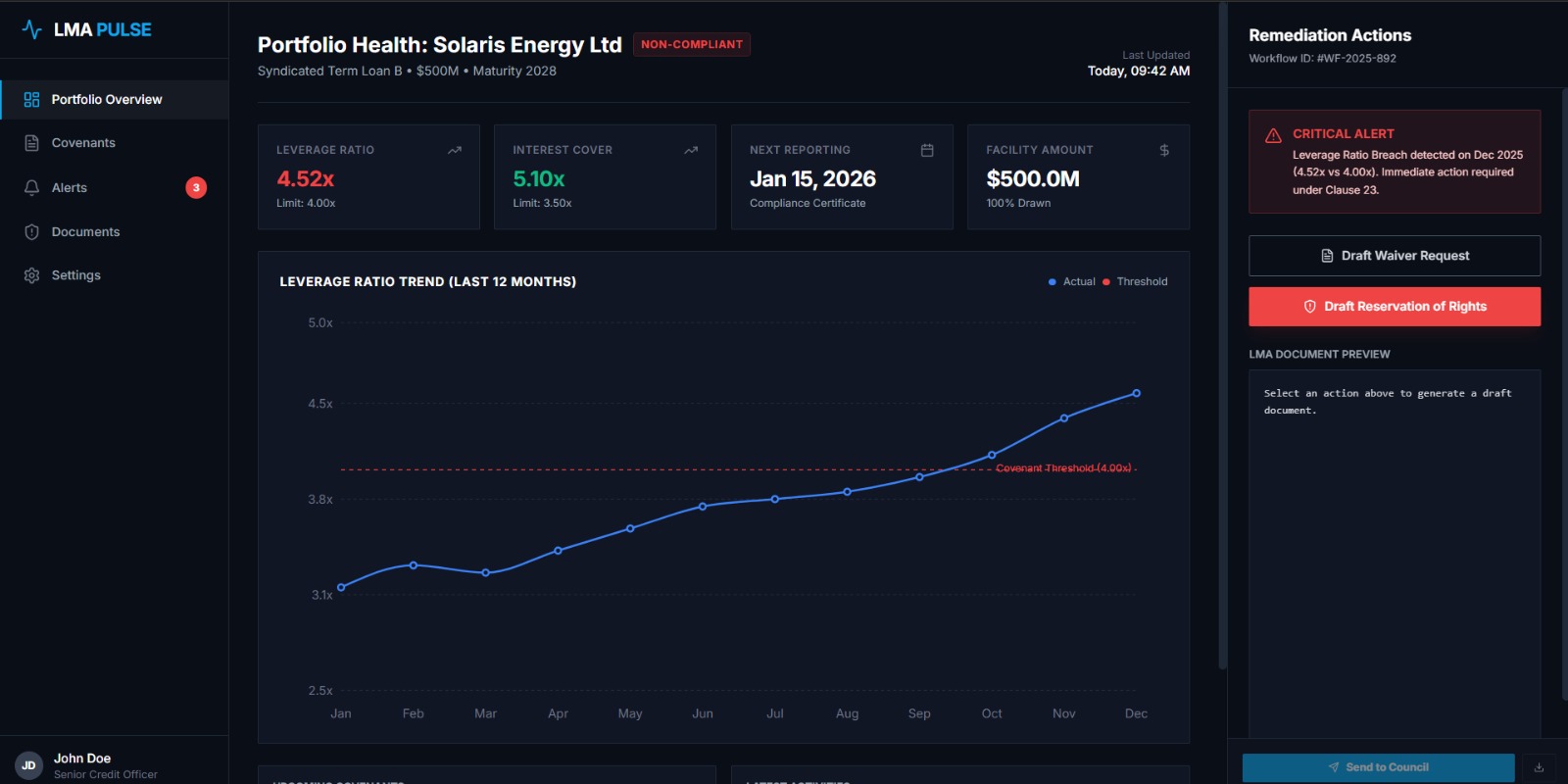
Live Dashboard: It visualizes financial health against the specific covenants agreed in Clause 21 (Financial Covenants) of the LMA Facility Agreement. If a ratio (e.g., Leverage Ratio) breaches the agreed threshold (e.g., 4.00x), the dashboard alerts the banker immediately—not 90 days later.
GenAI "Legal Brain": This is our killer feature. When a breach is detected, the system integrates with OpenAI (GPT-4) to automatically draft the legal response. It reads the specific "Event of Default" clause from the loan document and drafts a formal, LMA-compliant "Reservation of Rights" letter or "Waiver Request," ready for the banker to review and send.
How we built it We focused on building a robust, commercially viable desktop application that mimics the security and feel of a Bloomberg Terminal:
Frontend: We used Electron and React to create a secure, high-performance desktop environment. We used Recharts for the financial visualization (Debt-to-EBITDA tracking).
Backend: We built a Python (FastAPI) server to handle data processing and logic.
The AI Engine: We utilized OpenAI's GPT-4o API. We used advanced prompt engineering to create a "Senior Banker Persona," ensuring that all generated text adheres to the strict formal tone required by LMA standards.
Data Simulation: We created a mock database for a fictional borrower, "Solaris Energy Ltd," to simulate real-world financial transaction data and trigger specific covenant breaches (specifically testing Clause 21.1: Leverage Ratio).
Challenges we ran into Legal Precision: Getting an AI to sound like a 20-year veteran banker is hard. Early versions of our waiver letters sounded too casual. We had to iteratively refine our system prompts to ensure the AI used specific terminology like "without prejudice" and "Event of Default" correctly, avoiding the risk of "involuntary waiver" (referencing Lombard North Central plc v European Skyjets Ltd).
Data Mapping: Mapping unstructured loan clauses (text) to structured code (thresholds) was complex. We had to design a data structure that could "read" a clause like "4.0x Leverage Ratio" and turn it into a checkable variable in our Python backend.
Accomplishments that we're proud of The "One-Click" Workflow: We successfully achieved a flow where a banker can go from "breach detection" to "legal letter drafted" in under 10 seconds.
LMA Alignment: We successfully programmed the AI to distinguish between a "Reservation of Rights" (strict) and a "Waiver" (commercial), aligning with the LMA Senior Multicurrency Term Facility standard templates.
Commercial Realism: The dashboard looks and feels like a product a bank could deploy tomorrow. It solves a specific, high-value pain point (reducing Credit Risk) without requiring a complete overhaul of the banking infrastructure.
What we learned The Value of Standards: The LMA standard templates made this project possible. Because loan documents follow a standard structure (e.g., Clause 21 for Financial Covenants), we were able to train our system to predict and draft responses effectively.
The "Frozen GAAP" Problem: We learned about the complexity of IFRS 16 lease liabilities and how manual adjustments are often needed. Our next iteration will automate these "Frozen GAAP" adjustments.
AI as a Copilot: We learned that AI shouldn't replace the banker; it should empower them. Our tool doesn't send the letter automatically—it drafts it for human review, keeping the "human in the loop" for compliance.
What's next for LMA PULSE ERP Integration: Building real adaptors for SAP, Oracle, and Xero to move beyond mock data.
Smart Covenants on Canton: We plan to move the covenant logic onto the Canton Network (a privacy-enabled blockchain). This would allow for "Smart Covenants" where the interest margin automatically decreases (Margin Ratchet) via a smart contract if the borrower hits their green targets, creating a truly self-driving loan.
Clause Matching: Adding a feature to scan incoming PDF drafts and compare them against the "Golden Source" LMA standard to highlight deviations in real-time.


Log in or sign up for Devpost to join the conversation.