-
-
O_<
Inspiration
Honestly, LLMeeting began with one very simple thought: I wanted to watch AI assistants have a party.
What would happen if ChatGPT, Gemini, Grok, Claude, and Meta AI were placed in the same room? Would they agree, argue, roast one another, form alliances, act out characters, or discover that one of them was secretly causing trouble?
I was not trying to build another serious dashboard that merely displays several answers side by side. I wanted the assistants to actually read one another's messages and react. The project started as playful curiosity—an AI party inside the browser—and gradually became a surprisingly useful way to explore different viewpoints without manually copying and pasting between tabs.
What it does
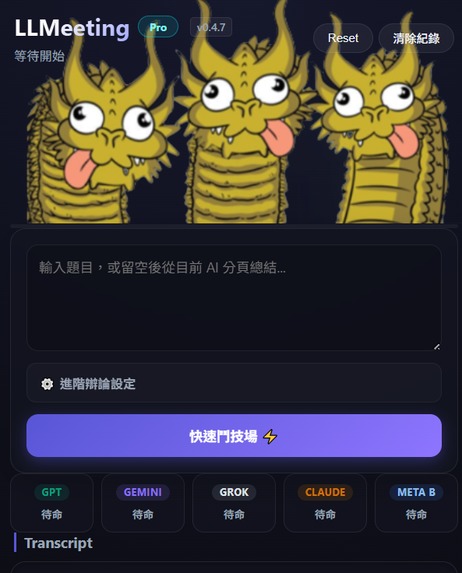
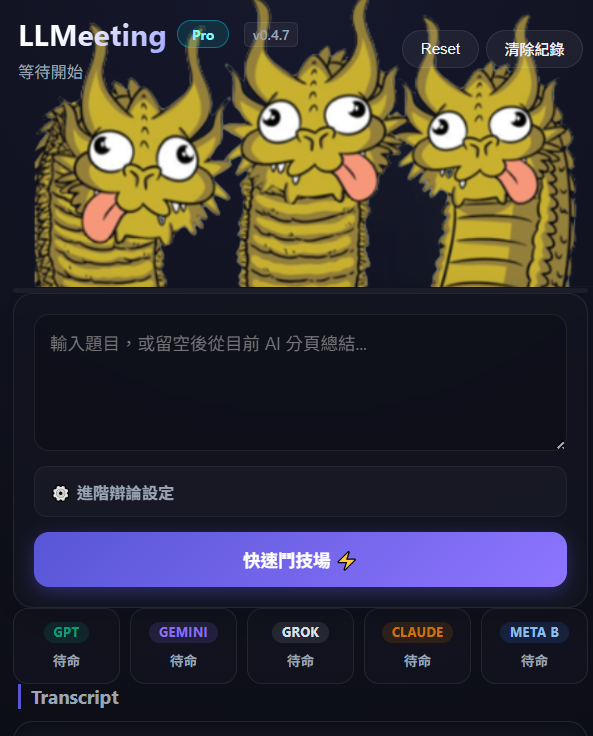
LLMeeting is a Chrome side-panel extension that coordinates discussions across AI services the user is already signed in to, including ChatGPT, Gemini, Grok, Claude, and an opt-in Meta AI Beta adapter.
Users can start a topic once and let the participating assistants:
- answer independently;
- read and critique one another's responses;
- continue through multiple rounds;
- debate seriously, build consensus, role-play, or participate in a hidden-dissenter game;
- appoint a chair to summarize the discussion;
- use anonymous review to reduce brand bias;
- recover from common provider failures instead of losing the whole meeting.
The extension also supports fast debate, free-form group chat, custom character roles, user interjections, and summary-focused sessions.
How we built it
I designed the product, chose the workflows, reviewed the behavior, and directed development through Codex. The implementation was produced collaboratively with Codex: earlier versions were developed with GPT-5.4, while the OpenAI Build Week extension was completed with GPT-5.6.
The extension uses Chrome Manifest V3, a side-panel interface, a background service worker, provider-specific content scripts, and local Chrome storage. It works with the user's existing logged-in AI web sessions, so LLMeeting does not require users to provide API keys and does not send conversations to an LLMeeting developer server.
During Build Week, GPT-5.6 and Codex meaningfully extended the existing product across 12 dated commits touching 49 files (about +3,092/-665 lines). LLMeeting grew from a working four-provider debate extension into a five-provider system with Meta AI Beta, provider-specific adapters, fresh-tab isolation, session checkpoints, service-error classification, bounded retries, local-data controls, long-response handling, response normalization, and diagnostics. The hidden-dissenter mode also gained a traceable reveal evidence board and more distinct theater personas. Automated tests grew from 116 to 165, and a CodeRabbit follow-up reported 0 issues. The dated Git history distinguishes this work from the earlier version.
Challenges
The hardest problem was that every AI website has different input controls, streaming behavior, response markup, and failure states. These interfaces can also change without notice. A robust meeting therefore needs more than simple copy and paste: it needs provider adapters, completion detection, retry boundaries, state checkpoints, response cleanup, and safe cancellation.
Another challenge was preserving privacy while coordinating several services. LLMeeting keeps its latest session state locally for up to 24 hours and lets the user clear it immediately. Prompts are sent only to the AI providers selected by the user, subject to each provider's own privacy policy.
Accomplishments
- Five meeting modes and multiple interaction styles
- Cross-model critique and multi-round orchestration
- Chair, observer-chair, anonymous-review, and hidden-dissenter workflows
- Local-first session state with recovery and explicit clearing
- Provider diagnostics and defensive automation
- A published Chrome Web Store extension and 165 passing automated tests
- Build Week work spanning 12 commits and 49 changed files
What we learned
Building with Codex works best when the human remains responsible for product direction, constraints, review, and acceptance criteria. GPT-5.6 was especially valuable for tracing asynchronous browser flows, reasoning across provider-specific edge cases, proposing narrow fixes, and expanding regression tests without unnecessary architectural churn.
We also learned that multi-model collaboration is most useful when the system structures disagreement. Simply collecting several answers creates more reading; critique, anonymity, roles, and a final chair turn those answers into a decision process.
What's next
Next steps include completing a wider signed-in browser smoke-test matrix, adding an optional English interface, improving accessibility, hardening adapters against future provider UI changes, and exploring additional meeting templates for research, planning, and education.
Built With
- chrome
- codex
- css
- gpt-5.6
- html
- javascript
- manifest-v3
- node.js

Log in or sign up for Devpost to join the conversation.