Inspiration
What it does
How we built it
Challenges we ran into# About the Project
Inspiration
Modern AI applications rely on multiple LLM providers, but integrating them directly into every application creates unnecessary complexity. Every team ends up solving the same problems such as authentication, rate limiting, provider routing, budget tracking, caching, resilience, and observability.
The inspiration behind LLM Gateway was to build a unified control plane that sits between applications and AI providers. Instead of every application handling infrastructure concerns independently, the gateway centralizes them into a single platform. This makes AI applications easier to build, cheaper to operate, and more reliable.
What it does
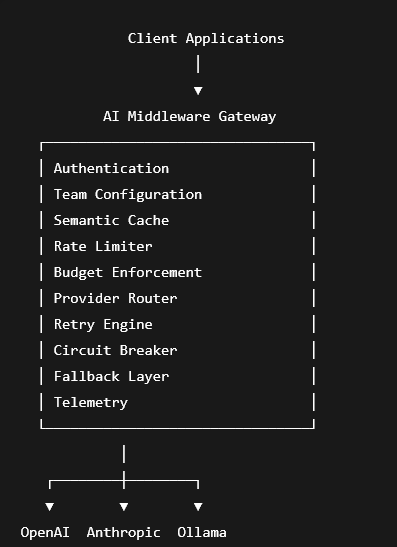
LLM Gateway is an AI middleware platform that acts as a single entry point for LLM requests.
It provides:
- Provider-agnostic request routing
- Semantic caching to reduce latency and cost
- Team-based authentication and access control
- Rate limiting and token budget enforcement
- Automatic retries, fallback routing, and circuit breaker protection
- Real-time metrics and telemetry
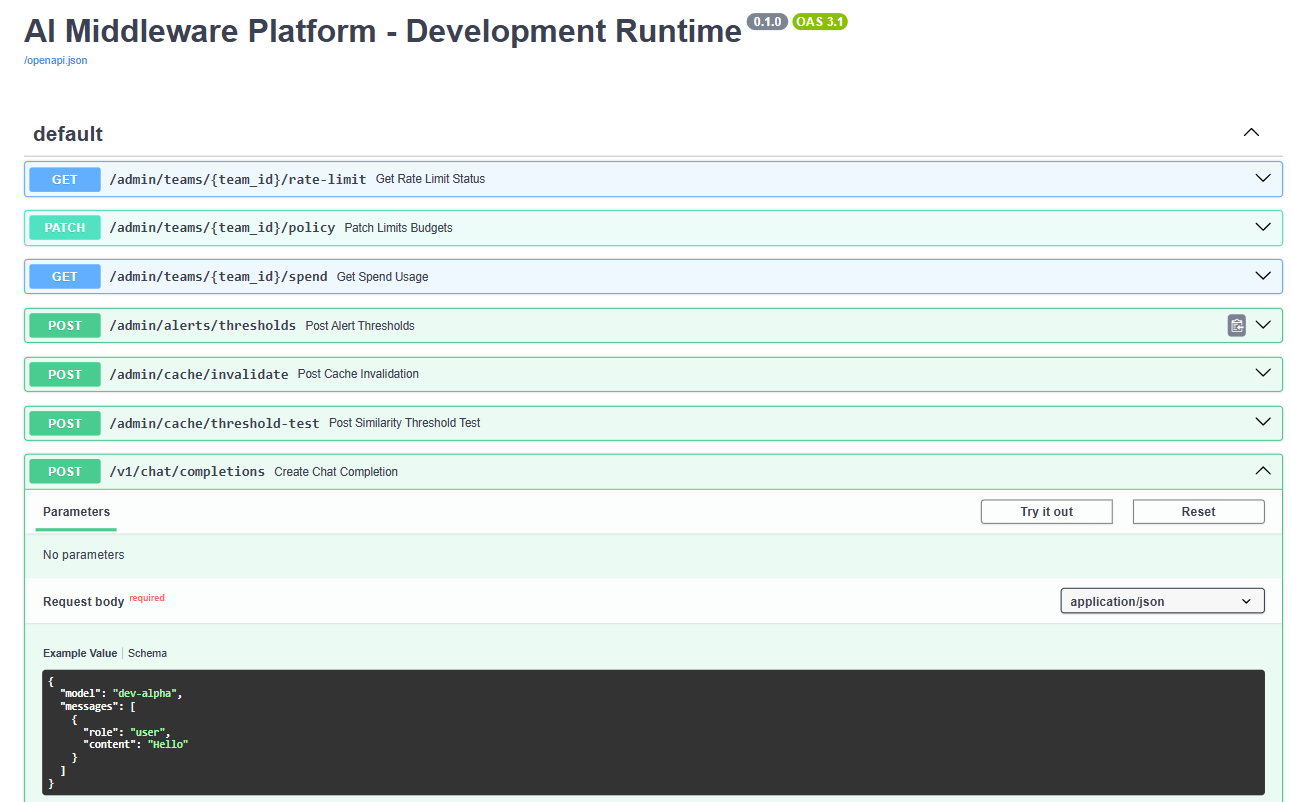
- Runtime policy updates through admin APIs
- OpenAI-compatible Chat Completions API for easy integration
Applications only communicate with the gateway, while the gateway intelligently decides how every request should be processed.
How we built it
We built the gateway using FastAPI with a modular middleware architecture where each responsibility is isolated into its own component.
The platform includes:
- Semantic caching powered by vector similarity search
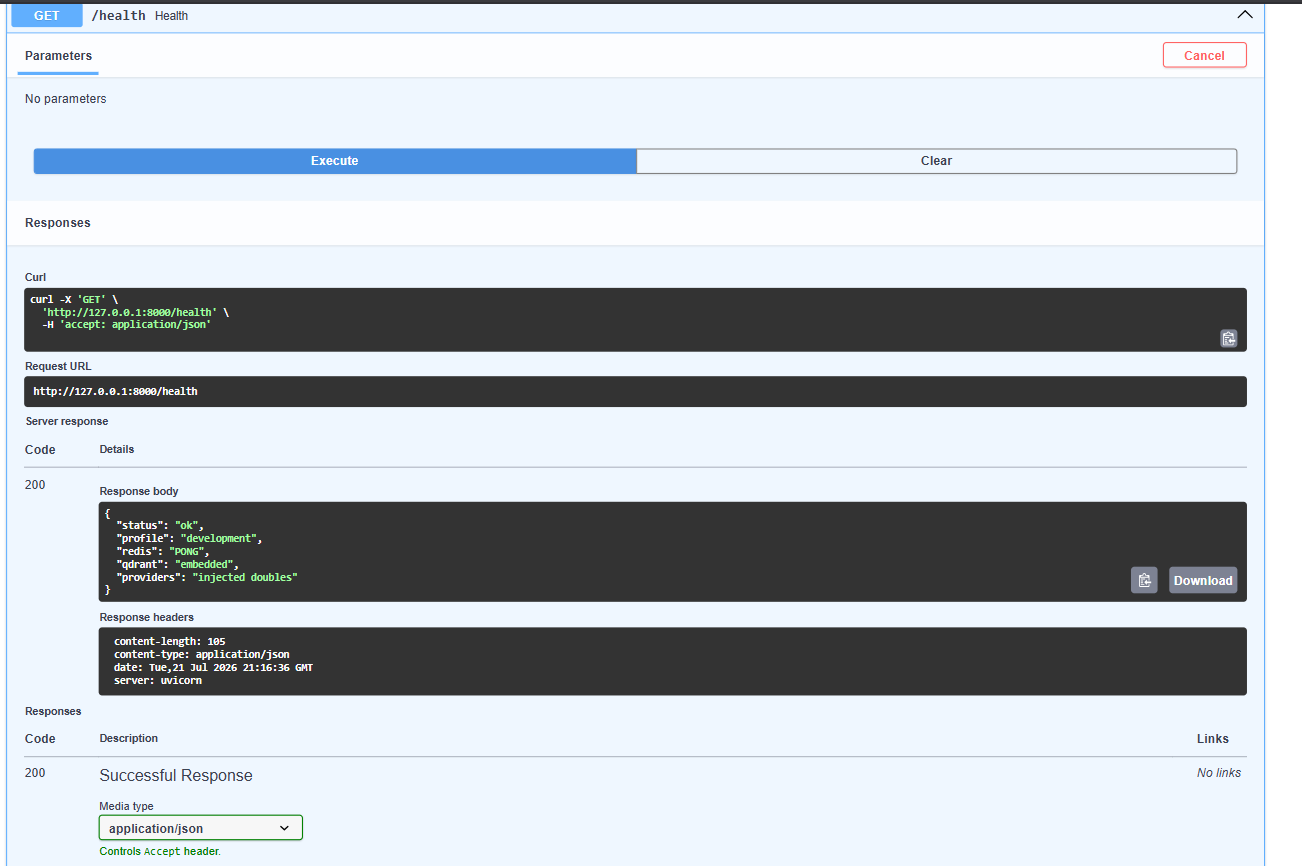
- Redis-compatible storage for rate limiting and budgets
- Embedded Qdrant for local development
- OpenTelemetry-compatible metrics with Prometheus support
- Configurable policy management through YAML and admin APIs
- Dependency injection to switch seamlessly between development and production environments
For development, we created an isolated runtime using injected provider doubles, embedded infrastructure, and mock transports. This allowed us to verify the complete middleware pipeline without requiring paid APIs or cloud infrastructure while keeping the production deployment path unchanged.
Challenges we ran into
The biggest challenge was designing a gateway that could remain provider agnostic while keeping the request flow consistent across different AI providers.
Another challenge was balancing a production-ready architecture with an efficient local development experience. We wanted developers to run the complete platform without requiring Docker, paid API keys, or external monitoring systems, while ensuring the production deployment remained completely untouched.
We also spent significant effort validating reliability features such as semantic caching, rate limiting, budget enforcement, retries, circuit breakers, and fallback routing under simulated load before moving toward production deployment.
Accomplishments that we're proud of
- Built a unified AI middleware platform instead of a single AI application.
- Designed a modular architecture that cleanly separates routing, caching, resilience, observability, and policy management.
- Created a development runtime that mirrors production behavior without modifying production code.
- Successfully validated thousands of simulated gateway requests using local infrastructure and injected provider doubles.
- Exposed an OpenAI-compatible API, making it easy for existing AI applications to integrate with the gateway.
What we learned
This project taught us that building reliable AI infrastructure involves much more than calling an LLM API.
We gained hands-on experience with distributed systems concepts such as caching, resilience patterns, observability, dependency injection, and policy-driven infrastructure. We also learned how important it is to separate development and production environments so that new features can be tested safely without affecting deployment.
Most importantly, we learned that developer experience is just as important as system architecture. A platform is far more useful when it is easy to understand, run, and extend.
What's next for LLM Gateway
Our next goal is to complete the production deployment by integrating Docker, Redis, Prometheus, Grafana, and production-grade Qdrant deployments.
Beyond deployment, we plan to expand the gateway with intelligent provider selection based on latency and cost, multi-region support, advanced analytics dashboards, stronger security and audit capabilities, and support for additional LLM providers. We also want to make the gateway deployable with a single command so that teams can adopt it with minimal setup.

Log in or sign up for Devpost to join the conversation.