-
-
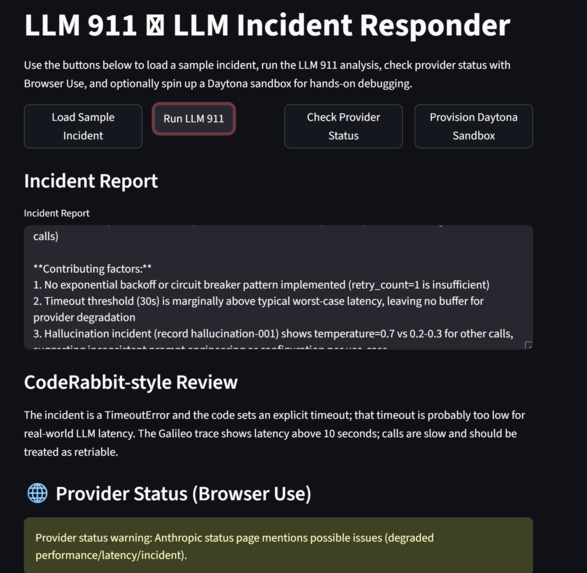
This is how project looks
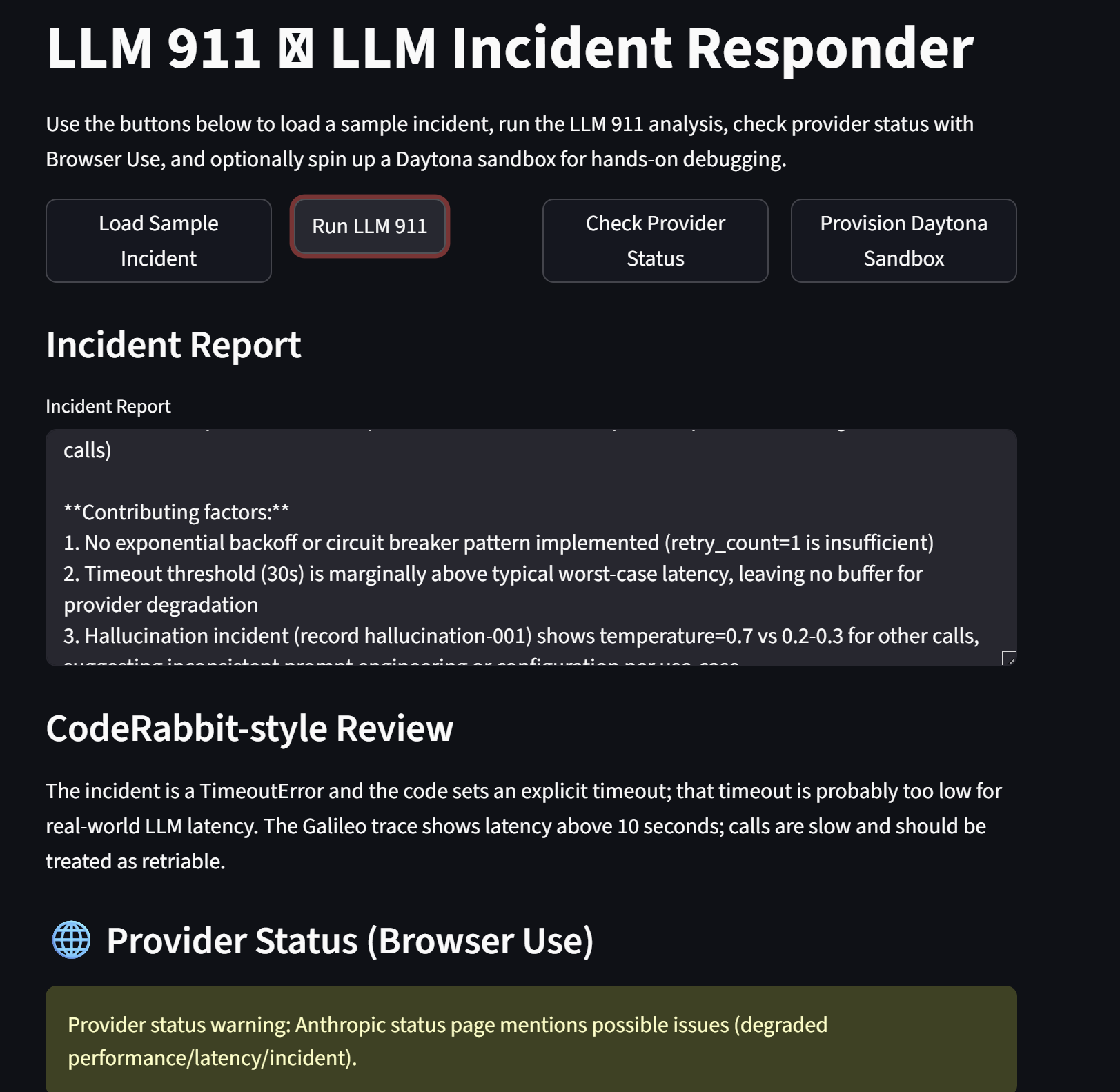
Inspiration :LLM 911 is an AI-powered incident responder that analyzes failures from simulated Sentry logs and Galileo LLM traces, checks model provider outages using Browser Use Cloud, reviews your source code like CodeRabbit, and then generates a clean, actionable debugging report using Claude. It also offers a Daytona one-command reproducible environment, so engineers can instantly spin up a clean workspace and apply the fix safely.
This project turns all the scattered signals of an incident into one single AI-readable timeline:
Sentry Error → LLM Trace → Provider Status → Code Review → Fix Suggestion → Daytona Workspace
What it does : LLM 911 ingests:
- A Sentry-style JSON error
- A Galileo-style trace (latency + hallucination + quality)
- A broken code file that calls an LLM poorly
- A Browser Use check of Anthropic’s status page
Then produces:
- Root cause explanation
- Latency + hallucination analysis
- CodeRabbit-style code review
- Provider outage summary
- Fix recommendation
- Daytona command for reproducible debugging
How we built it : Streamlit frontend
-Claude analyzes logs, traces, and code -Browser Use Cloud checks Anthropic status -Daytona spins up reproducible dev environments: -daytona create https://github.com/arun3676/LLM-911.git -Sentry / Galileo JSON generated to behave like real incidents -Code review helper flags timeouts, no retries, and bad API usage -These signals are merged → Claude → polished incident report
Challenges we ran into :
-Making Sentry/Galileo data realistic -Daytona CLI port conflicts -Multi-source prompt reliability -Clean UI layout for 4 tools -Integrating Browser Use without slowing the app
Accomplishments that we're proud of:
-Fully working deployed app -Multi-source incident understanding -Automated provider check -Daytona-powered reproducible debugging -Clean, simple UX
Complete end-to-end debugging workflow: -Load Incident: Import Sentry-style error JSON and Galileo LLM trace. -Check Provider Status: Browser Use Cloud reads Anthropic’s status page to detect outages or degraded performance. -Analyze Code: A CodeRabbit-style reviewer inspects the broken Python file for bad patterns (low timeout, no retries, missing error handling). -Generate Incident Report Claude combines: Sentry error, Galileo trace, Provider status, Code review into one clear root-cause analysis and fix recommendation. -Reproduce Environment LLM 911 gives a one-command Daytona environment so engineers can safely reproduce and apply the fix: daytona create https://github.com/arun3676/LLM-911.git
What we learned :
_How LLM failures behave _How incident signals combine _Multi-tool prompt engineering _Using Browser Use + Daytona in real workflows -Clean Streamlit deployment pattern
What's next for LLM 911 AI Incident Responder with Daytona + Browser Use
-Real-time monitoring -Auto-created PR fixes -Multi-provider checks -Live ingestion from real Sentry instances -Better trace visualization
Built With
- anthropic-claude
- browser-use
- daytona-cli
- intel-galileo
- json
- python
- sentry-(simulated)
- streamlit
- windsurf

Log in or sign up for Devpost to join the conversation.