Website
Interactive Prototype
Lean Business Canvas
What Inspired us?
It is almost summer, and kids have not finished the school curriculum by the end of the year. Due to COVID-19, the technological gap, altogether with education accessibility for everyone has increased the concern of parents and educators. Therefore, we thought we could create a safe environment for all the parties involved. Bringing parents, children, and educators together in one platform: LIX.
Which problem are we solving?
Gathering data from desktop research and 10 deep interviews, we identified 3 main pain points: The school routine stops when children are with their families Parents are assuming the role of teachers Only Only 6 countries worldwide have +75% of their education systems with efficient online platforms.
Considering these points, we decided to solve the following problem statement: How might we support families to maintain their children learning routine because of COVID-19?
Our Solution: LIX - Learning, Intelligence, Xperience
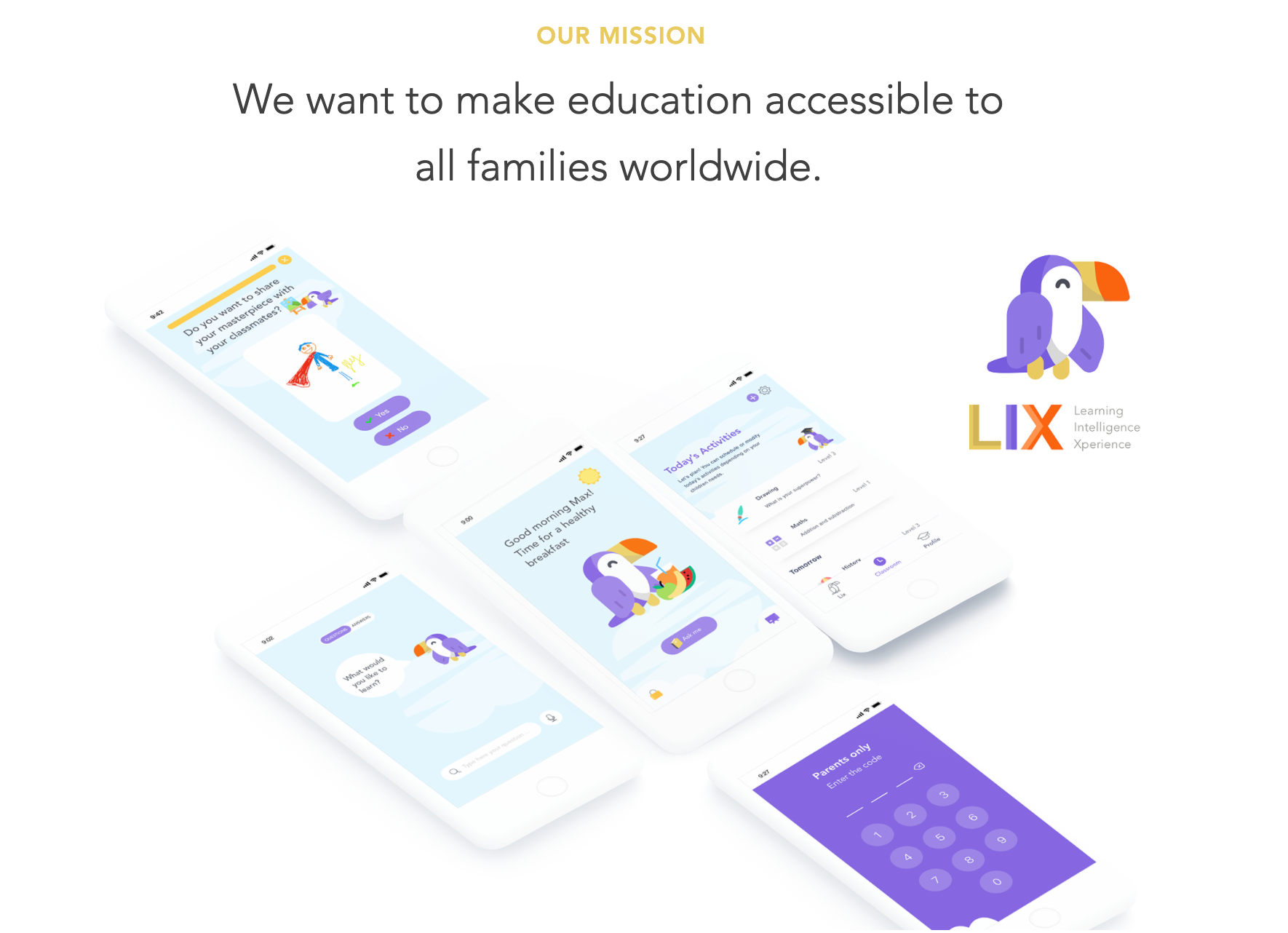
LIX is an APP to ensure children education. It is an AI that acts as a friend for children at home. The goal is to support parents by teaching their children tailored daily routines & school materials.
LIX Design values:
- Accessibility (Content): Considering the technological gap, we decided to design LIX just on a mobile-based platform in order to align it with the accessibility values that we are striving to promote.
- Engagement (Social): Sharing the results among kids to keep engaging with their classmates. Connecting them remote minimizing children isolation.
- G-learning (Game-based learning): Gamification based design with a positive reward system to encourage learning motivation.
Impact of LIX
We are helping families reinforce their children routines and education through LIX. We use gamification learning resources for every lesson. Parents establish routines like brushing your teeth and class schedules. Then the AI buddy guides the children through their activities.
We believe through data we can give a tailored experience for each student to adapt to their needs and strengths. Our goal is to involve parents in their children’s education at home, they set what and when. They will be able to work and create a great experience for their children.
Minimum Viable Product (MVP)
We have designed two user views:
Parents board: It establishes the actions that the children are able to do within the platform. For example: setting a Math class. Features that they can find:
- Children routine schedule: Parents can schedule their children's activities in a daily way and modify them at any time.
- Profile setting: Parents can access to performance tracking reports, personal details of their children, and the possibility to create new profiles.
- Activity Book: Library with suggested activities to help families train their imagination even at home.
Children playground: Kids interact with an AI that gives them lessons and routines. They Interact with LIX asking questions or curiosities. Features that they can find:
- Learning buddy: Interact with LIX, to learn beyond the content and satisfy all their possible interests.
- Playground: LIX guidance on the family routine and scheduled classes in a friendly way.
- Class board: Keep in touch with classmates in a safe place. Sharing creations and emotions.
- Activity Book: A library with suggested activities to help families train their imagination even at home.
Users types
Our target is parents who get the app. Our users are parents and children, the first set the schedule and the second complete the activities.
Both of them are in a situation where education resources are limited mainly by COVID-19 situation, but also during holiday periods such as Summer, Easter, sicknesses periods... Being LIX users, they will ensure children’s learning anywhere and at any time.
Distribution strategy
Our channels are divided into two. First, we have direct channels of distribution, which are mainly the APP Store & Google Store (main platform to get the APP), LIX’s Website, where you can find all the information you need and links to the App Stores, and LIX’s Social Networks. Second, we have the indirect channels. These are indirect ways to be known, which are mainly Parent Influencers, Partnered Websites, Online Advertising, and Partnered schools.
Why should Schools promote LIX?
The more families use the platform, the more they can ensure the level of its students when they return to school. It is a way for schools to ensure students achieve the curricular objectives set by the government of each European country.
Why should parents and kids use LIX?
LIX will not just offer e-learning possibilities for parents and children but will connect them with their schools following their teaching portfolio with tailor-made schedules. They have the possibility to get reports on their children results from data to know their strengths and weaknesses.
How have we built our solution?
We have built the app following a design thinking approach. Our process has been...
- First step: Starting with a UX Research: 10 in-depth interviews with teachers and parents, desk research on the topic (Cotech report), affinity map, and task analysis.
- Second step: Defining a problem Statement and a Solution.
- Third Step: Designing a prototype from low to high fidelity. We did a benchmark on the main apps related to education like Duolingo, Babbel, Lingoda, Script, Lingokids, and Drops. Based on this we decided to organize our information architecture and navigation following user-friendly patterns.
- Fourth Step: Creating the interactive prototype, the LIX’s Website, and promotional video. Throughout the process, our work culture has been bringing the best of each team member, and at the same time getting out of our comfort zone to create a smooth synergy exchanging skills.
What did we achieve during the Hackathon?
Following Design Thinking methodologies and a design sprint approach, we were able to perform within 48 hours a user-centered and solution-oriented app, learning how to listen to a contemporary problem in order to propose an immediate solution.
On top of this, and thinking further, we designed a landing page to promote our product and spread the worth trough investors.
What's next | Scalability
In order to keep going with the idea we established key resources and a cost structure. The main assets we need as key resources are data analysts to review the results, developers to code our experience, and product managers to join our team. According to each profile preferences, we would also need physical assets such as servers, computers, high speed Internet connection, tech gadgets…
Before this, we would need to go deeper on a plan to check the viability and feasibility of the project. As well and intellectual property and legal advice to ensure a reliable platform.
Based on the information above our cost structure would be the following:
Fixed Costs: People, Softwares, Material and Intellectual Property costs. Variable Costs: Advertising, Cybersecurity protection, legal advice, UX Research tools (focus groups, Usability Hub, …)
Team: As a team made by Product Designers, we would like to invest more time than 48 hours for continue exploring the project to match as best as we can with coding requirements. This way we can continue enhancing the user experience and iterate in our MVP.
And last but not least, investors who trust our idea as we do :)


Log in or sign up for Devpost to join the conversation.