-
-
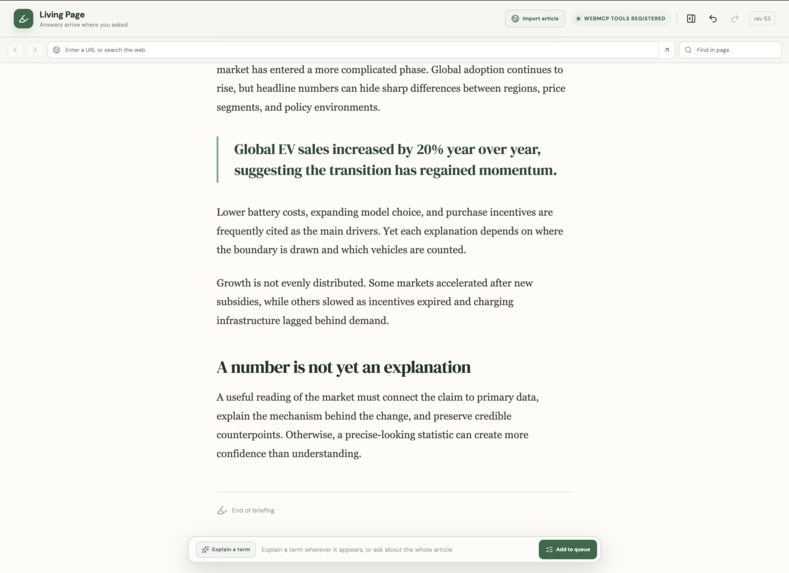
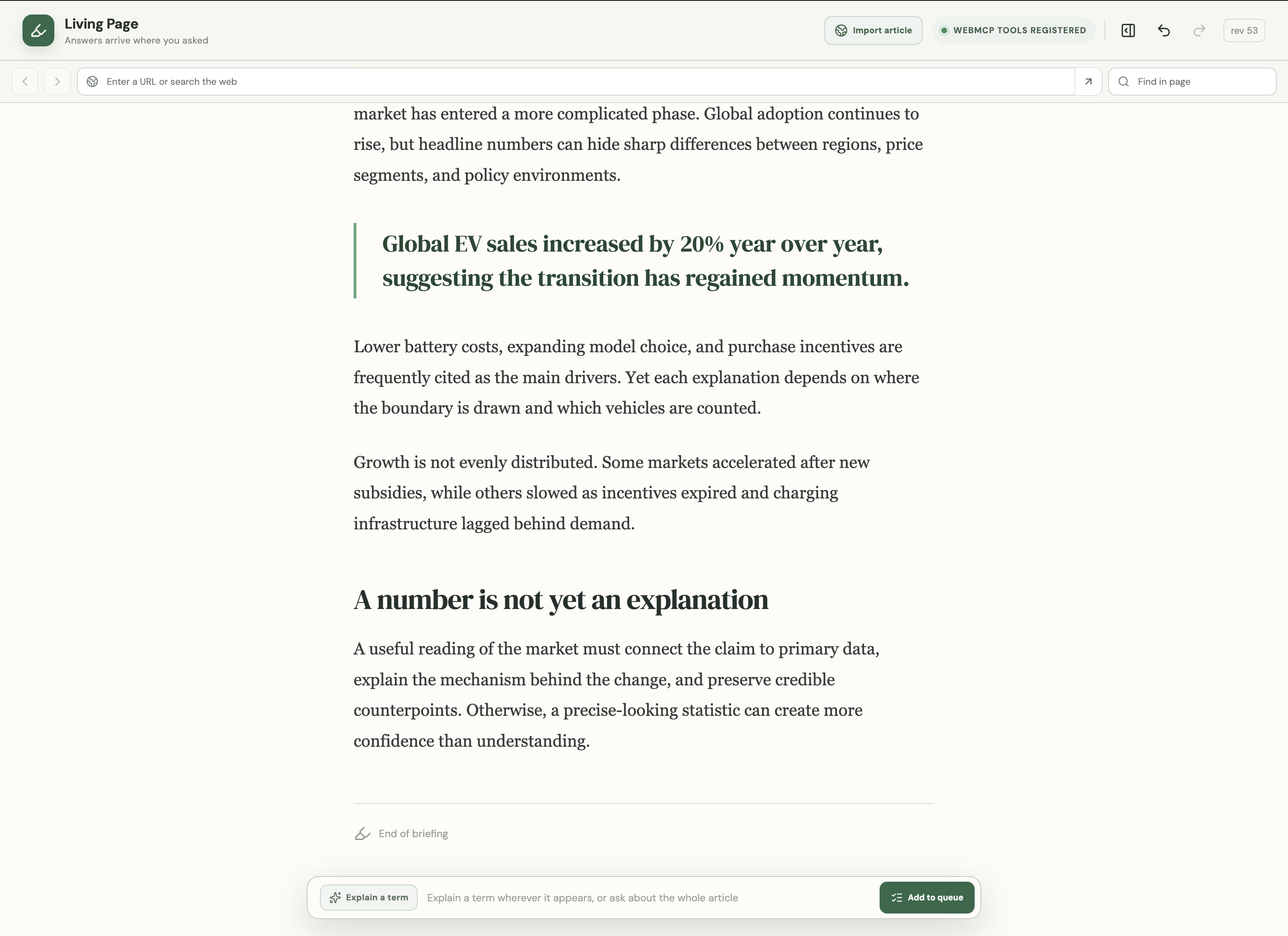
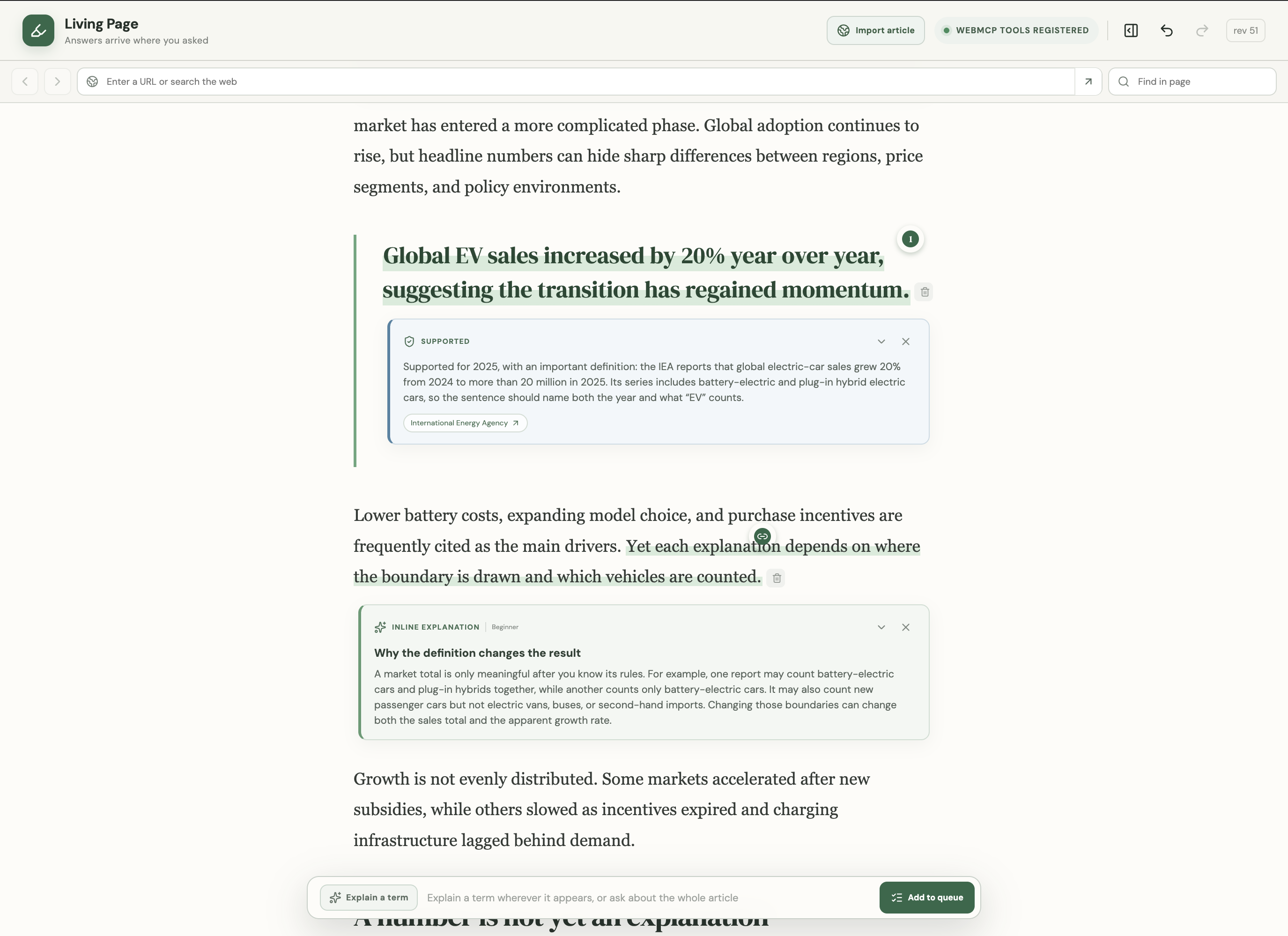
The original reading view before any agent actions.
-
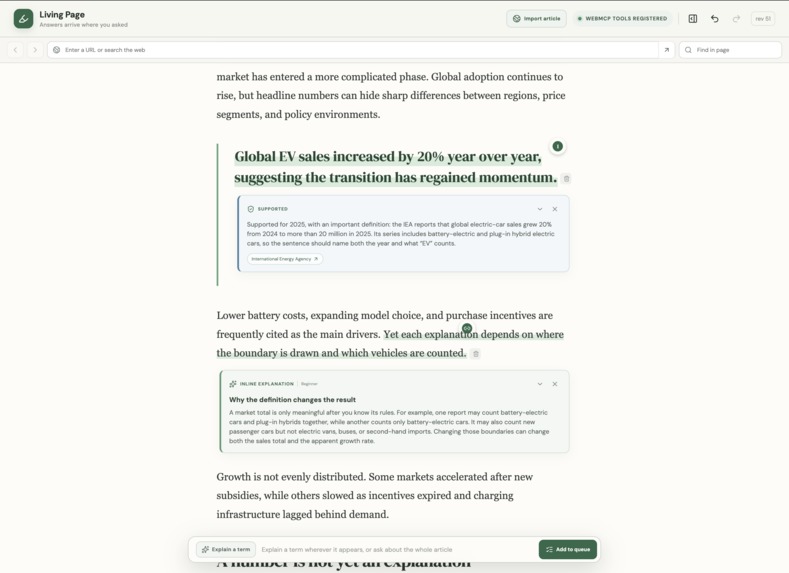
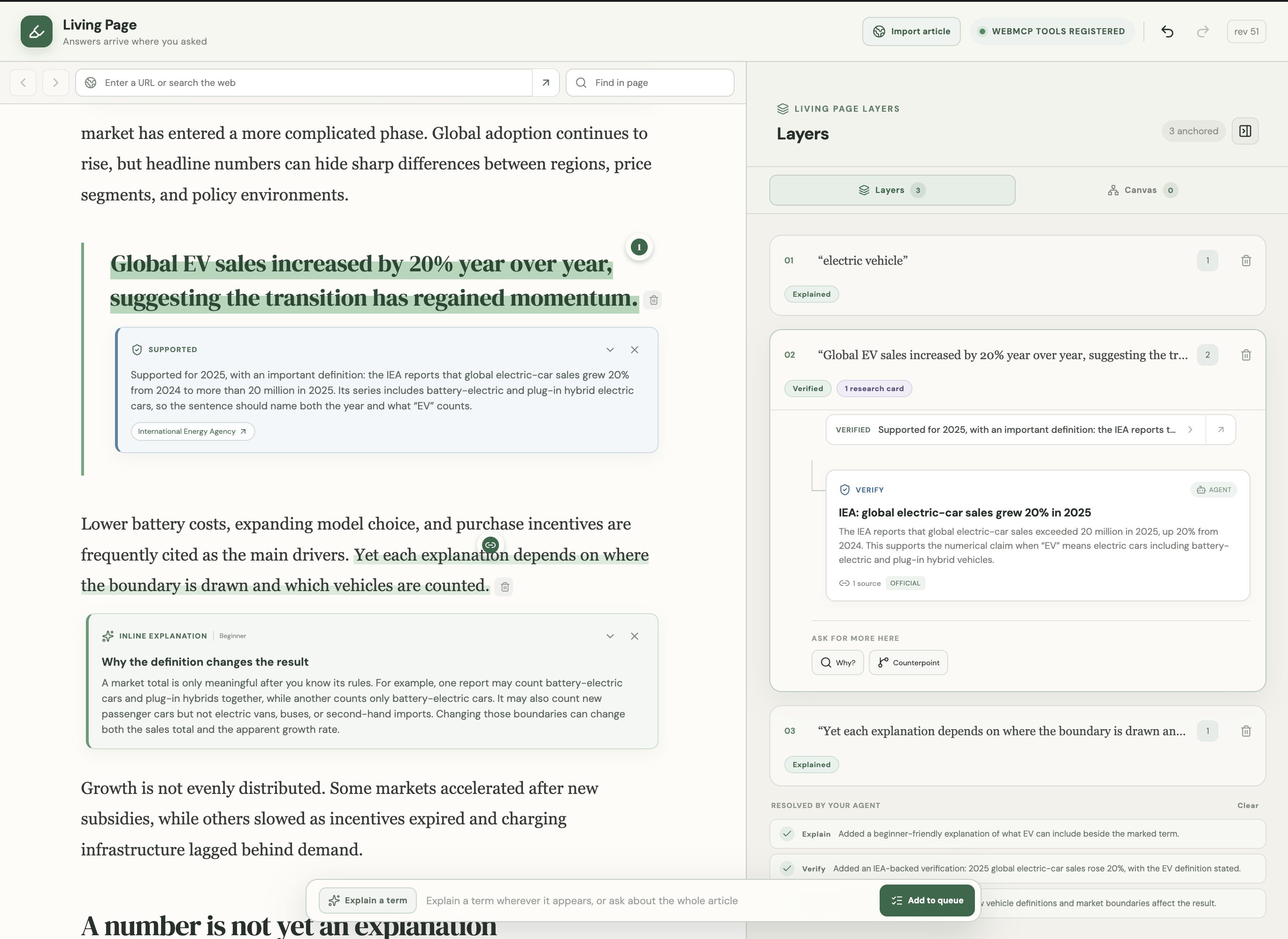
Agent-generated explanations and verification appear directly beside the relevant passages.
-
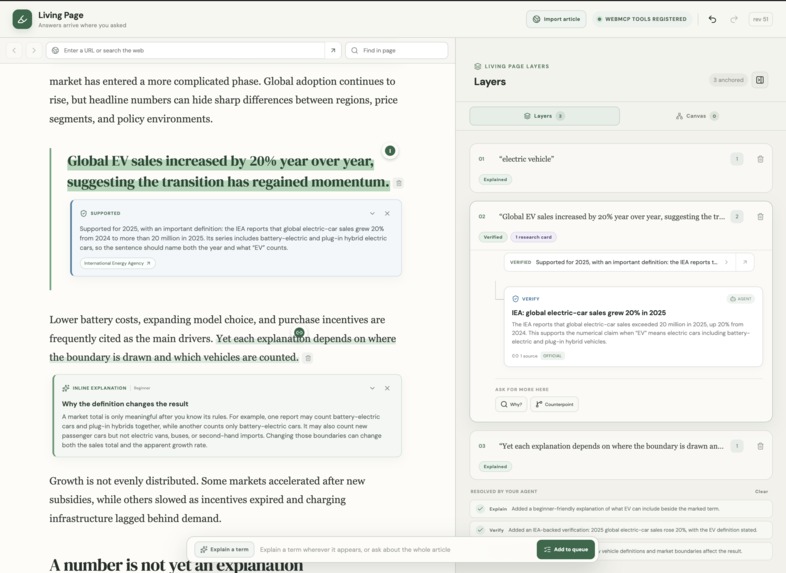
The Layers panel shows the agent’s changes, sources, and resolved requests alongside the article.
Inspiration
When something on a page raises a question, we usually have to look it up. We copy passages one by one, search in another tab or paste them into a chat, read the explanation, and then return to the original page.
I wanted to eliminate this back-and-forth and make it possible to complete the whole process without leaving the page.
What it does
While reading an article, you can leave marks such as Explain, Simplify, and more on the parts you are interested in, and send those requests all at once.
Instead of asking the agent one question at a time whenever something comes up, you can keep reading while leaving your questions on the page, then ask the agent only once when you are ready.
The agent processes the queued requests together and makes the results available directly on the page.
How we built it
The page exposes both reading and editing capabilities to the agent as WebMCP tools.
We also implemented web page and PDF importing, research layers, Undo / Redo, maps using Leaflet, and sandboxed interactive widgets generated by the agent.
Originally, I wanted LivingPage to work directly with the web page the user is already viewing, instead of requiring them to import a URL into LivingPage. However, because development time was limited, the current version uses an import-based approach.
Challenges we ran into
One of the hardest parts was coming up with an idea that felt like a new experience unique to WebMCP.
Many of the ideas I considered ended up moving toward things similar to existing demos, such as agent-controlled UIs or games, so I struggled to find a different direction.
The idea for LivingPage came from something that felt like it should already be possible with chat AI, but still was not commonly done in practice.
Instead of bringing information from the page into the chat, bring the AI's results back into the original page.
I arrived at this idea only three days before the deadline, so from that point on, it became a race against time.
Accomplishments that we're proud of
I decided to enter the WebMCP Challenge, and although LivingPage is not perfect, I was able to turn the idea into something that actually works and make it all the way to submission.
I think the rapid progress of AI tools made it possible for one person to build this much in such a short period of time.
LivingPage is also the first program I have ever publicly released.
More than achieving a perfect level of polish, I am proud that I was able to turn the idea into a working project and release it to the public.
What we learned
By actually using WebMCP, I realized that when an agent needs to operate multiple tools one after another, it can still take a noticeable amount of time.
For an experience like LivingPage, where multiple requests are processed at once, processing speed has a major impact on the user experience.
I also learned that if I keep working until I am completely satisfied, the project may never be finished.
With limited time, it is also important to decide where to stop, finish a working version, and release it.
What's next for LivingPage
I expect AI agents to become faster and able to handle multiple tasks much more quickly than they can today.
When that happens, an experience like LivingPage — where you leave multiple questions while reading, process them together, and have the results returned directly to the page — could become more natural and practical.
I also want to develop LivingPage beyond the current approach of importing URLs into a separate reader.
Ultimately, I want the web page you are already viewing to become the "Living Page" itself — changing and growing based on the user's questions.
Built With
- cloudflare
- leaflet.js
- react
- readability
- typescript
- vite
- webmcp
- workers

Log in or sign up for Devpost to join the conversation.