-
-
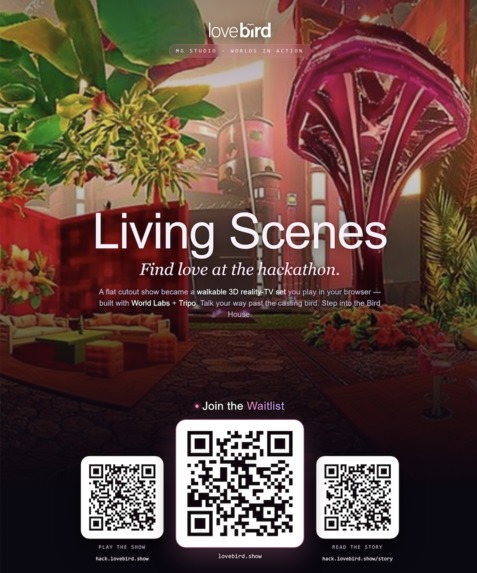
Living Scenes
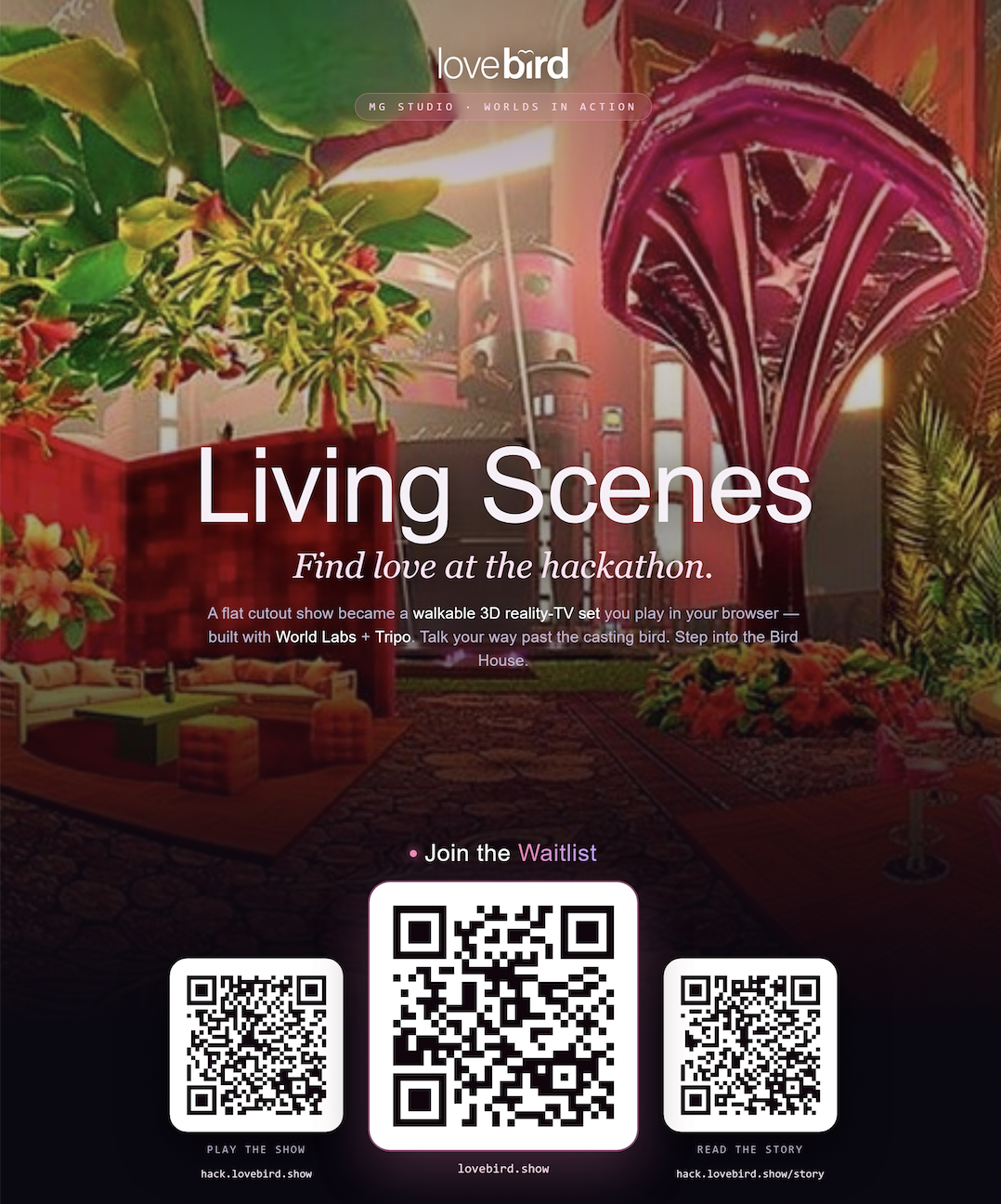
Full story: hack.lovebird.show/story Full demo: hack.lovebird.show
Inspiration
We wanted to build a mobile-first way to interact with 3D character-driven scenes with generative AI conversational dialogue. To achieve this, we wanted to build a small slice of a game in progress called Love Bird, specifically showing how World Labs and Tripo can come together to build a fully agentic scene builder that generates 3D characters and rigs them through Tripo, pulls from a custom motion capture library, and places them intelligently into a high-fidelity render of a World Labs scan, brought in via panorama-to-splat building that allows the scenes to feel alive, three dimensional, and not flat, unlike the game felt before.
What it does
Living Scenes is a scene building agent that turns a flat mobile chatbot scene into a walkable, camera-ready 3D reality-TV set you play in a browser — no install. Point a phone at a QR code and you're on set: it asks your name, asks if you've found love yet, and drops you into a 3D casting audition with Piatrice, a bird casting director rendered against the "before" of what our experience looked like - a flat environment with a cutout character. If you swoon Piatrice, you talk your way into the Tea-ki Bar, a full 3D Gaussian-splat environment with other hopefuls standing in it, talking back. The bird characters are all generated agentically via Tripo, and the human characters are powered by Genie. Everyone in the room plays the same show at once, on their own device.
How we built it
The World: We built an agent called Maestro that captured our Unreal set, generated a true 2:1 equirectangular panorama, then fed it to World Labs Marble"to synthesize a navigable 3D world: a Gaussian splat streamed in tiers from a phone build up to full fidelity, plus a depth mesh and equirect pano. Nine Love Bird locations became real 3D worlds this way, with the best result being the Tea-Ki. The cast: We built a 3D character generation tool directly in our site. "Bring to Life" takes concept art → validated T-pose → mesh → auto-rig → walk cycle, and we retargeted Unreal mocap onto the rigged birds. The stage: A WebGL / Three.js splat renderer (React Native / Expo, exported to web) places the animated cast inside the World Labs world; a Cloudflare Pages + Workers slice serves it at hack.lovebird.show and proxies the live character brain (Claude + Gemini, Inworld voices) for real conversation.
Challenges we ran into
Streaming a 4.3M-splat world to a phone browser without a 30-second "Loading the house…" wall meant tiered .spz splats. Keeping detail under Meshy's 300k-face rig cap, and reconciling Meshy vs. Tripo behind one interface. Expressive bird faces in 3D are hard, caricature lives in 2D, so we kept rendering options open rather than forcing full 3D emotion. iOS can't render the splat in the Simulator (expo-gl), so the reliable open demo is the web.
Accomplishments that we're proud of
A real, navigable World Labs 3D Love Bird set, live, open, on a phone. You can talk to a bird in a 3D world and it talks back, in character, in real time. A Meshy ⇄ Tripo toggle with head-to-head compare, so the pipeline is never locked to one vendor. The whole thing is one QR code away, the audience becomes contestants during the demo. It's genuinely funny. People laughed. A few might have flirted.
What we learned
World generation is now good enough to go from one panorama to a walkable set, the bottleneck moved from geometry to art direction and streaming. Provider seams beat provider bets: wiring Meshy and Tripo side-by-side taught us more than committing to either would have. "3D" isn't the win, coverage is. Reality TV is cameras, cuts, and a tally light; the format matters more than the polygon count. The best demo isn't watched. It's entered.
What's next for Living Scenes
All nine worlds playable, with broadcast direction: multi-cam push-ins, confessional cutaways, chyron + tally light. Cast placement inside every world (the scene-world payload already has a characters slot waiting). The Meshy ⇄ Tripo compare graduates into "Bring to Life" so any bird can be regenerated and rigged on demand. Emotion-exaggerated mesh variants and Unreal mocap for real performances. Ship it into the Love Bird app so the show itself becomes a place you stand inside. Full spec the starting line → what it became: hack.lovebird.show/story

Log in or sign up for Devpost to join the conversation.