-
-
Living Memory overview and project identity.
-
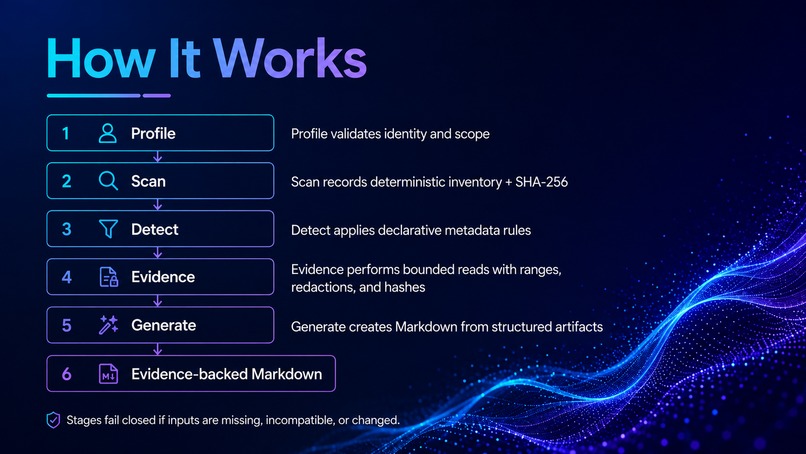
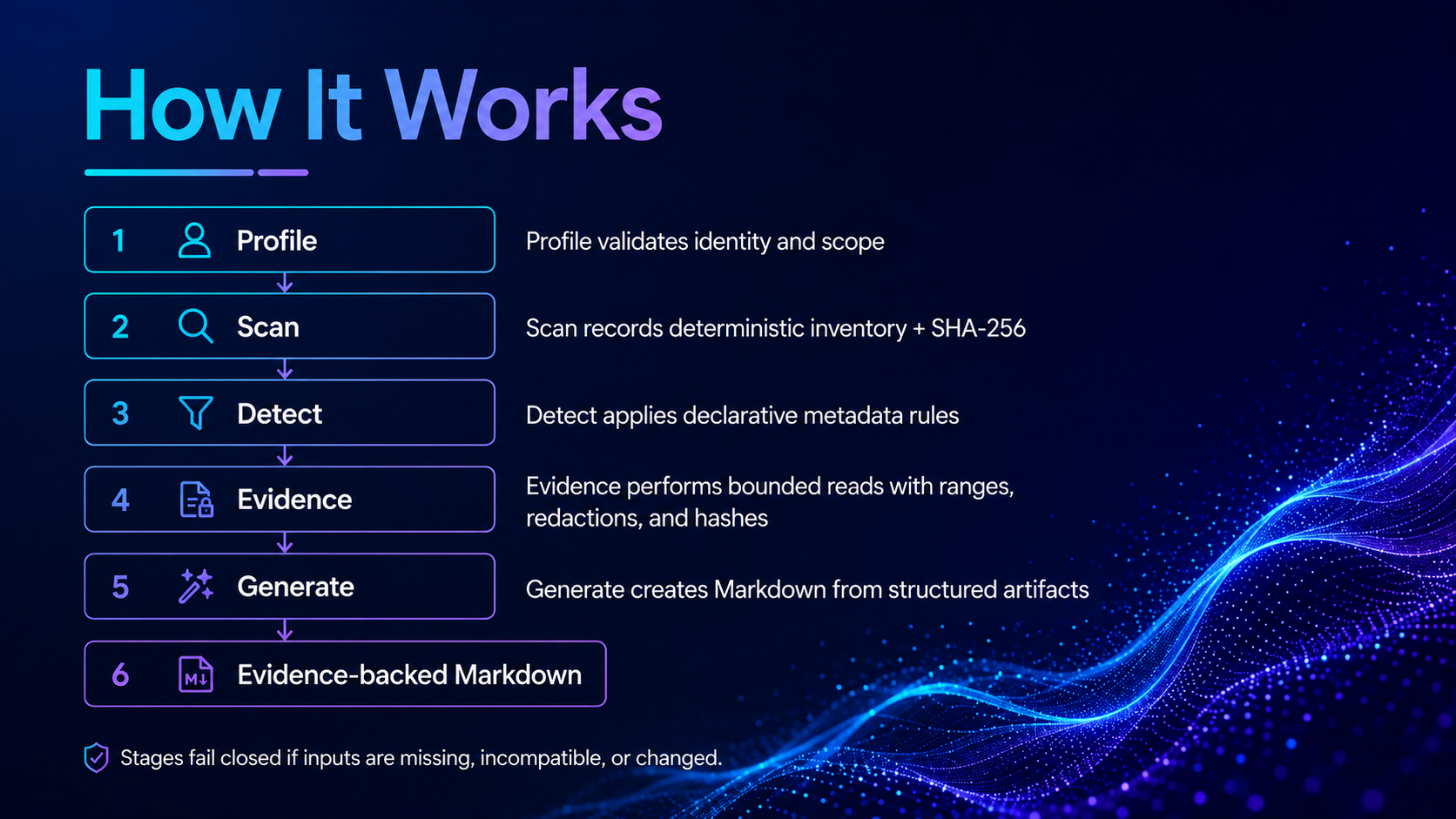
Deterministic pipeline: Scan, Detect, Evidence, and Generate.
-
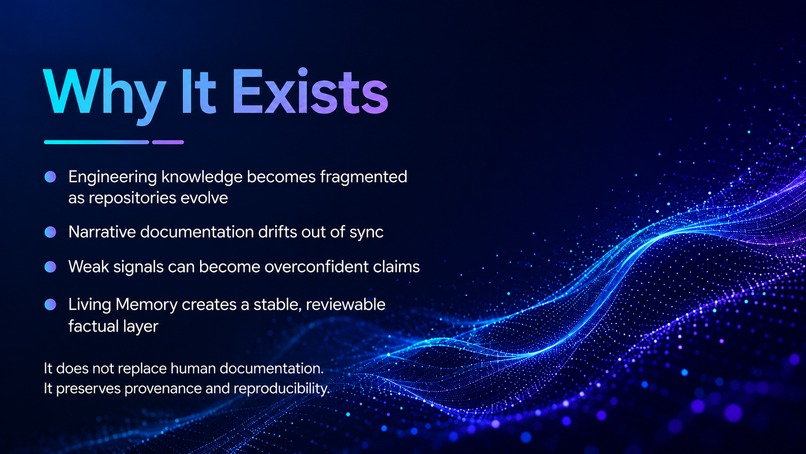
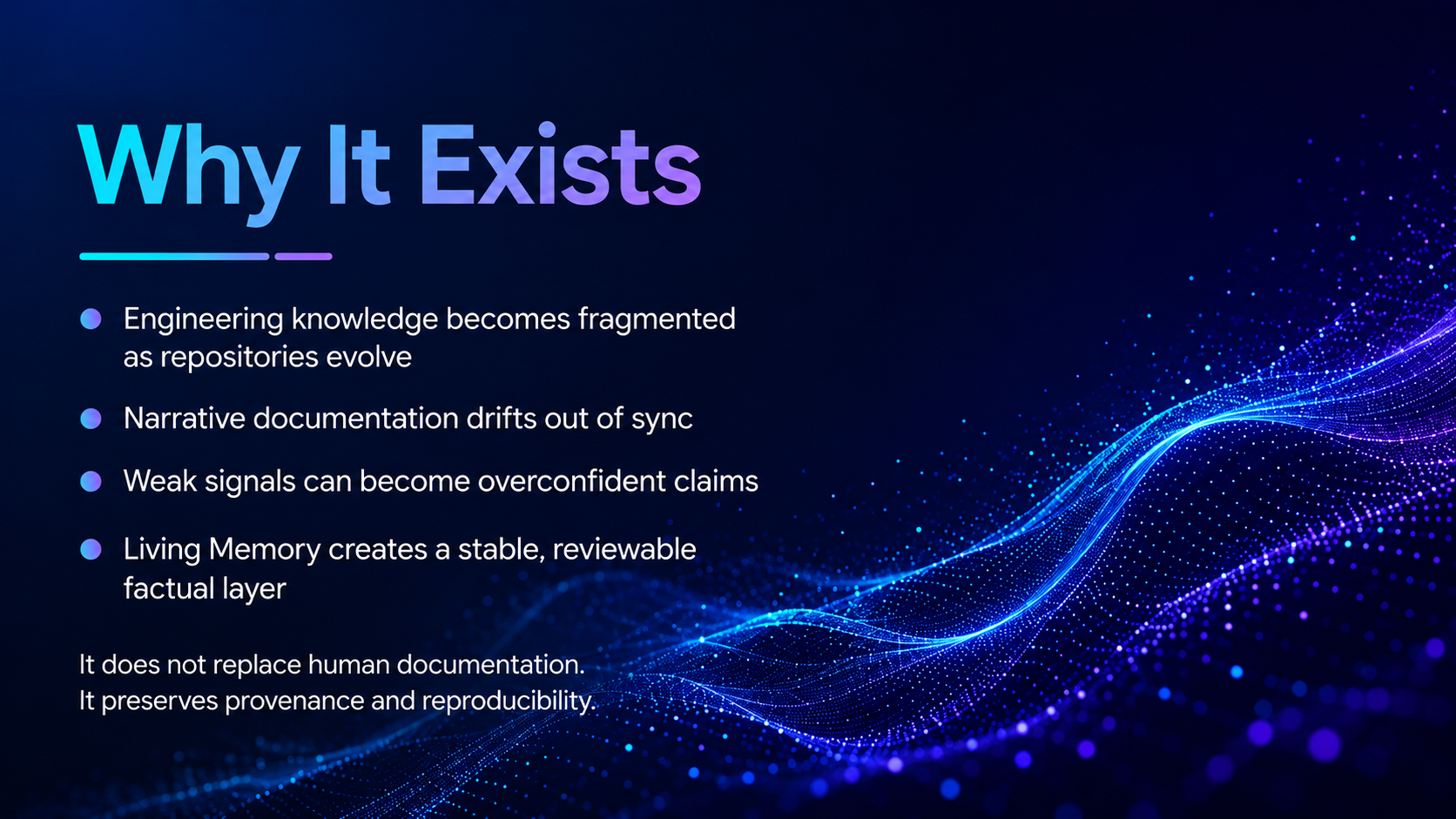
The problem: technical knowledge becomes fragmented across repositories.
-
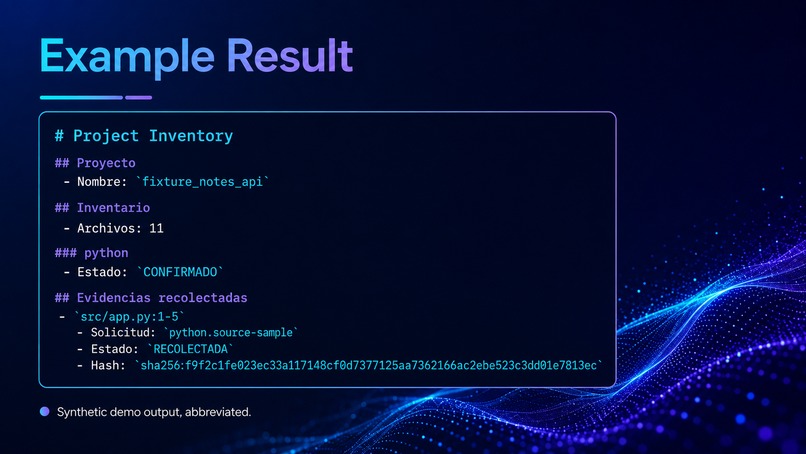
Evidence-backed documentation with traceable and reproducible output.
-
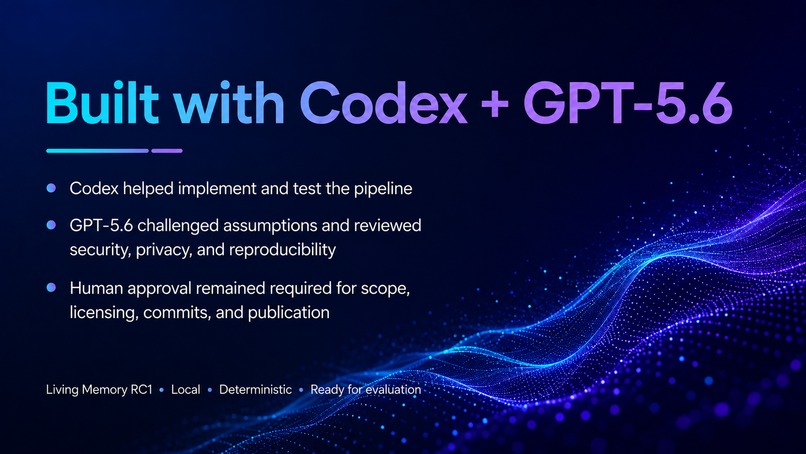
Human engineering decisions accelerated through Codex and GPT-5.6.
Living Memory
Inspiration
Software repositories evolve continuously, but their explanations often do not. Critical knowledge becomes fragmented across source code, configuration files, database migrations, generated artifacts, and documentation.
Living Memory originated from a real need I encountered while developing a private professional transcription platform. As the project grew, its technical knowledge became distributed across multiple implementation layers, databases, migrations, configuration files, and documentation with different levels of freshness.
I needed a reliable way to reconstruct and preserve that knowledge without depending on assumptions, incomplete context, or outdated notes.
Living Memory was created to preserve a deterministic, evidence-backed technical memory that remains traceable, reviewable, and reproducible over time.
What it does
Living Memory transforms an explicitly authorized repository scope into a structured technical memory.
Its pipeline:
- Scans the repository deterministically
- Detects relevant technical structures using conservative rules
- Collects bounded and traceable evidence
- Records provenance, redactions, and integrity information
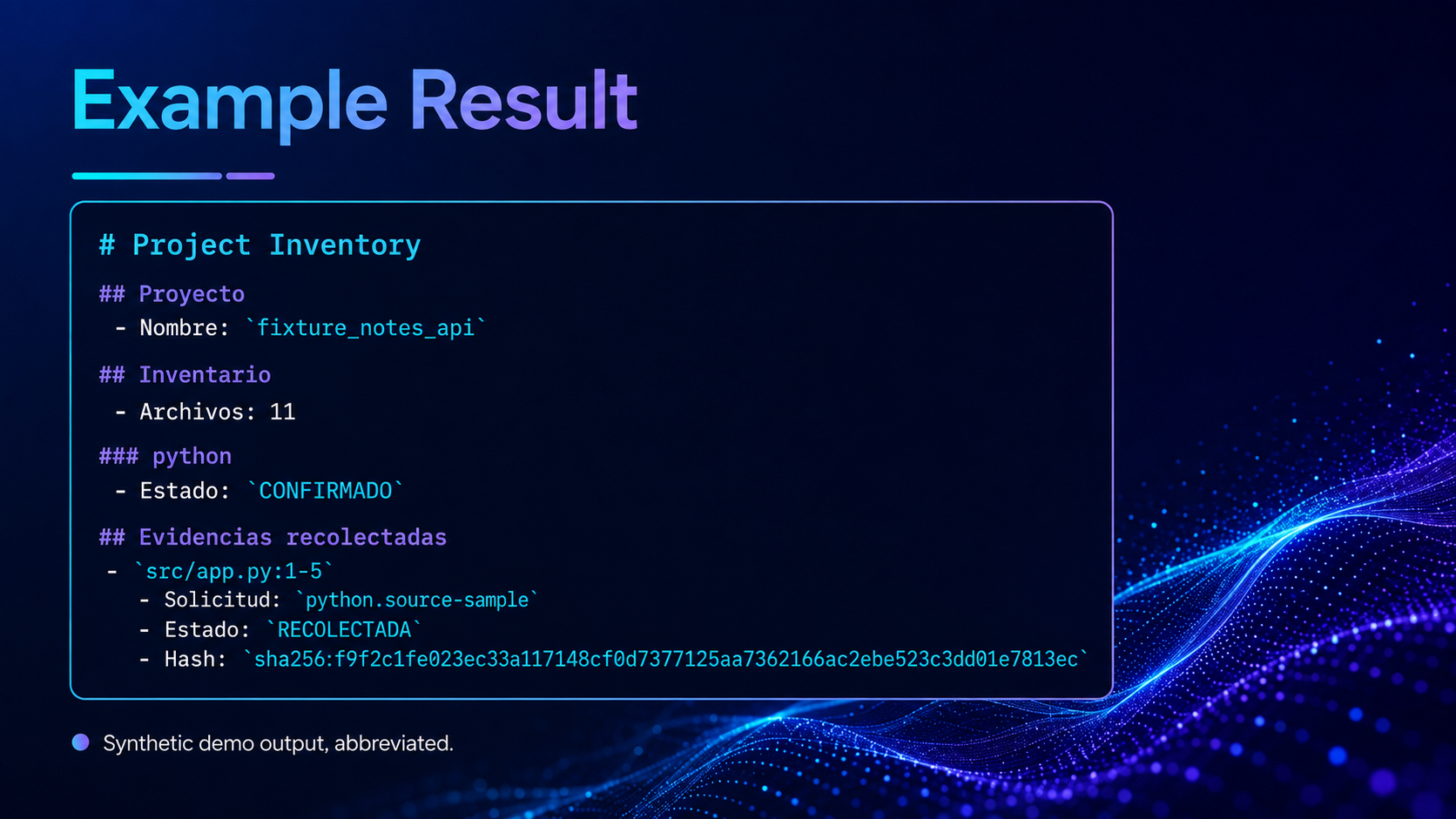
- Generates reviewable Markdown documentation from validated structured artifacts
Every statement is supported by explicit evidence rather than assumptions.
How I built it
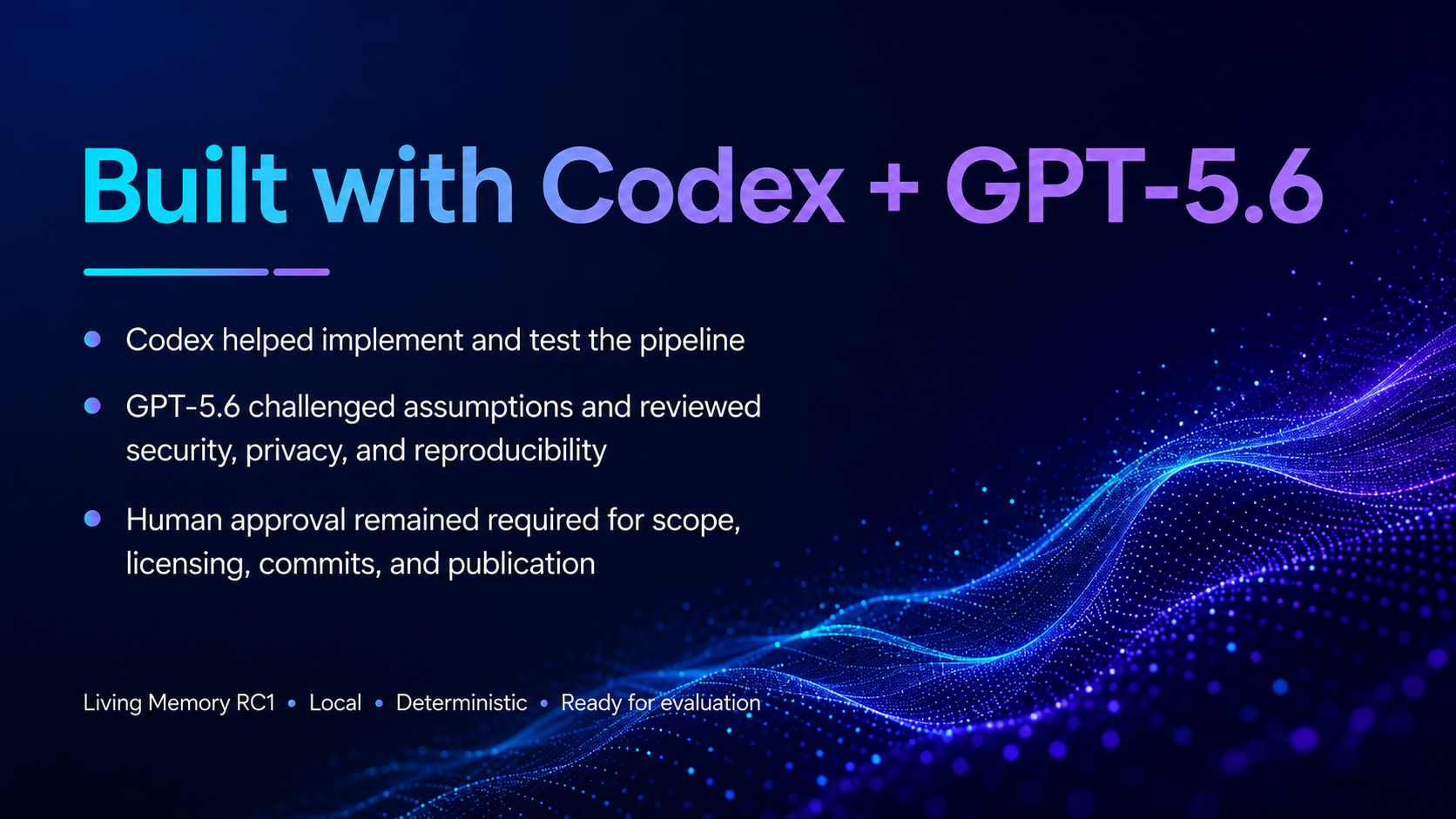
Living Memory was developed through iterative collaboration with Codex and GPT-5.6.
I defined the architecture, security model, scope boundaries, acceptance criteria, and product direction. Codex accelerated implementation, repository-wide analysis, testing, documentation, and validation.
The system was tested against my private transcription platform as a real-world development case. This helped validate its ability to inspect a complex repository, identify evidence across multiple implementation layers, document uncertainty, and reconstruct technical knowledge reproducibly.
To protect privacy and ensure that the evaluation remains reproducible, the public demonstration uses only a packaged synthetic fixture. It does not expose the private repository, credentials, secrets, or proprietary data.
Challenges
The main challenge was designing a deterministic pipeline that never invents technical facts.
Every stage had to remain reproducible, auditable, and fail safely whenever required evidence was missing, insufficient, or incompatible.
Another challenge was handling complex real-world repositories in which current and legacy implementations, multiple databases, migrations, filesystem state, and documentation can coexist without complete parity.
The system also had to preserve provenance while limiting reads, documenting redactions, and ensuring that generated claims could always be traced back to structured evidence.
Accomplishments
Living Memory produces deterministic technical documentation supported by structured and reviewable evidence.
The packaged demonstration:
- Requires no private repository
- Requires no credentials or secrets
- Requires no network access
- Runs entirely from an included synthetic fixture
- Verifies that two clean executions produce identical outputs
The final demonstration confirms:
- Determinism check: OK
- Network used: NO
- Status: SUCCESS
Living Memory was also validated against a real development repository while keeping the public demonstration safe, private-data-free, and fully reproducible.
What I learned
Building trustworthy AI-assisted developer tools requires prioritizing evidence over assumptions, explicit uncertainty over false confidence, and reproducibility over convenience.
Testing Living Memory against a real development project showed that technical memory is not only a documentation problem. It is also a problem of provenance, freshness, ownership, consistency, scope, and traceability across an entire repository.
I also learned that human judgment and AI assistance are most effective when their roles are clearly separated: human decisions define the product, constraints, and standards, while AI accelerates analysis, implementation, testing, and documentation.
What's next
Future work includes:
- Additional programming-language support
- Richer evidence extraction
- Support for larger repositories
- Improved visualization of technical knowledge
- Stronger support for multi-database and hybrid architectures
- Incremental repository updates
- Change detection between repository snapshots
- More configurable evidence and reporting profiles

Log in or sign up for Devpost to join the conversation.