-
-
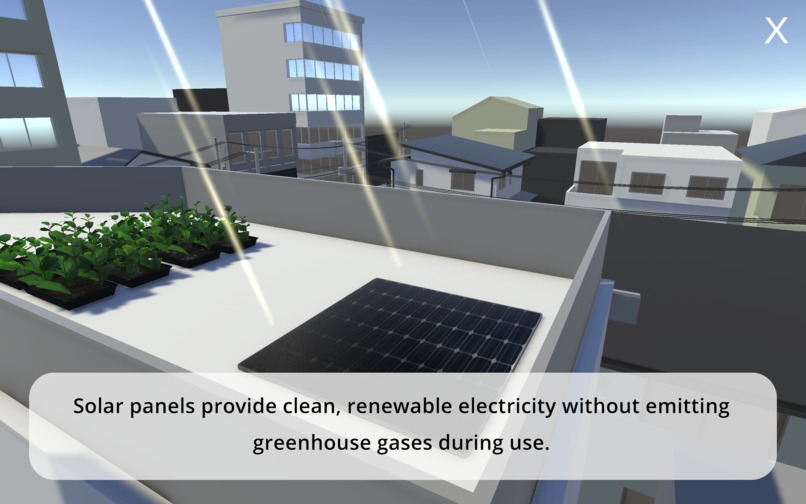
Solar Panel Scene
Inspiration
I recall my first assignment in AP Environmental Science: calculating your carbon footprint. It asked questions like your diet, your housing type, and the materials your house is made of. My results showed that if everyone lived like you, we would need “X” Earths. That didn’t mean anything or spark any motivation in me. It was only when I learned the concepts themselves that I understood the environmental concepts behind certain actions, leading me to care more about my actions, like building a cardboard house with passive solar design. How could the everyday person actually learn and interact with environmental concepts to understand their carbon footprint, instead of a vague sentence describing how many Earths it would require to sustain their lifestyle? This inspired me to create a virtual interactive simulation called Living Footprints.
What it does
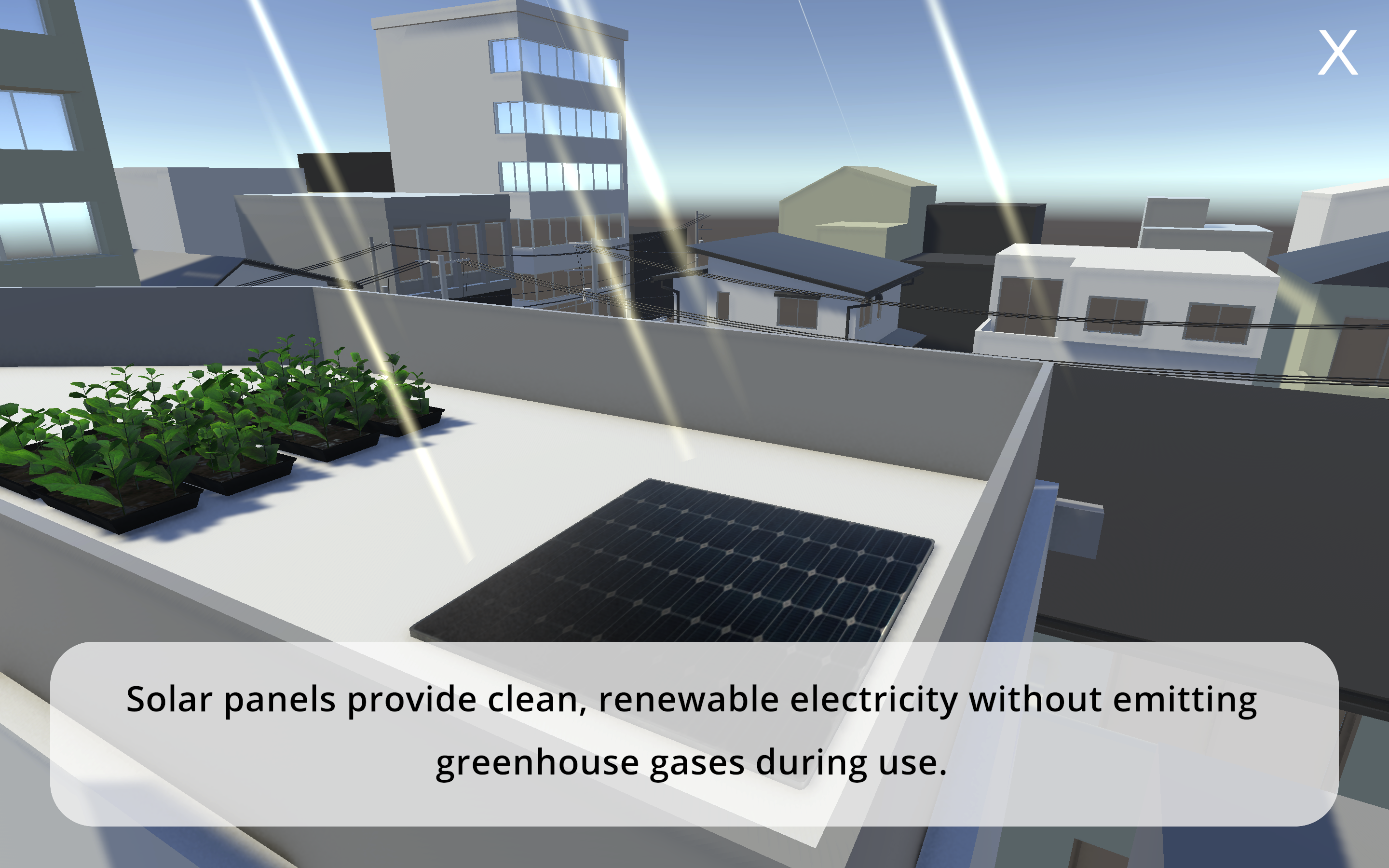
Living Footprints is a virtual simulation created through the game development app Unity. In this simulation, users tour through living spaces. As they explore, they can interact with objects. Once clicked, these objects take the user to another scene, where they are informed both textually and visually of the environmental concepts and processes that allow them to gain a deeper understanding of the impact of this object on the environment.
How I built it
I built it using the game development app Unity. The logic of the interactions was created through C#, which is the coding language Unity runs on.
Challenges we ran into
This was my first time using Unity, so I came into this project with no experience. Adjusting to the complex interface was my biggest challenge. It took quite a while for me to learn how to implement everything I wanted, like player movement, mesh colliding, interactions, and more.
Accomplishments that we're proud of
I'm proud of how far I've come with my Unity experience. I was able to create a fully functioning project, having had zero experience with this app prior. Additionally, I'm proud of my initiative to identify a problem through my school education and go further to tackle it.
What we learned
While I learned technical skills through C#, Unity mechanics, and more, I most importantly learned the value of using technology as a tool to educate and inspire change. When we understand the human connection to technology, it becomes a powerful force for good, capable of benefiting society in countless ways, including raising awareness through environmental education.
What's next for Living Footprints
I plan on creating a positive impact on my community by reaching out to local environmental groups. I’ve partnered with CarbonFreeMountainView, where the app is being used in their group, and I'm in contact with Mountain View City Council members, trying to work out how it can be used in my community. Likely, additional features will be added or changes will be made to cater to certain groups’ needs.

Log in or sign up for Devpost to join the conversation.