-
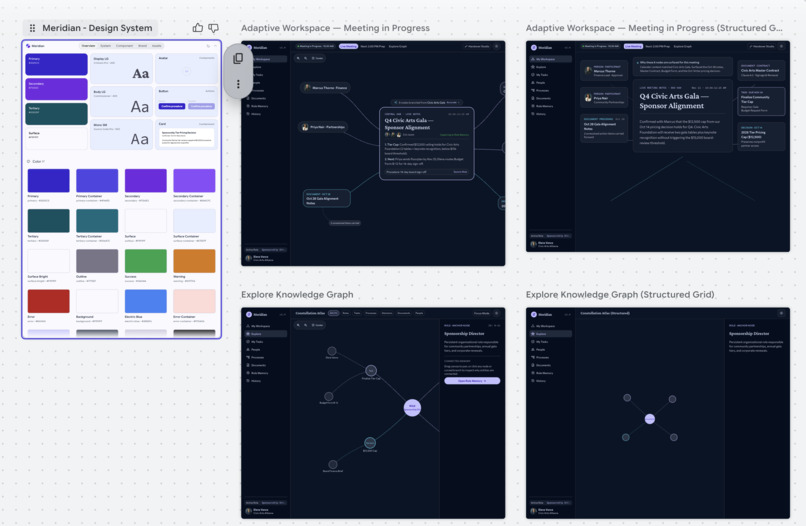
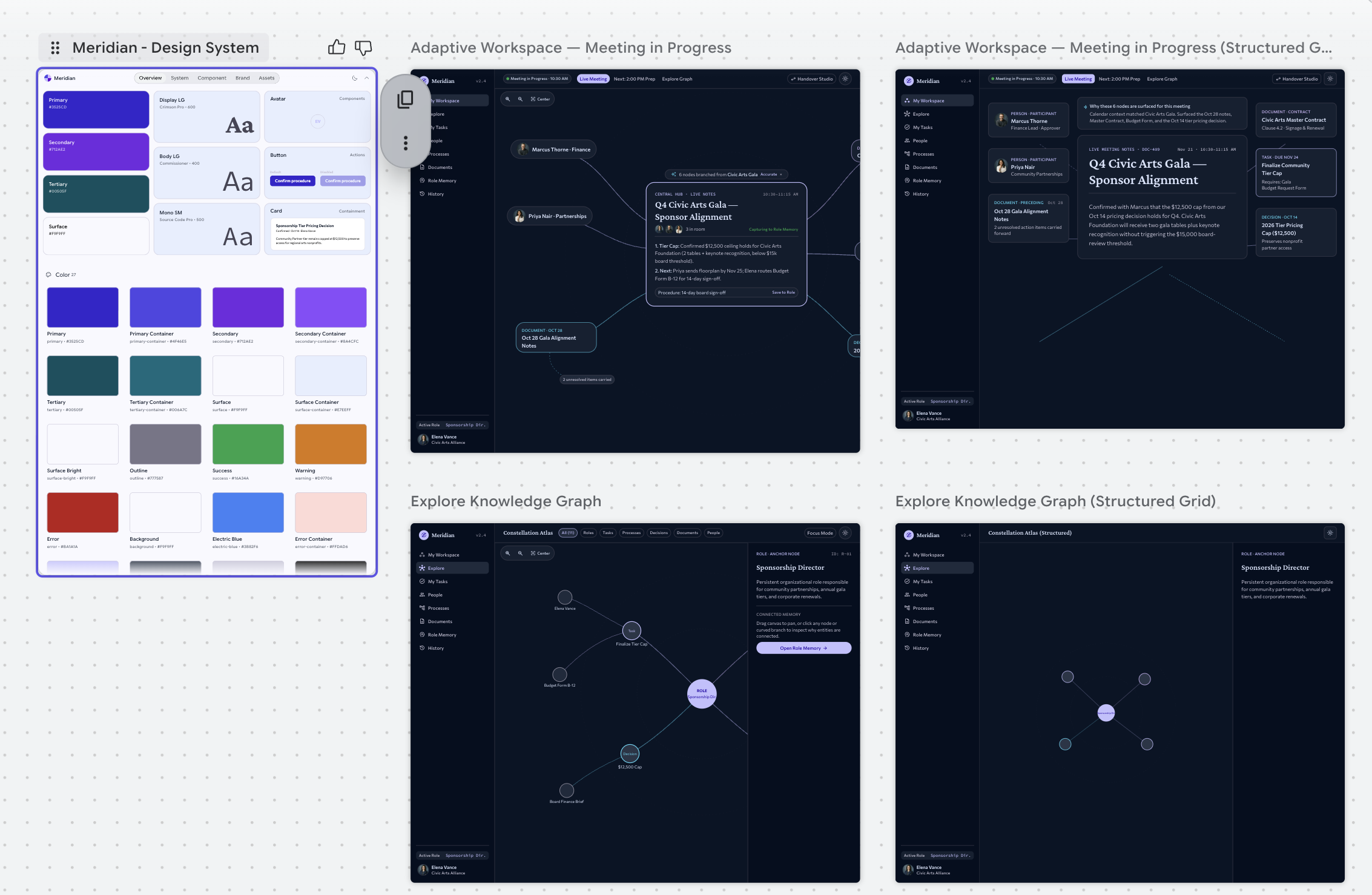
shows how visuals evolved
Inspiration
"Work doesn't leave when people do."
Small businesses, student groups, and community organizations run on institutional knowledge—who to contact, why past decisions were made, and how projects actually get done. Traditional tools like Google Drive and Notion trap that context inside rigid folders, assuming you already know which department owns a task or which file holds the answer. When someone graduates, switches roles, or steps away, that context disappears, and the next person is forced to start in the dark.
Inspired by the theme "When You Wish Upon A Whale" and the lifecycle of stars—where fading stars scatter elements into space to spark new stars while constellations endure across generations—we wanted to build a Living Organizational Memory. Instead of digging through static folders, users place what they are working on at the center of an interactive constellation canvas, illuminating the exact people, past examples, workflows, and decisions connected to their task.
What It Does
Our platform transforms fragmented documents into an AI-powered, role-aware organizational constellation:
- Task-Centered Constellation Discovery: Type what you are working on (for example, "preparing a sponsorship proposal" or "planning strike closeout"), and the AI generates an interactive mind map around your prompt—branching into People, Past Examples, Documents, Processes, Decisions, and Roles.
- Role- & Position-Aware Access Control: Every team member logs in with their organizational position and permission tier (
admin,project_lead, ormember). The AI automatically filters retrieved knowledge so restricted files are never leaked through recommendations, while still letting members pull historical craft knowledge across past seasons. - A Memory That Grows Through Use: Every time an employee explores a node, links a resource, or logs a project update, the constellation strengthens those connections—turning one-time handovers into continuous institutional memory.
How We Built It
We designed and built the prototype across three core layers using Figma, Cursor, Next.js / React, Supabase, and the Google Gemini API:
- Frontend & Constellation Canvas: Designed in Figma and built in Cursor with Next.js/React, featuring a dark-sky midnight aesthetic, interactive node branching, and accessibility-first controls (including adjustable text scaling and high-contrast modes).
- Database, Auth & Row Level Security (Supabase): We modeled organizations, seasonal productions, team assignments (
project_members), and a 10-position role mapping table (position_role_map) in PostgreSQL. Using Supabase Auth and database triggers, user profiles automatically sync with their organizational role, and Row Level Security (RLS) policies enforce permissions directly at the database layer. - AI Retrieval Pipeline (Gemini +
pgvector): We structured and chunked a multi-season organizational dataset (378 documents and 1,120 metadata-rich chunks), generated 768-dimensional embeddings via the Gemini embedding API, and stored them in Supabase usingpgvectorwith an HNSW cosine-similarity index. At query time, user prompts are embedded and matched against authorized chunks using cosine similarity:
$$\text{similarity}(\mathbf{q}, \mathbf{d}) = \frac{\mathbf{q} \cdot \mathbf{d}}{|\mathbf{q}| |\mathbf{d}|}$$
- Grounded Synthesis: Retrieved chunks—strictly scoped to the logged-in user's RLS session—are passed to Gemini 2.5 Flash to synthesize contextual guidance and populate the surrounding constellation nodes.
Challenges We Ran Into
- Enforcing Permissions Inside AI Search: Standard RAG pipelines search an entire vector database and risk exposing restricted documents in AI summaries. We solved this by executing our
match_document_chunksRPC function withSECURITY INVOKERin Supabase so PostgreSQL RLS policies filter unauthorized rows before cosine similarity results ever reach Gemini. - Aligning Schema, Dimensions, and Metadata Across the Team: Coordinating frontend auth, backend database schemas, and chunk ingestion meant catching vector dimension mismatches ($1536$ vs. $768$ dimensions) early, separating historical author labels from live authorization roles, and enabling cross-season position retrieval without breaking production-level privacy.
- Balancing Visual Wonder With Clarity: Designing an organic, constellation-style canvas that feels exploratory without overwhelming first-time users required careful visual hierarchy, progressive node expansion, and accessible typography.
What We Learned
- Security Belongs in the Data Layer: Pushing authorization into Supabase Row Level Security meant our AI retrieval pipeline inherited role, department, and production permissions automatically without duplicating fragile access logic in application code.
- Context Matters More Than Storage: Organizing knowledge around work and relationships rather than folders dramatically changes how quickly new team members can ramp up.
- Dogfooding Our Own Tool: Building this under hackathon constraints taught us how vital clear handoffs are—and once the hackathon wraps up, we plan to use our own constellation platform to organize our team!
What's Next for Living Constellation
- Interactive Feedback Loops: Weighting future constellation recommendations based on which nodes and past examples teams click and confirm most frequently.
- Automated Handover Snapshots: One-click AI project summaries that capture active blockers, recent decisions, and key contacts whenever someone transitions off a project.
- Live Workspace Integrations: Connecting directly with Google Drive, Slack, and calendar workflows so organizational memory updates effortlessly as teams work.
Built With
- css3
- cursor
- figma
- gemini
- google-gemini
- html5
- json
- next.js
- pgvector
- postgresql
- python
- react
- supabase
- tailwindcss
- typescript
