-
-
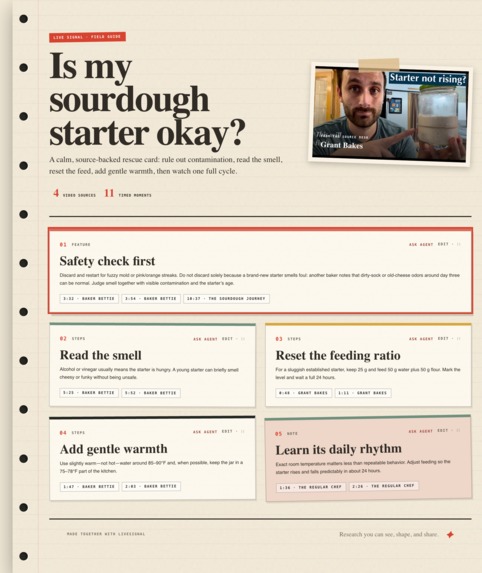
Chrome test result
-
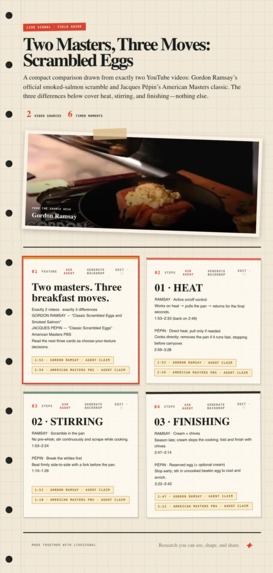
Chatgpt in app browser result
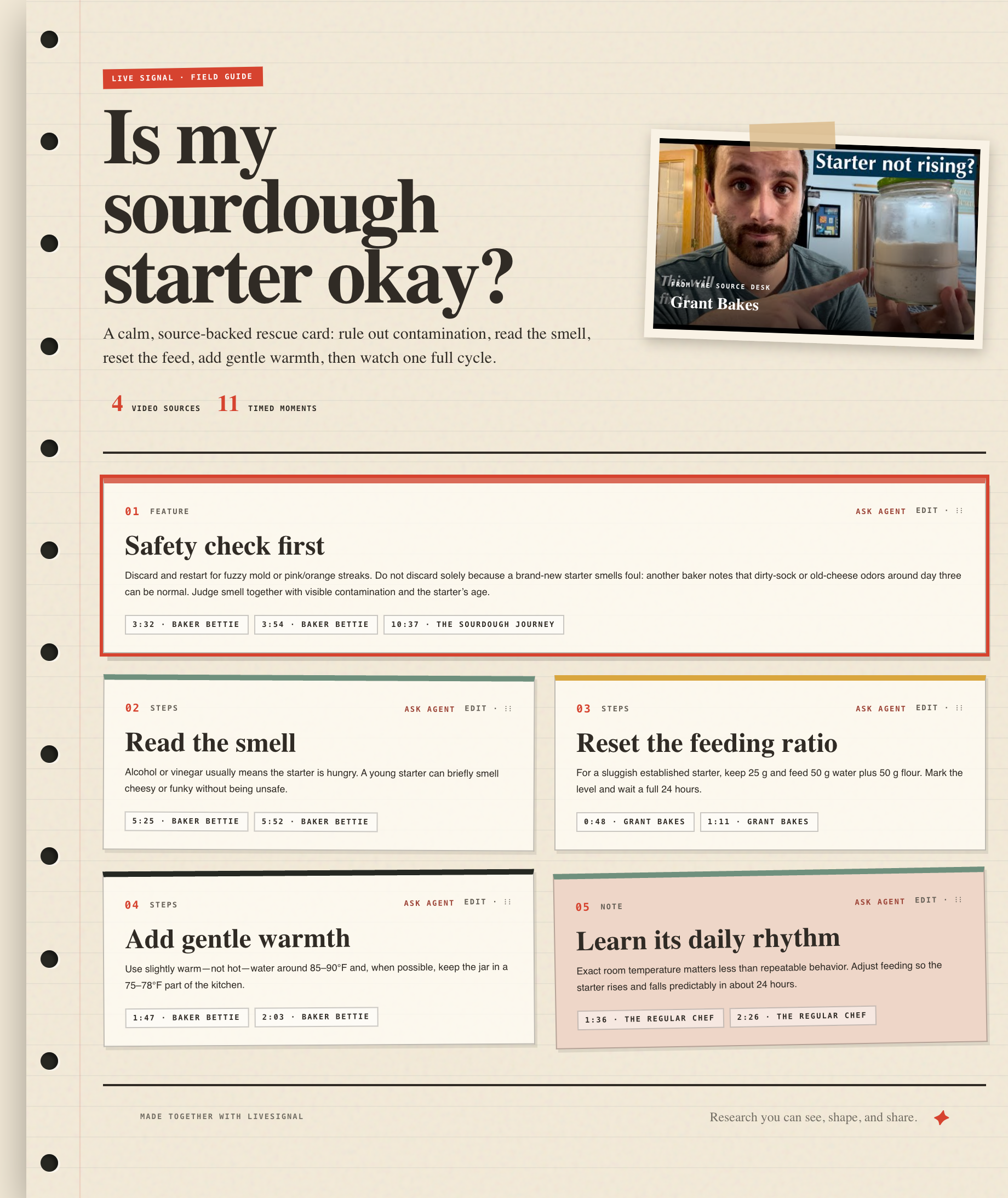
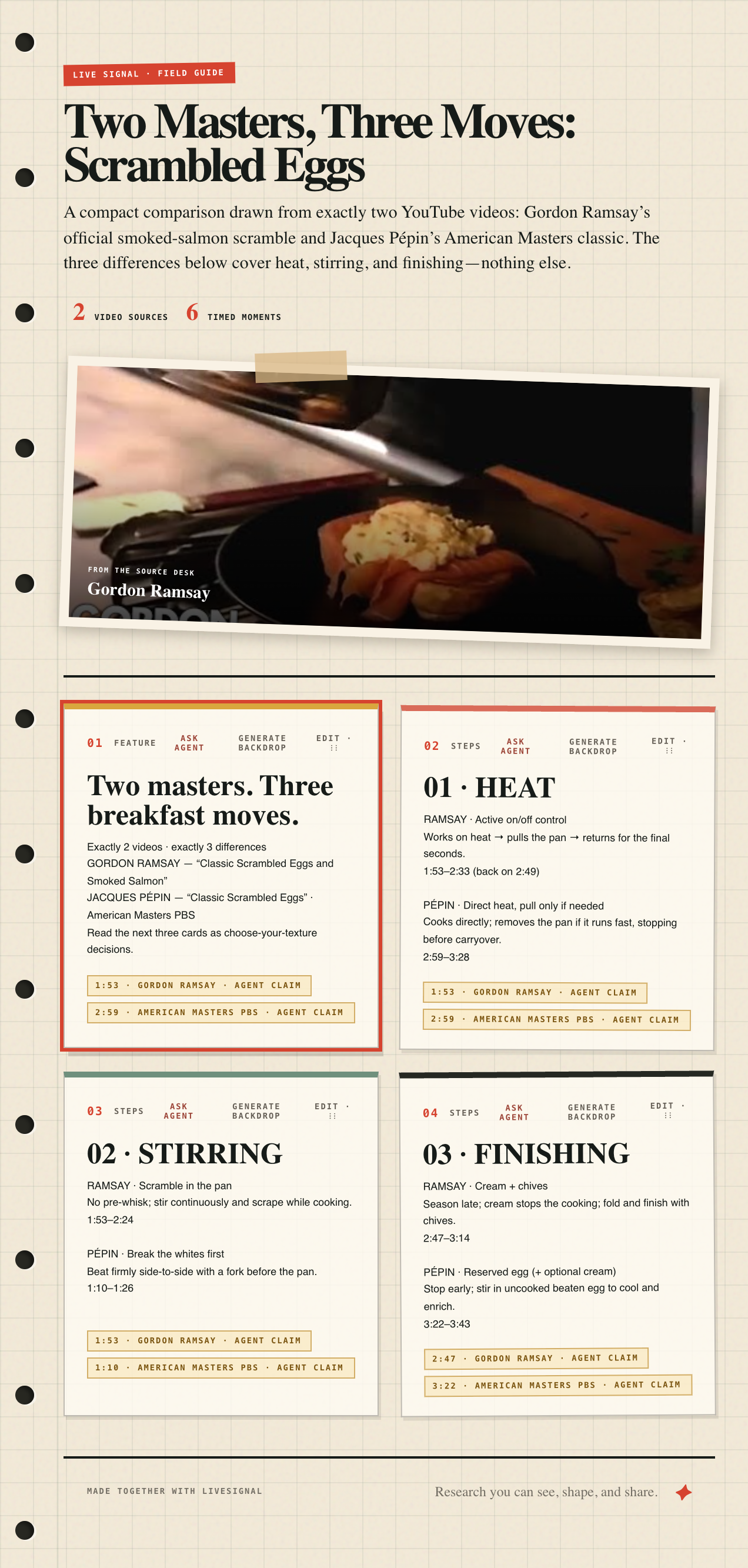
Inspiration
Useful knowledge is often buried inside hours of YouTube video. Even when an AI can summarize those videos, the result usually ends as another chat response: difficult to verify, difficult to edit, and disconnected from the original evidence.
I built LiveSignal around a different idea: the agent should handle the repetitive research, while the human keeps control over judgment, presentation, and the final result. Instead of replacing the webpage, the agent collaborates with the person inside it.
What it does
LiveSignal turns YouTube research into an editable, evidence-backed visual guide.
A user gives the agent one goal. The agent finds relevant videos, captures useful excerpts with timestamps, compares the sources, and writes its findings into the LiveSignal workspace. Every researched claim remains connected to its source moment.
The user can then rewrite, resize, reorder, or restyle cards on the visual canvas. Saved changes and comments are sent back to the active agent as structured events, allowing it to respond to one card without rebuilding the entire project. Users can also request AI-generated illustrations or full-card backdrops while preserving the existing copy, citations, thumbnails, and layout.
The finished canvas can be exported as a PNG, while the underlying evidence report remains available as Markdown with clickable timestamp citations.
How we built it
LiveSignal is a Next.js and React application that exposes 37 semantic WebMCP tools. These tools cover agent identification, research setup, YouTube discovery, transcript ingestion, evidence recording, report generation, canvas composition, scoped revisions, human comments, image generation, source navigation, and export.
The visible React interface and the agent tools operate on the same workspace state. Research cards retain their source and evidence IDs as they move through the canvas, keeping citations attached to the claims they support.
Renewable wait tools create the human–agent collaboration loop. When a user saves a layout change or submits a comment, the active agent receives a structured event containing the affected card and current canvas state.
A Manifest V3 browser adapter provides native-caption and optional user-approved real-time transcription support for YouTube and Twitch. Generated visuals use a rate-limited server route backed by Vercel AI Gateway, and are explicitly separated from research evidence.
Challenges we ran into
The first version generated a report and stopped. It automated research, but it did not create meaningful collaboration.
The harder problem was translating human canvas actions into precise agent context. Moving one card should not authorize the agent to rewrite the entire guide. We introduced scoped revision events, acknowledgements, comments, and renewable collaboration sessions so the agent can respond without erasing the human’s work.
Evidence integrity was another challenge. We needed to distinguish verified timestamped excerpts from untimed agent claims, personal notes, and generated artwork. We also had to handle unavailable YouTube captions honestly rather than inventing evidence.
Finally, WebMCP tool availability does not necessarily mean an agent is actively connected. We added an optional identity handshake, tool-activity detection, and separate listening states so the interface does not make misleading presence claims.
Accomplishments that we're proud of
- Built a shared artifact that both the human and agent can inspect and change.
- Exposed 37 WebMCP tools across the complete research and creation workflow.
- Preserved timestamp evidence as content moves from transcripts to reports and visual cards.
- Created a renewable collaboration loop for saved edits and scoped comments.
- Allowed agents to update one card without destroying the rest of the composition.
- Added agent identification and honest presence indicators for different WebMCP clients.
- Kept generated illustrations and backdrops visibly separate from source evidence.
- Supported real YouTube research while reporting missing transcripts transparently.
- Exported both a shareable visual canvas and a citation-preserving Markdown report.
What we learned
Human–agent collaboration needs shared state and alternating turns, not just a generation button.
WebMCP becomes especially useful when a website exposes the meaning behind human actions. A card move, rewritten title, visual request, or source rejection can become structured context that an agent understands without taking control away from the user.
We also learned that trust depends on preserving provenance. Generated artwork, personal notes, agent claims, and verified transcript evidence must remain visibly distinct. Finally, giving the work a shareable final form encourages people to review and improve it instead of accepting the first generated answer.
What's next for LiveSignal
Next, we want to add durable projects, richer freeform canvas layouts, reusable templates, multi-agent presence, and clearer previews of proposed agent changes before they are applied. Ask people around me if it is actually useful and interesting, so I can pivot a bit to market-fit before going too deep.
We also want to support more video platforms and improve source-aware visual generation. Longer term, LiveSignal could become a general workspace for turning video knowledge into trusted explainers, learning boards, itineraries, comparisons, and buying guides, created by people and agents together.
Built With
- ai-agents
- chatgpt
- chrome
- elevenlabs
- html
- image-generation
- javascript
- manifest-v3
- next.js
- openai-codex
- react
- speech-to-text
- typescript
- vercel
- vercel-ai-gateway
- web-apis
- webmcp
- youtube
- youtube-captions


Log in or sign up for Devpost to join the conversation.