-
-
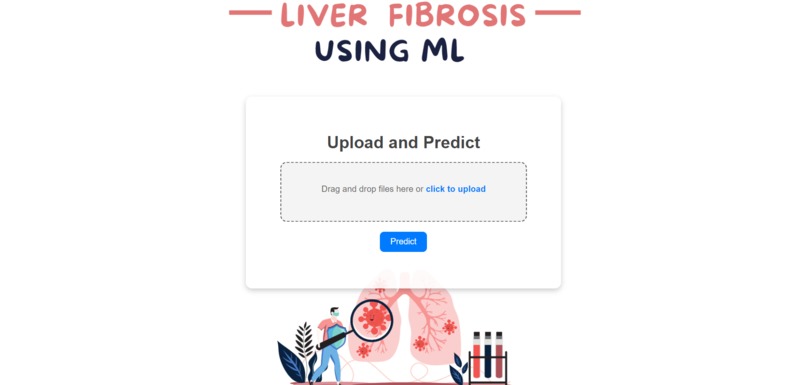
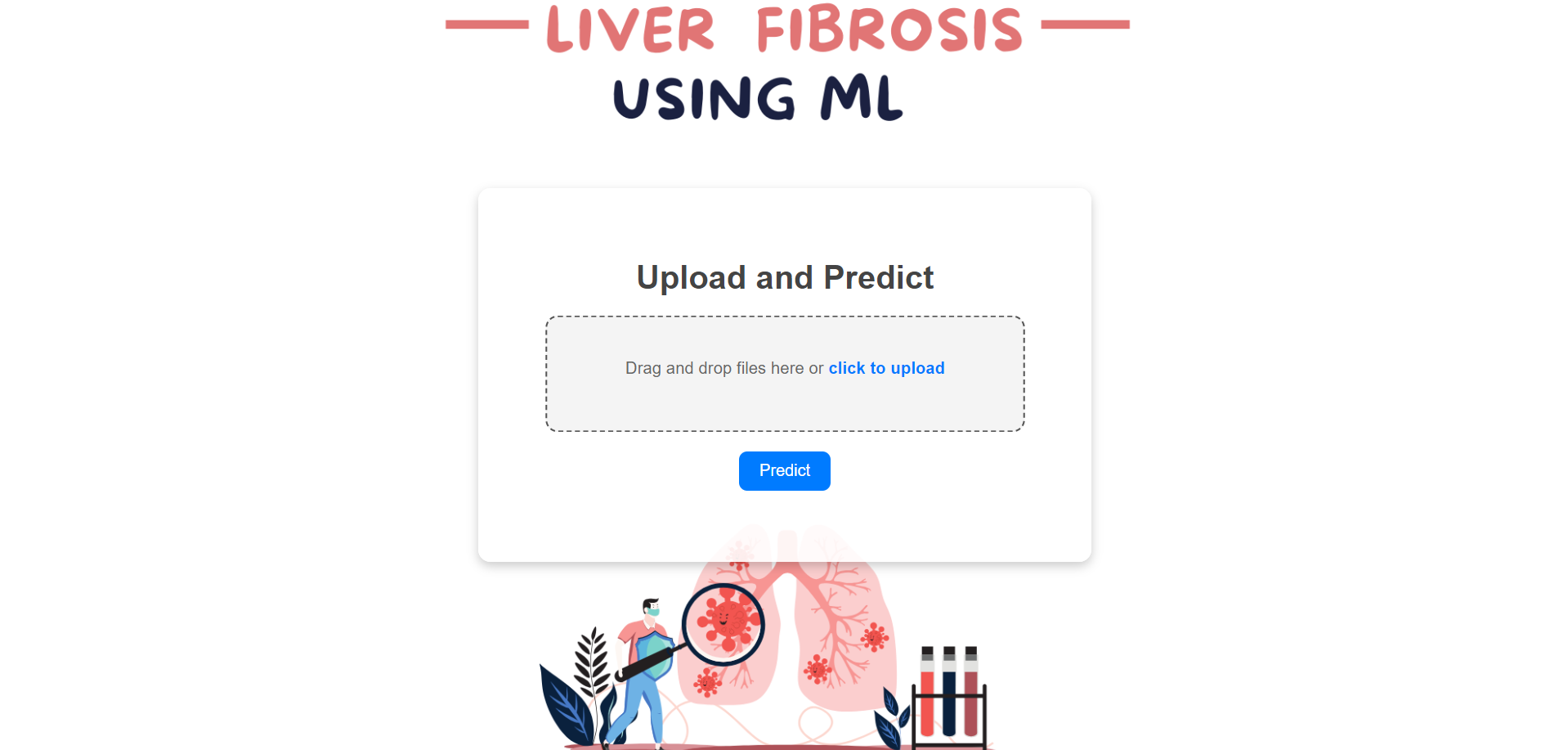
web application interface
-
our webapp theme
This project is built in the Healthcare domain..
Inspiration
They say, "You can't live-r without your liver!" And it's true—this powerhouse organ plays a vital role in keeping us healthy. But when it faces challenges like fibrosis, early detection becomes crucial to avoid complications. Inspired by the need to protect this multitasking hero of the body, we decided to combine the magic of AI and deep learning to lend a helping hand to healthcare professionals. Our tool is designed to accurately classify liver fibrosis stages using ultrasound images, making timely diagnosis easier and treatment more effective. After all, your liver deserves some love too!
What it does
LiverCare Solutions is an AIML-driven diagnostic tool that classifies liver fibrosis stages from high-resolution ultrasound images. By providing a clear classification of fibrosis stages (F0: No fibrosis, F1: Mild fibrosis, F2: Moderate fibrosis, F3: Severe fibrosis, F4: Cirrhosis), it enables healthcare professionals to make informed decisions for timely medical intervention and treatment.
How we built it
-Data Collection and Preparation:
-Dataset link: Kaggle
- Gathered a comprehensive dataset of ultrasound images categorized into five stages of liver fibrosis (F0 to F4).
Data Preprocessing:
-Performed EDA on dataset to understand the structure.
- Resized images to 224x224 pixels and normalized pixel values for consistency.
- Applied data augmentation techniques like rotations, flips, and color jitter to enhance model robustness.
Model Design and Training:
- Developed a convolutional neural network (CNN) using ResNet-50 as the base model.
- Fine-tuned the model by unfreezing the later layers and using a weighted loss function to handle class imbalance.
- Trained the model with a learning rate scheduler and implemented early stopping to prevent overfitting.
Model Evaluation:
- Evaluated the model's performance using metrics like accuracy, precision, recall, and F1-score.
- Visualized the results with confusion matrices and ROC curves. -Here are some key insights highlighting the best metrics from the training and validation performance:
Epoch 5: Showed significant improvement with Train Accuracy at 93.49% and Val Accuracy at 94.73%.
Epoch 9: Achieved high performance with Train Accuracy at 97.76% and Val Accuracy at 96.31%, indicating effective learning.
Epoch 10: Peak performance with Train Accuracy reaching 98.98% and Val Accuracy at 96.94%, along with the lowest Validation Loss at 0.1310.
Epoch 13: Maintained robust performance with Train Accuracy at 98.37% and Val Accuracy at 97.78%.
Epoch 14: Near-perfect Train Accuracy at 99.50% and strong Val Accuracy at 96.84%, confirming the model's reliability.
Deployment:
- Created a user-friendly interface using flask for healthcare professionals to upload images and receive predictions.
Challenges we ran into
- Class Imbalance: Dealing with imbalanced classes required implementing weighted loss functions and extensive data augmentation.
- Data Quality: Ensuring the quality and consistency of ultrasound images was challenging, necessitating rigorous preprocessing steps.
- Model Generalization: Striking a balance between model complexity and generalization to avoid overfitting was a key challenge.
Accomplishments that we're proud of
- Successfully developed an AI-driven tool capable of classifying liver fibrosis stages with high accuracy.
- Overcame significant challenges related to data imbalance and quality, ensuring robust model performance.
- Created a user-friendly interface that allows healthcare professionals to easily access and use the diagnostic tool.
What we learned
- The importance of data preprocessing and augmentation in building robust AI models.
- Techniques to handle class imbalance and improve model generalization.
- The challenges and nuances of working with medical image data.
- The importance of taking care of our health to prevent liver fibrosis.
What's next for LiverCare Solutions
- Enhanced Features: Implement additional features like segmentation to highlight areas of concern within the images.
- Clinical Trials: Collaborate with healthcare institutions to conduct clinical trials and validate the tool's effectiveness.
- Integration: Integrate with electronic health record (EHR) systems for seamless access by healthcare professionals.
- Continued Improvement: Continuously improve the model by incorporating new data and feedback from medical experts.
Acknowledgments
We extend our gratitude to the following for their invaluable contributions to this project:
- OpenAI's ChatGPT: For providing insights, guidance, and code suggestions throughout the development process.
- Render: For offering an accessible and reliable platform to deploy and host our application.
- Kaggle: For providing the dataset used to train and validate our model.
Classification Report
              precision    recall    f1-score   support

          F0       1.00      1.00      1.00         303
          F1       0.98      0.94      0.96         133
          F2       0.92      0.96      0.94         121
          F3       0.97      0.95      0.96         117
          F4       0.99      1.00      0.99         275

    accuracy                           0.98         949
   macro avg       0.97      0.97      0.97        949
weighted avg       0.98      0.98      0.98        949


Log in or sign up for Devpost to join the conversation.