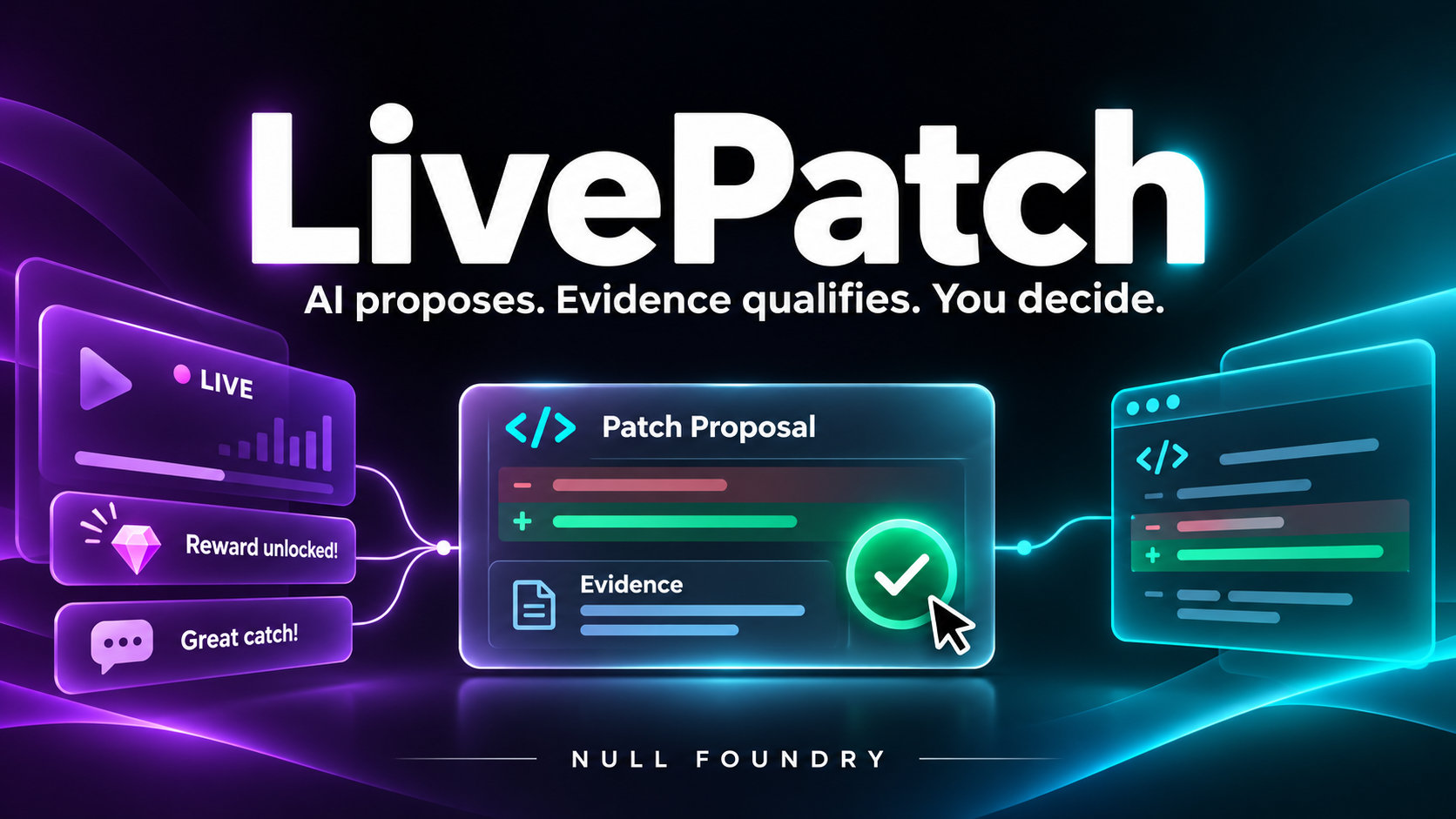
A redeemed Twitch reward is a promise to the audience. But receiving an event is not the same as knowing that the expected acknowledgement happened.
I built LivePatch around a second question: if AI suggests a correction, what evidence should be required before a creator trusts it?
My answer is simple: AI proposes. Evidence qualifies. The creator decides.
What it does
LivePatch is a local tool for observing Twitch Channel Point reward interactions, evaluating their acknowledgements, and reviewing bounded Codex-generated repair proposals.
It separates observation, proposal generation, qualification and approval. A model response cannot approve itself or silently become an active change.
The creator can:
- Observe real Twitch EventSub reward events and inspect pending, PASS, FAIL or INCONCLUSIVE results.
- Replay labelled offline fixtures without connecting a Twitch account.
- Explicitly request a bounded proposal through the local Codex CLI.
- Inspect a candidate and test it against the retained incident and negative controls.
- Keep approval and activation as separate decisions after qualification. LivePatch checks acknowledgement evidence. It does not fulfill rewards, control OBS or claim to repair arbitrary Twitch problems.
How I built it with Codex
I built the Python application with a local browser interface, Twitch EventSub integration, deterministic evaluation, retained evidence and a separate Codex proposal workflow. The source runtime uses Python’s standard library; the optional proposal lane uses an authenticated local Codex CLI.
Codex helped with implementation, debugging and regression coverage. The video includes a concrete development example: correcting a non-ASCII form-token defect and adding regression-test source.
Codex also produced a genuine repair proposal that I brought into LivePatch for qualification. That response remained an untrusted candidate until deterministic checks evaluated it.
What the demonstration proves
The live observation recording shows real Twitch reward events reaching LivePatch and an acknowledgement producing PASS. The creator-side Twitch recording and observation recording are separate sessions, clearly labelled in the video.
The repair demonstration uses a deliberately injected correlation fault in replay, not a naturally occurring Twitch failure. Against the retained case, the installed baseline failed and the proposed correction passed. Checks with varied identifiers also passed, while the missing-acknowledgement control still failed.
That distinction matters: a correction should fix the supported defect without weakening the rule that detects a missing acknowledgement.
The proposal shown was genuinely generated earlier. The video reviews the preserved response; it does not depict a new inference request. Creator approval and activation were not performed in this demonstration.
Challenges and lessons
The hardest part was preserving honest boundaries between states that can look similar: connected versus receiving events, pending versus complete, a proposal versus a qualified correction, and qualification versus permission to activate.
Event timing, correlation and recovery needed careful handling. Partial evidence must remain inconclusive rather than becoming a convenient success. The form-token defect also showed why small interface failures need regression coverage, not just a successful happy-path demo.
I learned that a useful AI workflow needs more than a persuasive answer. It needs a narrow scope, reproducible evidence, negative controls and a clear human decision point.
What I’m proud of
LivePatch connects real Twitch observation with a concrete Codex-assisted development and qualification workflow while making its limits visible. It is available as a runnable source release, not only a presentation.
What’s next
My next steps are to improve creator-facing explanations, broaden supported cases with evidence, and independently verify the approval and activation path before making stronger deployment claims.
Run it and inspect the source
Source code and instructions: https://github.com/Null007Void/livepatch
Downloadable release: https://github.com/Null007Void/livepatch/releases/tag/v1.0.0
Repository contents are released under the MIT License. The demo uses AI-generated narration. Third-party names and trademarks belong to their respective owners.
