-
-
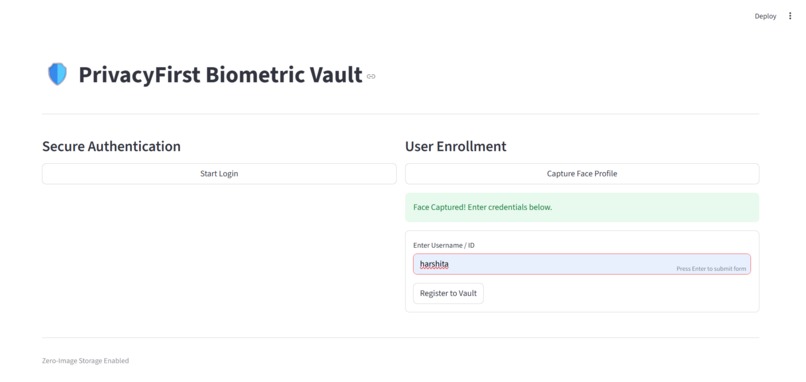
Registration pop-up
-
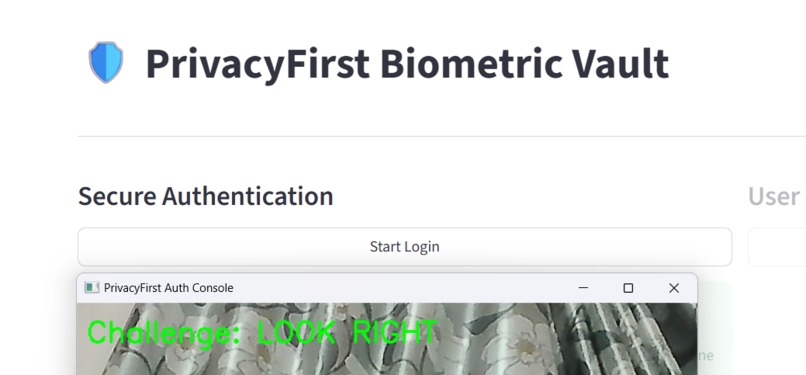
Secure Login Random Liveness challenge
-
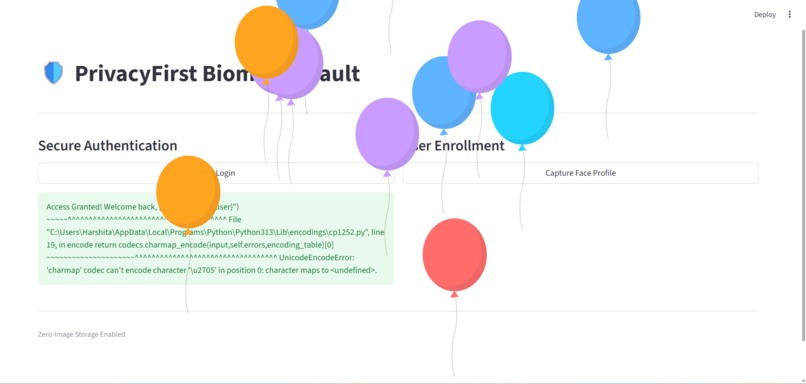
Successful Authentication of registered user
-
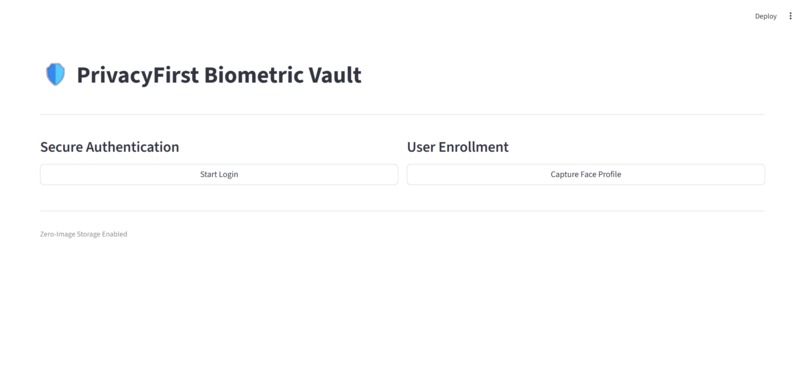
Basic UI


Inspiration
Traditional biometric systems store raw facial images, creating high-risk attack surfaces in the event of a database breach. We aimed to design a zero-image storage authentication system. Password-based systems remain vulnerable to brute-force attacks, phishing, and credential leaks. We explored secure password-less authentication using biometric embeddings. With the rise of AI surveillance systems, we wanted to build a privacy-preserving alternative that encrypts biometric data at rest.
What it does
- Extracts 128-dimensional facial embeddings using a deep metric learning model (ResNet-based architecture from face_recognition).
- Encrypts embeddings using salted symmetric encryption (Fernet) before storing them in an SQLite database.
- Implements real-time liveness detection using facial landmark geometry (head orientation + blink detection via Eye Aspect Ratio).
- Three types of random liveness detection tests have been implemented.
- Performs identity verification using Euclidean distance in high-dimensional embedding space.
How we built it
Captured live webcam frames using OpenCV and converted them into RGB format for embedding extraction. Represented each face as a vector:
𝐸 ∈ 𝑅^128
Implemented similarity matching using Euclidean distance:
$$d = \sqrt{\sum_{i=1}^{128}(x_i - y_i)^2}$$
Applied threshold-based decision logic for authentication. Secured stored embeddings using: 1. Salt concatenation 2. Fernet symmetric encryption 3. Local key-based decryption during verification Built an interactive dashboard using Streamlit for enrollment and authentication workflows.
Challenges we ran into
- Threshold calibration: Determining an optimal similarity threshold to minimize False Acceptance Rate (FAR) and False Rejection Rate (FRR).
- Process synchronization: Handling subprocess stdout/stderr communication between authentication scripts and the Streamlit UI.
- Environmental variance: Managing embedding fluctuations caused by lighting changes, camera noise, and slight facial pose variations.
- Liveness robustness: Ensuring blink detection and head movement verification were not falsely triggered.
Accomplishments that we're proud of
- We have successfully implemented a system for encrypted biometric storage without saving raw facial images to prevent data breaches to a good extent.
- Integrated computer vision, cryptography, database handling, and UI into a unified and working system.
- Developed a working anti-spoofing mechanism that combines geometric landmark analysis with dynamic challenges.
- Built a scalable prototype demonstrating secure password-less authentication.
What we learned
- We gained hands-on experience while working with high-dimensional face embeddings and understanding how similarity matching actually works in real-world biometric systems.
- Learned how facial landmark geometry can be used to detect blinks and head movement for real-time liveness verification.
- Understood why encryption, salting, and secure key management are critical when dealing with sensitive biometric data.
- Explored the balance between security and usability while tuning similarity thresholds to avoid false rejections and false acceptances.
- Debugged real-time AI workflows involving webcam input, subprocess handling, and integration between backend logic and the Streamlit interface.
What's next for LiveLock: Privacy-First Biometric Vault
Replace Euclidean distance with cosine similarity:
similarity=(𝑥⋅𝑦)/∥𝑥∥∥𝑦∥
Implement deep learning–based anti-spoofing models (CNN-based presentation attack detection). Deploy as a containerized web service with secure key management. Introduce multi-factor authentication and adaptive threshold tuning. Optimize for edge-device performance and real-time latency reduction.
