-
-
thumbnail
Inspiration
Personal health data accumulates across wearables (Oura Ring, Apple Watch, Whoop, et al.), training logs, habits, laboratory / bloodwork reports, and genomic files (e.g. 23andMe), but it rarely answers the question a person actually has: What appears to affect me, how uncertain is that signal, and what should I test next?
Many health products either display historical charts or generate confident AI recommendations. LiveForever is designed for serious self-trackers and biohackers who want evidence they can inspect, uncertainty they can see, and a safer next experiment, not another opaque score or medical-sounding conclusion.
What it does
LiveForever is a privacy-first personal evidence lab. It combines longitudinal wearable signals, daily habits, laboratory trends, and cautious genomic context to investigate one personal question at a time.
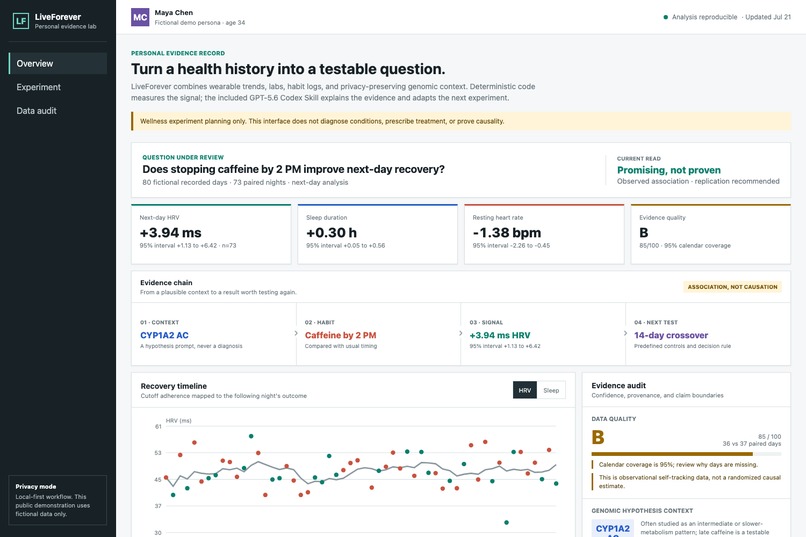
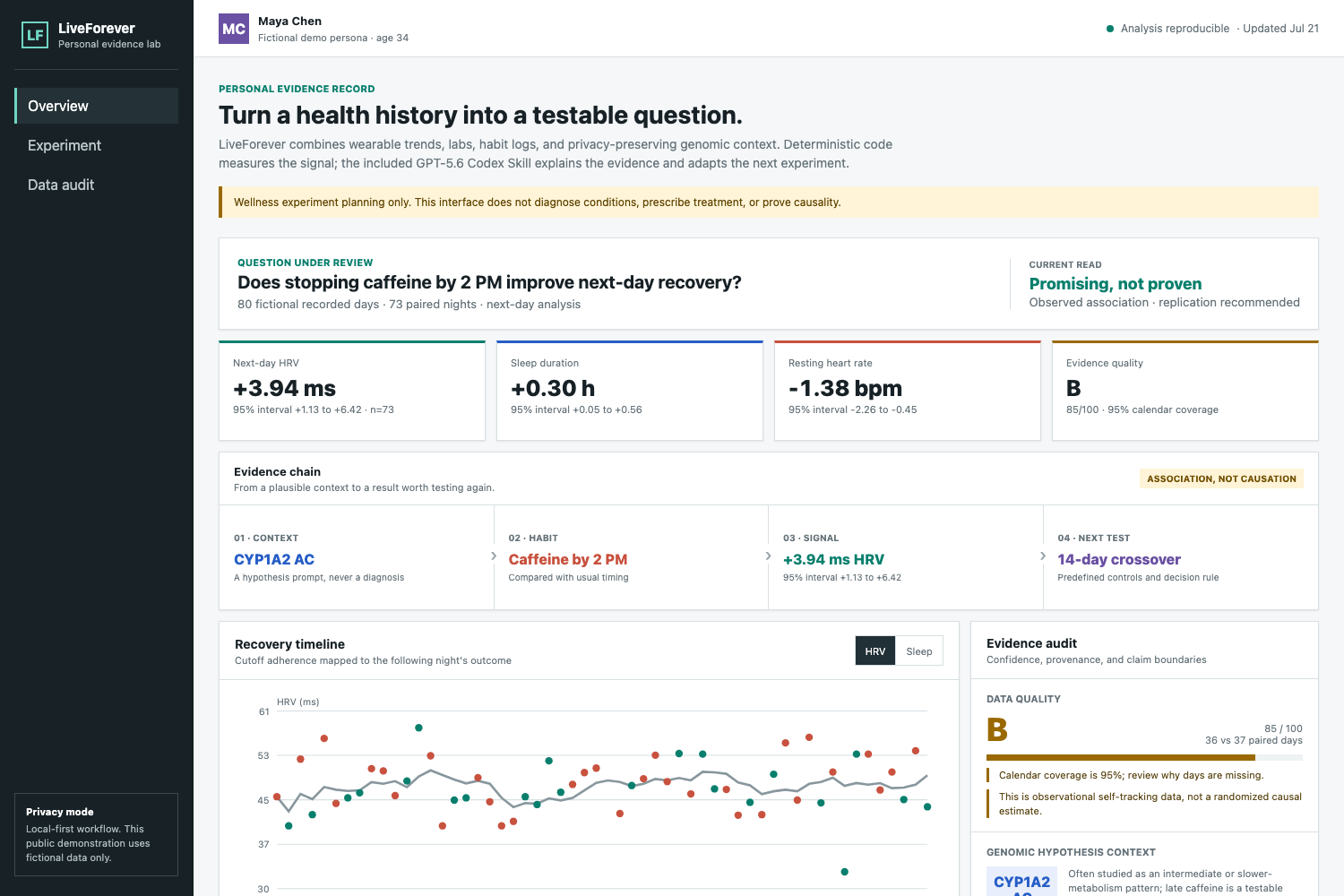
The public demonstration follows Maya Chen, a completely fictional user investigating whether stopping caffeine by 2 PM is associated with better next-day recovery.
LiveForever:
- Pairs each exposure day with the following night's outcome.
- Calculates effect sizes and 95% confidence intervals.
- Checks sample size, missingness, condition balance, and potential confounders.
- Produces a transparent evidence score and grade.
- Shows exactly which observations contributed to the result.
- Uses a synthetic CYP1A2 marker only as hypothesis context, not as a diagnosis or recommendation.
- Generates a balanced 14-day replication plan with a predefined decision rule.
- Lets GPT-5.6 explain the bounded evidence, identify blind spots, review relevant scientific context, and adapt the experiment to practical constraints.
All displayed health and genomic data are synthetic. LiveForever supports wellness evidence and experiment planning, not diagnosis or treatment.
How I built it
A private personal-health prototype existed before Build Week. During the submission period, I used Codex and GPT-5.6 to transform that starting point into a separate, public, synthetic-data evidence lab. The earlier private prototype, repo, and its personal data are not part of this submission.
The Build Week extension added:
- A new deterministic Python analysis engine.
- Lagged within-person exposure and outcome pairing.
- Seven-day moving-block bootstrap confidence intervals.
- Pearson correlations with Fisher-transformed intervals.
- Minimum-sample, missing-data, balance, and confounder checks.
- A deterministic evidence-quality score and grade.
- A published PhenoAge calculation with completeness enforcement.
- A genetics-to-hypothesis workflow with an explicit non-diagnostic boundary.
- A deterministic 14-day replication planner.
- A fictional longitudinal dataset and persona.
- A responsive public product interface generated from an immutable analysis contract.
- A reusable Codex Agent Skill for running the evidence workflow.
- Eleven automated tests covering the new analytical behavior.
Codex was the primary Build Week development environment. It helped inspect the earlier architecture without exposing private data, scope the public extension, design the model-versus-code boundary, implement and test the analysis engine, create the synthetic fixtures, build the interface, validate the Agent Skill, and prepare the submission.
GPT-5.6 operates through the included LiveForever Codex Skill. It frames tractable questions, reviews scientific sources, explains fixed analytical output, distinguishes observations from inferences, identifies alternative explanations, and adapts experiment plans. It is explicitly prohibited from changing calculated values, inventing health or genomic data, hiding uncertainty, converting association into causation, or presenting medical advice.
Challenges we ran into
The hardest product decision was determining what AI should reason about and what deterministic code must calculate. A model can synthesize a complicated health history, but it should not silently improvise statistics, confidence, or causality. LiveForever therefore gives GPT-5.6 the high-context work while code owns every displayed number, warning, interval, and evidence grade.
The second challenge was demonstrating a meaningful personal-health workflow without exposing sensitive information. The public repository uses a complete fictional persona and reproducible synthetic generator. Private wearable, laboratory, medication, genomic, and profile records remain outside the submission.
The final challenge was designing a complete experience around honest uncertainty. Weak evidence, missing observations, imbalanced conditions, and possible confounders are surfaced as product outputs rather than hidden as implementation details.
Accomplishments that I'm proud of
- Turned a broad longevity dashboard concept into an auditable personal evidence lab.
- Made uncertainty and null-result language first-class product features.
- Connected genomic context to longitudinal self-tracking without treating genotype as advice.
- Created a working public demo requiring no account, API key, or personal health data.
- Built a reusable Codex Agent Skill rather than only a static interface.
- Added a deterministic, tested analytical foundation beneath the AI interpretation layer.
- Documented exactly what existed before Build Week and what was built with Codex during the submission period.
- Preserved compatibility with the private baseline's 41 tests while passing all 11 tests for the new extension.
What I learned
The most useful role for an advanced model in personal health is not to sound certain. It is to help ask a better question, locate relevant evidence, explain an analysis honestly, surface what could be wrong, and propose the next bounded test.
The project also reinforced that AI systems become more trustworthy when their boundaries are visible. Separating deterministic calculation from probabilistic interpretation makes LiveForever both more useful and safer.
What's next for LiveForever
Next steps include user-selected confounders, multiple-comparison controls, interrupted time-series analysis, experiment preregistration, replication tracking, encrypted local profiles, source adapters for major wearable and lab formats, and clinician-exportable evidence summaries.
The long-term vision is a private personal evidence system that helps people learn from years of fragmented health history without pretending that self-tracking is medical diagnosis.

Log in or sign up for Devpost to join the conversation.