-
-
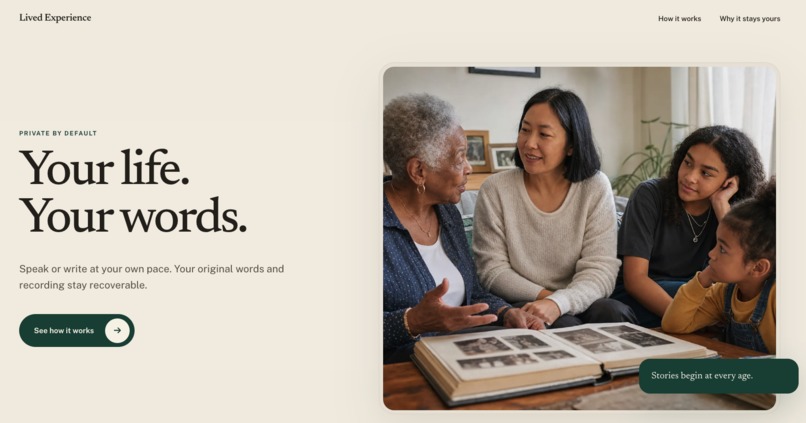
Easiest way to capture your stories and memories for your friends, family and the world
-
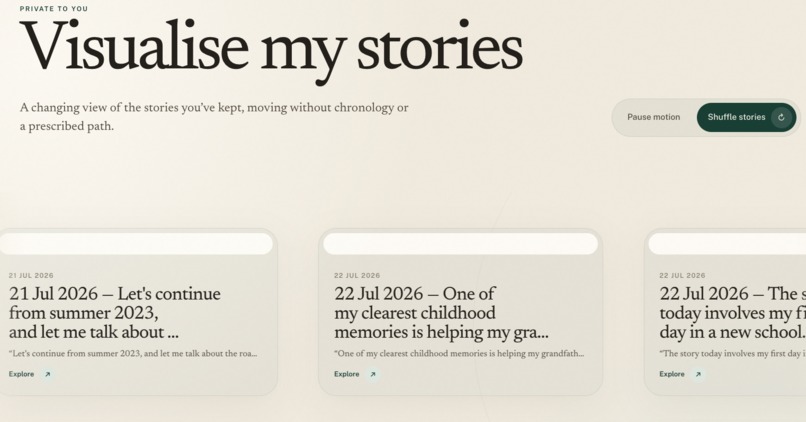
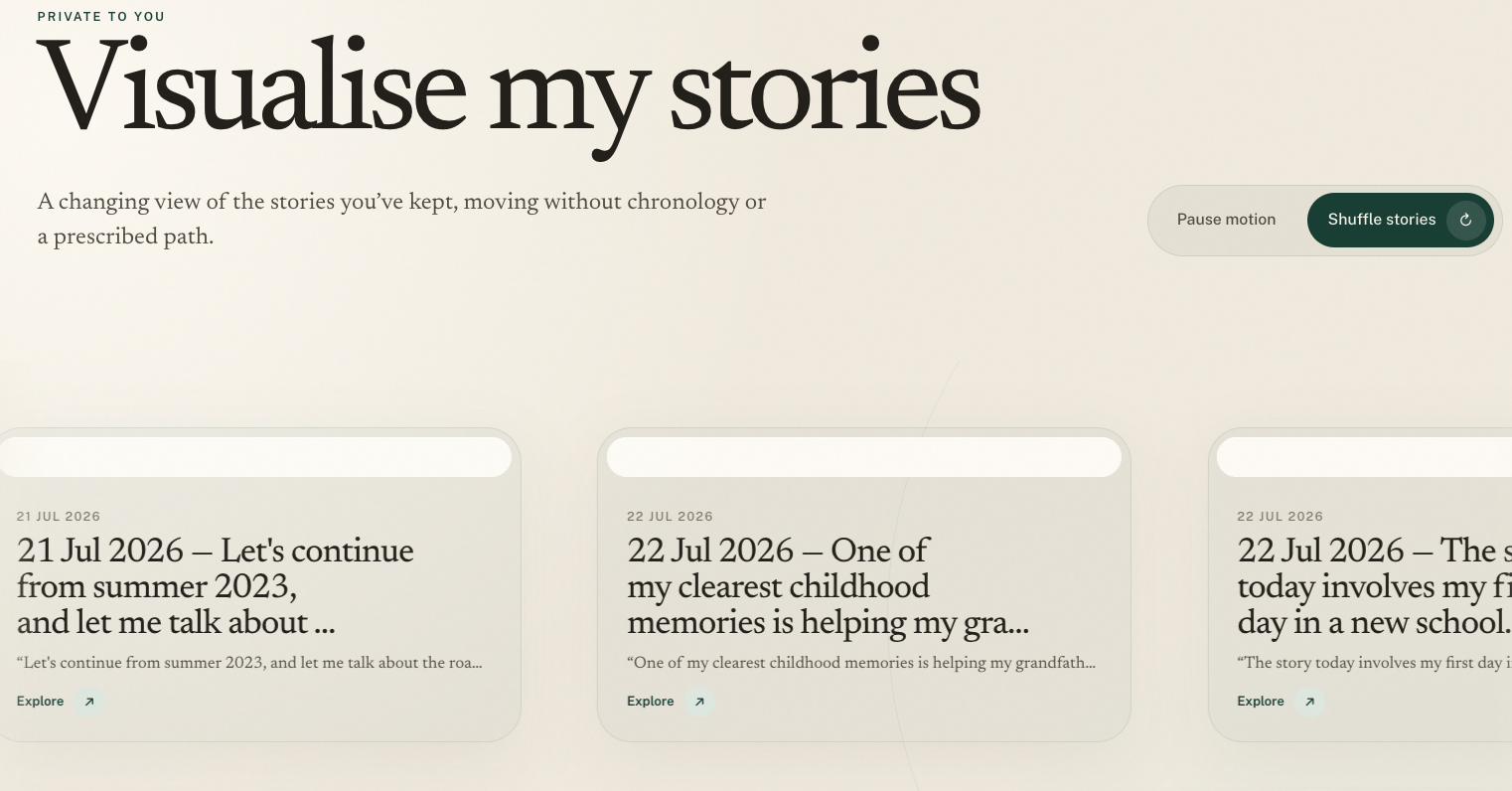
Visualise key moments in your life
-
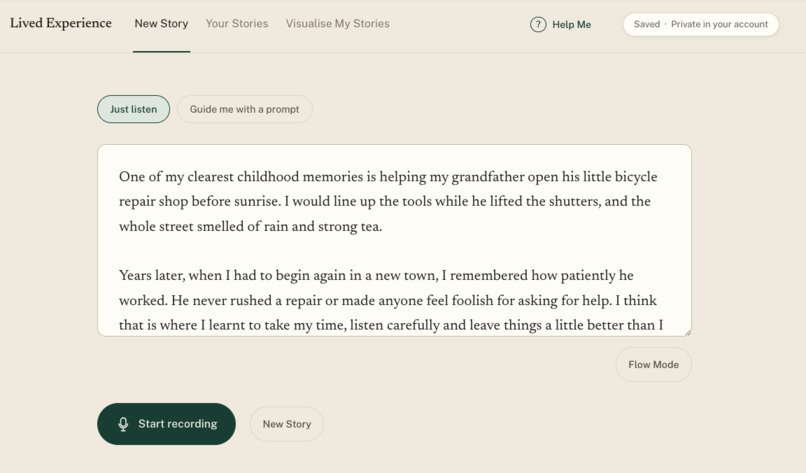
Interruption and distraction free voice and writing interface, assisted by AI
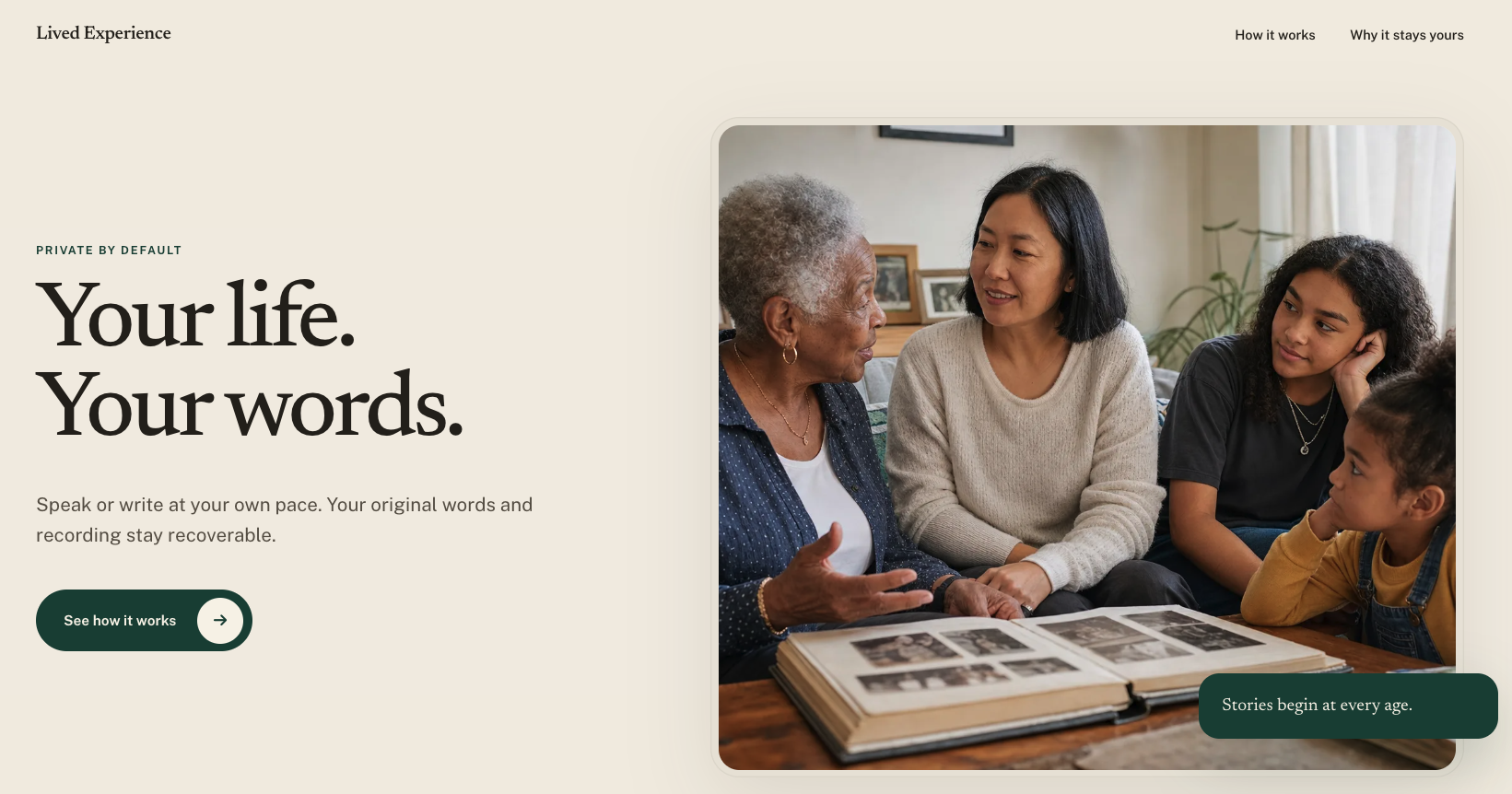
Lived Experience
Inspiration
We know what Steve Jobs built, what Nelson Mandela stood for and what Anne Frank experienced because their stories survived.
But history has a visibility problem. Countless meaningful lives go undocumented simply because the people who lived them were not famous, did not consider themselves writers or never had an easy way to begin.
Someone may be unknown to the world yet deeply important to a family, workplace or community. Their memories, struggles, humour, life’s work and wisdom are often preserved only through conversations and can disappear when those conversations are no longer possible.
I built Lived Experience to give every person a place to preserve their stories and memories, in their own words and voice, assisted by AI.
What it does
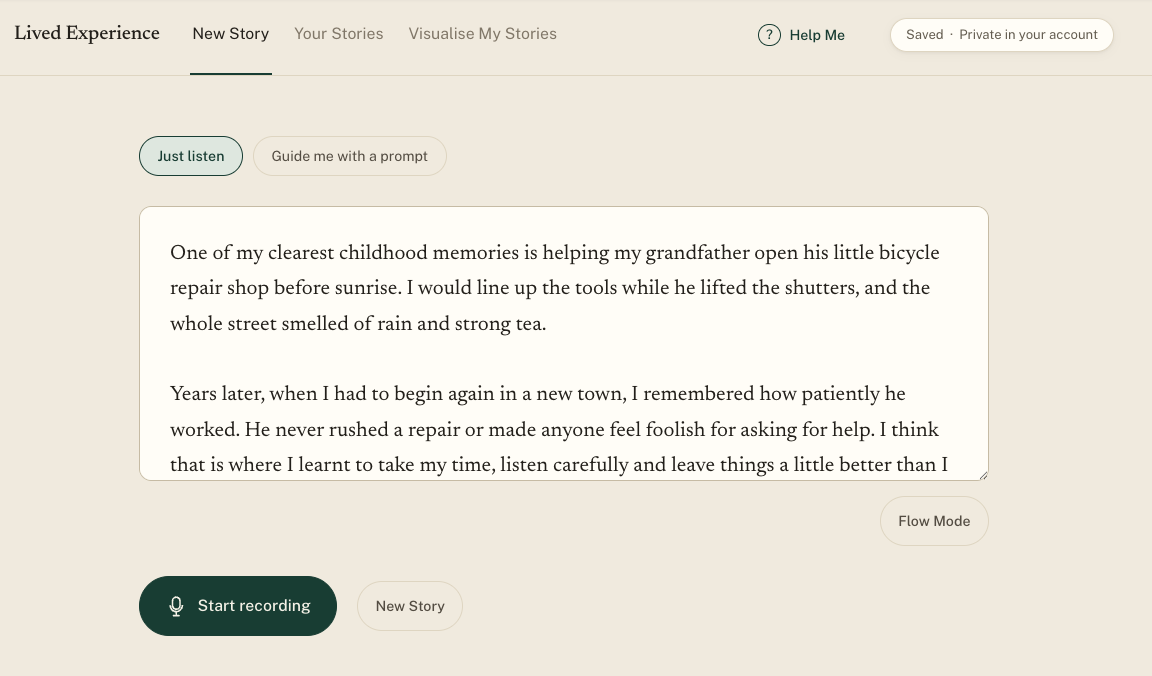
Lived Experience is a private, distraction-free platform for capturing personal stories and memories through voice or writing and for sharing with friends, family and the world.
An user opens directly onto a fresh canvas. There is no sign-up wall, questionnaire or pressure to organise their life into chapters. They can start typing immediately or record themselves speaking naturally.
The interface removes interruptions, when user decides when to stop, a readable transcript prepared and shown for review.
The transcript can add punctuation and paragraph breaks, but it does not remove repetitions, rewrite vocabulary or polish the person into someone they are not. The original audio and first transcript remain separate from later edits.
User stories are continuously saved on the device.
AI remains a guide and an assistant. User may request a prompt or guidance, AI jumps in to ask a question at a time and never takes control of the story. AI also shows prompt to navigate writers block.
How Codex and GPT-5.6 helped
Codex with GPT-5.6 was my primary product and engineering collaborator throughout Build Week. Also i used Codex to convert demo video from 5 mins to 3 mins, and removed filler words and silences without an external skill/plugin or MCP. I used most of recent product launches, Codex, GPT 5.6 Sol, ChatGPT Work to ideate and plan, OpenAI voice models to transcribe and more.
I used Codex to turn an idea into a detailed product specification, challenge assumptions, document architectural decisions, scaffold the application and translate principles such as “preserve the person’s voice” into testable code.
Codex accelerated implementation across the capture interface, browser recording, local persistence, race conditions, authentication boundaries, database locks and automated tests with Computer Use. GPT-5.6 helped to reason across product design, accessibility, privacy and engineering rather than treating them as separate concerns. Intelligently organise stories so user is not forced to narrate in a chronological order.
It caught subtle but important requirements: never create empty stories, never show Saved before persistence is acknowledged, make authentication migration safe to retry and keep personal story content out of routine logs and built double redundancies to ensure there is no data loss.
How I built it
I began with the smallest feature that could prove trust, immediate capture, recording, local storage and recovery, transcription reviews and safe account migration, with minimal interface. Engineering and AI usage are abstracted to behind the scenes.
The application uses Custom Agents, gpt-4o-mini-transcribe, gpt-5.6 (Sol, Luna), React, TypeScript, CF Durable Objects, PostgreSQL, IndexedDB and Vite. Browser recordings are divided into small chunks and stored in IndexedDB using Dexie, reducing the risk that a long recording is lost through a browser or network failure.
The data model separates original audio, the original transcript, the editable story and its version history. Supabase provides the authenticated data boundary, including row-level security and private audio storage, while a Cloudflare Worker provides a narrow server-side boundary for transcription and other protected operations. (Had a technical issue with ChatGPT Sites, reached out to support for resolution)
I also modelled capture and persistence separately. States such as Recording, Processing, Saved locally, Saving, Saved and Not yet synced prevent the interface from making promises the storage layer has not fulfilled.
Challenges and lessons
The hardest challenge was building AI that knows when not to act. AI assistant in Lived Experience creates value by remaining silent, mitigating uncertainty and jumps in to help when asked and silently does the heavy lifting in the background without interrupting the user. Given our expected user demographic, I designed UI to be minimal, AI interaction when asked or needed and giving timely assurance that their work is not lost. I started with 5 screens and reduced it to 1.
I also learned that save indicators are not decorative UI, they are promises. When the material may be irreplaceable, recovery and persistence matter as much as transcription quality.
Biggest lesson was, a great AI assistant is defined as much by its restraint, as by it's intelligence. I can't wait to see fathers, mothers, grand parents, brothers and sisters, just about anyone with a story to tell to use this platform and for the world to learn a thing or two from them.
Planned to add new features like interview mode, where AI gets into back and forth conversation just like a journalist or documentarian.
Thank you OpenAI team for a great product, models and timely resets.
Built With
- cf-durable-objects
- codex
- dexie
- gpt-4o-mini-transcribe
- gpt-5.6-sol
- indexeddb
- openai-api
- postgresql
- typescript
- vite
- vitest

Log in or sign up for Devpost to join the conversation.