-
-
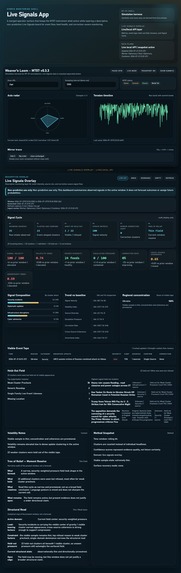
MT-07 Live Signals App
Inspiration
Most live-information dashboards show only what survived their filtering process.
They rarely show what was rejected, why it was rejected, whether the visible sample is too thin to support a broad conclusion, or how a later correction changed the reading. This can make information volume resemble certainty.
We began with a different question:
What if a monitoring instrument had to explain not only what it displayed, but also what it refused?
That question became Live Signals, a non-predictive, correction-aware situational monitor built from the Myth-Tech Delta / MT-07 experimental architecture.
Within that architecture, MT-07 represents The Vector: direction, movement, and commitment. In the application, this became a practical governing rule:
MT-07 does not merely extract signal from wording. It governs how wording is allowed to become visible signal.
The mythic language provides the memorable design vocabulary, while deterministic software contracts decide what actually appears on the board.
What Live Signals Does
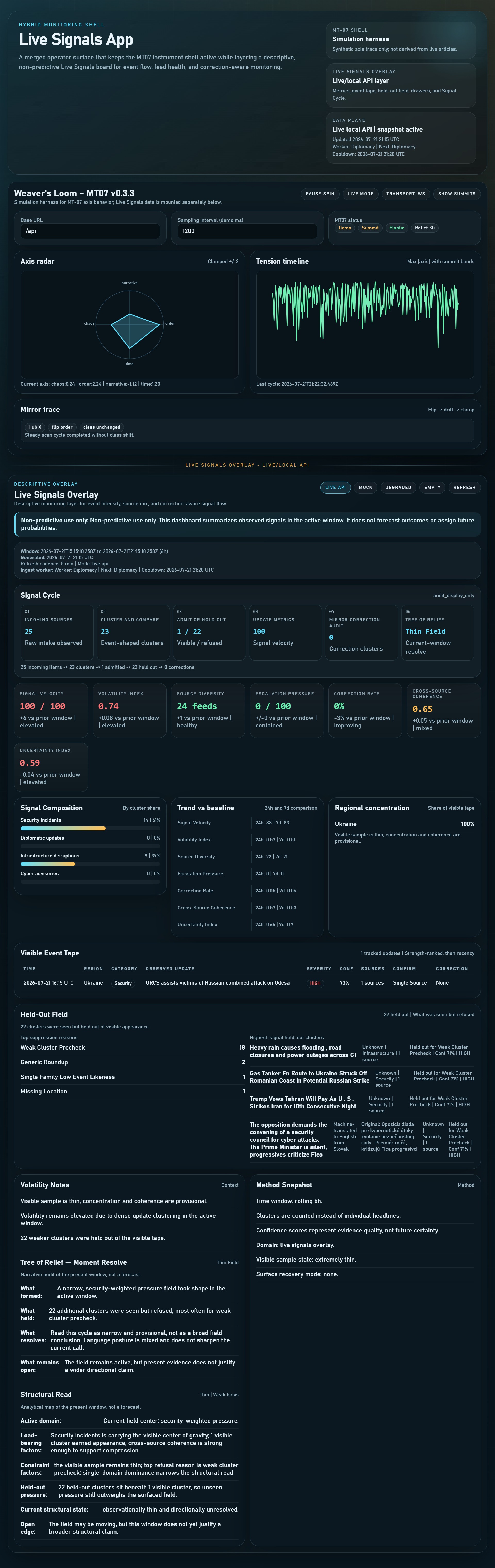
Live Signals processes incoming information through a six-stage Signal Cycle:
- Incoming sources
- Cluster and compare
- Admit or hold out
- Update metrics
- Mirror correction audit
- Tree of Relief
External feeds never write directly to the visible dashboard. Information first passes through normalization, incident formation, geographic interpretation, clustering, categorization, source-family comparison, field-authority checks, and visibility rules.
Clusters that pass those gates enter the Visible Event Tape.
Clusters that do not pass remain visible in the Held-Out Field, along with their confidence, source support, and suppression reasons. This means that absence from the primary tape does not mean disappearance from the system.
The application also produces descriptive metrics such as:
- Signal Velocity
- Volatility Index
- Source Diversity
- Escalation Pressure
- Correction Rate
- Cross-Source Coherence
- Uncertainty Index
Each metric has an explanation surface showing its definition, inputs, contributing evidence, and limitations.
The final Tree of Relief summarizes four things:
- What formed
- What held
- What resolves
- What remains open
It describes the present evidence window. It does not forecast the future.
How We Built It
Live Signals uses a static HTML/JavaScript interface with a Node/Express backend and SQLite persistence.
The backend supports a GDELT-first ingestion path, normalization and clustering services, source-family logic, translation-aware comparison, snapshot selection, held-out evidence, correction tracking, and metric explanation routes.
The upper MT-07 interface is clearly labeled as a synthetic simulation harness for axis behavior. The lower Live Signals interface is the live/local API data layer. Keeping those conditions visibly separate became an important part of the final product.
The application also includes Mock, Degraded, Empty, and Live API states so its behavior can be tested without depending entirely on current external feeds.
How We Used Codex and GPT-5.6
This project existed as an experimental MT-07 instrument before Build Week. During the submission period, it was meaningfully extended, hardened, tested, and prepared with Codex and GPT-5.6.
Codex accelerated the engineering work by helping us:
- Inspect the existing architecture and route boundaries
- Implement and refine the six-stage Signal Cycle
- Resolve differences between source code and the rendered application
- Separate simulated MT-07 behavior from live/local API data
- Add a deterministic correction demonstration
- Create regression tests and runtime verification
- Improve the README and judge quickstart
- Freeze, verify, commit, and push the submission build
GPT-5.6, working through Codex, supported the product-reasoning layer by helping us:
- Translate MT-07’s governing ideas into concrete software contracts
- Shape the non-predictive and correction-aware language
- Review held-out evidence and operator-authority boundaries
- Decide which features belonged in the Build Week freeze
- Preserve the distinction between explanation and prediction
GPT-5.6 is not used as a runtime forecasting engine. Visibility gates, correction logic, metrics, and held-out decisions remain deterministic and auditable.
Human-directed decisions preserved the central identity of the project: MT-07 governs the signal layer, refused evidence remains visible, and the Tree of Relief remains an explanatory audit rather than a future claim.
Challenges We Faced
The hardest problem was not displaying more information. It was deciding when information had earned visible appearance.
Live reporting is noisy, multilingual, repetitive, unevenly sourced, and frequently syndicated. Twenty articles may represent only one original report. We therefore had to distinguish source quantity from independent source families.
Thin samples created another challenge. A dashboard can always calculate a number, but that does not mean the number deserves strong interpretation. Live Signals marks concentration and coherence as provisional when the visible field is narrow.
We also needed to demonstrate correction behavior without manufacturing a correction in the authentic live field. The solution was a deterministic Mock fixture containing one clarified event and a 9% Correction Rate.
Finally, we had to preserve the unusual MT-07 identity while making the product understandable to someone encountering it for the first time.
What We Learned
We learned that uncertainty can be treated as a first-class output rather than an embarrassing limitation.
We also learned that rejected information can remain analytically valuable. The Held-Out Field helps reveal whether the visible surface is broad, narrow, over-concentrated, or resting above unresolved pressure.
Most importantly, explainability works best when it remains close to the number being explained. A metric drawer that exposes formulas, inputs, drivers, and caveats is more useful than a separate document claiming that the system is transparent.
Accomplishments We Are Proud Of
- A working no-credentials judge demonstration
- A visible six-stage Signal Cycle
- Correction-aware metrics and a deterministic correction fixture
- A Held-Out Field that preserves refused evidence
- Live, Mock, Degraded, and Empty operating states
- Metric-level explanation drawers
- Eleven passing regression tests
- A non-predictive contract maintained across the interface and backend
- A frozen Build Week commit:
34bc7b7
What Is Next
Future work could add stronger independent-origin analysis, additional bounded data connectors, historical correction replay, operator-selected regions and categories, and deeper source-lineage visualization.
The governing principle will remain unchanged:
The goal is not to predict what happens next. The goal is to show what the present evidence can honestly support now.
Live Signals is one instrument for the field—and one attempt to keep uncertainty visible rather than weaving it out.
Built With
- css3
- data
- express.js
- gdelt
- gpt-5.6
- html5
- javascript
- node.js
- openai-codex
- rest-api
- server-sent-events
- sqlite

Log in or sign up for Devpost to join the conversation.