-
-
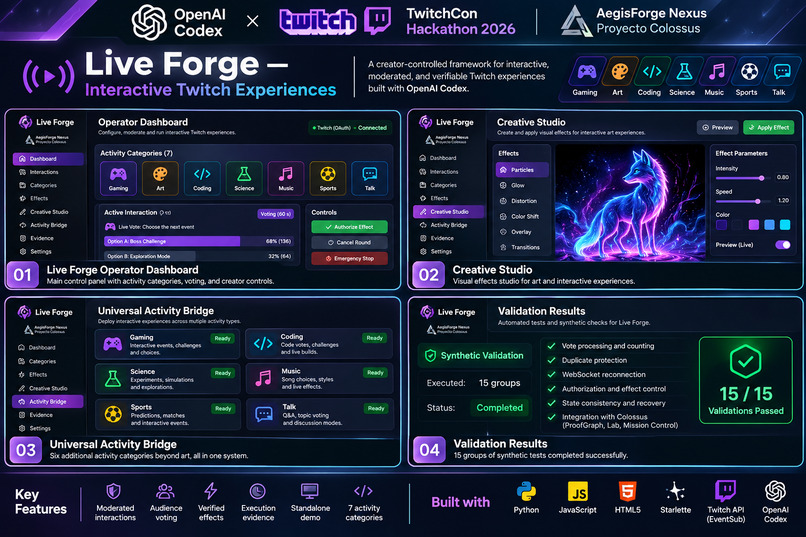
Live Forge concept art: creator controls, virtual effects, activity categories, and synthetic tests. Illustrative UI, not actual screenshot.
Inspiration
Live streams can become more engaging when viewers help shape interactive experiences. However, audience participation also introduces challenges: moderation, duplicate votes, unreliable connections, and the need for creators to retain control.
Live Forge was inspired by the idea of building a reusable, creator-controlled interaction system where community choices can influence virtual experiences without giving chat unrestricted access to the streamer's software.
What it does
Live Forge is an interactive experience framework designed for Twitch creators and their communities.
It supports seven activity categories: gaming, art, coding, science, music, sports, and talk.
Creators can configure approved interaction mechanics, open A/B voting rounds, review results, and explicitly authorize virtual effects.
Its main capabilities include:
- A local operator dashboard for configuring and supervising interactions.
- Twitch OAuth and EventSub integration for receiving authorized chat events.
- Vote validation, duplicate protection, and round management.
- An interactive overlay for displaying virtual effects.
- A Creative Studio for art-related experiences.
- A Universal Activity Bridge for six additional categories.
- Emergency-stop controls and auditable execution evidence.
- A standalone offline demonstration mode.
The system separates audience input from final operator approval, preventing chat messages from directly executing arbitrary commands.
How we built it
Live Forge was developed in Python, with a web interface built using HTML and JavaScript.
We used Starlette for the local application server, WebSockets for event delivery, and Twitch OAuth and EventSub for the optional authenticated chat integration.
OpenAI Codex CLI assisted with engineering work involving vote processing, reconnection handling, duplicate protection, authorization, effect dispatch, and evidence recording.
We also integrated Live Forge with existing components of AegisForge Nexus / Project Colossus, including its Laboratory, ProofGraph, and Mission Control infrastructure.
The implementation was designed to operate locally, without requiring a livestream for the standalone experience.
Challenges we ran into
One major challenge was designing interactions that remained predictable even when chat notifications were repeated or connections were interrupted.
Another was separating the voting result from the actual execution of an effect, ensuring that creators retained control over the experience.
We also needed to handle unavailable evidence storage safely and ensure that failed operations did not leave virtual activities in an inconsistent state.
Finally, we worked to distinguish synthetic testing from authenticated Twitch connectivity and actual audience participation.
Accomplishments that we're proud of
- Implemented seven supported activity categories.
- Developed a configurable and supervised voting workflow.
- Added duplicate-event protection and WebSocket reconnection handling.
- Built an interactive overlay, Creative Studio, and Universal Activity Bridge.
- Integrated verifiable evidence with Colossus infrastructure.
- Passed 15 groups of isolated synthetic validation checks.
- Observed an authenticated Twitch and EventSub connection status in the local application.
- Built a standalone demonstration that works without broadcasting.
Real Twitch chat votes have not yet been independently demonstrated. The completed synthetic validations are reported separately from live audience activity.
What we learned
We learned that building interactive experiences requires more than receiving messages and displaying effects.
Reliable systems need clear authorization boundaries, event validation, predictable state transitions, recoverable connections, and evidence that distinguishes simulated activity from real platform events.
We also gained practical experience using OpenAI Codex CLI as part of an iterative software engineering workflow.
What's next for Live Forge — Interactive Twitch Experiences
Our next priorities are to:
- Verify the complete installation process from a fresh repository clone.
- Complete an authorized end-to-end Twitch chat voting test.
- Expand the library of interactive activities and visual effects.
- Improve the creator dashboard and onboarding experience.
- Continue strengthening the integration with AegisForge Nexus.
Our long-term goal is to make Live Forge a reusable framework for creator-controlled, community-driven interactive experiences.
Built With
- 2.0
- api
- codex
- eventsub
- github
- html5
- httpx
- javascript
- oauth
- openai
- python
- starlette
- twitch
- websockets

Log in or sign up for Devpost to join the conversation.