-
-
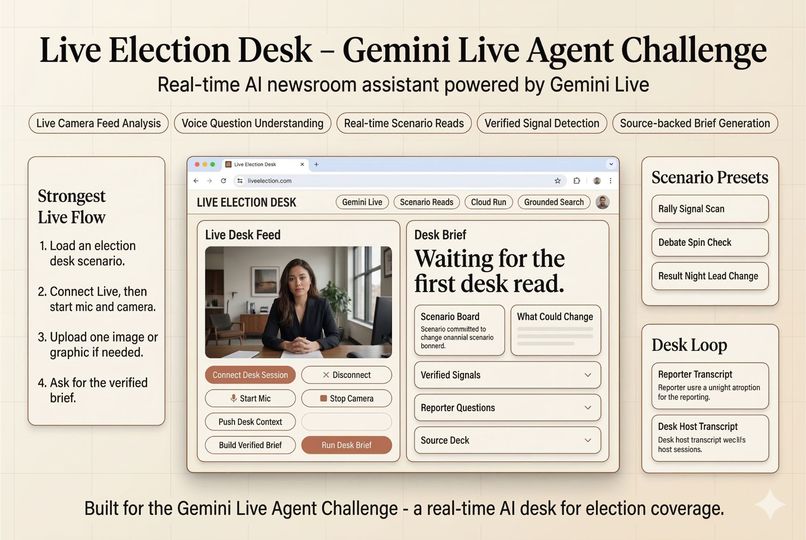
Overview of Live Election Desk, a Gemini Live multimodal assistant for real-time election reporting and verified brief generation.
-
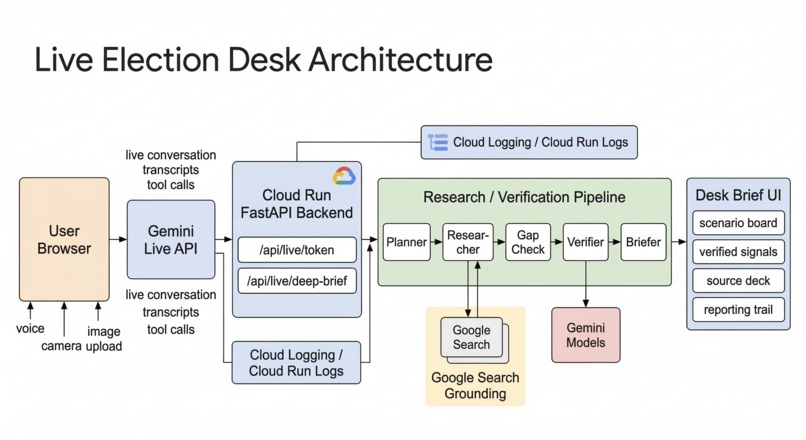
Live Election Desk architecture: Gemini Live, Cloud Run backend, grounded research, and verified briefing.
About the project Election coverage moves faster than verification.
A reporter in the field might be looking at a rally stage, a results board, a debate graphic, a candidate poster, or a breaking speech clip and needs to answer a simple question immediately: what is actually happening here, what matters, and what still needs to be verified before this goes on air?
That problem is what inspired Live Election Desk.
We wanted to build something that felt less like a chatbot and more like a real-time editorial desk: an agent that can see, hear, speak, and then escalate into deeper research when the user needs a source-backed answer. Instead of producing a generic wall of text, the goal was to create a live multimodal workflow that helps a reporter or researcher move from raw field context to a usable, grounded brief.
What it does Live Election Desk is a Gemini Live-powered election reporting assistant.
The user can:
speak a question naturally stream live microphone audio stream camera frames or upload a still image provide transcript context, region, and timeframe ask for a deeper verified brief when the live answer is not enough The system then responds in two layers:
Live layer Gemini Live handles the real-time multimodal interaction. It listens to the user, reasons over the visual context, and speaks back immediately.
Verified brief layer When the user asks for a deeper answer, the live host triggers a backend research pipeline that:
creates a reporting plan runs grounded search extracts structured evidence checks for missing evidence verifies contradictions and weak claims generates a concise desk brief with citations, scenarios, and follow-up reporting questions The result is a newsroom-style output:
a short anchor-ready brief verified signal cards scenario-based race reads a watchlist of what could change the read citations a visible reporting trail What inspired us A lot of “AI for news” tools still behave like document summarizers with a chat box attached. But real reporting is messier than that. It happens in motion. Reporters work with incomplete evidence, noisy visuals, partial quotes, live audio, and rapidly changing information.
We wanted to explore what a true live agent could look like in that environment.
The core idea was:
Can a live AI agent act like a calm election editor in your ear, while also being transparent enough to show its evidence, uncertainty, and reasoning trail?
That led us to a design principle for the whole project:
fast first response, deeper verification on demand
How we built it We built Live Election Desk as a full-stack Gemini Live application running on Google Cloud Run.
Frontend The frontend is a browser-based live desk interface that:
connects to Gemini Live using ephemeral tokens streams microphone audio streams camera frames supports image upload renders live transcripts shows the verified desk brief, scenario board, citations, and reporting trail Backend The backend is a FastAPI service deployed on Cloud Run. It provides:
health and analysis endpoints ephemeral token creation for Gemini Live sessions a deep-brief endpoint used by the live tool call flow logging that makes Cloud deployment and backend activity visible Agentic workflow The research pipeline is intentionally multi-stage rather than one-shot:
Planner agent decides what to investigate Research agent performs grounded search and evidence extraction Gap check detects where coverage is still thin Verifier agent filters weak, contradictory, or overconfident claims Briefer agent turns the result into a concise live-ready brief This structure helped us move from “LLM answer generation” to something more defensible and agentic.
Google technologies used Gemini Live API for real-time multimodal conversation Gemini models for planning, research, verification, and briefing Google Search grounding for current, attributed information Cloud Run for backend deployment Google Cloud IAM / service account setup for deployment and runtime access What we learned This project taught us that building a real live agent is very different from building a good prompt.
A few specific lessons stood out:
Multimodal UX matters more than expected. The hardest part is not just model integration. It is making the interaction feel live, coherent, and useful in a way that a judge or user understands immediately.
A strong agent needs a clear role. The product got much better once we stopped treating it like a generic political analysis system and defined it as a live election desk for reporters and researchers.
Verification has to be visible. In a sensitive domain like elections, confidence and uncertainty both need to be shown explicitly. That is why we added a reporting trail, citations, scenario reads, and “what could change” watchlists.
Live systems need graceful escalation. Real-time audio responses are great for speed, but deeper research needs a structured backend handoff. The combination of Gemini Live plus a planner/research/verifier/briefer flow ended up being the most useful pattern.
Cloud deployment is part of the product story. Making the backend cleanly deployable on Cloud Run, with logs that clearly show requests and tool calls, was important not just technically but also for submission readiness.
Challenges we faced
Turning a backend prototype into a real product We started with strong ideas around grounded analysis, but that alone was not enough. The bigger challenge was transforming those backend capabilities into a live experience that actually fits the hackathon’s standards.
Designing for a sensitive domain Election-related systems can easily drift into overclaiming, persuasion, or shallow forecasting. We had to keep the product neutral, evidence-first, and explicit about uncertainty. That pushed us toward scenario-based reads instead of deterministic winner predictions.
Live multimodal integration Streaming audio, handling camera frames, supporting image upload, and keeping the live session stable required careful coordination between frontend and backend. The orchestration between Gemini Live and the backend brief tool was one of the most technically demanding parts.
Deployment and IAM friction Getting a real Cloud Run deployment working cleanly involved dealing with environment loading, service accounts, API keys for ephemeral Live tokens, and Cloud Build / IAM permission issues. This was a very practical but important part of making the project submission-ready.
Making the output legible A lot of AI systems can produce analysis, but that does not mean the output is useful in a live reporting context. We spent time shaping the response into:
short spoken summaries verified signal cards scenario boards watchlists follow-up reporting questions That made the result feel much closer to a newsroom workflow.
Why this matters Live Election Desk is our attempt to show that a live agent can be both fast and responsible.
It does not just answer a question. It helps a user understand:
what is verified what is meaningful what is uncertain what should be checked next That is the kind of interaction we think live agents should enable, especially in high-noise, high-speed environments like election coverage.
What’s next If we continue building this, the next steps would be:
stronger multilingual support richer visual reasoning for charts and result boards better interruption handling in live conversations collaborative desk workflows for teams more robust source ranking and confidence scoring Live Election Desk is not just a reporting assistant. It is a prototype for how real-time, multimodal, verification-first agents can support serious information work.

Log in or sign up for Devpost to join the conversation.