Inspiration
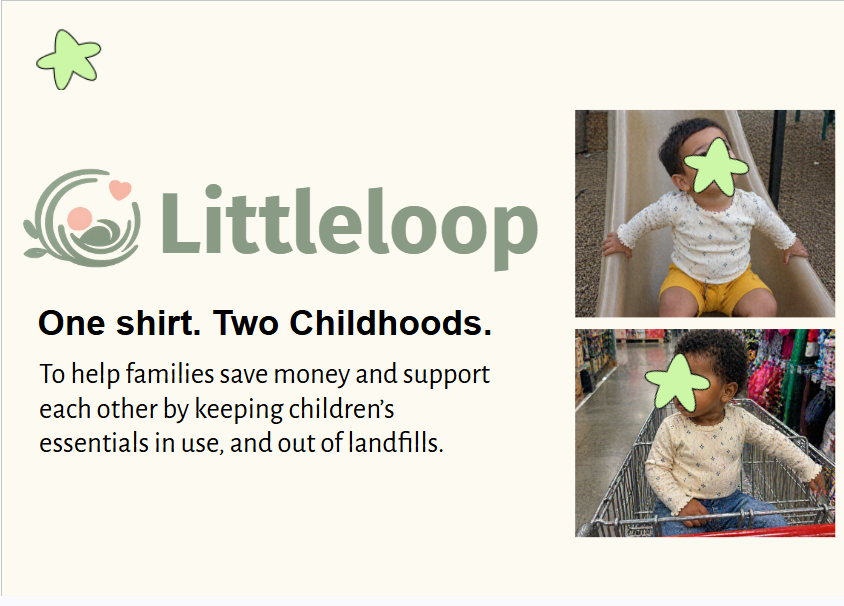
We were inspired by a real issue in our communities. Many families struggle to afford basic children’s essentials, while usable items are constantly being thrown away. This creates a clear gap between those who have resources and those who need them. We wanted to approach sustainability in a more human and practical way by focusing on a specific, overlooked problem. Littleloop is our way of reducing waste while directly supporting families through community connection.
What problem we are solving
Children outgrow items quickly, which leads to massive textile waste and constant repurchasing. Many families cannot keep up financially, while others have unused items with no easy way to pass them on. This disconnect creates both environmental and social challenges.
What is our solution
Littleloop is a platform that connects local families to share and reuse children’s essentials. It makes it easy for donors to give and caregivers to find what they need in a simple, accessible way.
What sets our solution apart from others
Our platform combines sustainability, community, and AI. Using Gemma 4, we verify donation items through image analysis and provide personalized recommendations to caregivers, creating a smarter and more supportive experience.
Impact we have
We reduce textile waste, lower demand for new production, and make essential items more accessible. At the same time, we help build stronger, more supportive local communities.
What it does
Littleloop is designed to be simple, intuitive, and personalized. When signing up, users choose whether they are a caregiver, donor, or both. Caregivers complete onboarding by sharing their situation, such as pregnancy stage or their child’s age, along with what they need. Donors enter their location and contact information, then access a dashboard where they can upload photos of items they want to donate. Our AI analyzes the uploaded images to verify they are appropriate for donation. Caregivers receive personalized recommendations based on their needs, along with suggestions for items they may not have thought of yet. The platform supports flexible use, allowing users to both give and receive.
How we built it
We used the MERN stack to build a full-stack and scalable application. We integrated Gemma 4 to power both image analysis and personalized recommendations. We designed the full experience in Figma first, focusing on usability and clear user flows, then translated that into a clean and responsive interface.
Challenges we ran into
One challenge was making sure our AI features were both useful and realistic within a limited timeframe. We also had to carefully design user flows that worked for different types of users without making the experience confusing. Balancing functionality with simplicity was a key focus.
Accomplishments that we're proud of
- Built an AI-powered system that does both image analysis and recommendations: AI helps analyze uploaded donation items and also suggests the most relevant items for caregivers based on their needs
- Designed and implemented a full user-centered experience from Figma to code: the entire flow was thoughtfully planned in Figma and mindfully built to make the experience clear, intuitive, and helpful for both caregivers and donors
What we learned
We learned how to design with real users in mind and how important clear UX decisions are for accessibility. We also gained experience integrating AI into a product in a meaningful way. This project helped us understand how to balance technical complexity with usability.
What's next for Littleloop
Next, we want to improve our recommendation system and make matching between users even more accurate. We also plan to add coordination/partnerships with local organizations to expand our impact. Long term, we want to grow Littleloop into a trusted platform that supports families while significantly reducing waste.


Log in or sign up for Devpost to join the conversation.