Inspiration
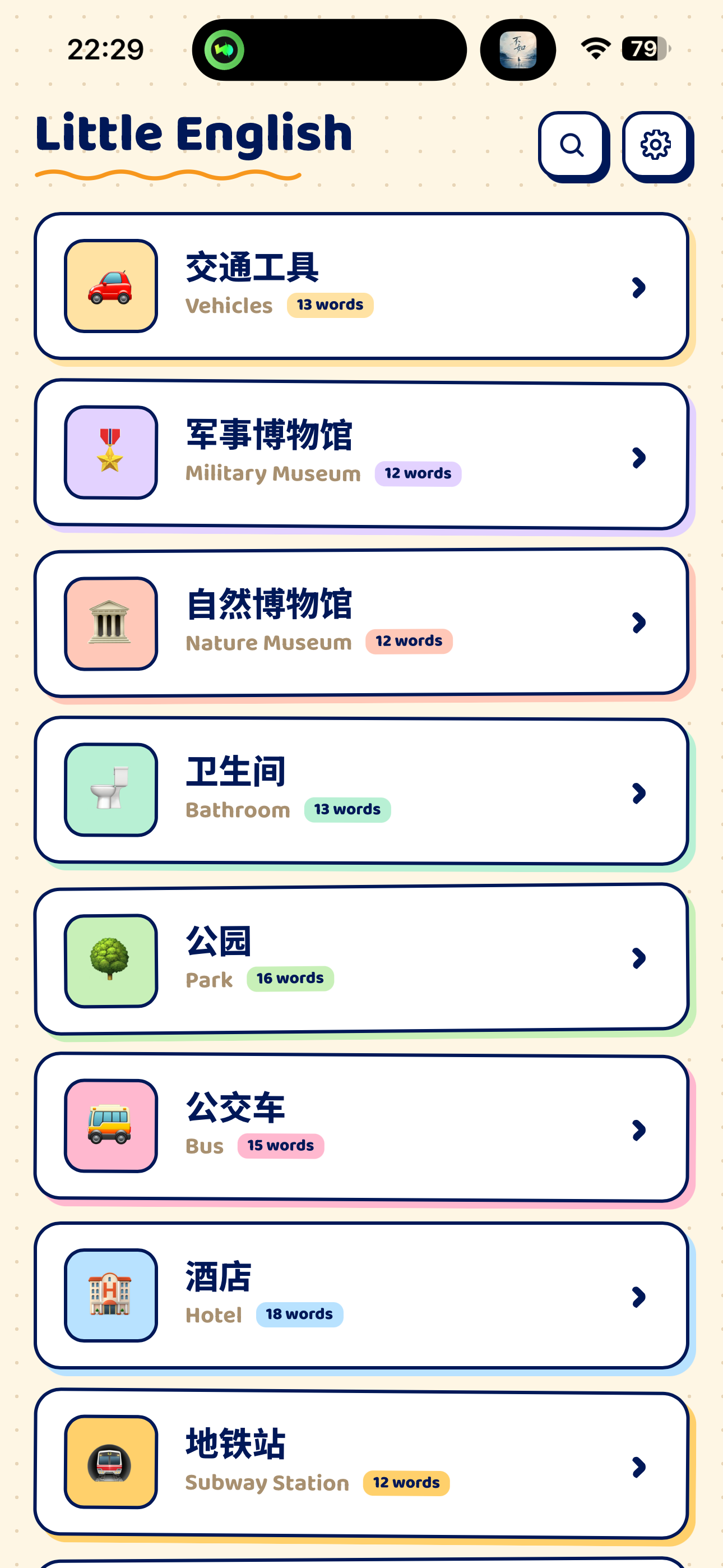
Young children do not learn language from word lists—they learn by connecting sounds and meaning to the world around them. I wanted to make that experience feel playful and immediate for families who speak Chinese at home: open a familiar scene, tap an object, see a friendly image, hear the word, and practice a sentence.
What it does
Little English is a scene-based language playground for young learners. Children explore places such as a kitchen, zoo, playground, and museum. Every concept includes a vivid visual, a target word, a short age-appropriate sentence, and tap-to-hear pronunciation. The interface supports Chinese, English, and Japanese, works on the web, and is packaged for iOS and Android.
The app is designed for safe, low-friction use: no child account is required, content can fall back to an offline bundle, and newly approved lessons sync from the server when a connection is available.
How we built it
The learner experience is a lightweight HTML, CSS, and JavaScript app wrapped with Capacitor for mobile. A content-review workflow separates drafts from published lessons, validates required images and audio, and serves approved content through a Vercel API. Cloudflare R2 stores the visual and audio assets with canonical, cache-safe URLs.
I used Codex with GPT-5.6 as an engineering partner throughout the Build Week iteration. It helped me reason across the web, iOS, Android, API, and storage layers; turn product intent into implementation plans; audit multilingual content; debug packaging and caching issues; and build repeatable publishing and asset-normalization workflows. The model was especially useful for tracing failures across multiple systems and converting one-off fixes into maintainable tools.
Challenges
The hardest part was making a content-rich children's app reliable across browsers and packaged mobile builds. Audio had to work online and offline, remote updates had to avoid stale caches, and the same lesson data needed to stay consistent in three languages. Mobile packaging also introduced a subtle production-base-URL issue: a build could work locally but fail to fetch newly published scenes after installation.
We solved this with a layered fallback strategy, canonical asset keys, explicit release configuration, review-time validation, and a single maintained normalization path for audio.
Accomplishments
- A working, responsive product children can use immediately
- Web, iOS, and Android delivery from one codebase
- Trilingual words, sentences, and pronunciation
- Server-synced content with offline fallback
- A review-and-publish workflow for safely adding new lessons
- A production asset pipeline backed by Cloudflare R2
What we learned
AI-assisted development is most valuable when it improves the system, not just the speed of typing. Codex and GPT-5.6 helped expose hidden assumptions, document operational knowledge, and turn fragile manual steps into verifiable workflows.
What's next
Next I want to add adaptive review, parent-visible progress, more real-world scenes, and guided speaking practice—while preserving the simple, private, child-friendly experience.
Built With
- gpt-5.6

Log in or sign up for Devpost to join the conversation.