Inspiration
Research becomes difficult after the papers have already been collected. Students and professors often have PDFs, notes and possible ideas, but no trustworthy way to see what the selected corpus actually supports, what is missing, or whether a proposed direction is genuinely distinct from the evidence already reviewed.
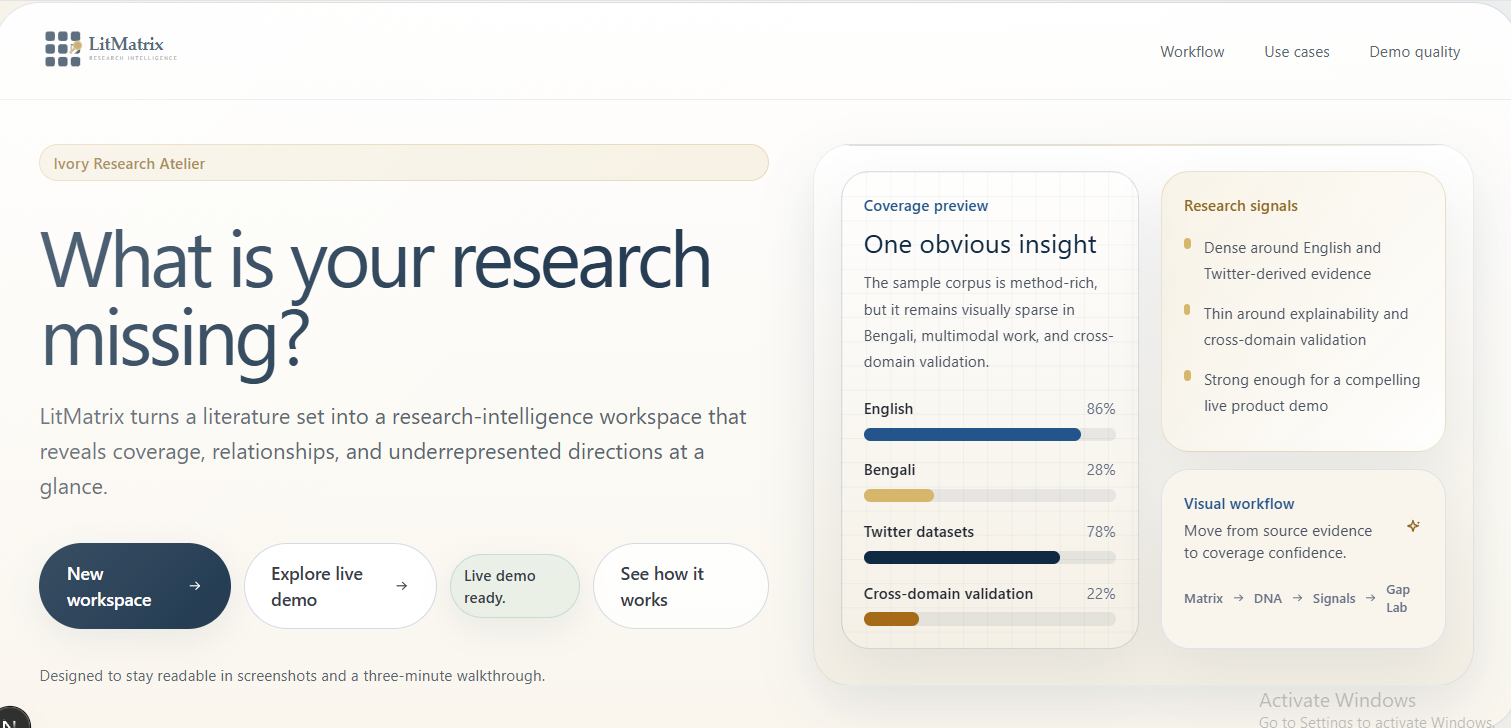
LitMatrix was built as a research-decision workspace for that stage. It does not claim to discover a global research gap. Instead, it helps a researcher identify potential blind spots within their uploaded corpus and make more defensible next-step decisions.
What it does
LitMatrix turns a selected research corpus into an auditable workspace:
- Uploads and processes research PDFs into page-linked evidence.
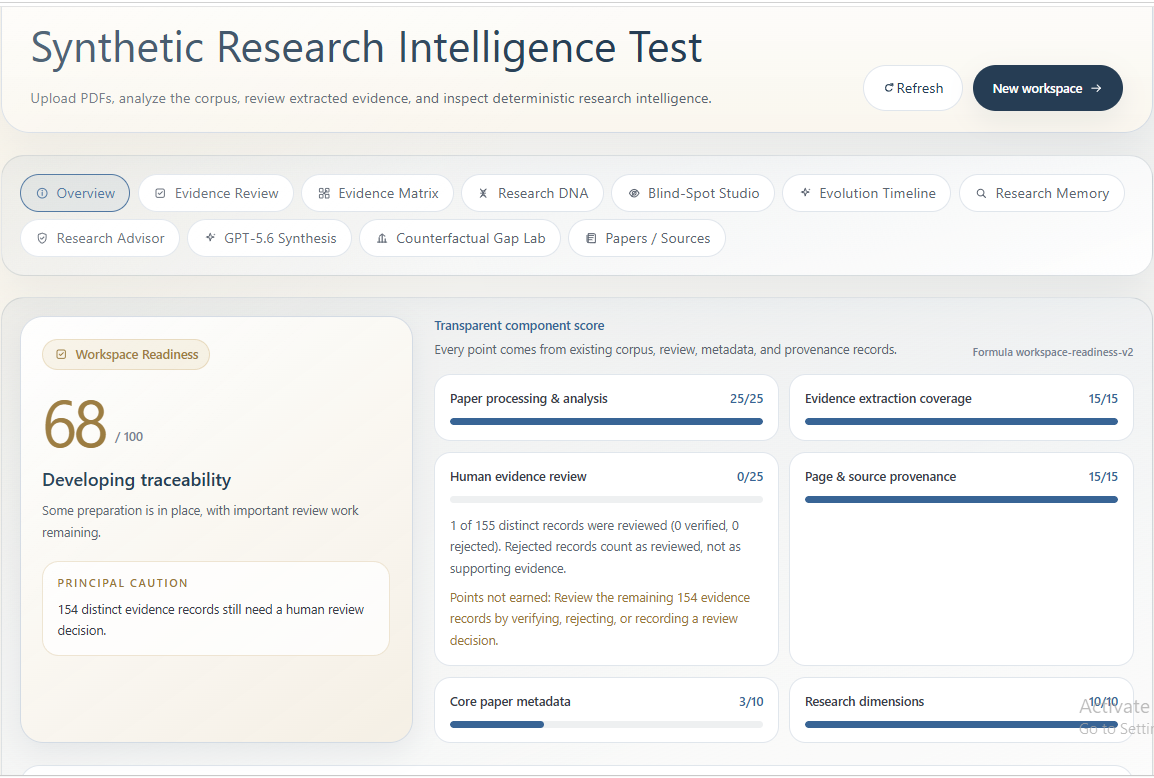
- Keeps evidence tied to source pages and supports human review states.
- Compares paper contributions through an Evidence Matrix.
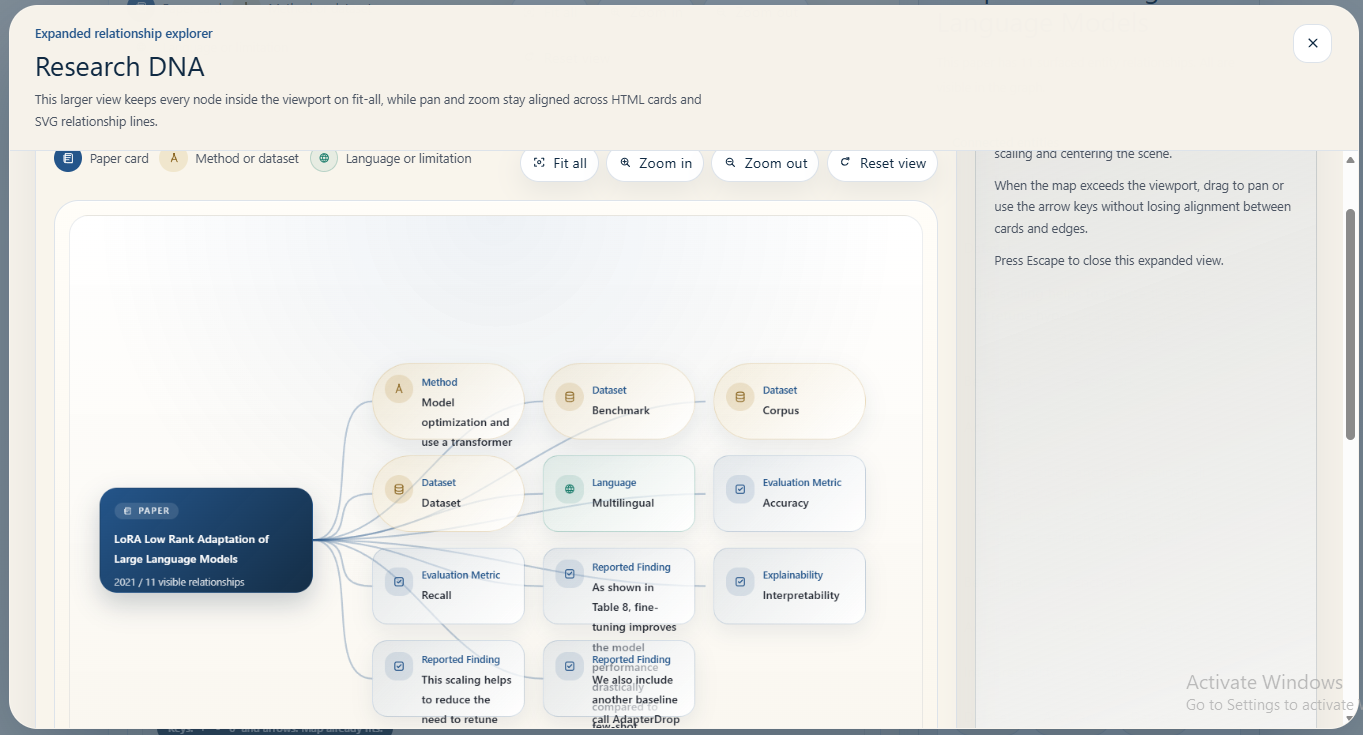
- Maps concepts, methods and relationships in a Research DNA graph.
- Shows research readiness and evidence coverage.
- Identifies potential corpus-level blind spots.
- Lets researchers use Gap Lab to compare and stress-test a proposed direction against existing evidence.
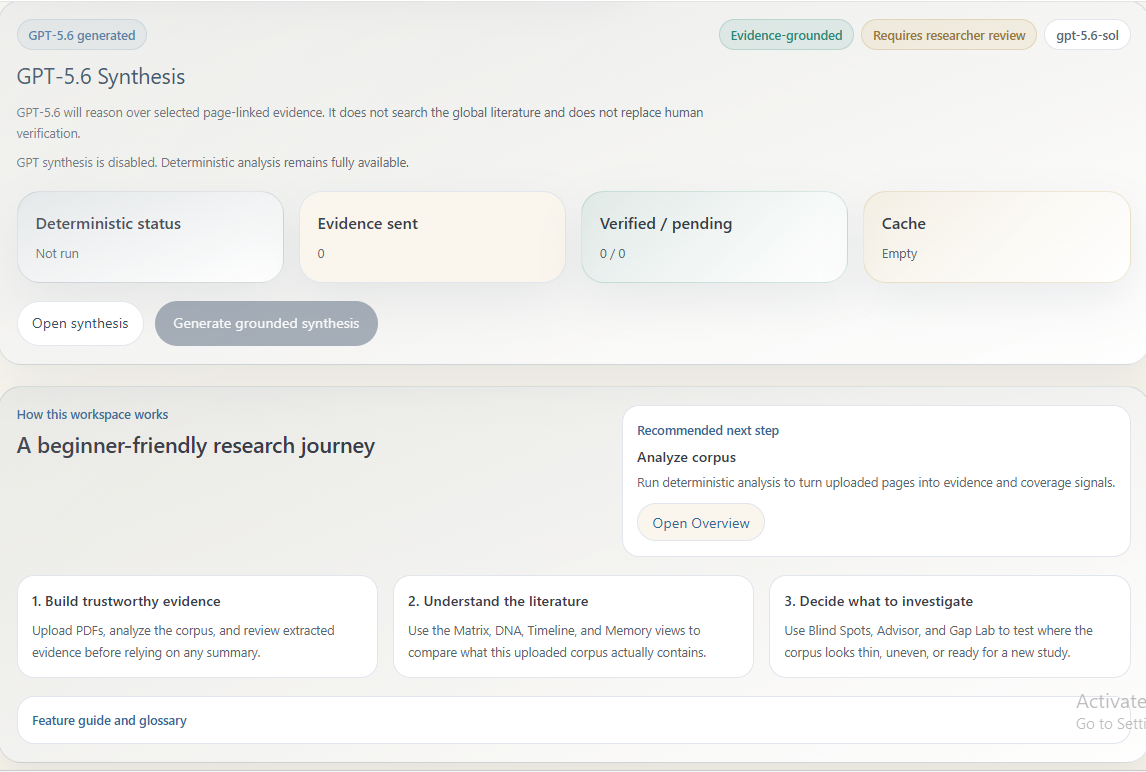
- Provides optional grounded GPT synthesis using bounded, verified evidence IDs and cited outputs.
The goal is not to replace researchers or declare novelty. The goal is to help them remember, connect and challenge the evidence they selected.
How we built it
LitMatrix is a full-stack monorepo built with Next.js, TypeScript, Python and FastAPI. The backend manages workspaces, papers, page records, evidence, entities and their links. PDF processing uses PyMuPDF, while SQLAlchemy and Alembic provide the data and migration layer.
The core Evidence Matrix, Research DNA graph, readiness scoring, gap signals and proposal comparison are deterministic. GPT-5.6 is optional: it produces synthesis only from bounded evidence records and must return valid citations.
Codex and GPT-5.6 Sol supported the project throughout architecture, implementation, testing, security review and release hardening.
Challenges we ran into
The hardest challenge was trust. A useful research system cannot turn every extracted sentence into “truth,” and it cannot claim a corpus represents the entire field.
We addressed that by preserving page-level provenance, separating extracted evidence from human-approved evidence, scoping gap signals to the selected corpus, validating grounded-synthesis citations, and testing workspace isolation so one workspace cannot access another workspace’s evidence.
We also kept the product useful without an API key. The research organization and deterministic decision-support features remain available even when optional GPT synthesis is disabled.
What we learned
We learned that the most valuable research AI is not simply a paper chatbot. It needs to make its evidence visible, preserve uncertainty, keep human judgment in control and be honest about the boundaries of its corpus.
LitMatrix is not another PDF chatbot. It is a research decision workspace that remembers, connects and challenges the evidence you chose.
Built With
- alembic
- codex
- fastapi
- gpt-5.6-sol
- next.js
- pymupdf
- python
- react
- sqlalchemy
- sqlite
- typescript

Log in or sign up for Devpost to join the conversation.