-
-
About
-
Gemini Use
-
Result
-
Result
PROJECT BRIEF: LITIGATION INTELLIGENCE ENGINE (LIE)
1. Application Overview
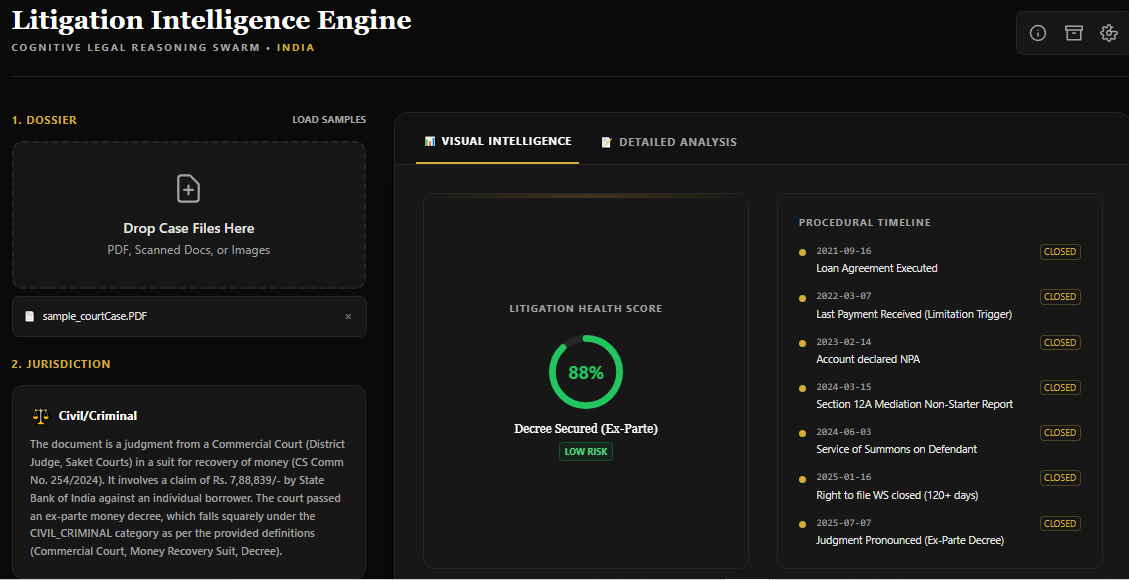
The Litigation Intelligence Engine (LIE) is a professional-grade cognitive reasoning platform designed to augment the thinking process of legal professionals. Unlike standard AI tools that focus on "Summarization" or "Drafting," LIE acts as a "Cognitive Auditor." It ingests complex case dossiers (loan agreements, court orders, pleadings, and evidence) and applies a Swarm Intelligence architecture to identify procedural fragility, strategic drift, and judicial pressure points.
2. Gemini 3 API: Proof of Concept (PoC)
This application serves as a cutting-edge PoC for the "Action Era" of Generative AI, specifically leveraging the native capabilities of the Google Gemini 3 API.
Key Gemini 3 Features Utilized:
- Multimodal Native Reasoning: Direct ingestion of raw, multi-page PDFs and scanned images (OCR-free) using
inlineData. - Structured JSON Artifacts: Using
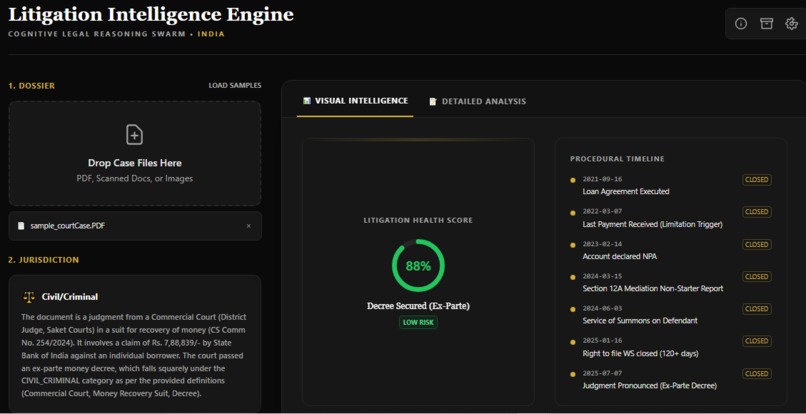
responseSchemaandresponseMimeType: "application/json"to drive visual UI components (Health Gauges/Timelines) alongside reasoning. - Long-Context Triangulation: Utilizing the 1M+ token window to correlate inconsistencies across hundreds of pages of conflicting documents.
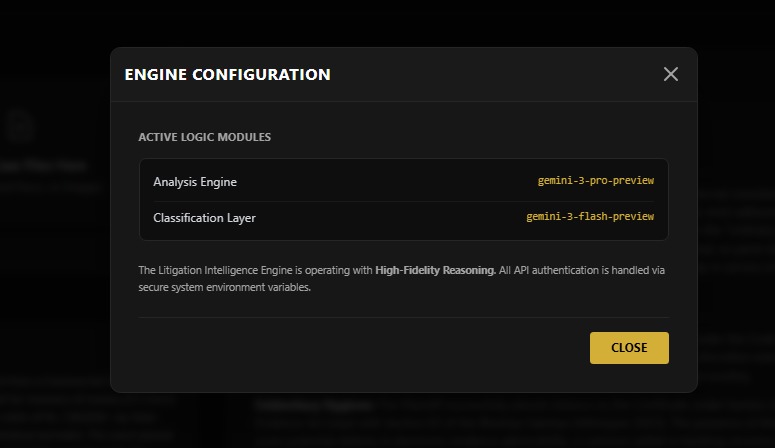
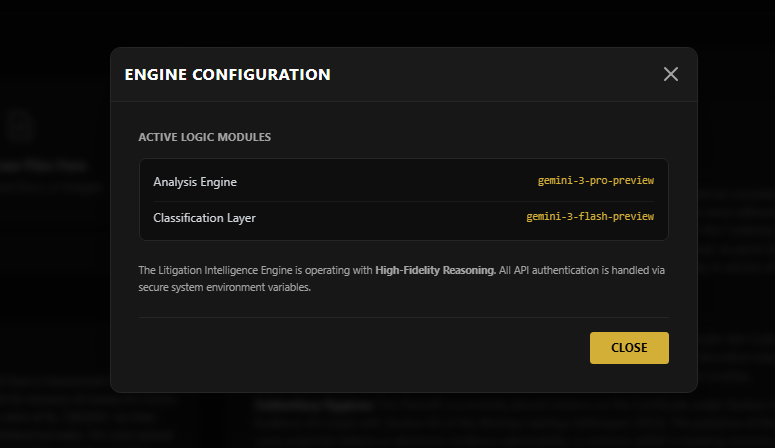
- Dual-Model Orchestration:
- Gemini 3 Flash: Rapid-fire auto-classification of document jurisdiction.
- Gemini 3 Pro: Deep-reasoning for adversarial simulation and complex legal logic.
- Advanced System Instructions: Enforcing strict declarative constraints to ensure the system reasons about law without providing prohibited "Legal Advice."
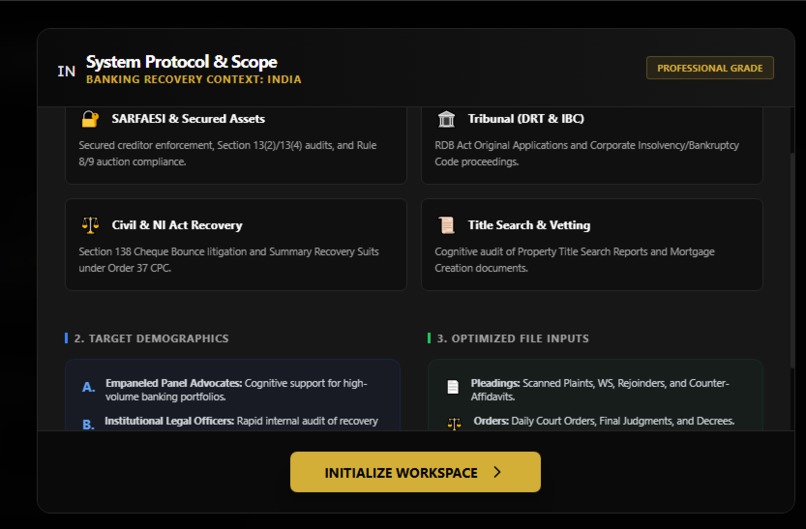
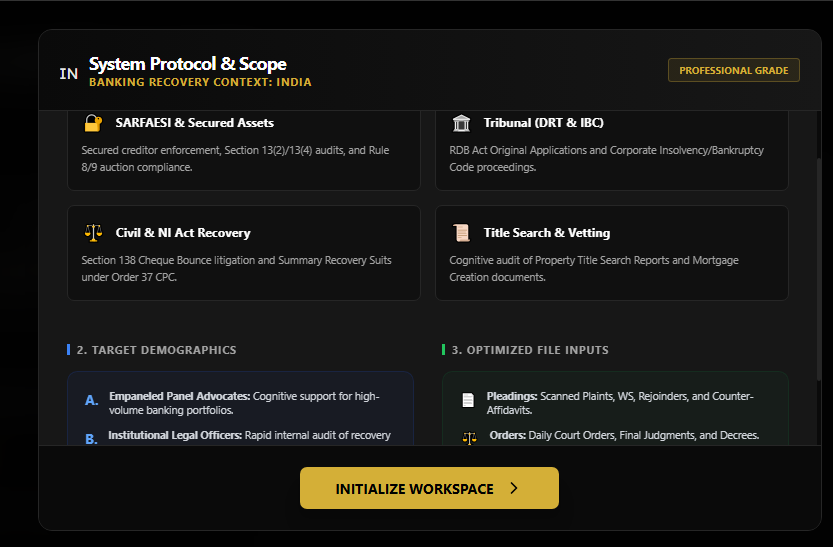
## 3. Jurisdiction, Laws, and Target Profession - Primary Focus: India (Phase 1).
- Core Statutes: SARFAESI Act 2002, IBC 2016, CPC 1908, Negotiable Instruments Act 1881, and RDB Act 1993.
- Target Profession: Empaneled Bank Advocates, Recovery Officers, In-house Legal Teams, and Commercial Litigators.
- Future Scope: Future updates are architected to include Global Common Law jurisdictions (UK, Singapore, UAE, USA).
## 4. The Brain: Intelligence Modules
### I. Litigation Logic (Pre-Judgment) - Procedural Posture: Maps the exact stage of litigation and identifies rights that are procedurally "closed" or forfeited.
- Hidden Assumptions: Uncovers facts treated as "truth" by the court simply due to a lack of specific rebuttal by counsel.
- Adversarial Simulator: Performs counterfactual reasoning by simulating aggressive Plaintiff vs. technical Defendant perspectives.
- Relief & Interest Logic: Analyzes how judges exercise discretion over monetary awards and penal interest rates.
- Compliance Auditor: Performs a "hard-audit" on Section 12A (Mediation), Pecuniary Jurisdiction, and Pre-institution compliance.
- Drafting Red-Team: Critiques pleadings from the perspective of an opposing counsel to find logic holes.
- Cross-Doc Logic: Triangulates inconsistencies between a party's pleadings and their own filed exhibits/annexures.
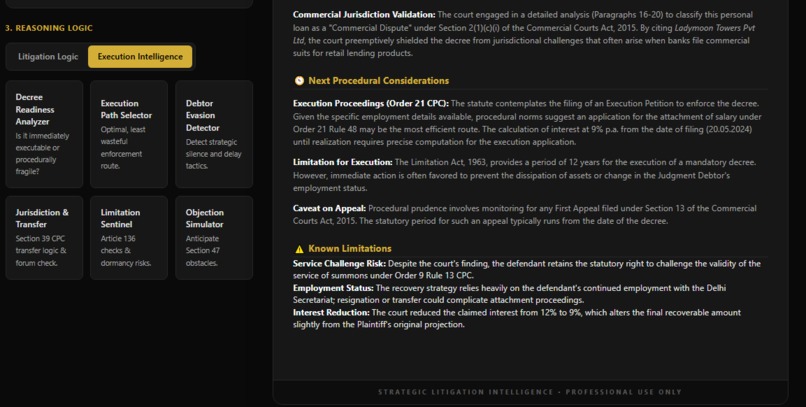
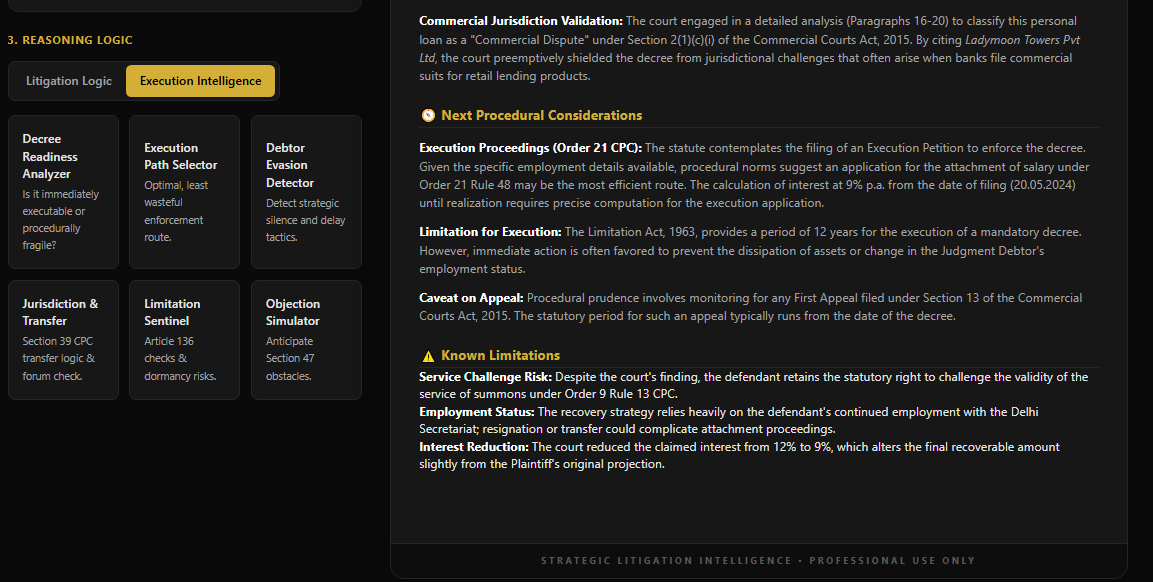
### II. Execution Intelligence (Post-Judgment) - Decree Readiness: Analyzes if a decree is "ripe" and executable or if it contains ambiguities that require Section 152 clarification.
- Execution Path: Recommends the most efficient enforcement route (Attachment of Moveables, Garnishee orders, or Arrest).
- Evasion Detector: Detects patterns of strategic debtor silence and delay tactics used to frustrate the decree.
- Jurisdiction Transfer: Reasons about Section 39 CPC transfers when assets are located outside the trial court's power.
- Limitation Sentinel: Monitors Article 136 risks to prevent the decree from becoming "dormant" or time-barred.
- Objection Simulator: Anticipates probable Section 47 CPC obstacles that a debtor might raise to stall the execution.
--- LIE: Making lawyers think better, not just faster.
Built With
- css3
- html5
- lucide
- react
- tailwind
- typescript

Log in or sign up for Devpost to join the conversation.