-
-
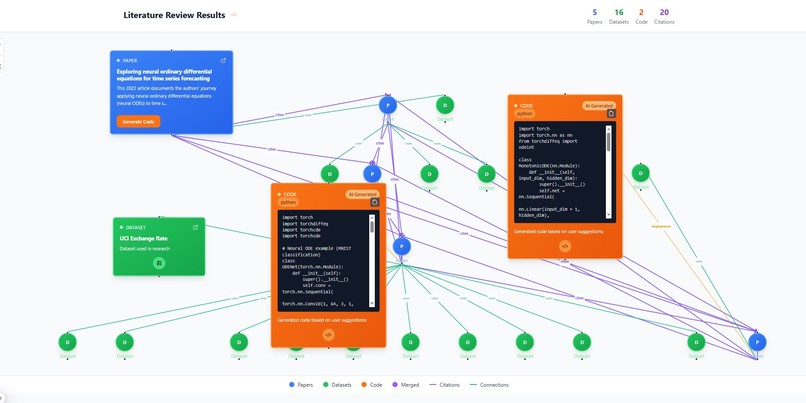
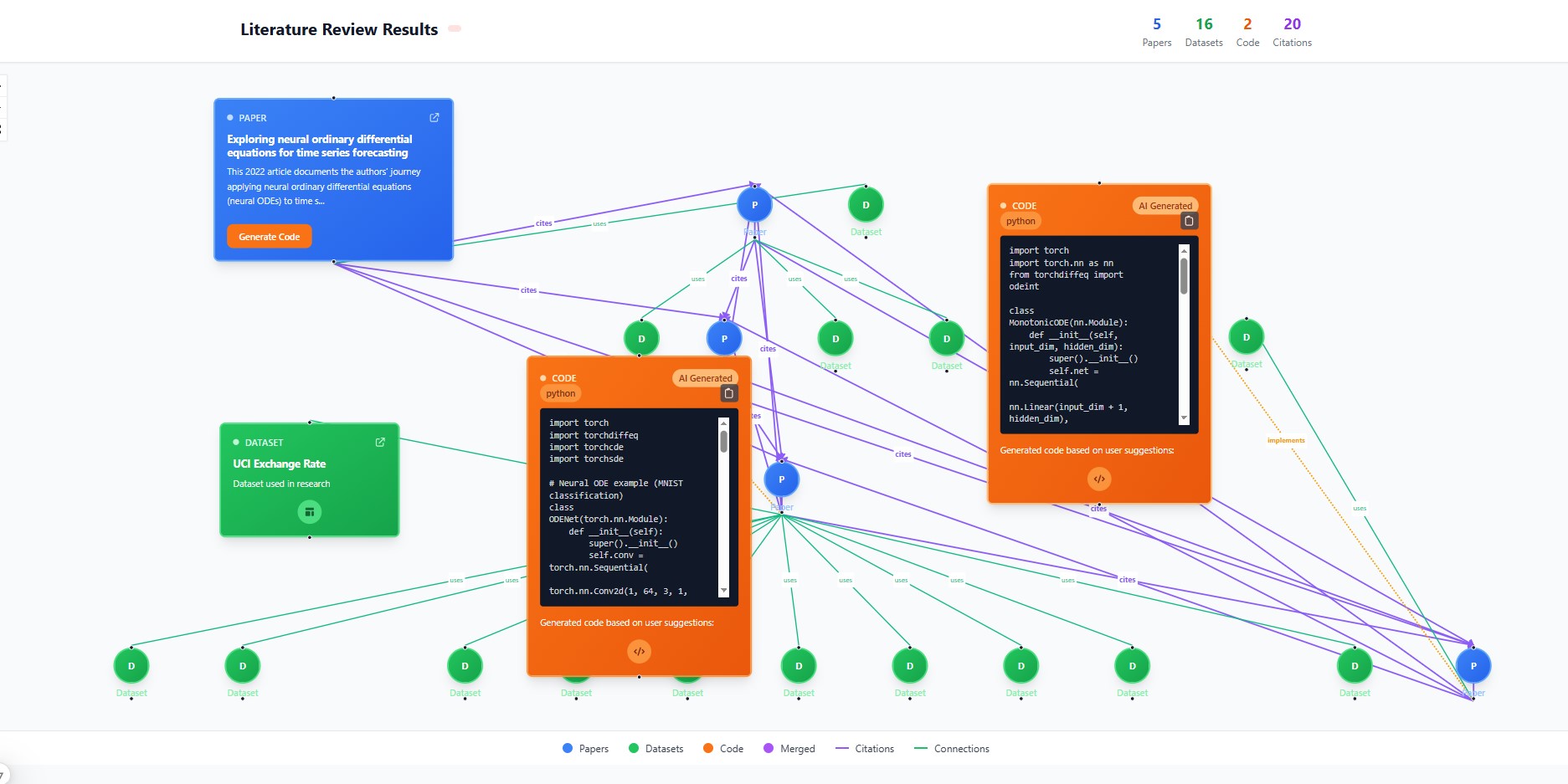
Generated network
-
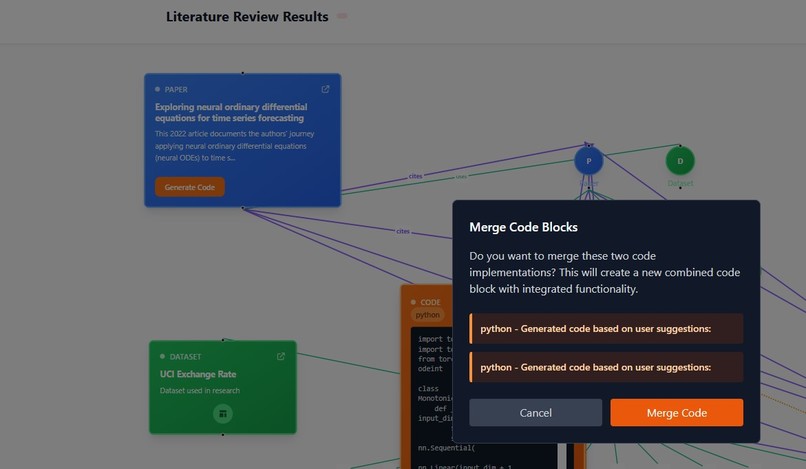
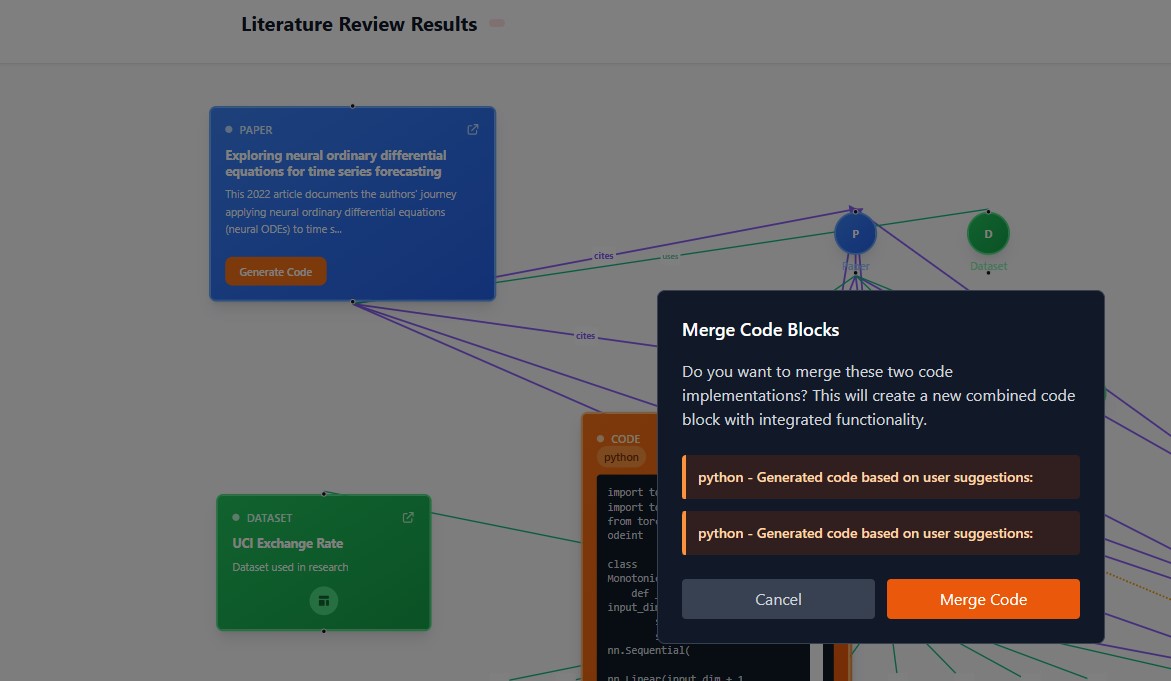
merging code nodes
-
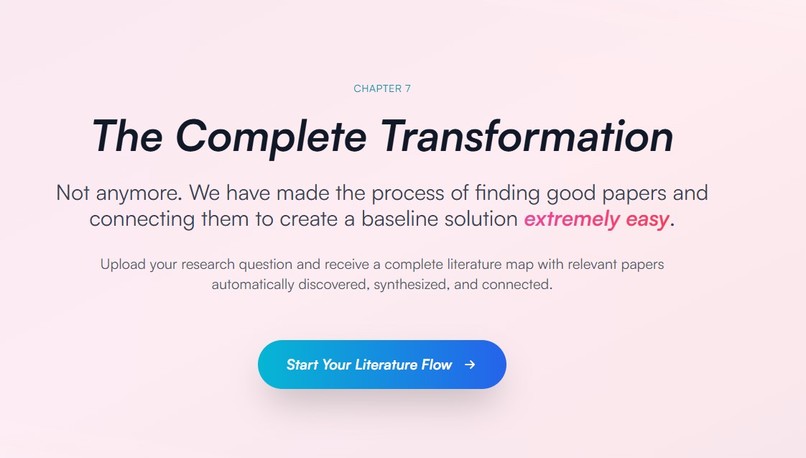
Story and Vision
-
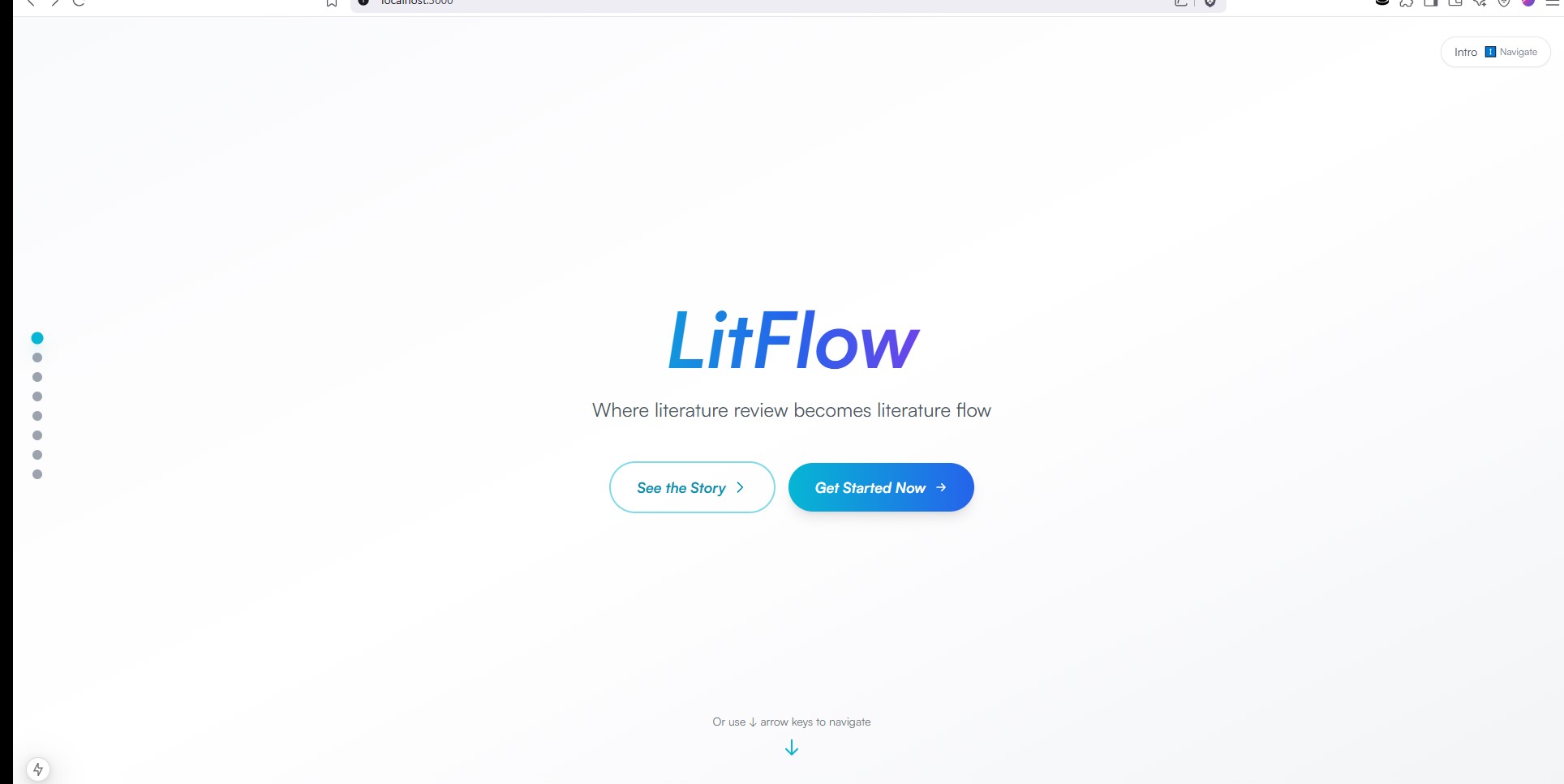
Initial Page
LitFlow: Transforming Literature Review with AI
Project Story
About the Project
LitFlow is an AI-powered literature review platform that reimagines one of academia’s most daunting tasks—digging through endless papers—into a fluid, visual experience. By combining Perplexity’s Sonar API with modern web technologies, LitFlow automatically discovers, analyzes, and maps research papers, datasets, and even code repositories in a dynamic, interactive flow diagram.
It’s research—made visual.
What Inspired This Project
Research is fun, you dig deep into a problem so niche that only five other people are concerned about it. You may even formulate a way to solve that problem, in a manner more efficient, more accurate, more practical than others. But who are these others you’re competing with? What did they try? And how do you know if you’re improving on something if you don’t know what came before?
That’s where literature review comes in. It’s also where momentum dies.
The traditional process usually looks like:
- Manually scraping twenty tabs across four platforms
- Reading 100-page PDFs to extract a single diagram
- Losing your place in a citation spiral of diminishing returns
- Desperately trying to connect Obsidian to Raindrop to Zotero to get a semblance of a knowledge graph
“Who’s got time for literature review? I let Perplexity do it,” a colleague once said. That remark led me to discover Perplexity in the first place. I don’t agree with them.
Because Perplexity can be used for more than just generating one liners. Used right, it's a discovery engine—and the brains behind LitFlow.
The Vision
LitFlow isn't a tool for cutting corners. It's a tool for cutting noise.
We’re building it to ease the literature review process by:
- Automating paper discovery using AI-powered search and analysis
- Visualizing research relationships through interactive flow diagrams
- Extracting key insights from papers, datasets, and code repositories
- Providing instant access to relevant resources and citations
- Reducing review time from weeks to days
How We Built LitFlow
Architecture Overview
LitFlow follows a modern serverless architecture with clear separation of concerns:
Backend (AWS Chalice + Python)
- AWS Chalice for API development (fast to deploy, easier to scale)
- DynamoDB for resilient, NoSQL-style data storage
- Perplexity Sonar API for real-time, context-aware research discovery
- REST API with full CORS support for frontend flexibility
Frontend (Next.js + React)
- Next.js 14 with App Router for modern React development
- React Flow to visualize knowledge as connected nodes
- Tailwind CSS for responsive, beautiful UI design
- Framer Motion to bring flow diagrams to life
- shadcn/ui for consistent, accessible components
🔍 Perplexity Sonar API: The Intelligence Backbone
Why Perplexity Sonar Was Game-Changing
The choice of Perplexity's Sonar API as LitFlow's intelligence engine was crucial to the project's success. Unlike traditional search APIs or static databases, Sonar provides real-time web search capabilities combined with advanced language understanding, making it perfect for academic research discovery.
- Semantic similarity: Understands “what is similar” in meaning, not just in wording
- Trend awareness: Surfaces emerging fields and fringe topics gaining momentum
- Citation graphs: Connects the influence chain from canonical works to niche derivatives
- Methodological linking: Identifies papers using similar techniques—even across domains
Beyond One-Liners
Our system can extract the structure of a methodology section—inputs, models, variables, evaluation metrics—and automatically scaffold code that approximates the experiment.
This means:
- Researchers can go from “I like how they ran this experiment” to “Here’s a runnable version of it”
- Methodologies become easier to replicate
- Papers become reproducible without endless tinkering
Multi-Source Aggregation
Perplexity’s breadth is also its strength. Sonar aggregates information from multiple sources simultaneously:
- arXiv for preprints and cutting-edge research
- Google Scholar for citation metrics and academic profiles
- GitHub for code repositories and implementations
- Academic conferences for peer-reviewed publications
- Research blogs for informal discussions and insights
Real-World Impact
Before Sonar Integration:
- Manual paper discovery taking hours or days
- Risk of missing recent breakthrough papers
- Inconsistent metadata extraction
- Limited cross-domain research connections
After Sonar Integration:
- Automated discovery in minutes
- Real-time access to latest research
- Structured, consistent data extraction
- Intelligent cross-domain recommendations
- Methodology sections can be parsed and converted into starter code
🔧 Technical Stack Summary
Backend
- AWS Chalice (Python serverless framework)
- DynamoDB (NoSQL database)
- Perplexity Sonar API (Real-time research intelligence and discovery)
- AWS Lambda (serverless compute)
Frontend
- Next.js 14 (React framework)
- TypeScript (type safety)
- React Flow (interactive diagrams)
- Tailwind CSS (styling)
- Framer Motion (animations)
- shadcn/ui (component library)
Development Tools
- Git (version control)
- npm/pnpm (package management)
- ESLint (code quality)
- Prettier (code formatting)
Conclusion
LitFlow is proof that literature review doesn't have to be a bottleneck or a burden. With AI, intelligent APIs, and thoughtful UX, we’ve built a tool that turns a painful academic ritual into a genuinely exploratory experience.
Building LitFlow has been an incredible journey of technical growth, problem-solving, and user-centric design. The project showcases how modern technologies can be combined to solve real-world problems that affect millions of researchers and students globally.
From the initial "hello world" API endpoint to a fully functional literature review platform, every challenge overcome has contributed to both technical expertise and a deeper understanding of user needs in academic research.
LitFlow stands as proof that with the right combination of cloud technologies, AI services, and thoughtful design, we can transform even the most traditionally painful processes into delightful, efficient experiences.
LitFlow: Where literature review meets modern technology. 🚀📚
Built With
- chalice
- react-flow
- sonar


Log in or sign up for Devpost to join the conversation.