-
-
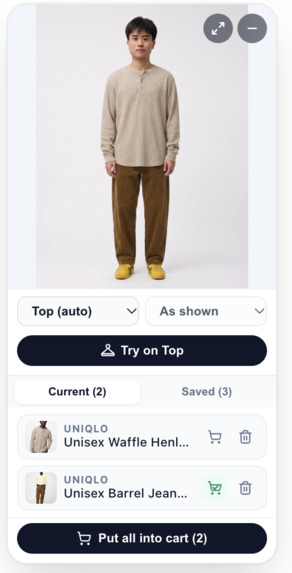
Small pop-up at the bottom right screen, that allows you to try on different clothes and shop all at once.
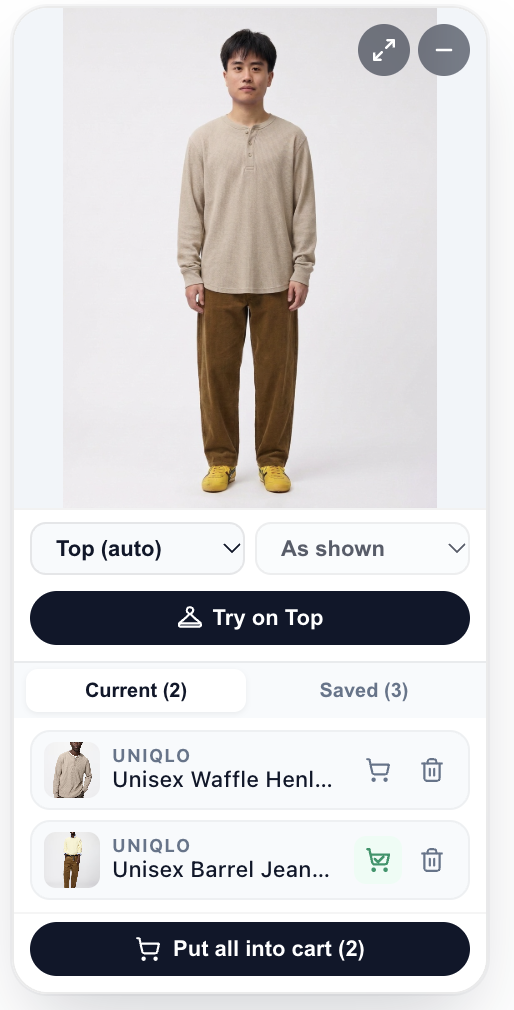
Inspiration
Buying clothes online is often a gamble: you never truly know how an item will fit or look until it arrives at your doorstep. To solve this and boost user engagement on e-commerce platforms, we created LitFits—a feature that allows customers to try clothes on a personalized, look-alike 3D avatar before committing to a purchase.
What it does
Users upload a single full-body, head-to-toe photo. From there, LitFits generates a customized virtual avatar that allows users to try on various garments, visualize how each piece looks, and check fit tension and size estimates before adding items to their cart.
How we built it
We built the avatar creation using Google Gemini's Nano Banana API. We made sure to go through each case with care and write prompts that would match the scenario that the user would be in. We then Integrated Gemini to parse and distribute shopping cart items across multiple distinct e-commerce websites simultaneously, enabling unified multi-store checkout in a single click.
Challenges we ran into
Creating the avatar was one of our biggest challenges, and we experimented with several approaches. We initially tried using the fashn/tryon/v1.6 API; while it worked at first, it produced significantly more rendering errors than Gemini. For instance, when trying on garments with complex patterns or intricate designs, the fashn/tryon/v1.6 API struggled to render the details accurately, whereas Gemini handled them cleanly.
We also considered open-source 3D body estimation models, specifically 4D-Humans (Reconstructing and Tracking Humans with Transformers). However, because 4D-Humans is built for complex dynamic tracking, such as sports movements, it overcomplicated the task of reconstructing a simple, static human figure.
Accomplishments that we're proud of
We are very proud that after lots of trial and error, we were able to create a working product. There are lots of parts that we would love to improve on, but we believe that where we are at is because of the time spent designing and thinking through all possible solutions feasible for the hackathon.
What we learned
We learned how to work effectively as a team in a fast-paced environment. We also learned how to code efficiently with AI, especially given our strict token limits. We had to choose our models strategically and reserve heavy API usage for critical production stages rather than wasting tokens on unnecessary tasks.
What's next for LitFit
Our next is accurate 3D modeling, whether that be using open source, or training our own models. We want users to have as real possible interaction using LitFit when choosing clothes online.
Built With
- claude
- cursor
- typescript

Log in or sign up for Devpost to join the conversation.