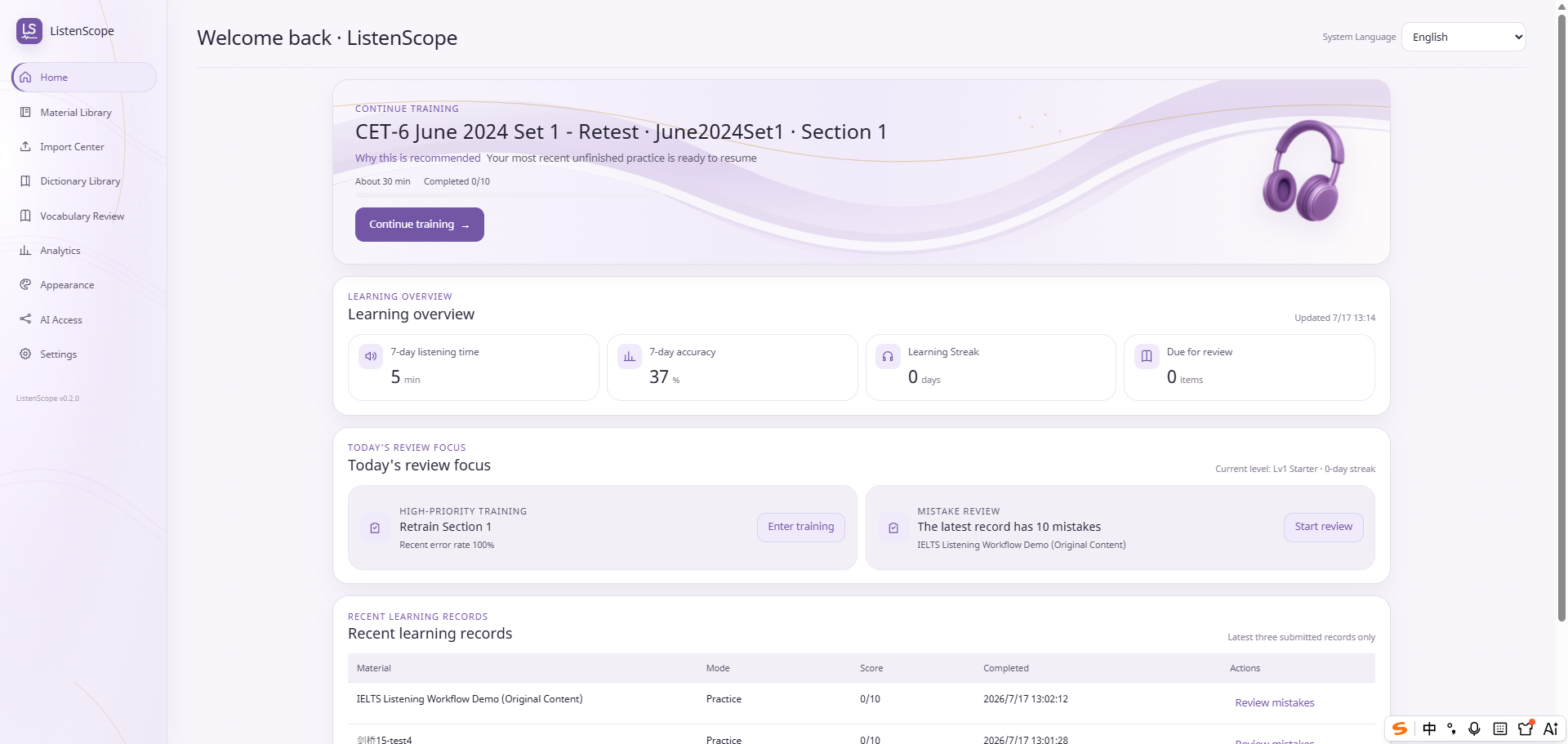
ListenScope AI: From Exam Practice to Real Listening Ability
Inspiration
I am a construction engineer and a postgraduate student preparing to pursue a PhD abroad. IELTS is an essential step on that journey, but listening has always been the skill I struggle with most.
My goal was never simply to achieve a higher exam score. I wanted to genuinely understand spoken English—to follow academic lectures, communicate confidently, participate in international research, and use English as a real tool rather than merely an examination subject.
At first, I only wanted to build a computer-based IELTS listening practice system for myself. As IELTS becomes increasingly computer-based, I needed a convenient way to practise answering listening questions on a computer instead of relying entirely on paper materials.
Then I began discussing the idea with Codex.
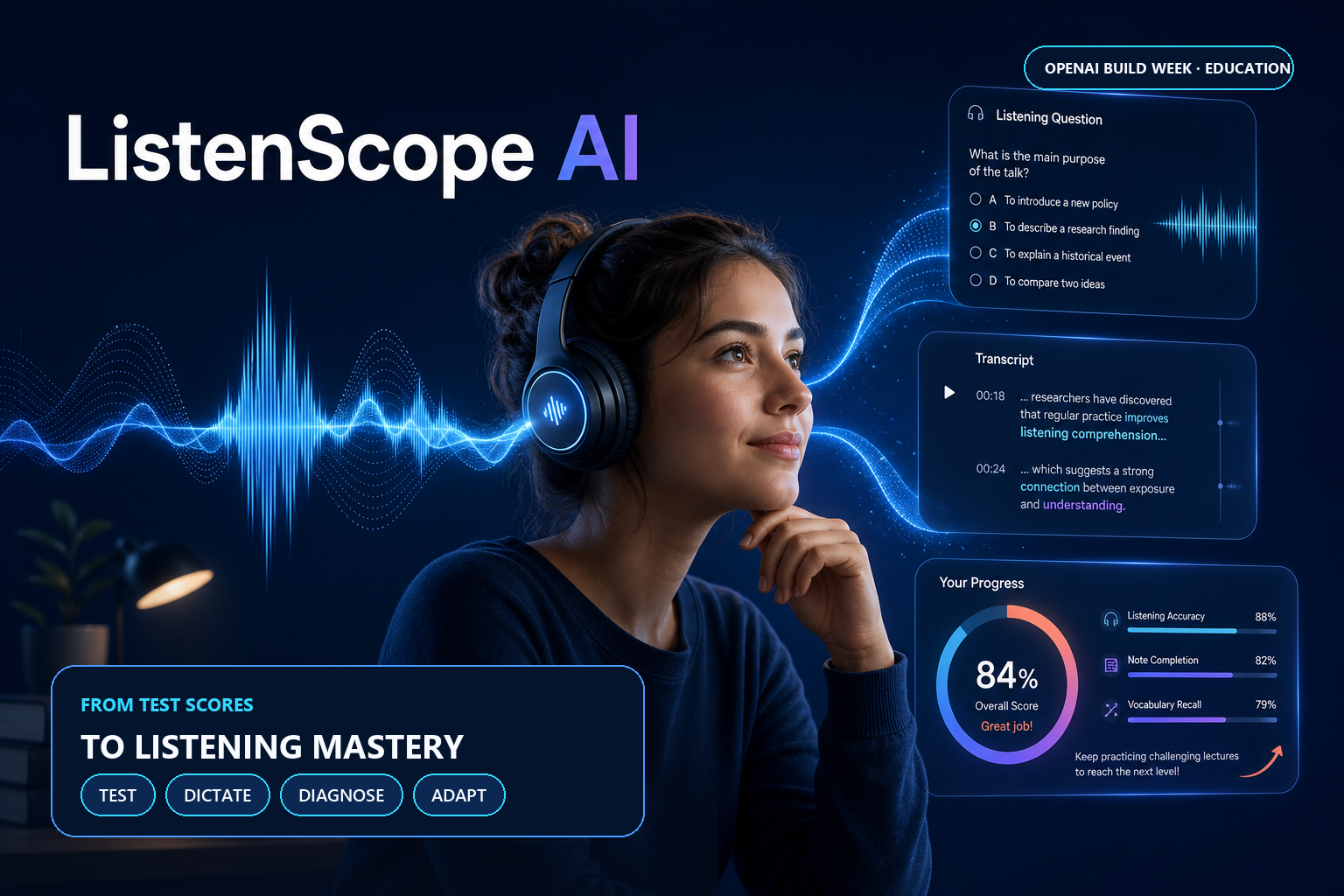
What started as a simple mock-exam tool gradually evolved into ListenScope AI: a comprehensive system that combines listening assessment, mistake diagnosis, targeted practice, vocabulary development, and long-term improvement in one connected learning environment.
I also incorporated the listening-training plan that I had previously developed through conversations with ChatGPT. Instead of leaving that plan as a document I might eventually stop following, I transformed it into a repeatable workflow inside the product.
What it does
Most listening tools stop after giving the learner a score.
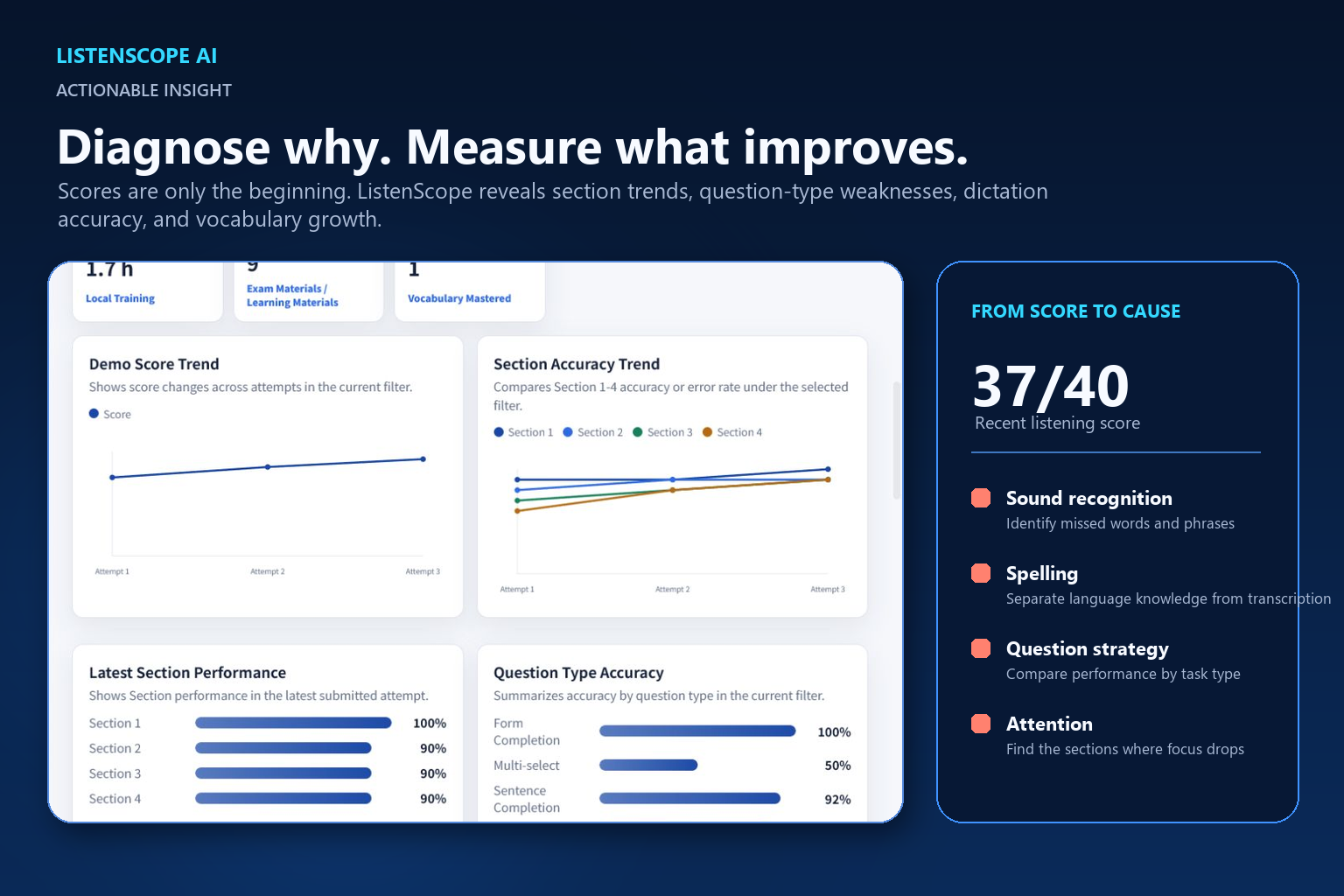
ListenScope AI goes further by helping learners understand why they failed to recognize an answer and what they should practise next.
The system creates a continuous learning loop:
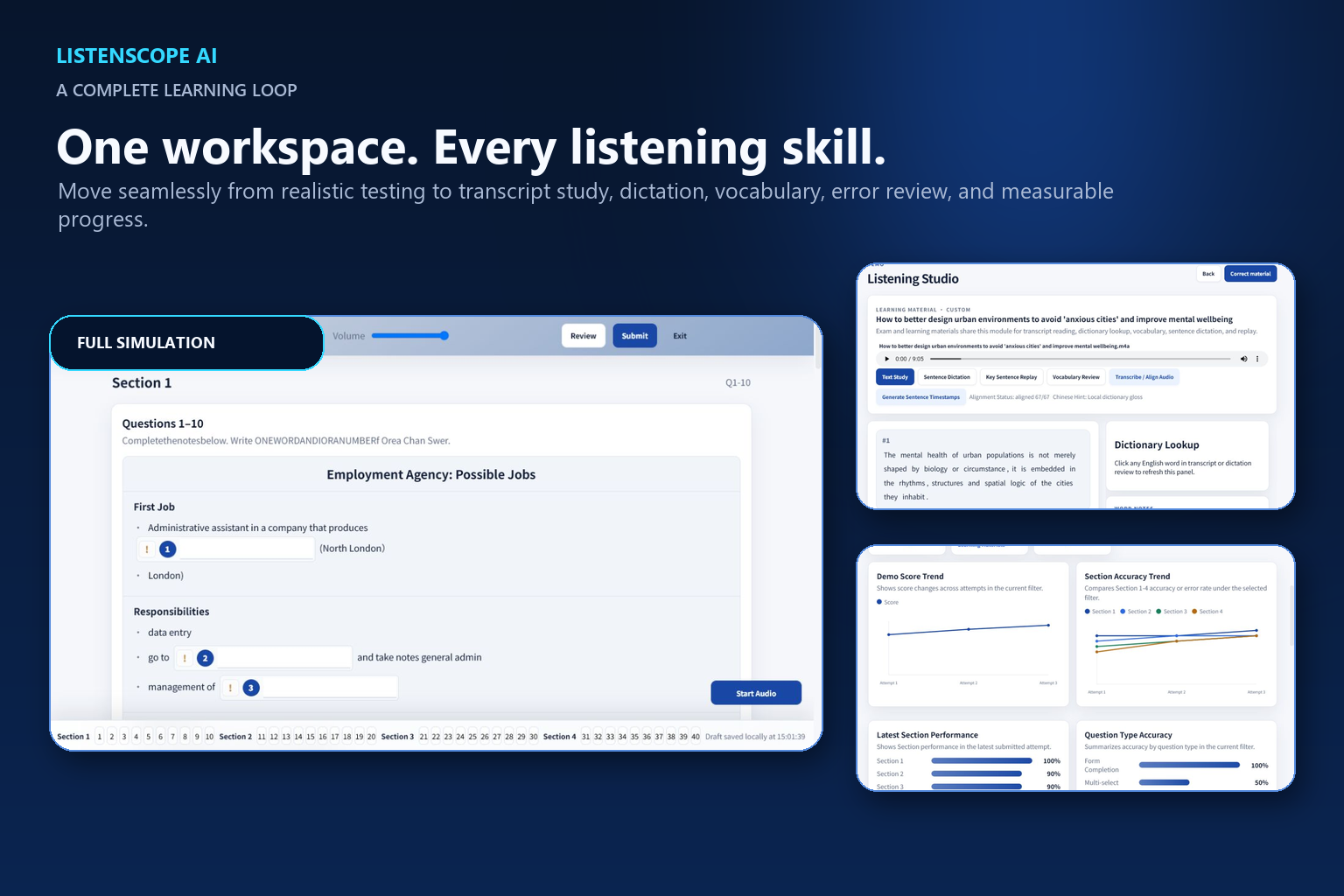
Listen → Answer → Diagnose → Practise → Review → Improve
Its core capabilities include:
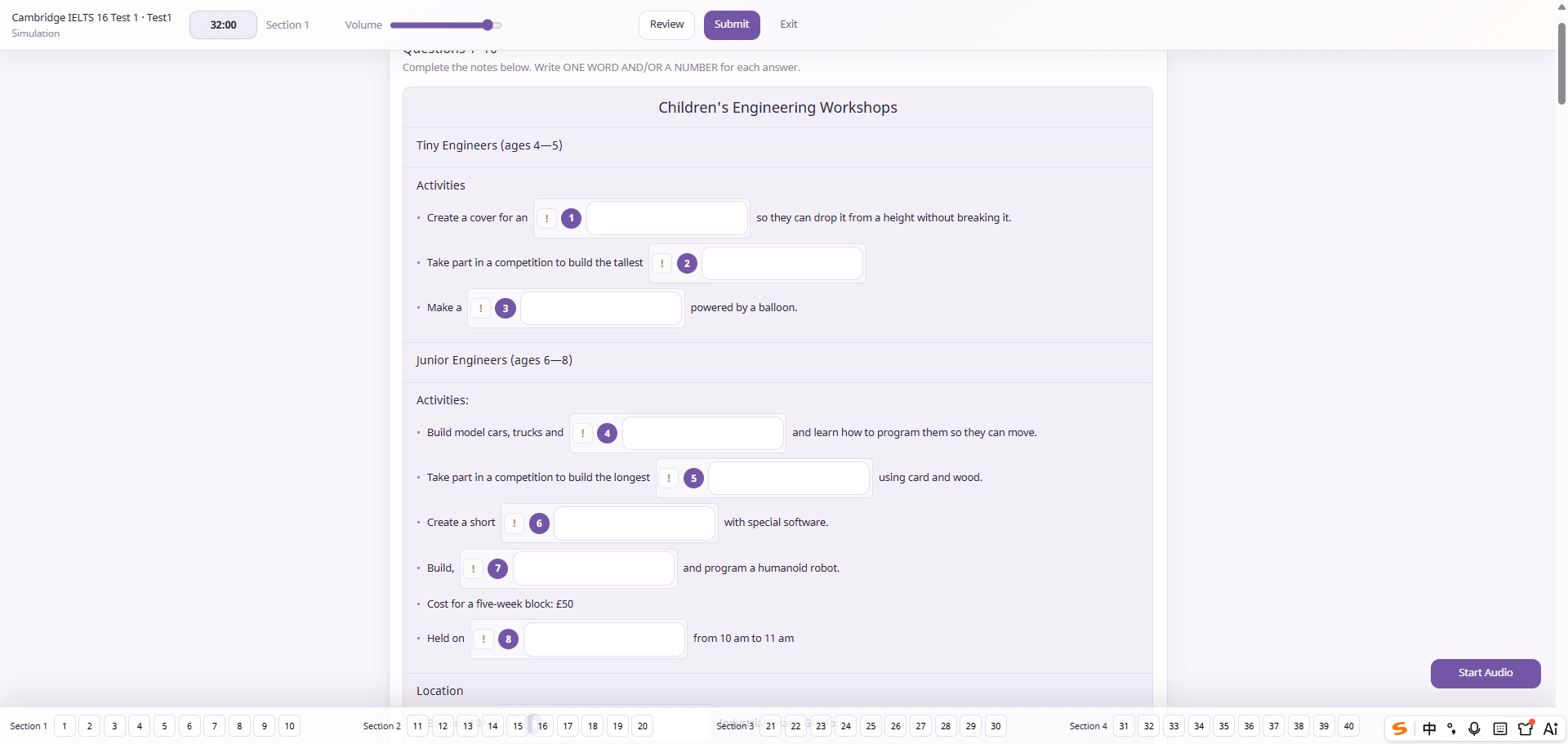
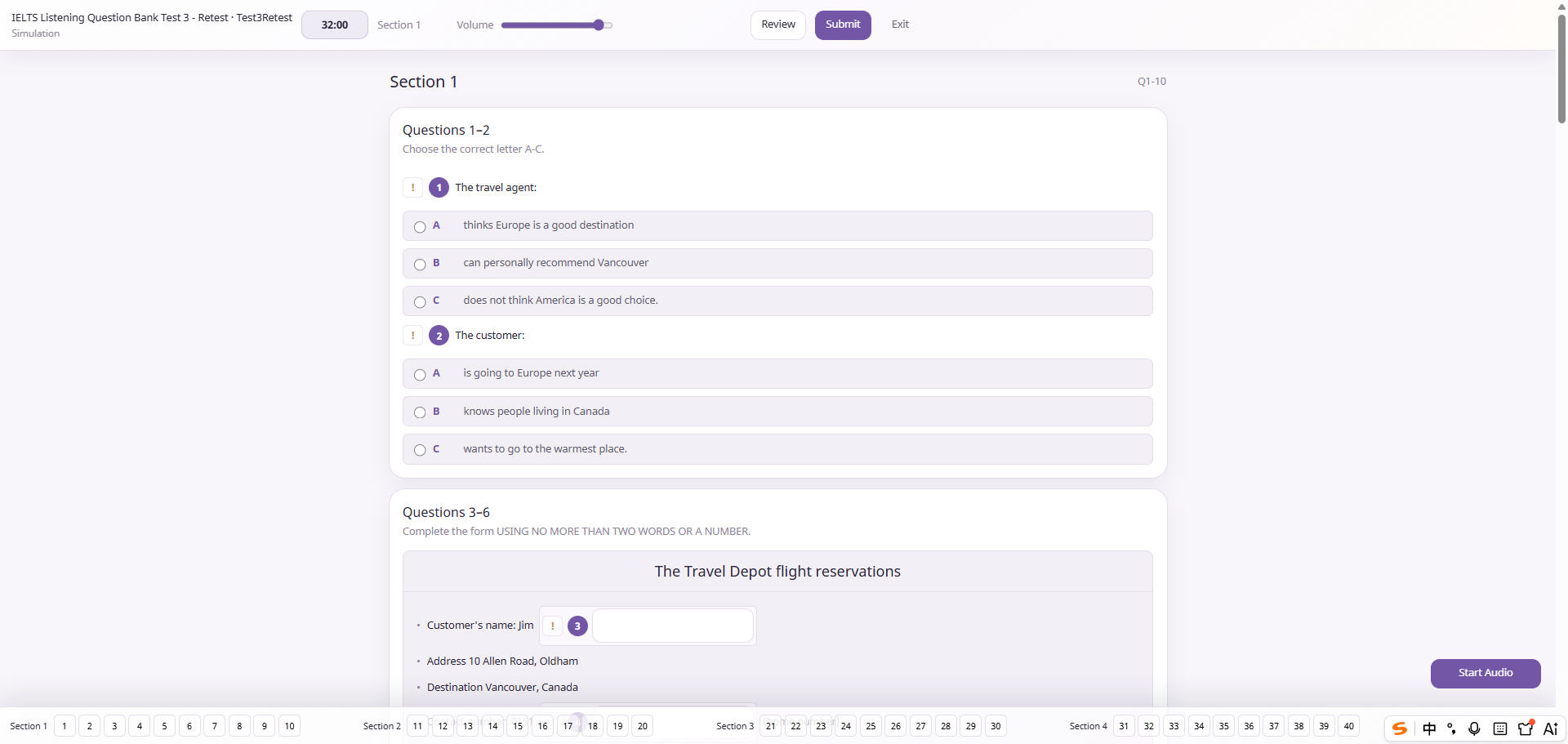
- Realistic computer-based IELTS listening mock tests
- Complete-test, section-based, and question-based practice modes
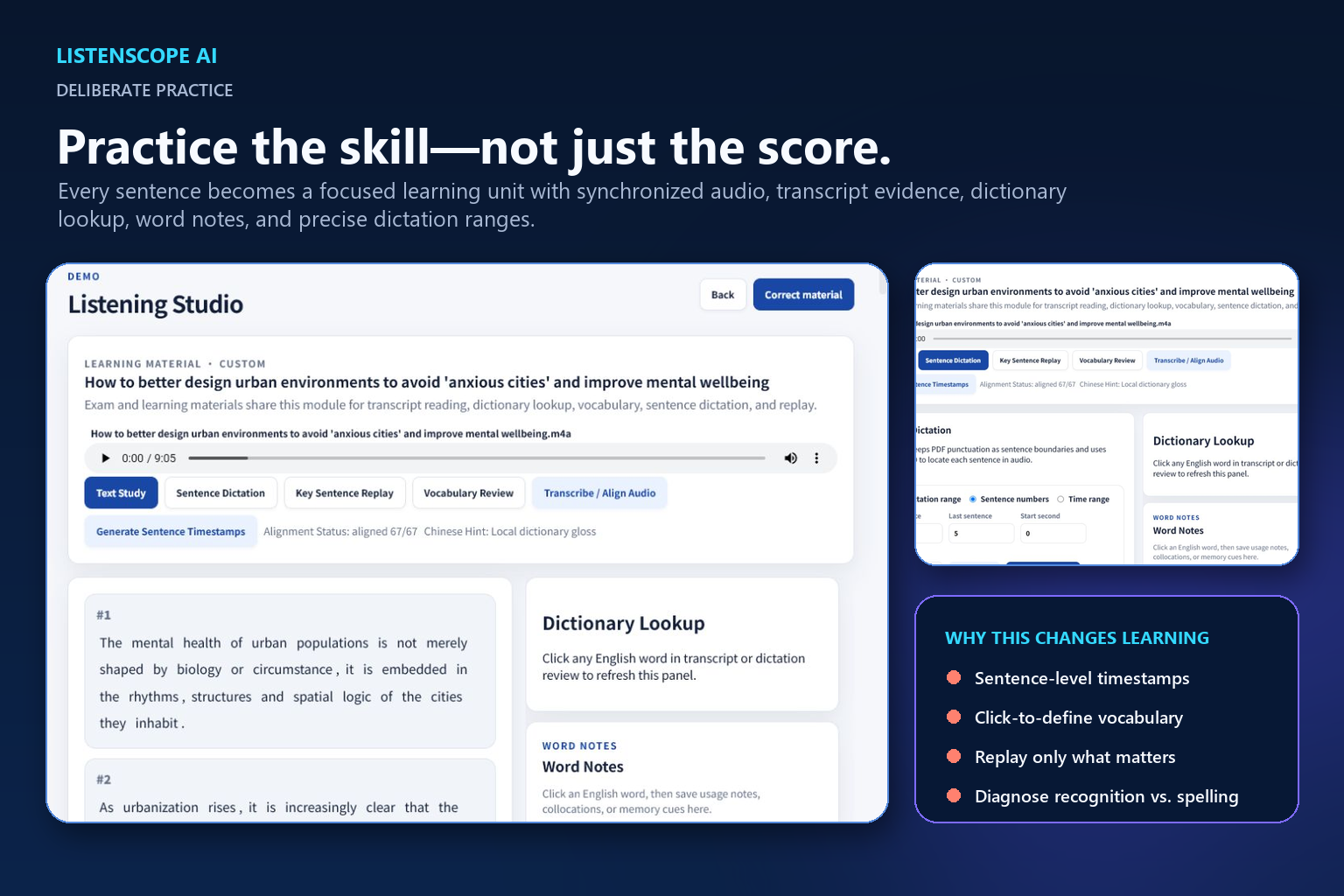
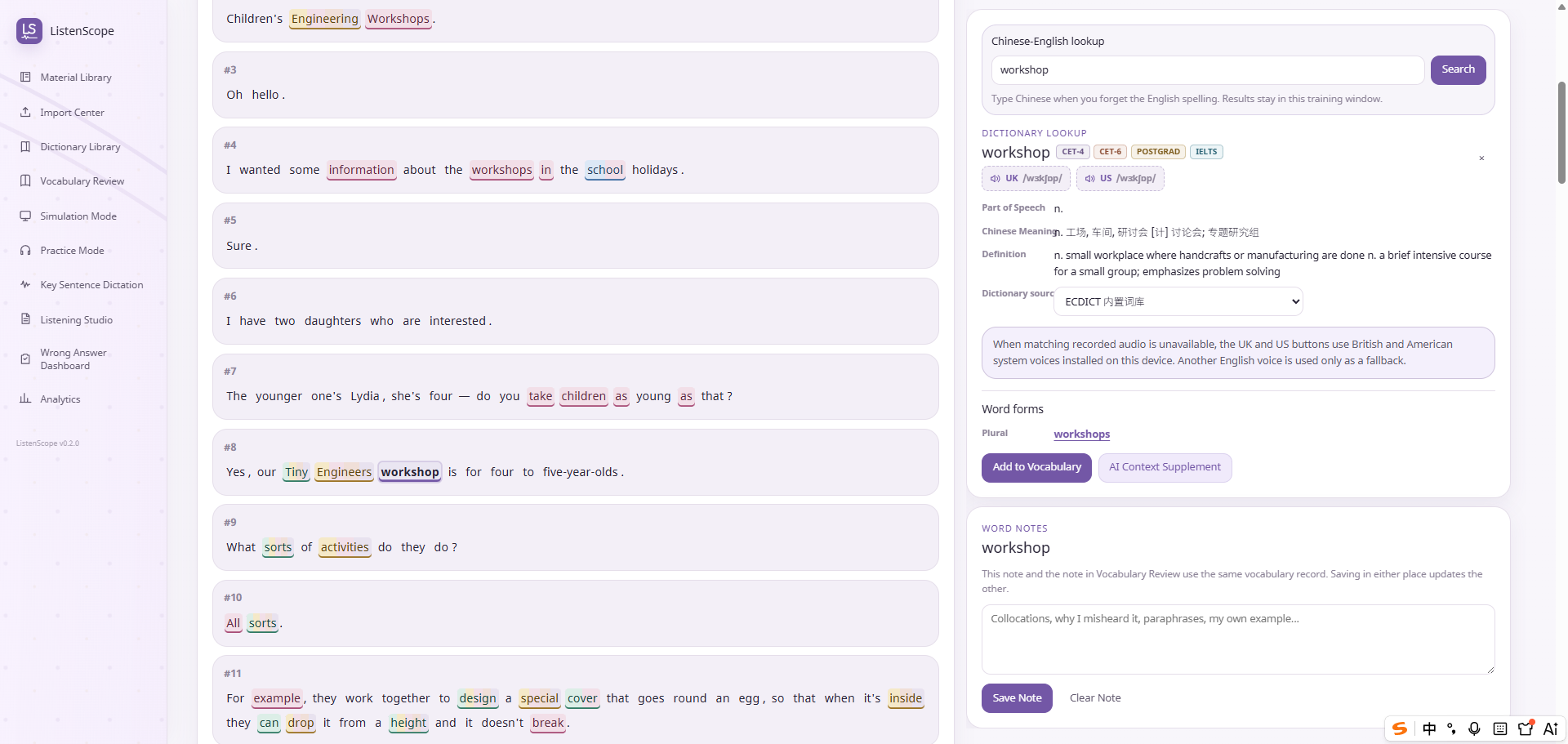
- Sentence-level dictation with accurately synchronized audio
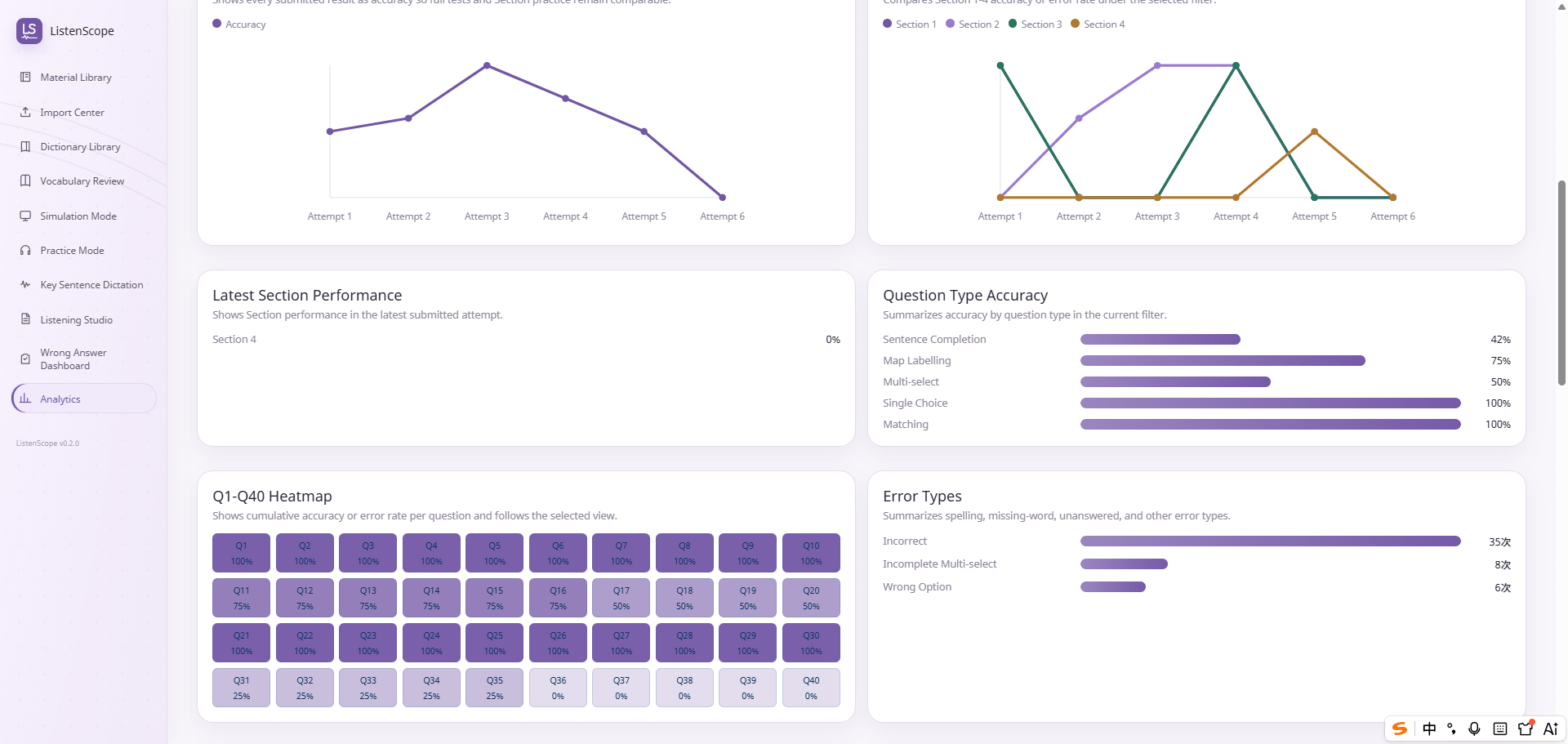
- Detailed answer review and mistake analysis
- Vocabulary and dictionary support
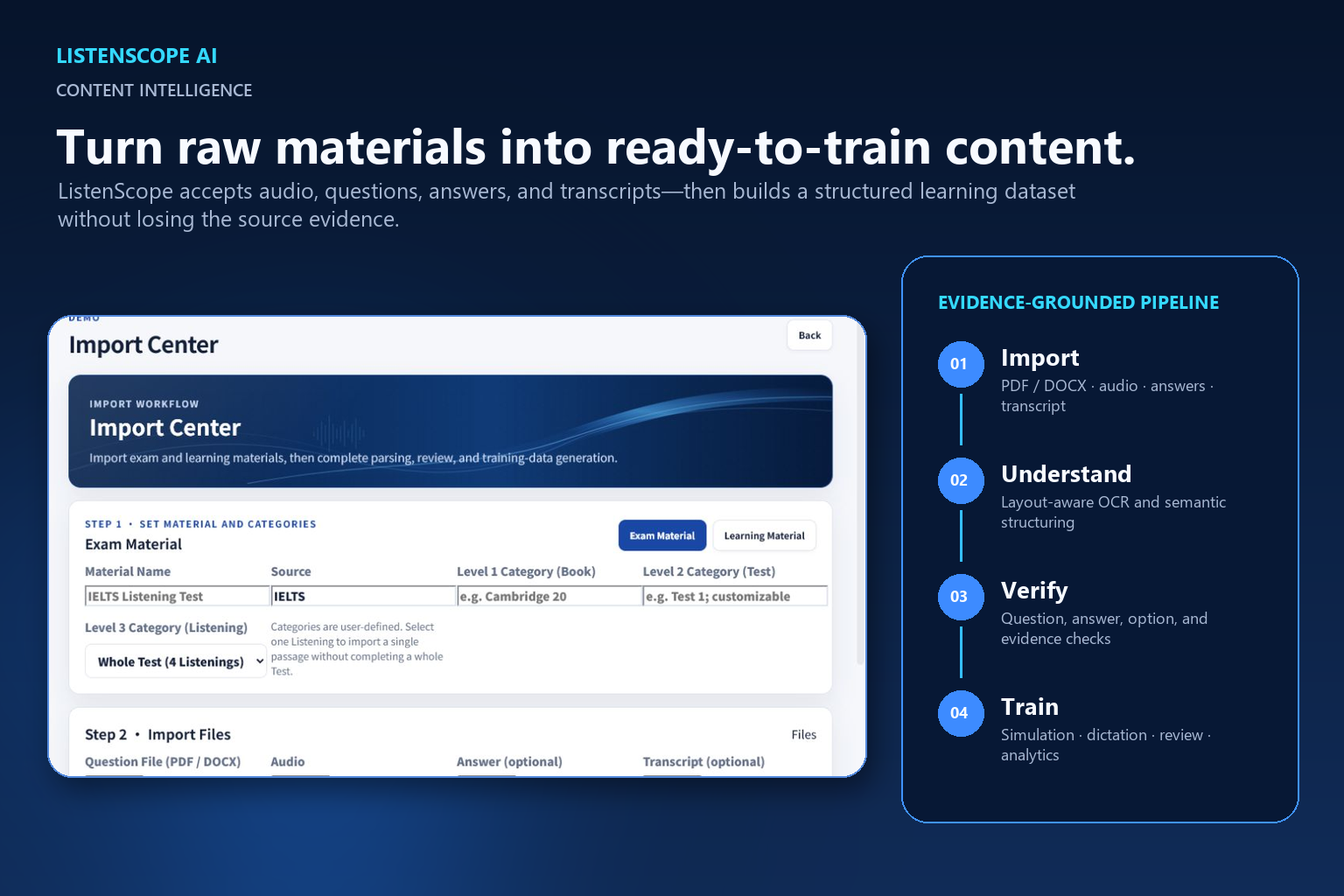
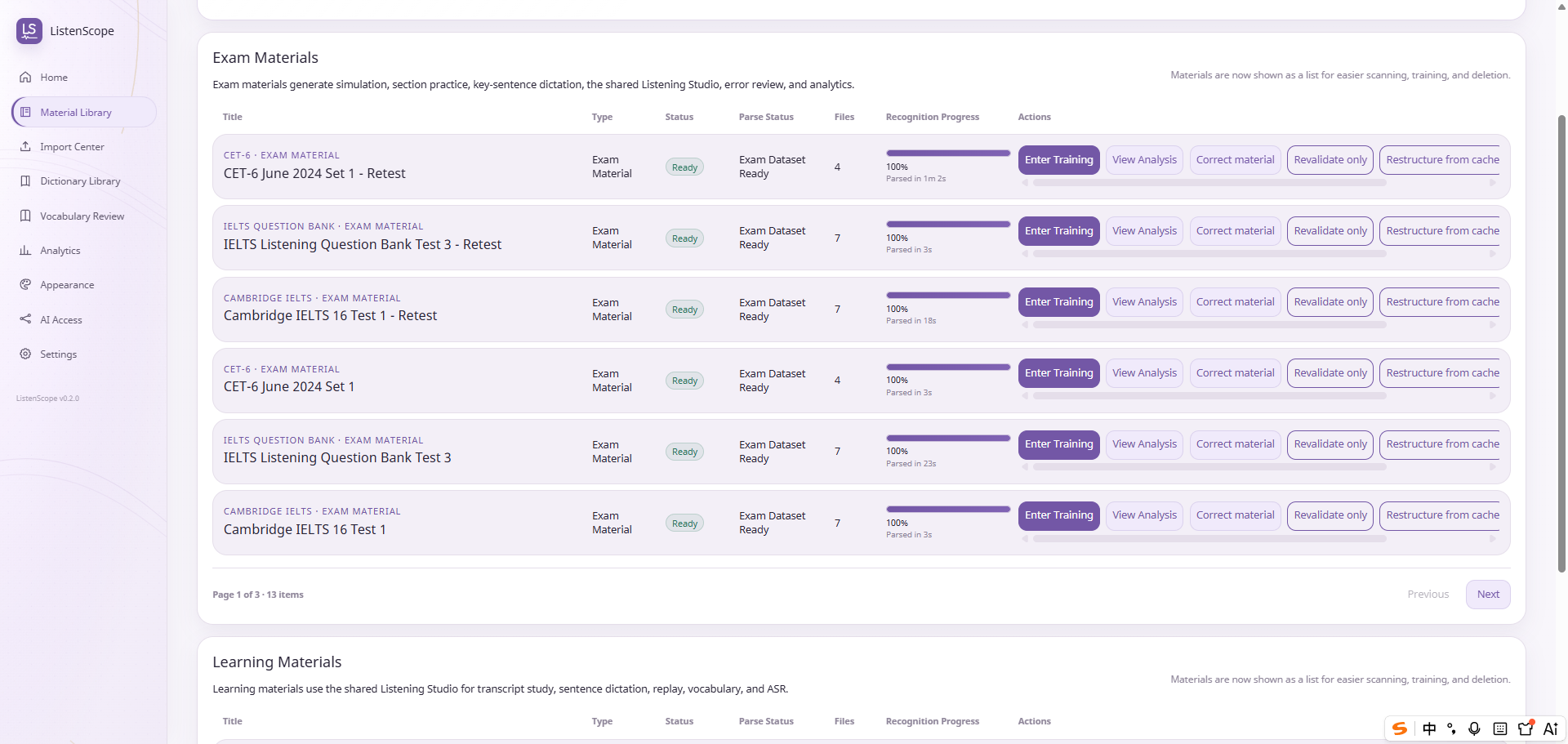
- Structured listening exercises created from uploaded materials
- OCR processing for scanned PDF examination papers
- Personalized listening-training workflows
- Repeated practice for difficult sentences and unfamiliar expressions
- Progress tracking across different learning activities
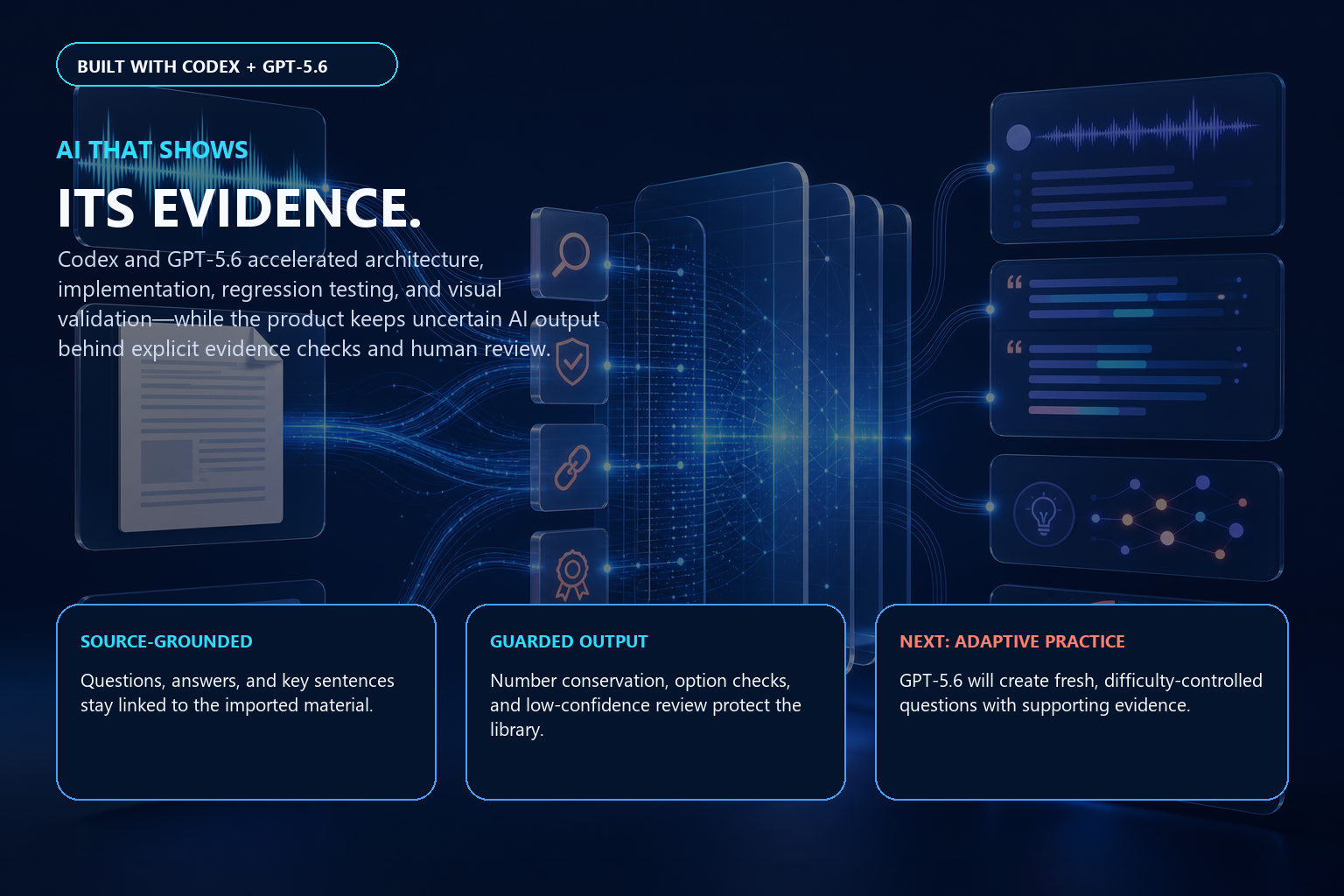
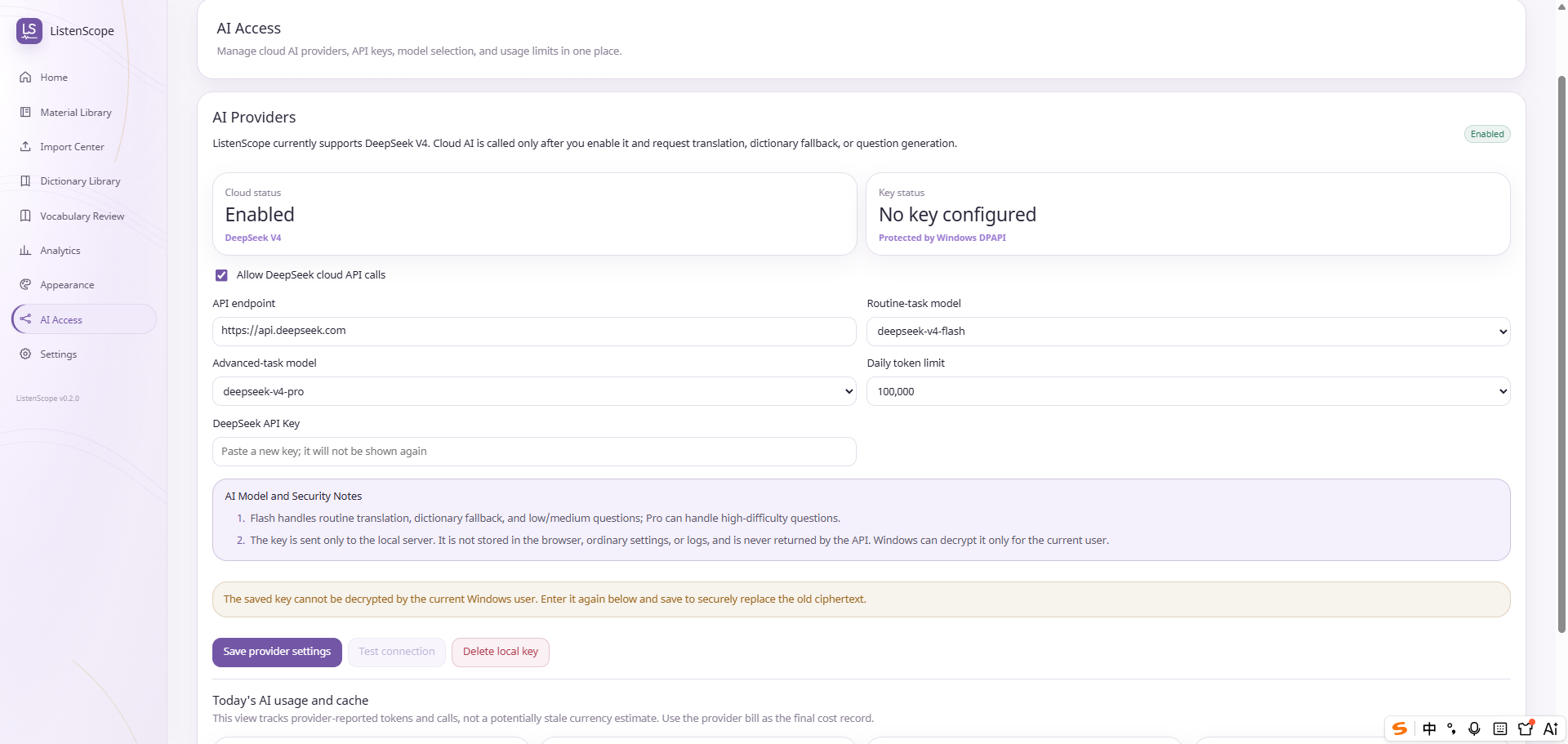
- Secure API-key handling and API-cost-conscious system design
- A polished, learner-focused interface designed for daily use
- Local-first file storage and processing for uploaded learning materials
The system connects examination practice with genuine listening development. Learners can move naturally from completing a mock test to reviewing mistakes, replaying difficult sentences, practising dictation, learning unfamiliar vocabulary, and strengthening the exact skills that caused them to lose marks.
This means ListenScope AI is not simply another IELTS question bank. It is designed to turn every mistake into a specific learning action.
Privacy and Local-First Design
ListenScope AI follows a local-first approach.
Materials uploaded by users are stored and processed locally on their own devices. The original uploaded files are not transferred to a centralized server or publicly distributed through the platform.
This design gives learners greater control over their materials, protects private study documents, reduces the risk of data leakage, and minimizes unnecessary distribution of copyrighted learning content.
Users can practise privately with materials they have legally obtained without placing those files into a public online content library.
Privacy was not added as an afterthought. It was considered from the beginning as part of the product architecture.
How I built it with Codex and GPT-5.6
My original request to Codex was simple: help me build an IELTS listening exam system.
As our conversations became deeper, however, the project changed dramatically. I shared my personal learning difficulties, study habits, interface preferences, and the listening-training plan I had previously created. Codex helped translate those experiences into product requirements, learning workflows, technical architecture, and working features.
I asked Codex to approach the project from several professional perspectives:
- As a product manager, it evaluated user needs, workflows, and feature priorities.
- As a development manager, it planned the architecture and implementation process.
- As a linguist and language-learning specialist, it examined whether each activity could genuinely improve listening comprehension.
- As a UI/UX reviewer, it helped refine the interface and user experience.
- As a software tester, it explored the application, found problems, verified fixes, and recorded complete testing flows.
Each role brought a different perspective. Together, they helped the project evolve from a basic examination simulator into a much more complete listening-learning system.
One of the most surprising moments occurred while GPT-5.6 was reasoning through a development task: it noticed an additional bug during the process and fixed it without requiring me to begin a separate debugging conversation.
Codex could also operate the application, test complete user journeys, capture screenshots, and record the system-testing process. The complete testing video is included in the project repository and parts of it are shown in the demonstration video.
Codex did much more than generate isolated pieces of code. It became my product partner, technical team, testing assistant, and thinking companion.
Challenges
Building ListenScope AI involved many challenges that were much harder than I initially expected.
One major challenge was converting scanned PDF examination materials into a structured computer-based test. The system needed to recognize content through OCR, understand the organization of the paper, and transform the extracted information into usable questions and answer fields.
Audio processing created another major challenge. Sentence dictation only works when the audio can be located and synchronized accurately at sentence level. Even a small timing error can make the practice experience frustrating or ineffective.
Other challenges included:
- Designing a reliable workflow for different PDF formats
- Synchronizing long recordings with individual sentences
- Building dictionary and vocabulary-learning functions
- Integrating external APIs safely
- Protecting API keys from accidental exposure
- Reducing unnecessary API calls and future costs for learners
- Keeping uploaded materials local and private
- Connecting testing, diagnosis, and practice into one coherent workflow
- Designing a clean interface despite the growing number of features
I also care deeply about visual details, so I repeatedly refined the UI until the system felt coherent and comfortable to use.
I worked through these challenges with Codex one by one—through discussion, implementation, testing, failure, revision, and verification.
Accomplishments that I am proud of
The achievement I am most proud of is the speed at which the idea became a real product.
From my first idea to the working system shown in this repository, the entire development process took less than one week.
ListenScope AI is not merely a presentation, a design prototype, or a future concept. It is already a functional system with implemented examination workflows, document processing, listening exercises, sentence dictation, vocabulary support, local file handling, testing capabilities, and a refined user interface.
Even the complete system test and screen recording were conducted with Codex. The recording is available in the repository for anyone who wants to examine the product in more detail.
As a construction engineer without a traditional software-development team, I could never have built something of this scope so quickly through a conventional development process.
Codex made it possible for one person with a genuine problem and a clear vision to design, build, test, and refine a substantial working product in less than one week.
What I learned
This project taught me that AI-assisted development is not only about writing code faster.
The greatest value came from continuous dialogue.
By giving Codex detailed context, sharing my learning experience, asking it to adopt different professional roles, questioning its suggestions, and repeatedly testing the results, I was able to transform personal knowledge into a structured product.
I also learned that language-learning systems should not separate assessment from improvement.
A score tells learners where they are, but it does not explain how to move forward. Effective learning requires a closed loop in which every assessment result leads to a specific practice action.
That idea became the foundation of ListenScope AI:
A mistake should not be the end of a test. It should be the beginning of the next learning step.
What's next
The next major feature will allow AI to generate new listening questions dynamically from a learner’s selected material.
In the future, articles, lectures, podcasts, interviews, and personal learning resources could be transformed into interactive listening exercises adapted to the learner’s level and weaknesses.
Planned improvements include:
- AI-generated questions based on listening materials
- More detailed mistake classification
- Personalized practice recommendations
- Intelligent review scheduling
- Deeper progress and learning analytics
- Pronunciation and speaking feedback
- More listening materials for academic and real-world scenarios
- Additional tools for teachers and independent learners
Most importantly, listening is only the beginning.
I want to bring the same approach to reading, speaking, and writing, creating a complete language-learning input-and-output loop.
My long-term goal is not to build another examination tool. It is to help people make English a genuine instrument for communication, education, research, and opportunity.
Millions of learners are still frustrated by English—not because they lack effort, but because many existing tools show them their mistakes without helping them systematically overcome those mistakes.
I want to change that.
I started ListenScope AI because I needed it myself. I am continuing because I believe it can help learners around the world.
And personally, I love building with Codex. It turned an idea I had carried for a long time into a working product in less than one week.
This is only the beginning of our journey. I intend to keep building with Codex, expand ListenScope AI beyond listening, and work toward a future where English becomes a bridge rather than a barrier.
Built With
- computer-based-testing
- data
- dictation-practice
- edtech
- english-learning
- ielts
- language-education
- listening-comprehension
- local-first
- personalized-learning


Log in or sign up for Devpost to join the conversation.