-
-
LISTEN
Inspiration
Every agentic music tool I'd seen made the agent write — notes, beats, sequences. Impressive, but it skipped the most human part of making music: sound design. A synthesizer has ~30 interdependent knobs, and "make it darker" maps to none of them. Producers do it by ear, endlessly listening and nudging. Meanwhile, agents were clicking through web UIs blind.
Then it clicked: WebMCP gives agents structured tools inside the page you're looking at. What if one of those tools wasn't an action, but a sense? What if the agent could hear the synth — and do what a sound designer does: listen → adjust → listen again?
That became LISTEN: you bring the taste, the agent measures, adjusts, and proves the result. The accessibility angle sealed it — if an agent can turn "warm and punchy, please" into sound, then people who don't know synthesis (or physically can't operate 30 tiny knobs) can finally design sound too.
What it does
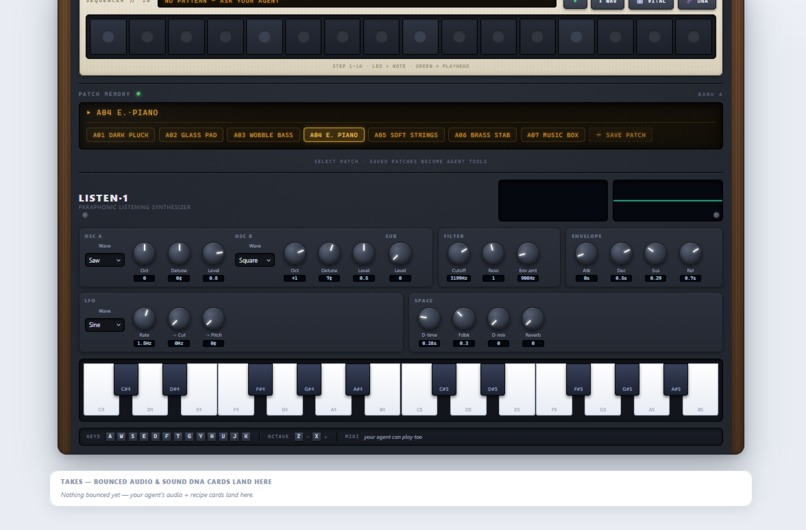
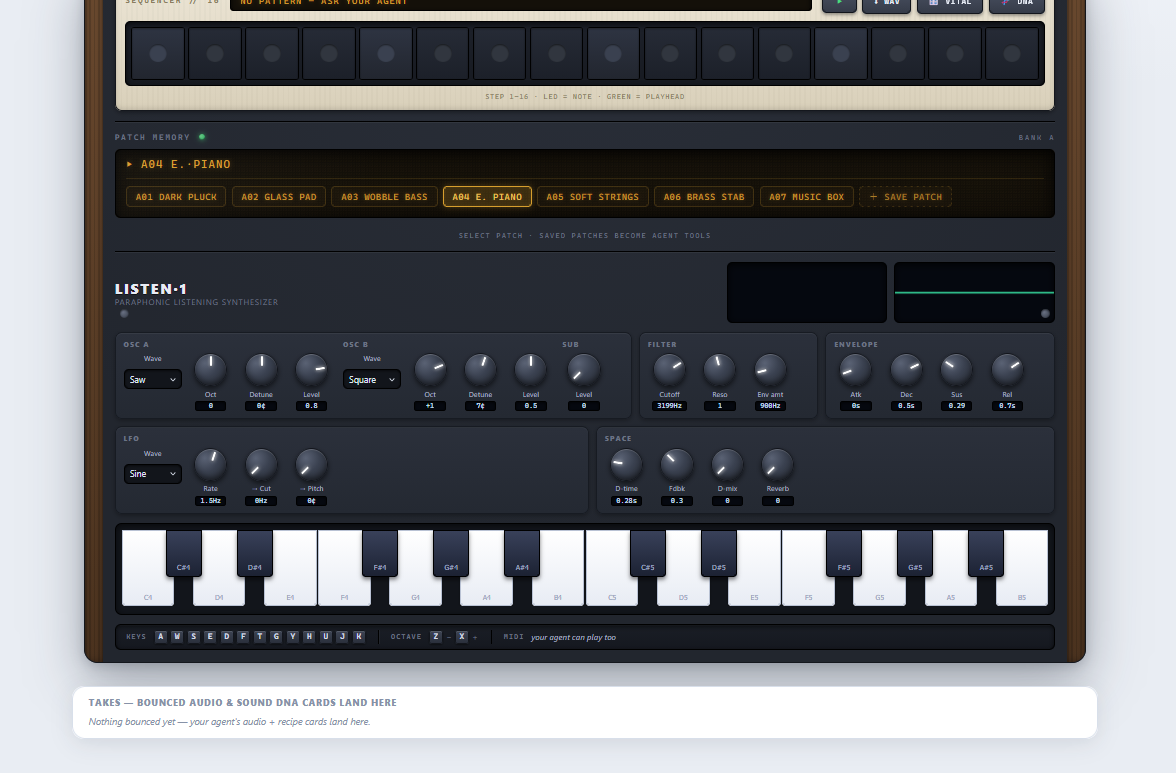
LISTEN is a synthesizer your AI agent can actually hear. You describe a vibe — "a calm, dreamy lo-fi pad" — and the agent plays a note, runs real-time FFT analysis on the synth's own output to get structured acoustic features (brightness, body, tone, envelope), shapes the knobs to match, then listens again to prove it worked. Turn a knob yourself and it notices, and works around your intent.
When the sound feels right, the agent composes a loop that fits it and exports real artifacts you keep: a DAW-ready Vital preset, a 44.1kHz stereo WAV of the loop, and a Sound DNA card with the agent's analysis and the full recipe. Saving a preset dynamically registers it as a new agent tool — the agent's vocabulary grows with your sound library.
It's WebMCP used as perception, not just actuation: 20 tools, one shared context, and an accessibility layer (plain-language controls) that opens sound design to people who don't know synthesis — or can't operate 30 tiny knobs.
Built With
- codex
- github
- javascript
- netlify
- webmcp

Log in or sign up for Devpost to join the conversation.