-
-
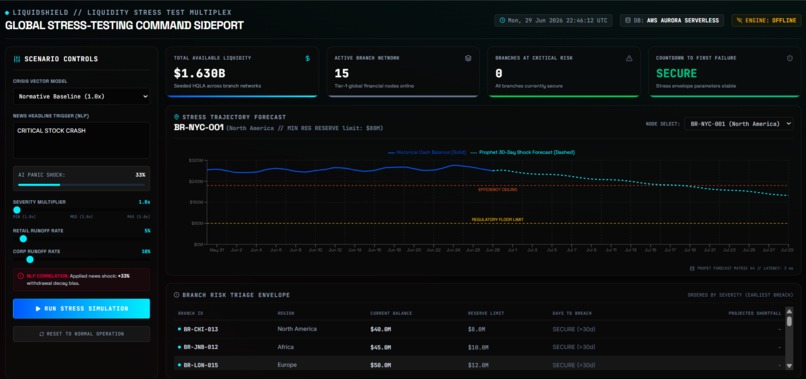
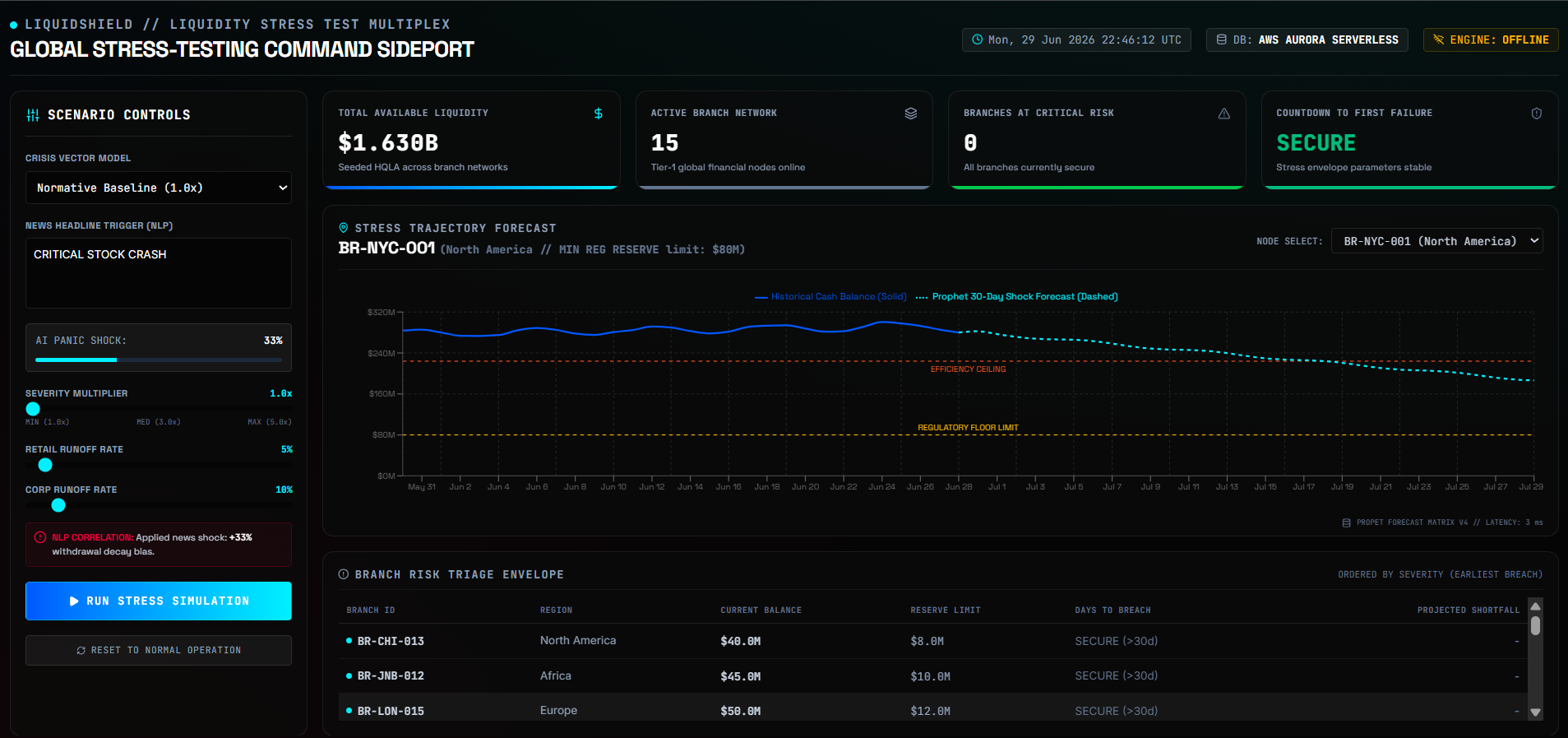
Live dashboard
Inspiration
It started with a terrifying realization about the speed of modern financial crises. Back in 2008, it took Washington Mutual nine long days to bleed $16 billion. But in the digital age, the landscape has completely fractured. When Silicon Valley Bank collapsed in 2023, fueled by social media panic and the instant convenience of mobile banking apps, customers withdrew a staggering $42 billion in a single day.
That is roughly one million dollars draining out every single second.
We asked ourselves: How can anyone keep up with a financial crisis that unfolds by the second?
The answer shocked us. Surprisingly, bank managers still use old, slow spreadsheets to fight fast moving digital bank runs. They spend hours desperately updating rows and columns just to guess which local branch might run out of cash next. This isn't just exhausting and stressful , it is incredibly dangerous. In 2012, JPMorgan lost $6 billion in the "London Whale" disaster simply because of an undetected copy-paste error inside a manual spreadsheet.
Because these teams cannot accurately predict exactly where a sudden panic will strike, they are forced to act defensively. They hoard massive piles of cash across their entire network, crossing their fingers and hoping they don't run dry.
We realized these risk managers didn't need another complex dashboard telling them what was already happening. They needed a tool that made their jobs proactively easier. They needed an early warning system.
That is why we built LiquiShield. We set out to replace the anxiety of error-prone spreadsheets with an automated AI command center. LiquiShield works continuously in the background, listening to market sentiment and running complex predictive math so humans don't have to.
Instead of staring at dense, confusing numbers while a crisis unfolds, executives are given a beautifully clean interface with an exact, real-time countdown of when a specific branch will hit zero. By predicting the failure days before it happens, LiquiShield turns a chaotic, terrifying financial emergency into a calm, controlled decision, giving real people the power to stop a disaster before the panic even starts.
What it does
LiquiShield is like a crystal ball for bank managers. It takes basic cash numbers and turns them into a clear, 30-day map showing how long a bank can survive a crisis. It replaces slow spreadsheets with four main tools:
Global Cash Dashboard: Shows exactly how much money every branch around the world has right now, all on one simple screen.
AI Panic Simulator: Lets managers test what happens during a bank run. They can enter custom numbers or let our AI scan the news to predict exactly how fast panicked customers will withdraw their money.
30-Day Forecast: Uses AI to draw a clear timeline showing exactly how fast a specific branch will run out of cash over the next month during an emergency.
The Zero-Hour Alarm: Automatically spots any branch that is about to drop below safe cash levels. Instead of guessing, it gives a clear "Days to Failure" countdown so managers know exactly where to send emergency money first.
How we built it
To build a tool that can handle a real-time bank crisis, we needed a system that is fast, smart, and easy to use. We built LiquiShield in three clear steps:
Phase 1: The Smart Database (AWS)
We needed to store a massive amount of bank transaction data without the system ever slowing down. We chose Amazon Aurora PostgreSQL (Serverless) for our database. On a normal day, the database is quiet. But if a risk manager starts a "bank run" simulation, thousands of data requests happen at the exact same time. Because Aurora is "serverless," it automatically powers up to handle that massive sudden spike. This keeps the app running smoothly without crashing.
Phase 2: The AI Brain (Python & Machine Learning)
Our back-end is built with Python and FastAPI. This is where the heavy thinking happens. Our main goal here was to turn human panic into a mathematical equation.
The Baseline: First, the back-end takes the bank's history from our AWS database and feeds it into Facebook Prophet (an AI forecasting tool). This draws a normal 30-day map of the bank's cash.
The Panic Factor: At the same time, our custom NLP (Natural Language Processing) engine reads the news to measure how scared people are. It turns this human "panic" into a math multiplier.
The Result: It instantly applies this panic multiplier to the AI forecast. This shows us exactly how much faster the bank will run out of money during a crisis.
Phase 3: The Fast Dashboard (Vercel & Next.js)
We wanted the front-end to feel perfectly balanced with the powerful back-end. We built the screen using Next.js and React, and hosted it on Vercel.
Performance: Vercel's technology helps our heavy charts load instantly. Even when the AI is doing massive calculations, the user's screen never freezes.
Design Philosophy: We purposely hid all the complicated background math from the user. Instead of showing them confusing data, the UI does the hard work. When a branch is in danger, the screen simply isolates it, turns red, and gives the manager a clear "Days to Failure" countdown so they can fix the problem immediately.
Challenges we ran into
Building a real-time AI financial tool is difficult, and our team had to overcome several major technical hurdles:
Turning Emotion into Math: Our biggest challenge was figuring out how to measure human panic. It is easy for an AI to read the news, but translating those words into a strict "Shock Multiplier" that our Facebook Prophet model could actually understand required a lot of trial, error, and fine-tuning.
Preventing Screen Freeze: Facebook Prophet does some very heavy math to predict 30 days of cash flow. At first, sending all that complex data to the front-end caused the dashboard to lag. We had to heavily optimize our Next.js code and rely on Vercel's fast rendering to ensure the screen updated instantly without freezing.
Connecting the Database and the AI: Setting up our Amazon Aurora database to talk perfectly with our Python/FastAPI brain was tricky. We had to structure our data very carefully so the AI could pull massive amounts of banking history in milliseconds without crashing the system.
Handling Sudden AI Drops: Most AI prediction tools are built to show smooth, slow trends over time. A "bank run" is the exact opposite it is a sudden, massive drop. We had to adjust our AI models so they would react violently and immediately to sudden stress, rather than trying to smooth the data out.
Accomplishments that we're proud of
We set out to build an enterprise grade tool, and we are incredibly proud of the seamless integration we achieved across our entire stack. It is one thing to run complex Facebook Prophet time-series forecasts in a simple Python environment but getting that heavy math to pull data from an AWS database, run through a high-speed FastAPI server, and show a live countdown on our Next.js website in under three seconds genuinely feels like magic. We are thrilled that we took complex, messy financial datasets and turned them into a clean, deterministic visual experience that reacts instantly to user stress tests.
What we learned
Building a high-stakes financial tool from the ground up taught us some massive lessons:
Mixing AI is hard: We learned that combining human emotion (from our NLP model) with strict math (from Facebook Prophet) takes a lot of careful tuning. Getting them to work together smoothly was a huge learning curve.
Speed changes everything: We learned the hard way about server lag. It is totally different to run an AI on your own laptop compared to making it run live using an AWS database, a FastAPI backend, and a Next.js website. We learned so much about optimizing our code just to hit that strict 3-second speed goal.
The banking world is fragile: Researching this project opened our eyes to how vulnerable huge banks are to sudden panic. We walked away understanding exactly why the financial world desperately needs to upgrade from manual spreadsheets to automated AI.
What's next for LiquiShield
Our immediate next step is taking LiquiShield from a powerful simulation engine to a live, continuous monitoring system. We plan to integrate directly with real-world data streams connecting our NLP engine to live Bloomberg and social media feeds to constantly track market sentiment in real-time. By coupling this with direct API integrations into live banking core systems, LiquiShield will transition from a manual stress-testing tool into a fully automated, 24/7 early warning system that quietly monitors the globe and alerts risk managers the second a storm starts brewing.
Built With
- amazon-aurora
- amazon-web-services
- facebook-prophet
- fastapi
- machine-learning
- natural-language-processing
- next.js
- postgresql
- python
- react
- recharts
- tailwind-css
- vercel

Log in or sign up for Devpost to join the conversation.