-
-
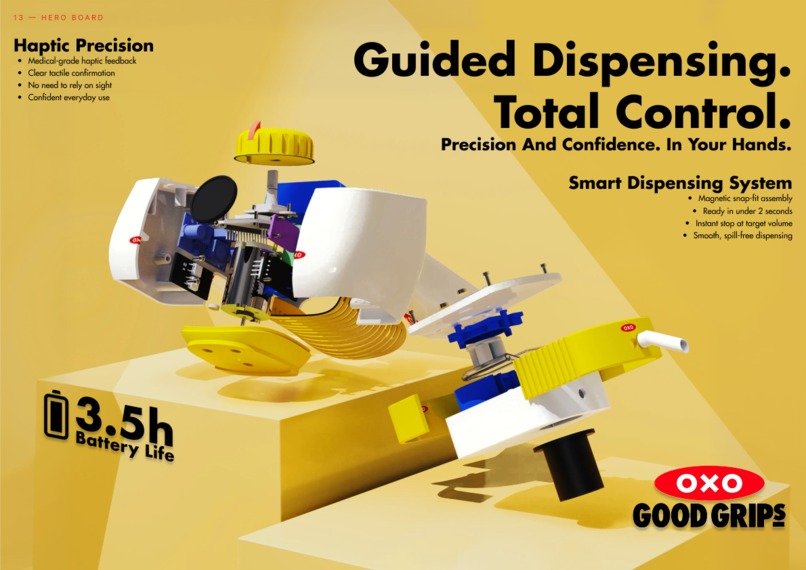
Decomposition
-
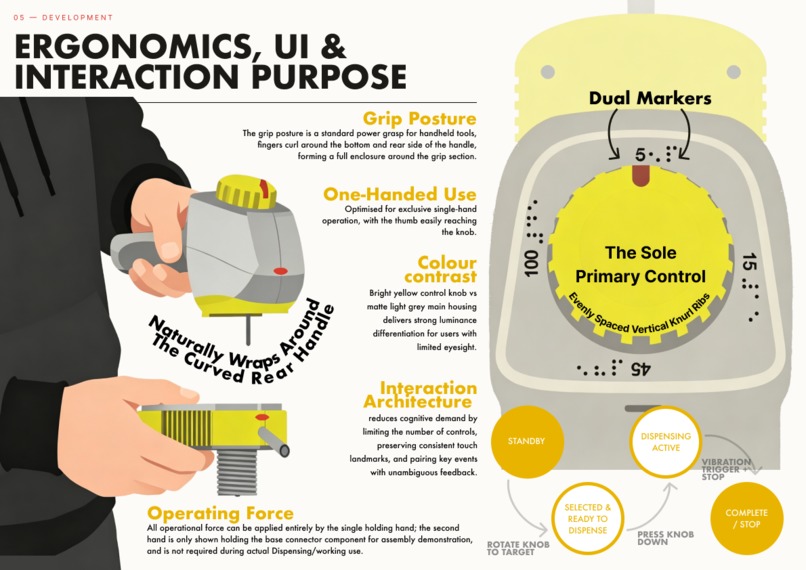
UI design
-
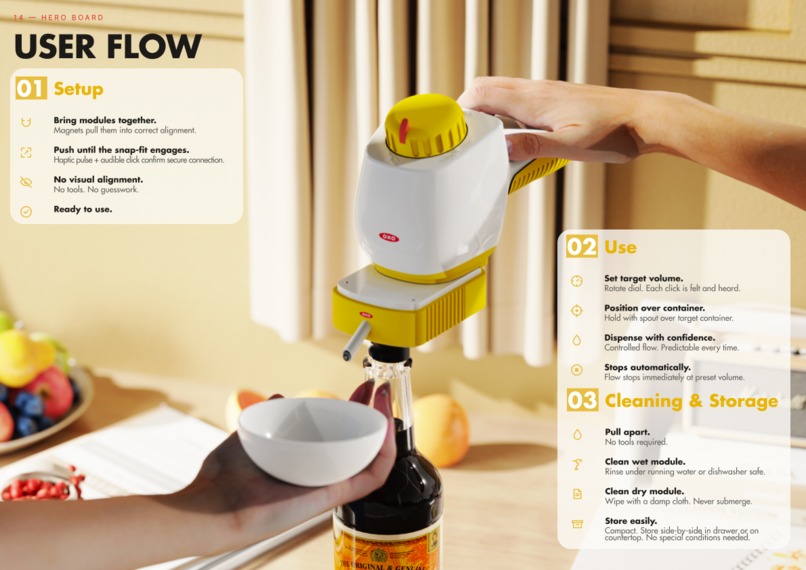
User manual
-
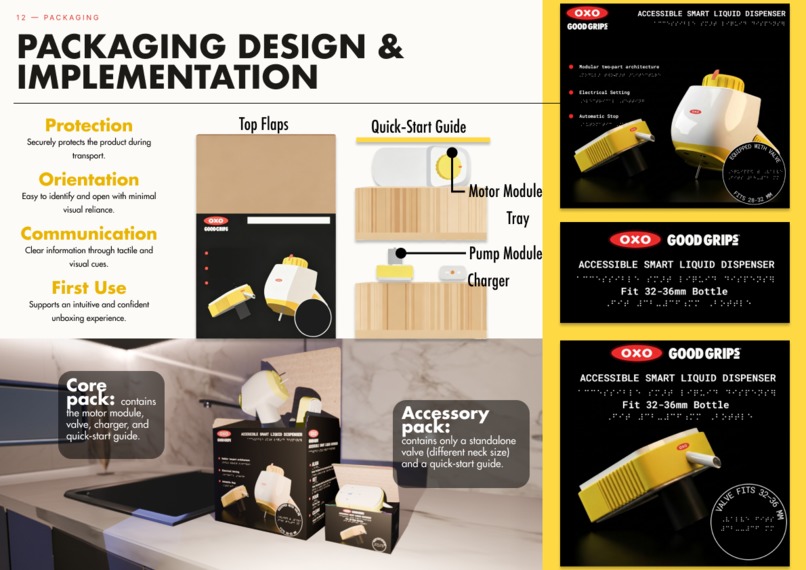
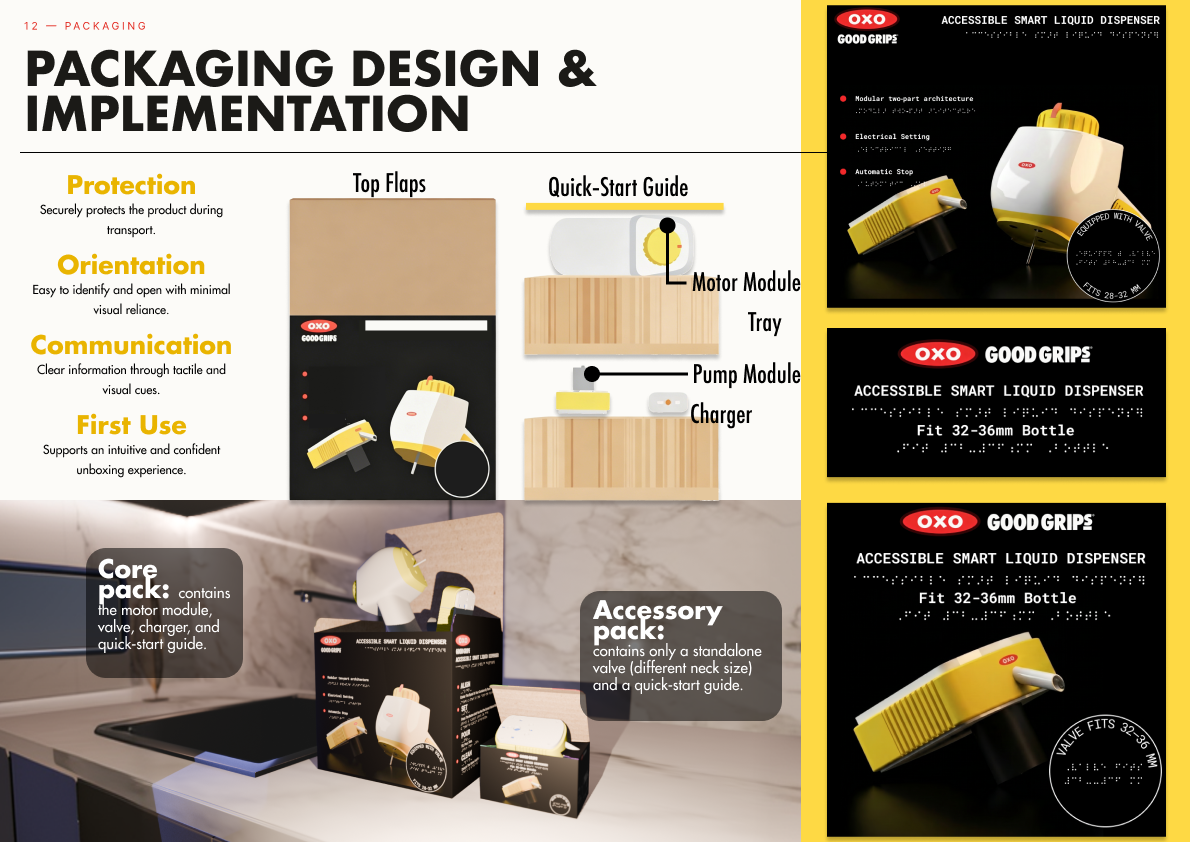
Packaging
-
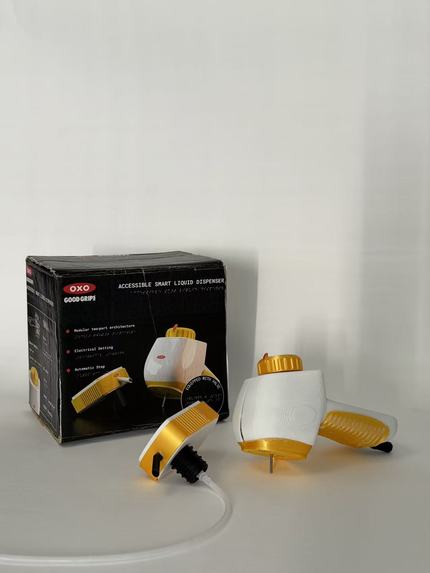
Product in real life
Inspiration
What it does
Inspiration
Pouring and measuring liquids is an everyday task, but most kitchen tools are designed around visual feedback: identifying the bottle, locating the outlet, aligning it with a container, judging the amount being poured, and knowing when to stop.
Through our research into non-visual dispensing, we found that this creates unnecessary uncertainty, effort, and spill risk for people with visual impairments.
We asked:
How might we make dispensing liquid predictable and independent without relying on sight?
Our goal was not to create a specialised medical-looking device, but an inclusive everyday product that could fit naturally into a normal kitchen.
What it does
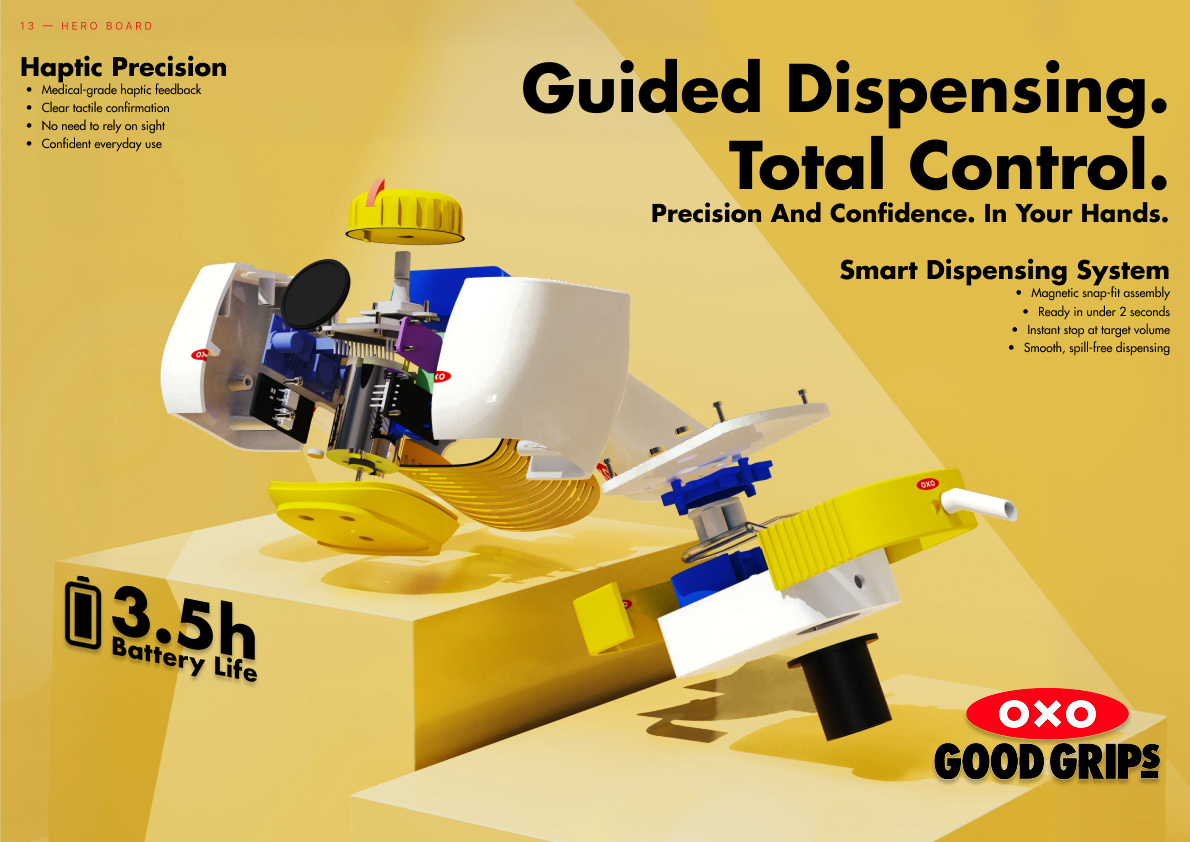
We developed an Accessible Smart Liquid Dispenser that provides non-visual control over liquid dispensing through tactile, haptic, and audio feedback.
The interaction is intentionally simple:
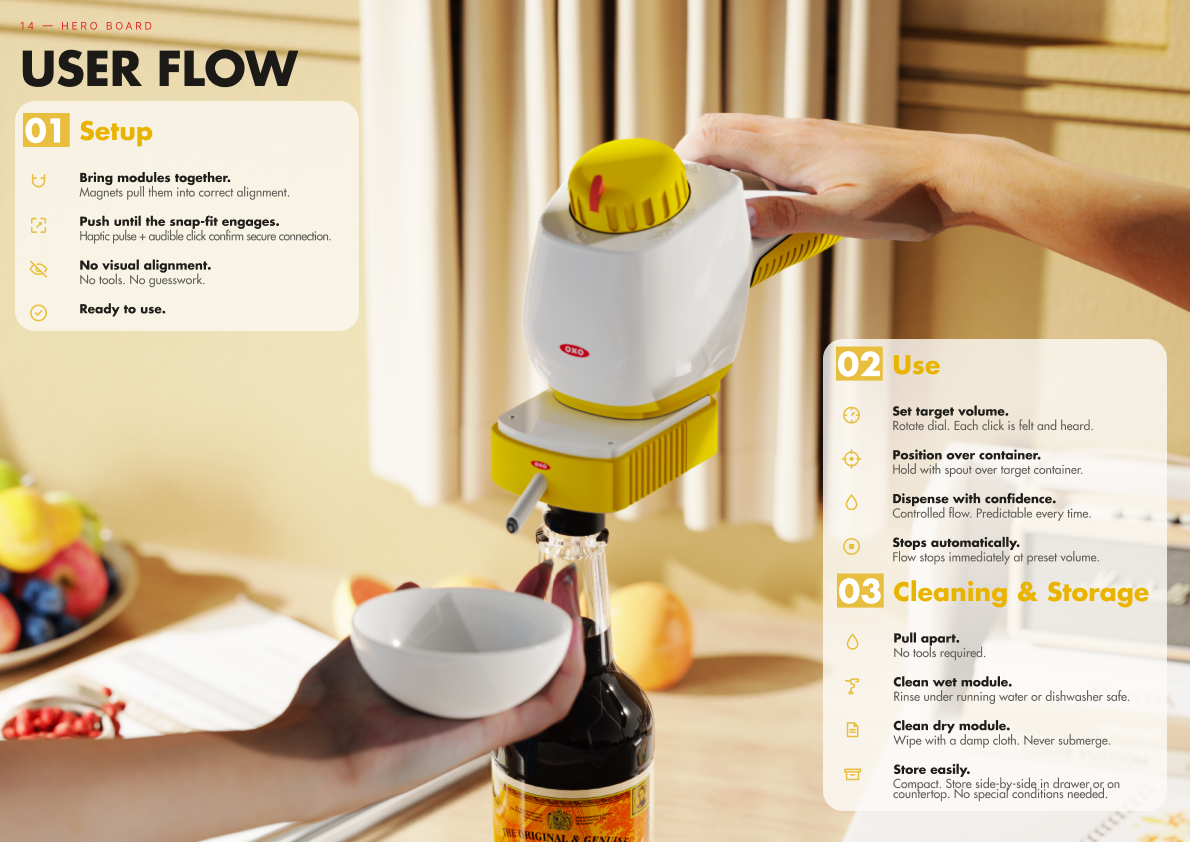
- Attach the dispenser to the bottle.
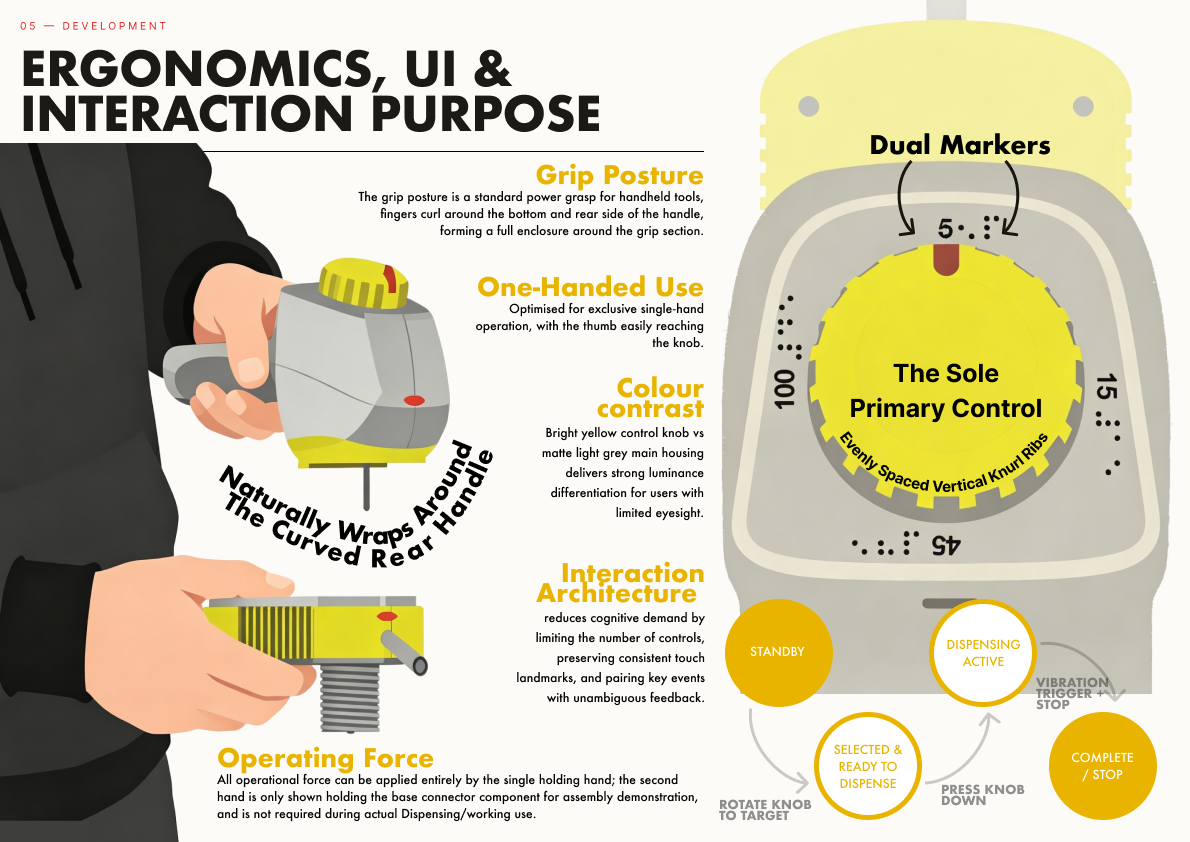
- Rotate the tactile knob to select a target dose.
- Position the outlet over the container.
- Press the knob to begin dispensing.
- The system automatically stops at the selected amount.
- Haptic and audio feedback confirm key actions and completion.
This reduces the need to visually monitor the liquid while pouring and gives the user clear physical confirmation throughout the process.
How we built it
The prototype combines mechanical design, electronics, firmware, and accessible interaction design.
An ESP32 acts as the main controller. A rotary encoder provides both dose selection and confirmation input, while the ESP32 controls the peristaltic pump and vibration motor through MOSFET switching.
The system uses:
- ESP32 microcontroller
- Rotary encoder
- Peristaltic pump
- Vibration motor
- Speaker and audio feedback
- MOSFET motor control
- Rechargeable Li-ion battery system
- Custom-designed modular housing
- Tactile and high-contrast interaction features
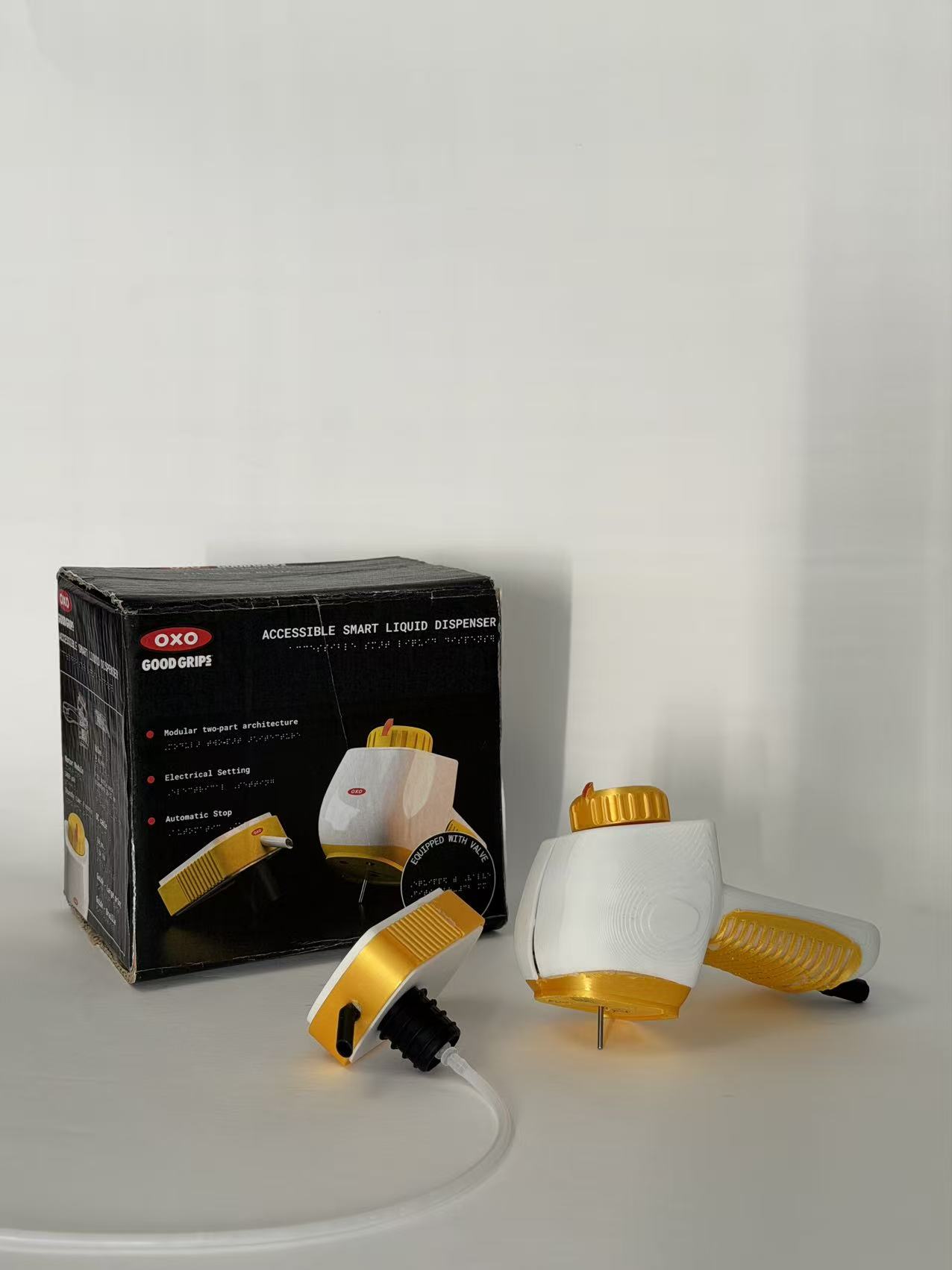
A major design decision was separating the product into dry and wet modules. The electronics, battery, controls, and feedback components remain protected in the reusable upper housing, while the liquid-contact pump, tubing, and outlet are contained in a removable lower module that can be cleaned or replaced.
We iterated from early form exploration and breadboard pump testing to an integrated functional prototype, while considering ergonomics, manufacturing, assembly, cleaning, and real-world kitchen use.
Challenges we faced
Designing without relying on vision
The biggest challenge was not simply controlling a pump. It was designing an interaction that communicates enough information without requiring the user to look at the product.
We therefore treated tactile, haptic, and audio feedback as core parts of the interface rather than secondary accessibility features. Important events such as dose selection, connection, dispensing, and completion each needed clear and consistent feedback.
Balancing accessibility with simplicity
Adding more buttons and feedback could technically provide more information, but would also increase cognitive load.
We reduced the interface to a single primary rotary control and designed consistent tactile landmarks so the interaction could be learned through touch.
Integrating liquid and electronics safely
Combining pumps, batteries, electronics, and a washable liquid path inside a handheld product created another challenge.
Our design evolved from an all-in-one housing into a modular wet/dry architecture. This reduced the handheld bulk, protected the electronics, and made the liquid-contact components easier to clean and service.
Designing beyond the prototype
We also wanted the concept to be realistically manufacturable rather than stopping at a proof of concept.
We developed the housing architecture with assembly and manufacturing in mind, including modular subassemblies, snap-fit opportunities, serviceable fasteners, material selection, and an accessible packaging and onboarding experience.
What we learned
This project changed how we think about accessibility.
We learned that inclusive design is not simply about adding an accessibility feature to an existing product. It requires reconsidering the entire interaction around what information the user actually needs.
We also learned that solving for a specific accessibility challenge can create benefits for a much wider group. Predictable dosing, one-handed operation, reduced spills, washable components, and clear physical feedback can also help older users, people with reduced dexterity, and anyone who wants a simpler dispensing experience.
Most importantly, we learned to treat confidence and independence as engineering requirements, not just emotional outcomes.
What's next
The next stage would focus on broader testing with visually impaired users and accessibility organisations, improving dispensing accuracy across different liquid viscosities, refining the wet/dry interface, and developing the prototype toward a manufacturable product.
Our long-term goal is simple:
Make accessible interaction feel like good everyday design, rather than specialist equipment.


Log in or sign up for Devpost to join the conversation.