-
-
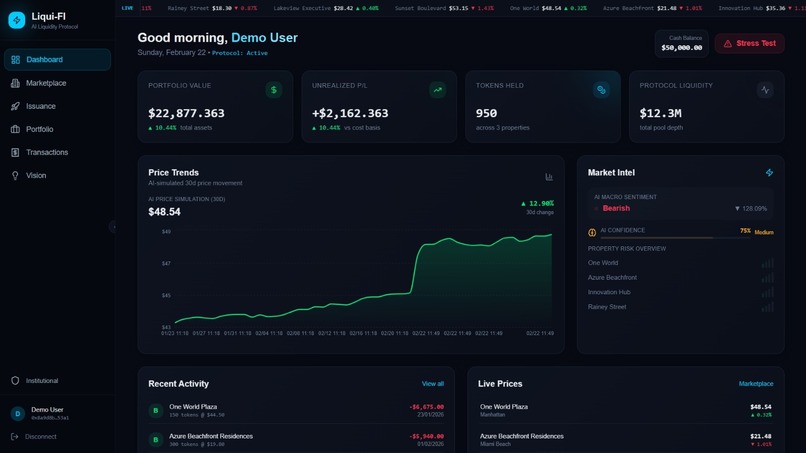
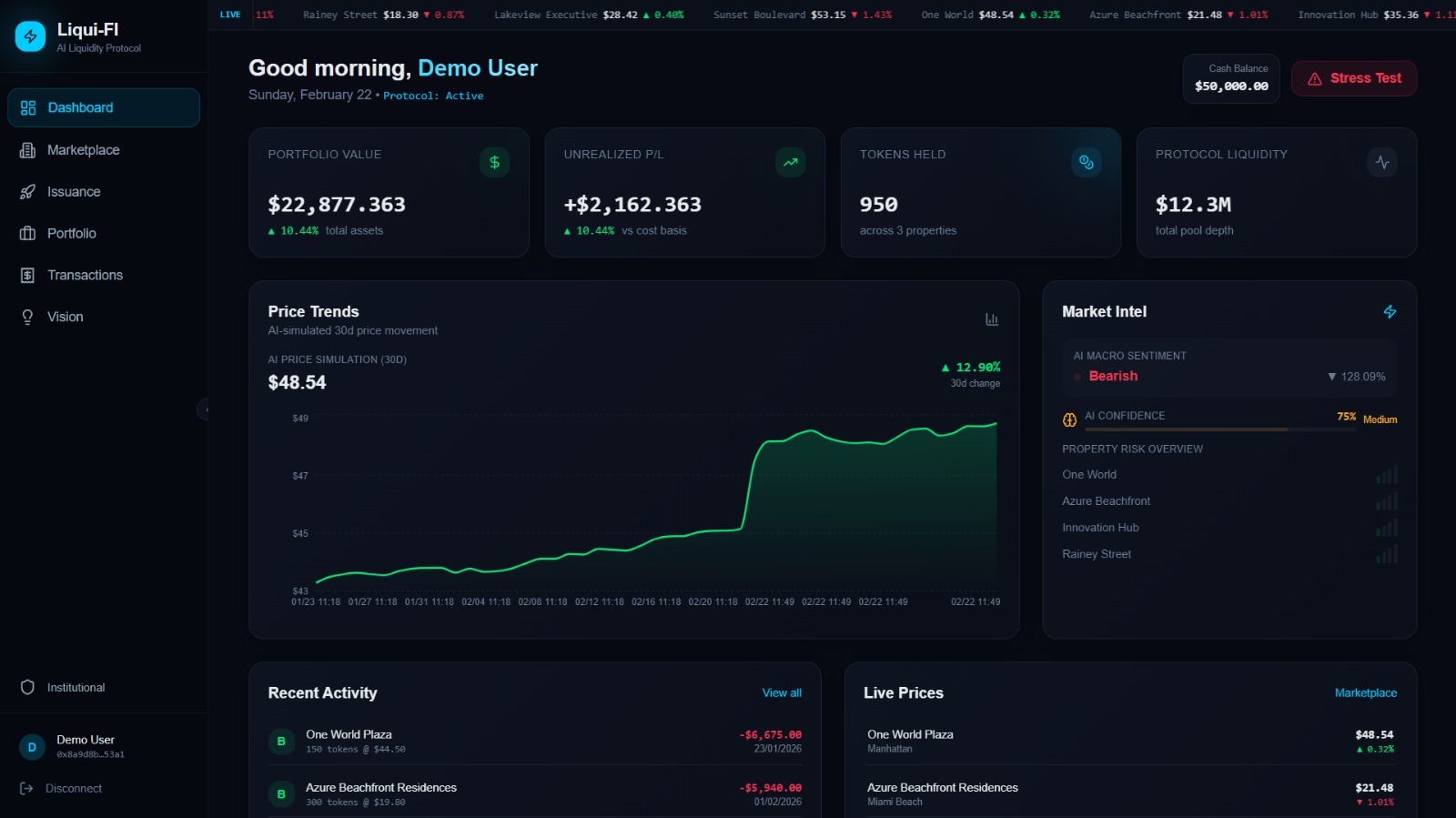
Snapshot of Dashboard
-
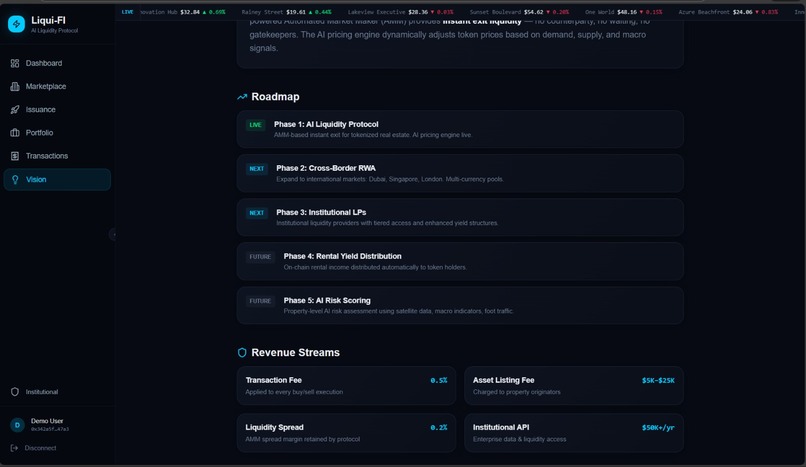
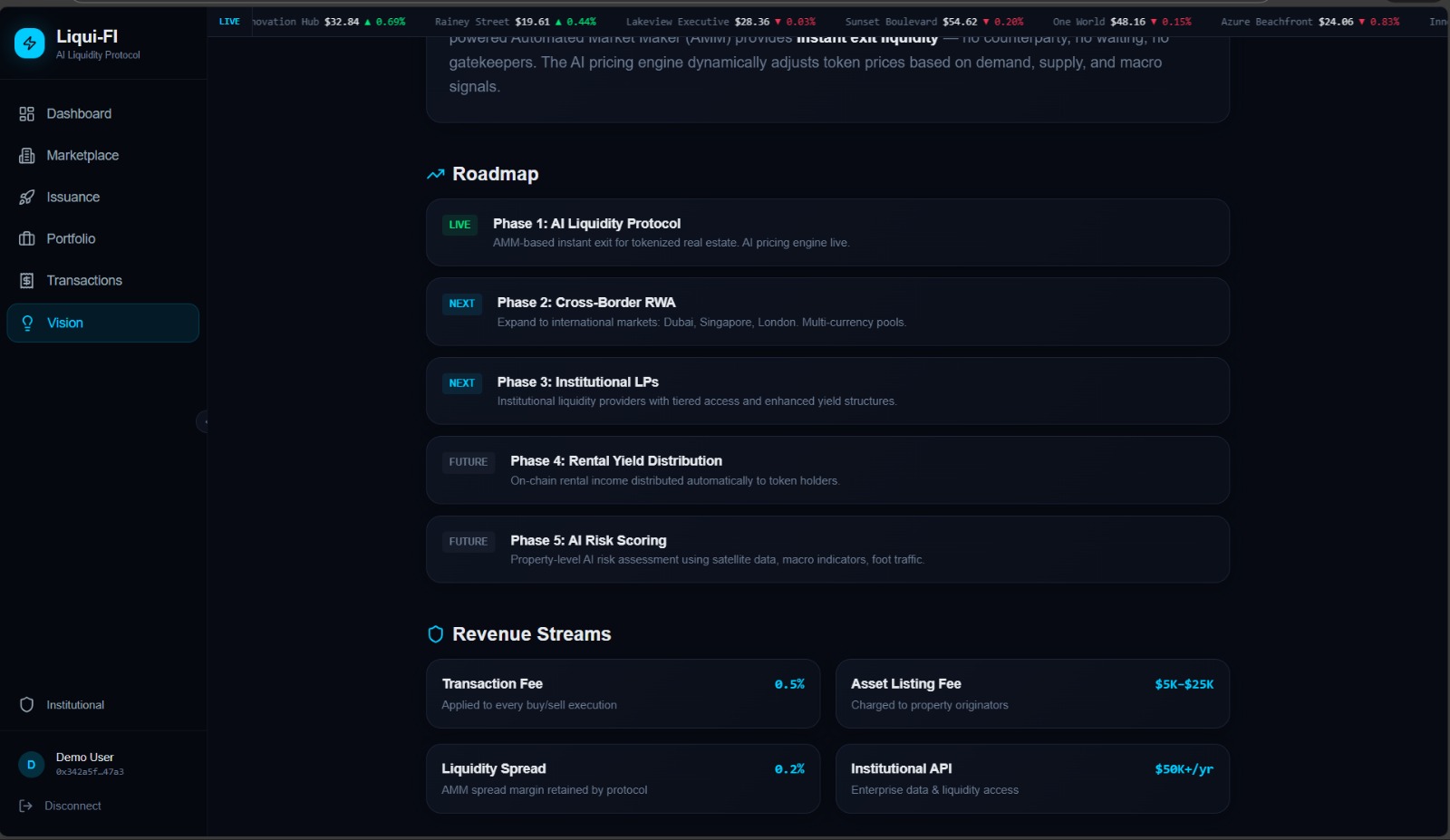
Roadmap
-
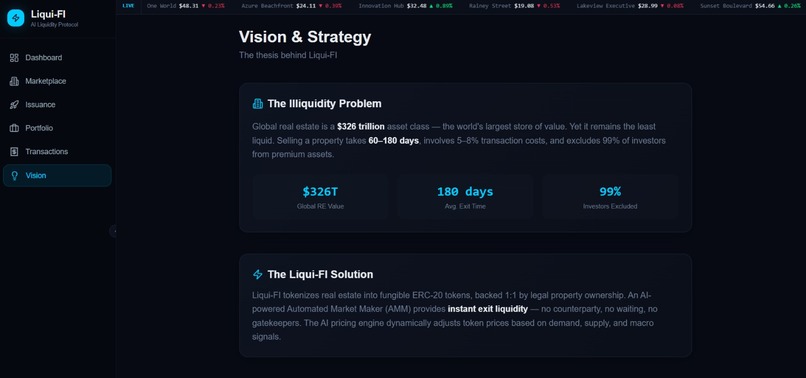
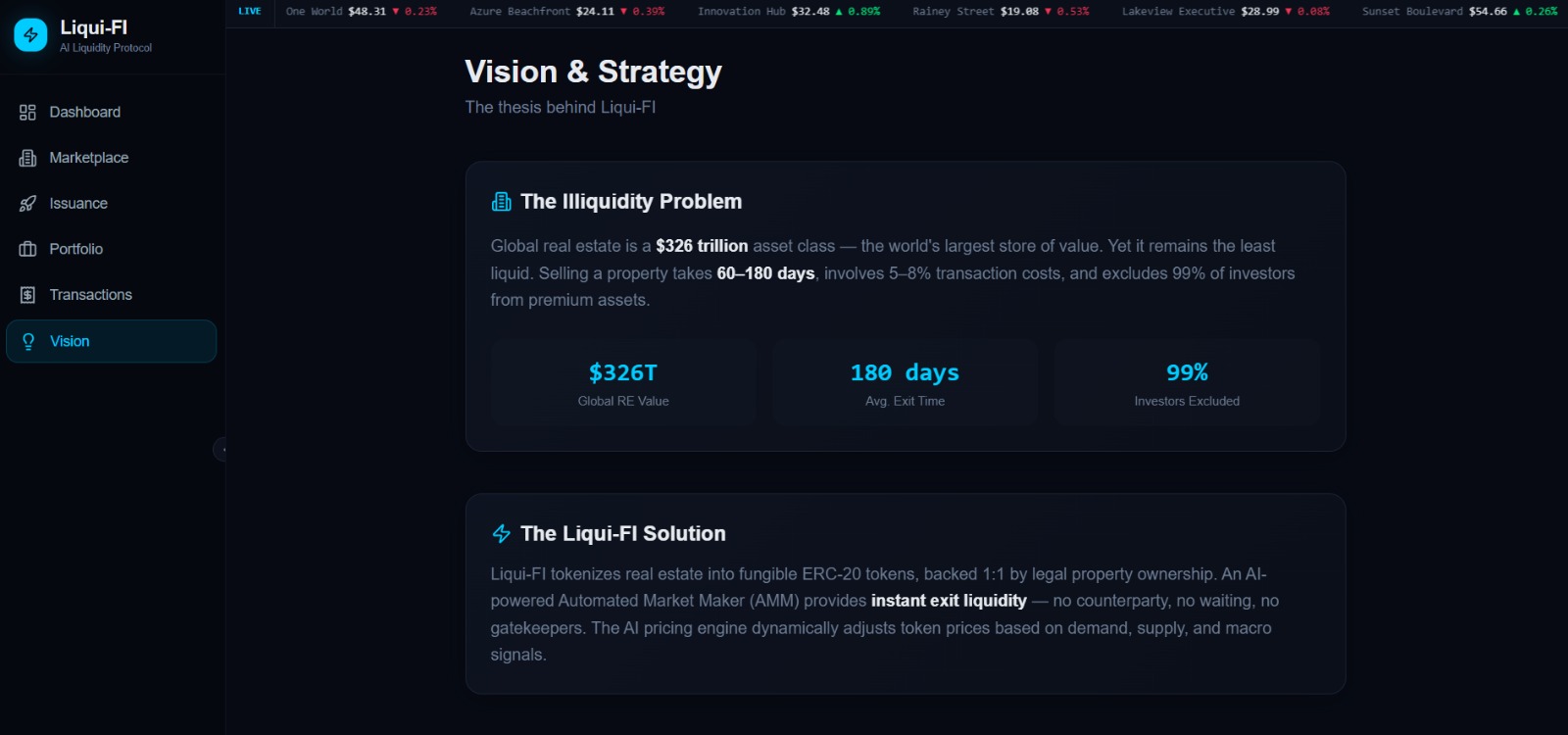
Vision & Statergy
-
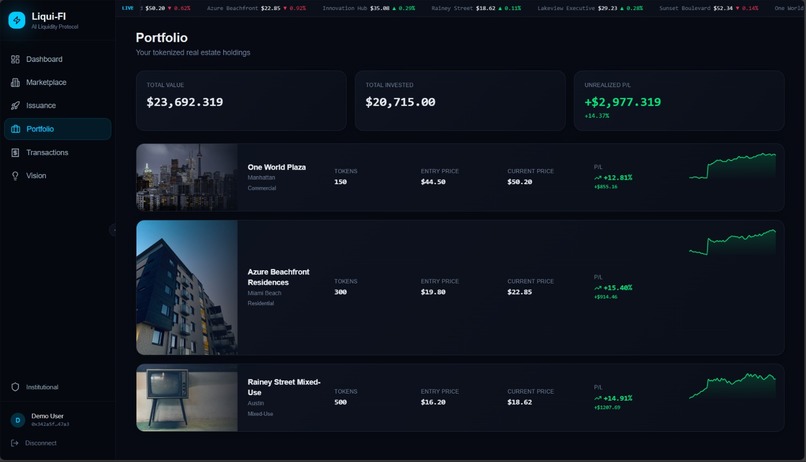
Portfolio
-
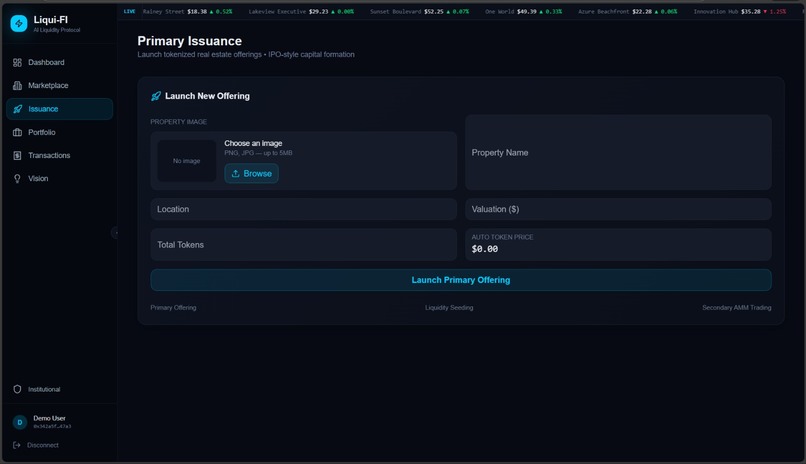
Snapshot of Issuance
Inspiration
Real estate is one of the largest asset classes in the world, yet it remains highly illiquid and capital intensive. Buying property requires significant upfront capital, and exiting can take months due to legal and market friction.
We were inspired to rethink real estate as a programmable financial asset. What if real estate could behave more like a liquid market instrument — with transparent pricing, fractional ownership, and instant exit?
Liqui-Fi was built to explore how automated market maker (AMM) mechanics and structured token issuance could unlock liquidity for tokenized real estate.
What it does
Liqui-Fi is an AI-powered liquidity protocol for tokenized real estate.
It enables:
- Fractional ownership of real-world properties
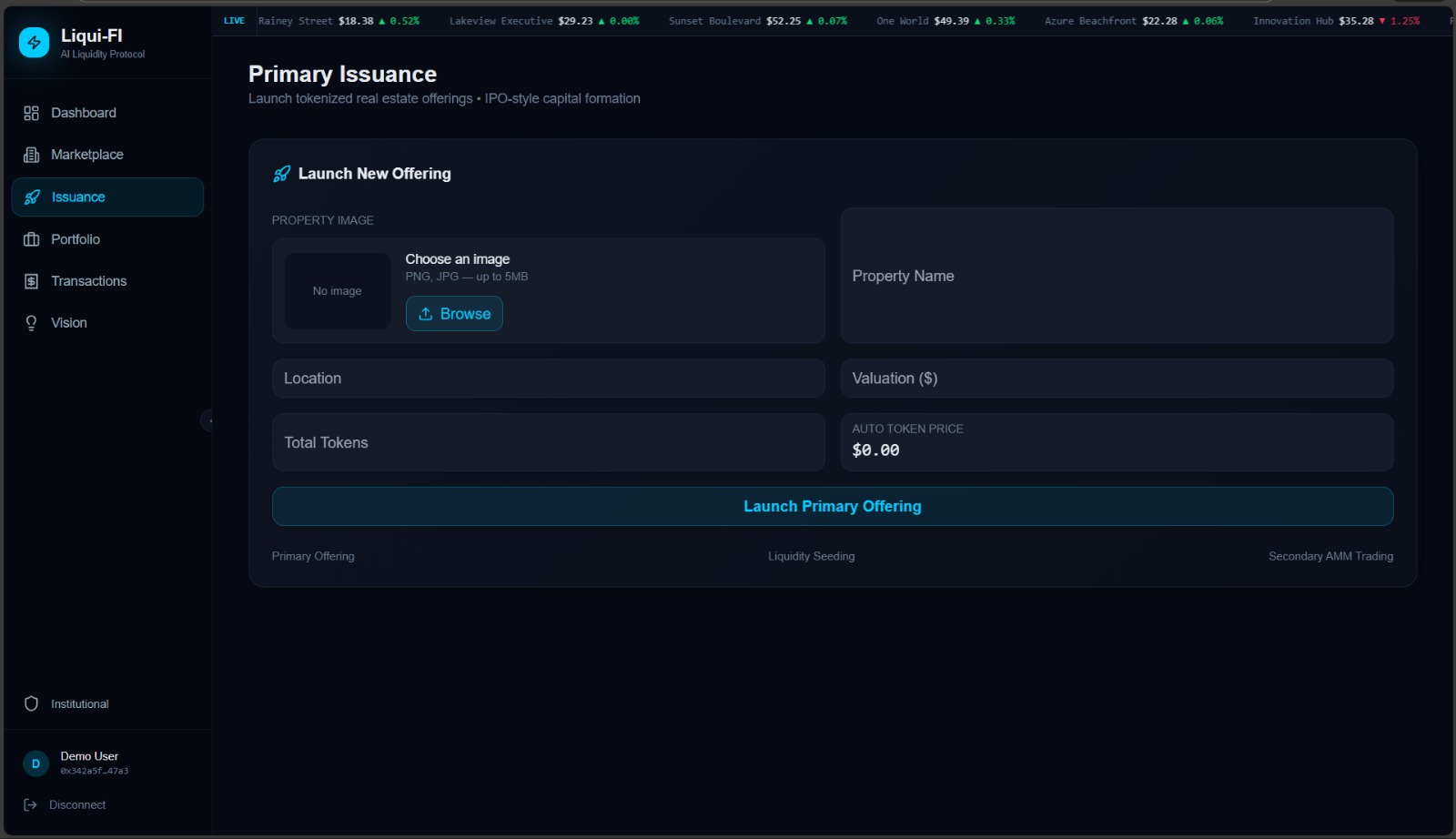
- IPO-style primary issuance with structured allocation (80% public, 20% liquidity)
- Instant secondary trading via AMM logic
- Real-time price updates based on buy/sell pressure
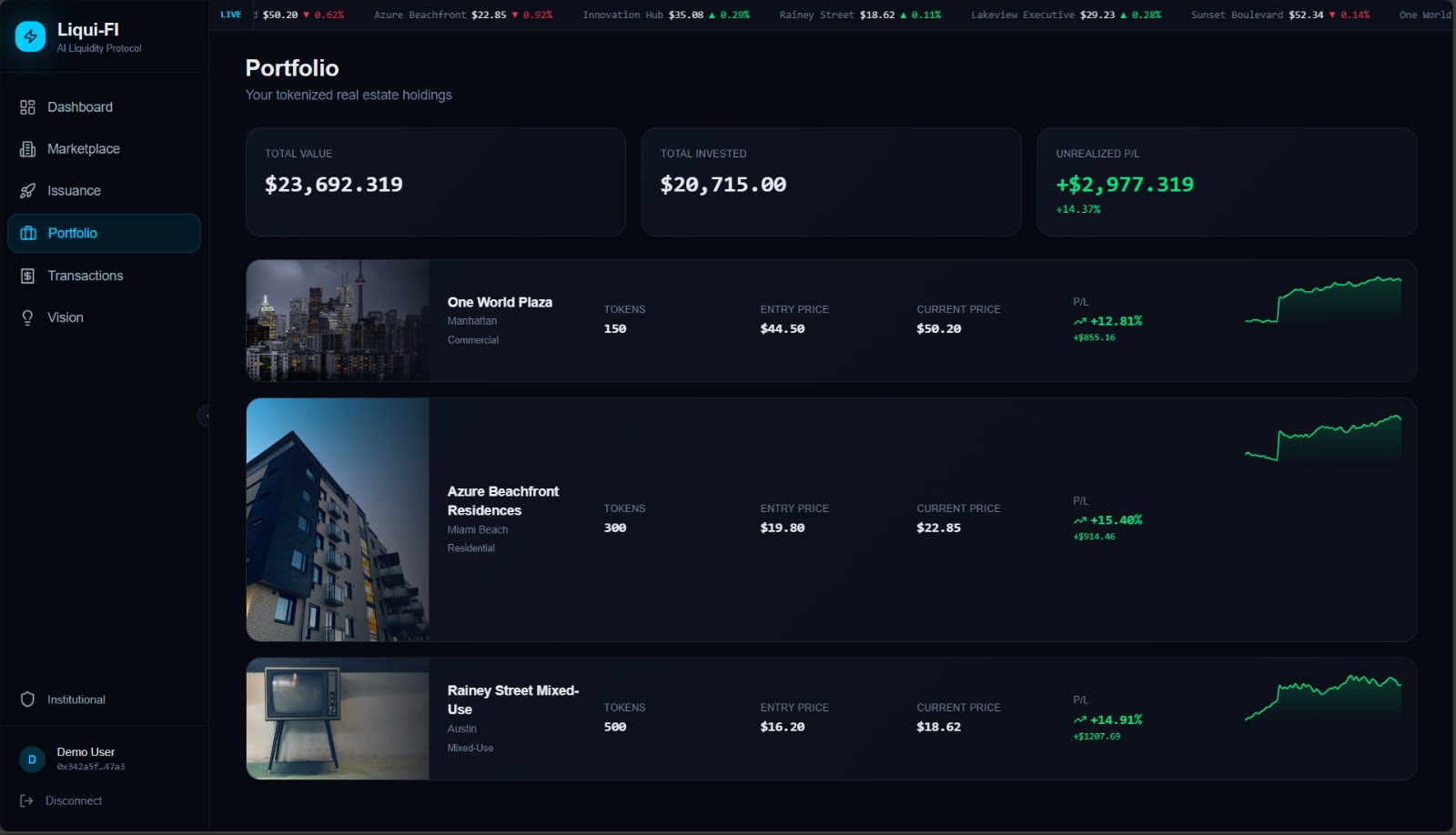
- Portfolio tracking with P/L in USD and percentage
- Liquidity depth and risk visualization
Each property transitions from a structured primary offering into a live automated market maker environment, enabling continuous price discovery without order matching.
How we built it
Liqui-Fi is built using React, TypeScript, and Zustand for deterministic state management.
The system maintains:
- Liquidity pool balance
- Available token supply
- Total supply
- Real-time price history
- Portfolio holdings
- Transaction logs
- Issuance capital allocation logic
During issuance:
- 80% of tokens are sold to public investors
- 20% are automatically reserved for liquidity provisioning
Once the public allocation is fully subscribed, the asset transitions into an AMM-powered secondary market.
Pricing follows strict directional rules:
- Buy pressure increases token price
- Sell pressure decreases token price
- Price movement per transaction is capped for stability
- Liquidity pool reserves update dynamically
This ensures financially coherent simulation rather than arbitrary UI-based price changes.
Challenges we ran into
One of the biggest challenges was maintaining economic consistency.
We had to:
- Prevent liquidity allocation from being sold during primary issuance
- Ensure price always reacts directionally to buy and sell pressure
- Cap volatility to avoid unrealistic price spikes
- Maintain portfolio and liquidity pool integrity across all state transitions
- Synchronize issuance lifecycle with secondary AMM activation
Designing a pricing model that felt realistic while remaining deterministic was a key technical challenge.
Accomplishments that we're proud of
- Implementing a structured 80/20 issuance-to-liquidity lifecycle
- Building a deterministic AMM pricing engine
- Enforcing strict directional price mechanics
- Maintaining real-time portfolio P/L updates
- Creating a coherent transition from primary market to secondary liquidity
We focused on financial correctness rather than just visual simulation.
What we learned
Through building Liqui-Fi, we gained deeper understanding of:
- Automated Market Maker mechanics
- Liquidity provisioning and reserve balancing
- Token allocation modeling
- Deterministic financial simulation
- The importance of enforcing economic constraints in system design
We learned that realistic financial infrastructure requires more than UI — it requires disciplined state modeling and pricing logic.
What's next for Liqui-Fi - AI Powered Tokenized Real Estate Liquidity
Future development could include:
- Rental yield distribution to token holders
- On-chain settlement integration
- Institutional liquidity provider pools
- Real-world valuation oracle integration
Liqui-Fi aims to demonstrate how programmable liquidity can transform static real-world assets into dynamic, tradable financial instruments.
Built With
- css
- ether.js
- hardhat
- javascript
- react
- recharts
- solidity
- typescript
- zustand


Log in or sign up for Devpost to join the conversation.