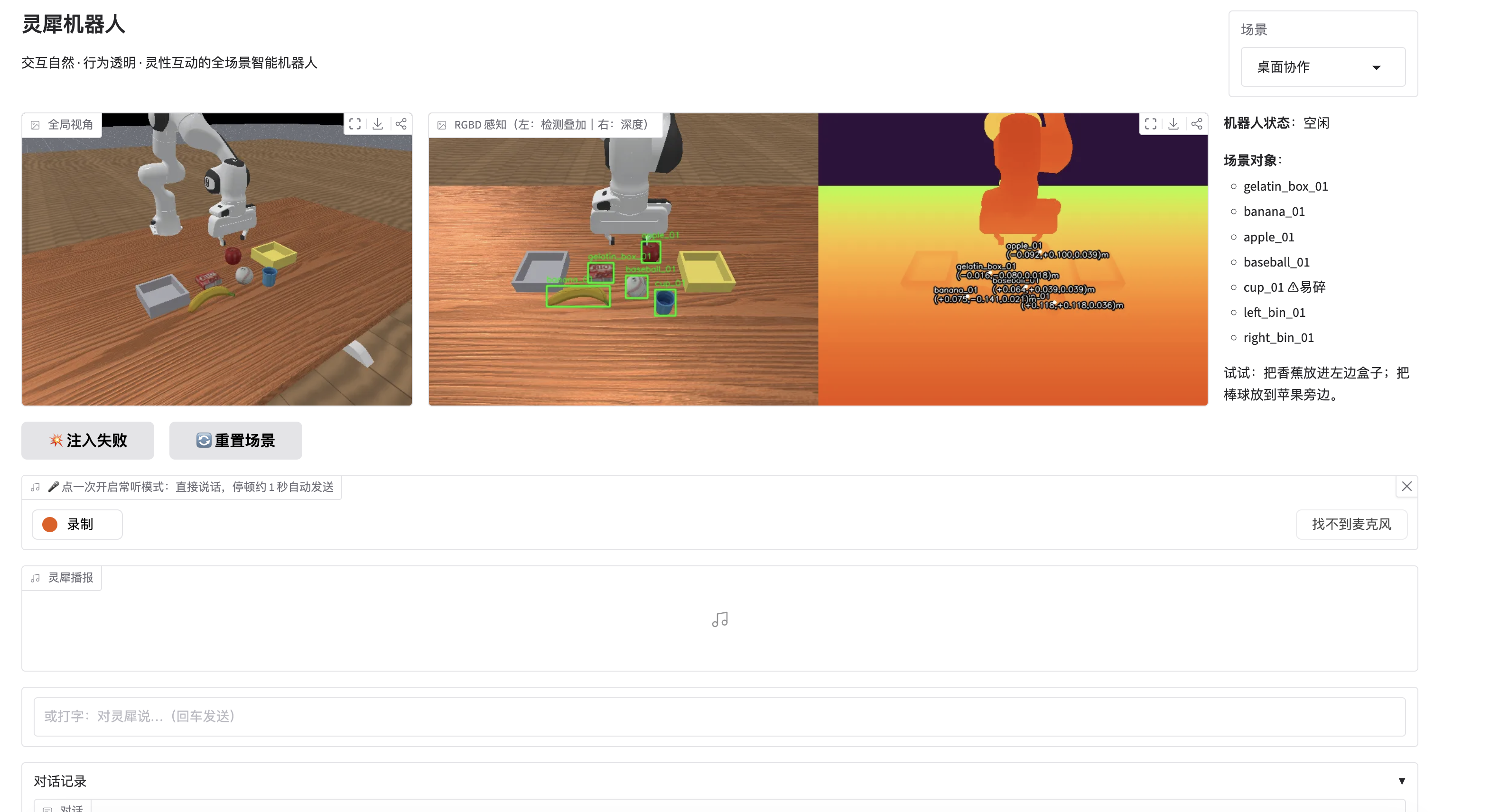
基于目前对 LingxiRobot 的项目信息,整理成以下项目故事:
LingxiRobot: Building an Embodied AI System for Continuous Human–Robot Collaboration
Inspiration
LingxiRobot was inspired by a simple observation: most robots can execute predefined commands, but they struggle to collaborate with people continuously in open and changing environments.
Real-world human needs are often incomplete, ambiguous, and expressed through natural language rather than structured instructions. A user may describe only the desired outcome, while the robot must understand the intention, observe its surroundings, determine the necessary actions, execute them safely, and confirm that the task has actually been completed.
We therefore set out to build LingxiRobot as an embodied intelligent robot system that could transform abstract human needs into reliable physical actions.
What We Learned
The most important lesson was that embodied intelligence is not a single-model problem. Reliable human–robot collaboration requires a closed-loop system that connects perception, reasoning, action, and verification:
[ \text{Observe} \rightarrow \text{Understand} \rightarrow \text{Plan} \rightarrow \text{Act} \rightarrow \text{Verify} ]
A robot must not only recognize objects or generate plans. It must also detect environmental changes, recover from execution failures, and continuously update its understanding of the task.
We also learned that natural interaction and physical execution operate at different levels of abstraction. Human instructions are semantic and goal-oriented, while robot controllers require precise and executable commands. Bridging this gap became one of the core design problems of the project.
How We Built It
LingxiRobot was designed as a modular embodied AI platform centered on continuous collaboration.
The system integrates:
- Multimodal environmental perception to understand objects, people, spatial relationships, and changes in the environment.
- Natural language and voice interaction to support intuitive communication between users and robots.
- Task understanding to convert user requests into structured goals and constraints.
- Intelligent decision-making and planning to decompose complex goals into executable action sequences.
- Motion execution to connect high-level plans with robot navigation and manipulation capabilities.
- Result verification to evaluate whether each action achieved its intended outcome.
- Autonomous learning to improve the system’s behavior through experience in open environments.
At the system level, we treated task execution as an optimization problem:
[ \pi^{*}=\arg\max_{\pi} \left( P(\text{success}\mid \pi, s) -\lambda_1 C(\pi) -\lambda_2 R(\pi) \right) ]
where (s) represents the current environmental state, (\pi) is an action plan, (C(\pi)) is the execution cost, and (R(\pi)) represents operational risk.
Instead of following a fixed plan from beginning to end, LingxiRobot repeatedly observes the environment and replans when necessary. After completing an action, the system verifies the result before moving to the next step. This closed-loop architecture makes the robot more robust to uncertainty and environmental change.
Challenges We Faced
Connecting Language to Physical Actions
Natural-language instructions are often underspecified. A request that appears simple to a person may require object grounding, spatial reasoning, task decomposition, and motion planning.
We addressed this by separating high-level semantic reasoning from low-level execution while maintaining a structured interface between them.
Handling Dynamic Environments
Open environments are unpredictable. Objects may move, people may interrupt the robot, and an action may produce an unexpected result.
To improve reliability, we introduced continuous perception and result verification, allowing the robot to detect changes and revise its plan rather than blindly continuing.
Balancing Intelligence and Reliability
More flexible reasoning can produce more diverse solutions, but physical robots require predictable and safe behavior. The challenge was to preserve the adaptability of AI models while constraining execution through verified skills, environmental checks, and task-level safeguards.
Integrating Heterogeneous Components
Perception models, language models, planners, control systems, and robot hardware operate at different frequencies and use different representations. Building a stable end-to-end system required careful interface design, state synchronization, error handling, and modular testing.
Evaluating Task Completion
Completing an action does not necessarily mean completing the user’s goal. The robot needed to verify outcomes rather than merely confirm that a command had been issued.
This led us to treat verification as a first-class component of the system instead of an optional post-processing step.
Conclusion
LingxiRobot represents our effort to move from command-driven robotics toward continuous, natural, and reliable human–robot collaboration.
The project taught us that useful embodied intelligence emerges not from perception, language understanding, or control alone, but from their integration into a closed feedback loop. By combining multimodal perception, natural interaction, intelligent planning, motion execution, autonomous learning, and result verification, LingxiRobot aims to become a general intelligent robot platform capable of operating and learning in open environments.
Built With
- embodied
- multimodal
- robotics

Log in or sign up for Devpost to join the conversation.