-
-
RESULT AFTER A POST
-
REMOVE ACTION
Inspiration
As a Latin American developer and AI engineer, I've experienced firsthand how language barriers fragment online communities. Subreddits like r/france, r/de, and r/chile enforce language-only rules, but moderators spend 3–5 minutes per post manually reading, translating, and deciding on off-language content. I wanted to build a tool that reduces that to under 30 seconds — with full transparency into why a post was flagged and how the decision was made.
What it does
LinguaGuard is a multilingual moderation tool for Reddit that detects, translates, and helps moderators act on off-language posts and comments. When a mod right-clicks any post or comment:
- Signal detection — A 3-layer hybrid engine analyzes the content: heuristic language detection first, AI verification second (Gemini 2.0 Flash), graceful fallback third
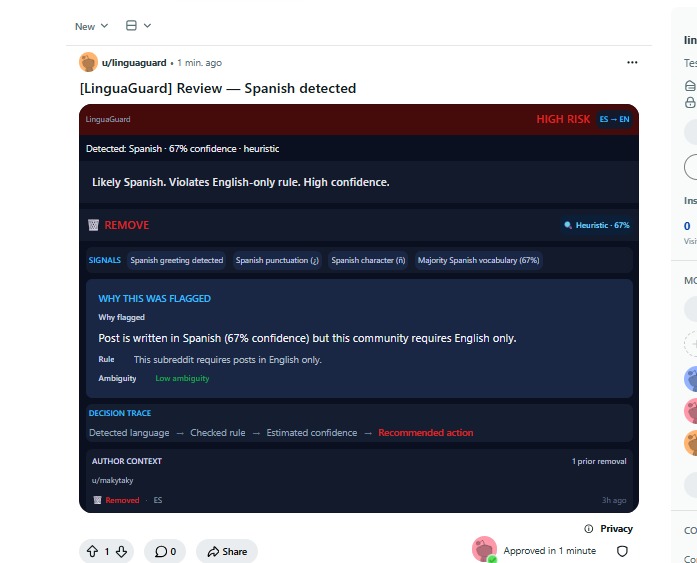
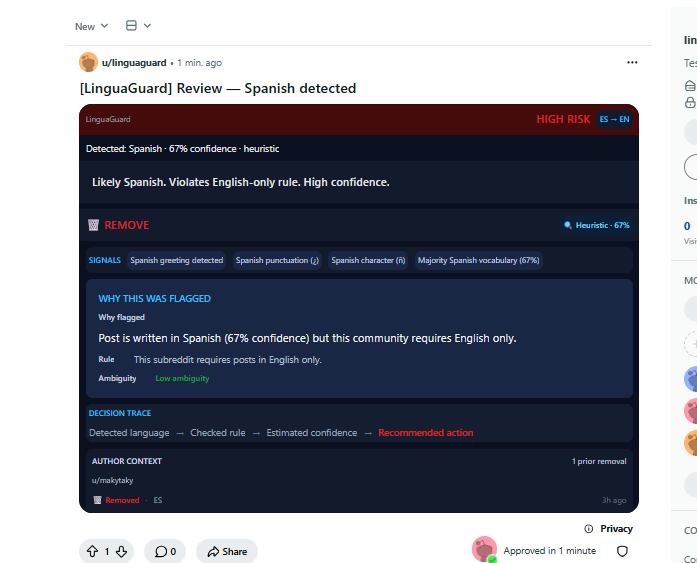
- Interpretation — A rich Devvit Blocks panel shows risk level, semantic signals (e.g. "Spanish greeting detected", "Spanish punctuation (¿)"), confidence score, and matched rule
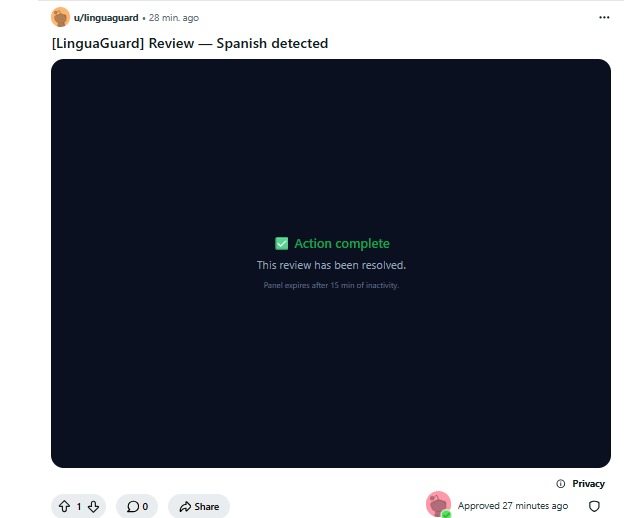
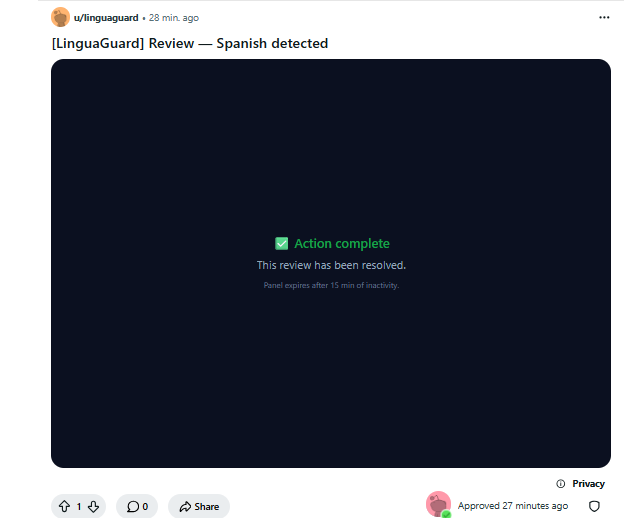
- Action — The mod sees a recommended action (Remove / Approve / Review) with full context, then chooses — and if they disagree with the AI, the override is logged for quality tracking
Key features:
- Explainable AI: Semantic signals, decision trace pipeline, confidence %, and ambiguity indicators — not just a black-box recommendation
- Human-in-the-loop: Moderator overrides are tracked and logged in mod notes for auditability
- Author history: Tracks repeat offenders across sessions with auto-escalation (3+ removals → HIGH RISK)
- Progressive disclosure: Primary actions (Remove/Approve) prominent, secondary actions (Remove+DM, Review, Dismiss) tucked below
- Resilient architecture: Works offline — heuristic detection covers 10+ languages even when AI is unavailable
How I built it
- Platform: Devvit (Reddit's developer platform) with TypeScript and Devvit Blocks for native Reddit UI
- AI layer: Gemini 2.0 Flash via Devvit's native AI integration, with a heuristic fallback engine that scores word frequency across Spanish, Portuguese, French, German, Italian + script detection for Japanese, Korean, Chinese, Arabic, Russian, Thai, Hindi
- Architecture: 5-module TypeScript codebase —
ai.ts(3-layer analysis engine),actions.ts(mod action execution + override tracking),redis.ts(state management with 15-min TTL),history.ts(author decision history with 90-day retention),types.ts(shared interfaces) - UX design: Trust & safety console aesthetic with Signal → Interpretation → Action flow, inspired by operational dashboards used in content moderation platforms
Challenges I faced
- Domain allowlisting: Devvit only permits
api.openai.comandgenerativelanguage.googleapis.comfor external HTTP — Claude API (api.anthropic.com) was blocked. I pivoted from Claude Haiku to Gemini, then built the hybrid heuristic engine as a resilient fallback - Devvit Blocks constraints: No HTML/CSS — all UI is built with
vstack,hstack,text, andbuttonprimitives. Achieving a trust & safety console look within these constraints required creative use of background colors, padding, and text hierarchy - API version compatibility:
context.ai.chat()wasn't available in the Devvit SDK version that supported Blocks UI (useState,useAsync). Resolved by using direct HTTP fetch to Gemini's REST API - Playtest vs production: Settings, HTTP fetch, and Redis behaved differently between playtest and uploaded versions — required extensive debugging with Redis-based debug markers
What I learned
- Resilience > perfection: The 3-layer architecture (heuristic → AI → fallback) makes the tool useful even when external APIs fail. This is critical for moderation tools that need to work reliably
- Explainability matters: Showing why the AI flagged something (semantic signals, confidence %, decision trace) builds moderator trust far more than just showing a recommendation
- Human-in-the-loop is a feature: Tracking when moderators override AI recommendations creates an implicit feedback loop that improves the system over time
What's next for LinguaGuard
- Gemini full integration: Once domain approval is confirmed, real-time AI translation and analysis will replace heuristic detection for ambiguous cases
- Feedback dashboard: Aggregate override data to show moderators how often the AI agrees with their decisions
- Auto-moderation mode: For high-confidence, repeat-offender cases, allow auto-removal with mod notification (opt-in)
- Multi-rule support: Extend beyond language rules to detect other policy violations using the same Signal → Interpretation → Action framework
Built With
- devvit
- devvit/public-api
- gemini
- reddit-developer
- redis
- typescript

Log in or sign up for Devpost to join the conversation.