1.) Inspiration:
The idea for Lingua-Lens was born from a common frustration faced by students and travelers alike: The Language Gap.
As a student interested in history, I realized that true understanding often stops at the language barrier. Whether it is a 15th-century Latin manuscript, a French museum plaque, or a local signboard in a foreign city, valuable information remains "locked" if you cannot read the script.
I asked myself: What if we could build a "lens" that doesn't just see the world, but reads it for us?
I wanted to move beyond simple copy-paste translation tools and create a dedicated, visual-first experience that empowers history students accessing primary sources, travelers navigating foreign environments, and researchers needing quick, contextual translations.
2.) What it does:
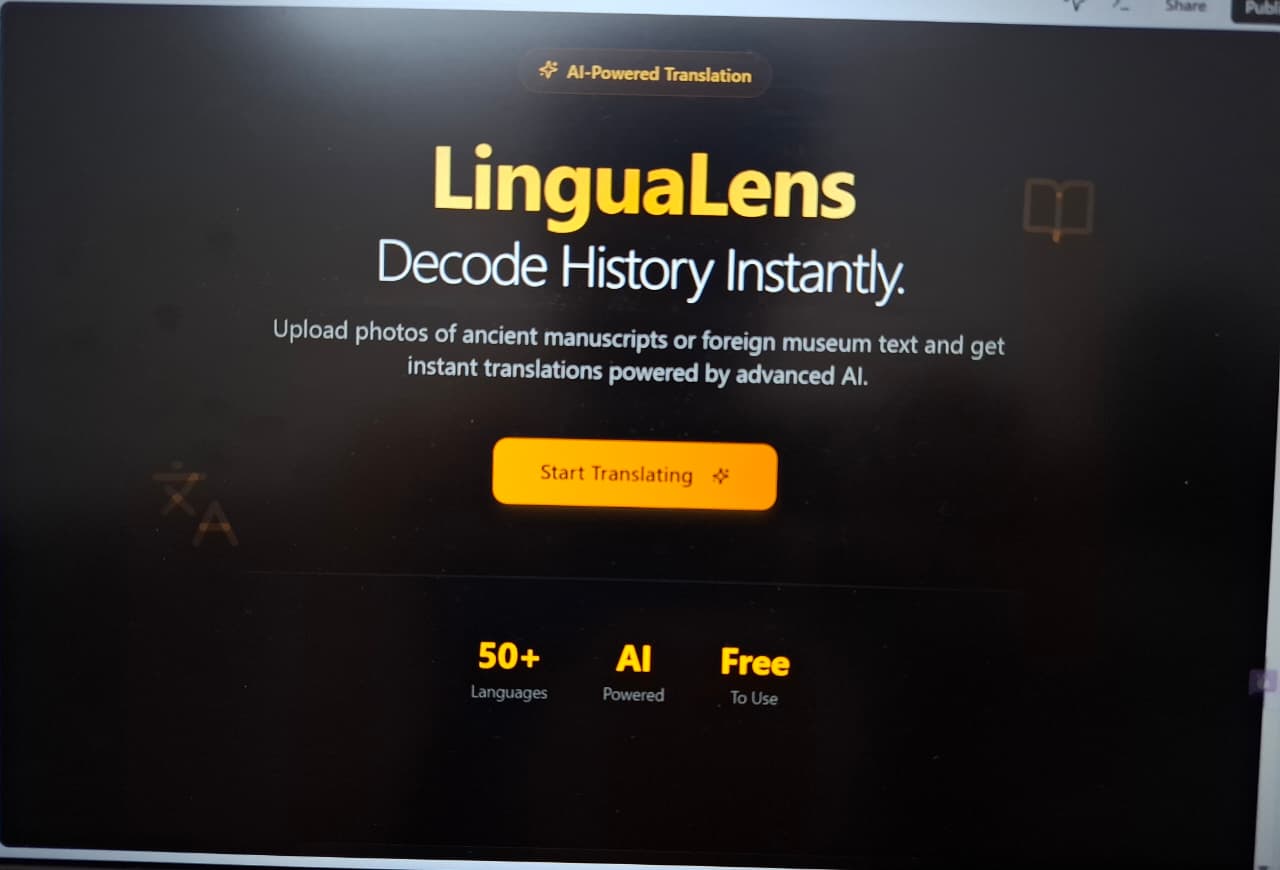
Lingua-Lens is an intelligent visual translation web app that turns any smartphone into a historical decoder.
Snap & Translate: Users can take a photo of any physical document—be it an ancient scroll or a modern sign—and get an instant translation in their preferred language (English, Hindi, Spanish, etc.).
Contextual Understanding: Unlike basic translators, our AI engine (powered by Gemini) understands the context of historical texts, providing more accurate interpretations of older scripts.
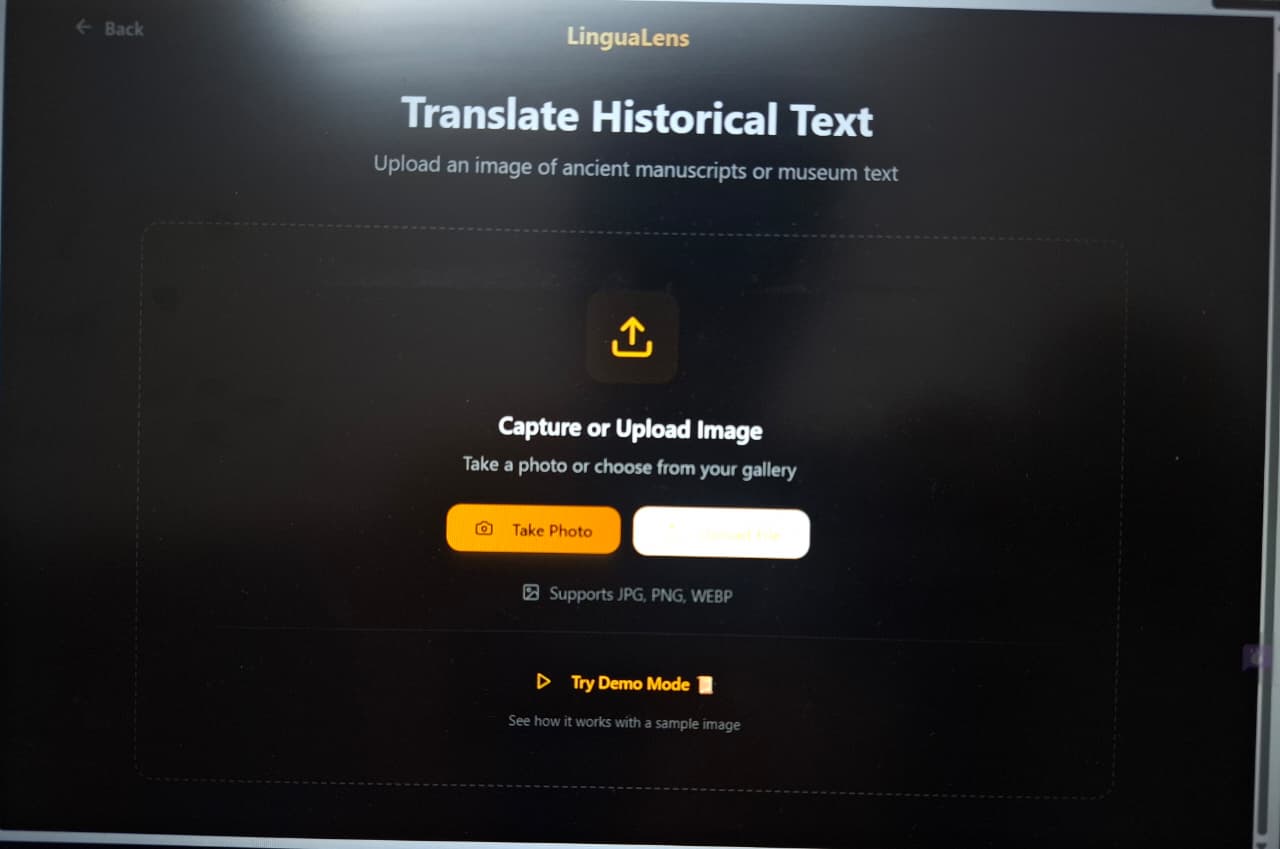
Dual-Mode Input: It supports both live camera capture for on-the-go translation and file uploads for high-resolution archival research.
Demo Mode: For users (or judges!) without a historical document at hand, we included a "Demo Mode" that instantly loads a sample of the Declaration of the Rights of Man (1789) to showcase the app's capabilities in real-time.
3.) How we built it:
We adopted a Low-Code / High-Intelligence architecture to maximize speed and functionality within the 24-hour timeline.
Frontend & Backend: Built entirely on Base44. We utilized natural language prompting ("Vibe Coding") to rapidly generate the React-based user interface and manage the PostgreSQL database schema.
AI Engine: The core logic leverages Multimodal LLMs (Google Gemini via API) to perform simultaneous OCR (Optical Character Recognition) and Contextual Translation.
Integration: We connected the frontend to the AI models using API webhooks, allowing us to process images and return text dynamically.
4.) Challenges we ran into:
The journey wasn't a straight line. We encountered several "roadblocks" that required creative problem-solving:
The "Camera" Paradox: Initially, our "Scan" button just opened the file manager on Android, which was a terrible user experience. We had to dive into HTML5 documentation to discover the specific capture="environment" attribute, allowing us to force the back camera to open immediately.
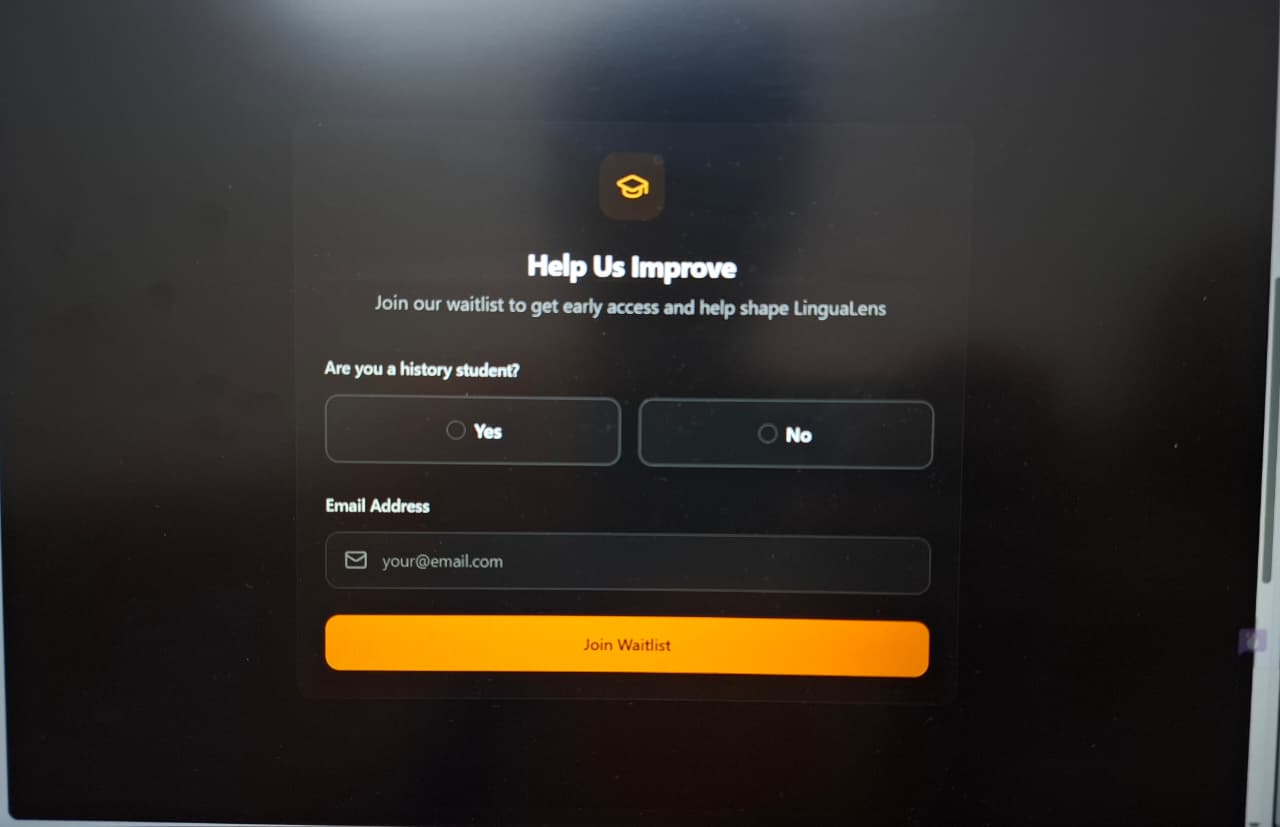
The "Infinite Loading" Waitlist: Our idea validation form would get stuck on "Joining..." forever. We realized this was a Database Permission (RLS) issue where the table was set to "Private" by default. We had to explicitly re-configure the security policies to allow public inserts.
Privacy Concerns: The first version of the app displayed a history list of everyone's translations. We quickly realized this was a privacy risk and refactored the app to be session-based, showing only the current user's data.
5.) Accomplishments that we're proud of:
Building a Full Stack App in 24 Hours: Going from a sketch on paper to a working, deployed web app with database integration in such a short time.
The "Demo Mode" Feature: We realized that judges might not have foreign text nearby to test the app. Implementing a one-click "Demo Mode" that loads a historical French document was a smart UX decision that ensures everyone can see the value of LinguaLens instantly.
Mobile-First Experience: We successfully optimized the web app to feel native on mobile devices, correctly triggering the hardware camera and responding to touch inputs.
6.) What we learned:
Participating in the NIAT x Base44 Hackathon was a crash course in "AI-Native Development."
Prompt Engineering is the New Coding: We learned that the quality of the app depends entirely on the precision of the instructions given to the AI builder. A vague prompt yields a vague UI; a specific prompt yields a production-ready feature.
The Power of Validation: Adding the "Waitlist" feature wasn't just a hackathon rule; it taught us the value of capturing user interest early to validate the product before building complex backends.
Security Policies (RLS): We gained practical experience with Row Level Security, understanding that even low-code tools require careful permission management to ensure data is both accessible and secure.
7.) What's next for Lingua-lens
Lingua-Lens is just the beginning. We plan to expand the platform with:
Text-to-Speech: Adding accessibility features so users can hear the pronunciation of the translated text, which is crucial for language learners.
Offline Mode: Enabling basic translation models to run locally for travelers in remote locations without internet.
Built With
- base44
- geminiapi
- goooglegemini
- html5

Log in or sign up for Devpost to join the conversation.