-
-
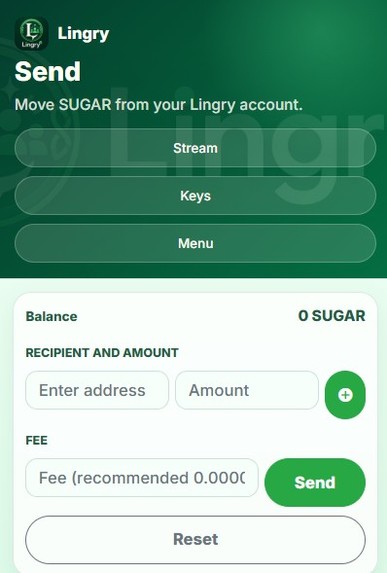
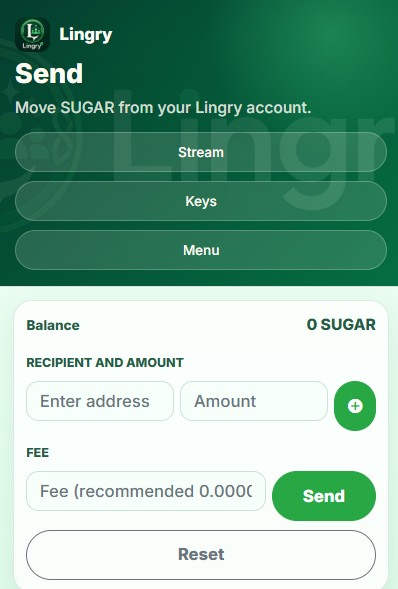
Send Sugars by entering the recipient, amount, and fee, then review every detail before confirming the transfer.
-
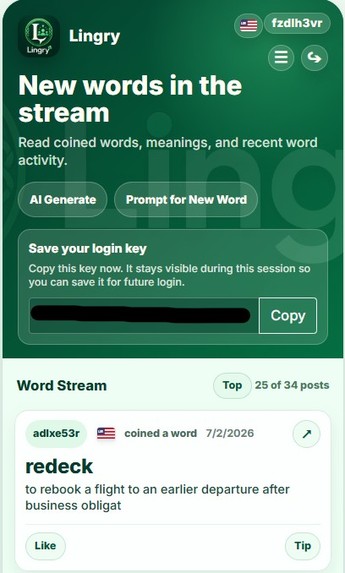
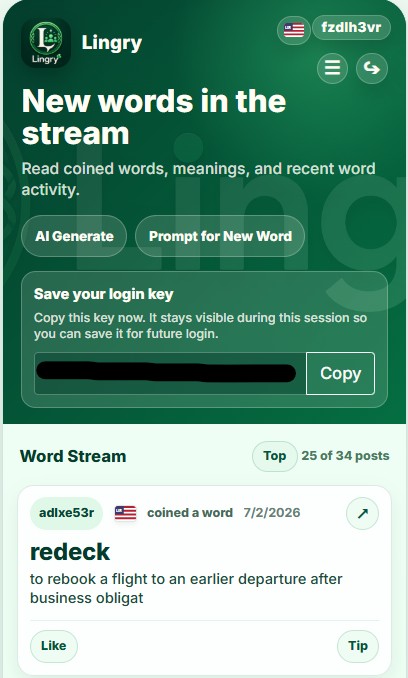
Save your Lingry login key securely—it’s your private credential for accessing your wallet later. Never share it.
-
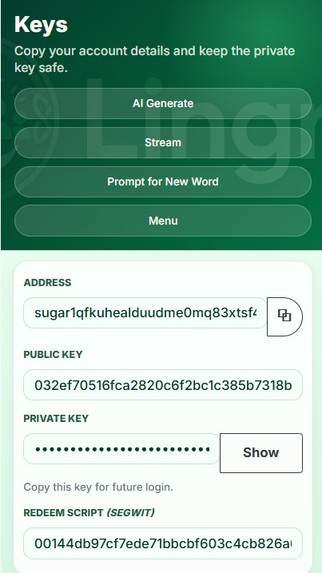
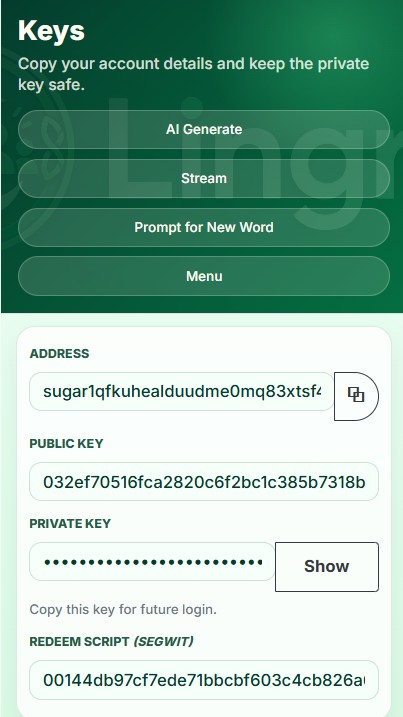
Open Show Keys to view and securely save your wallet details. Keep your private key secret and never share it.
-
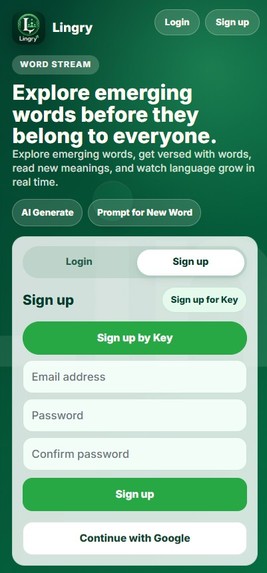
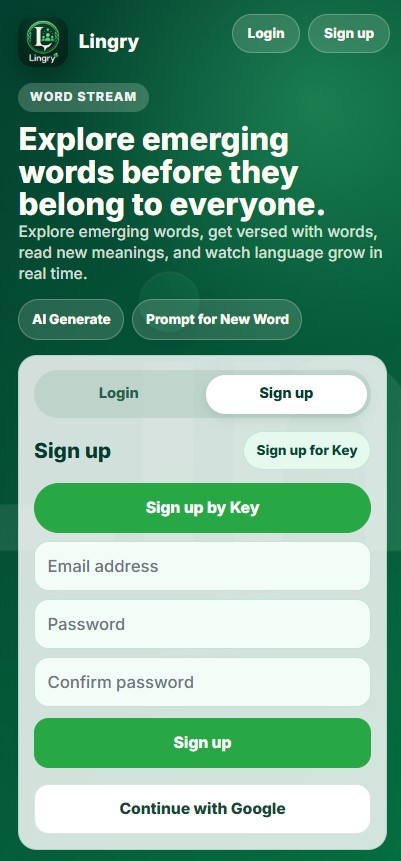
Create your Lingry account with email, Google, or key access—and start inventing new words in seconds.
-
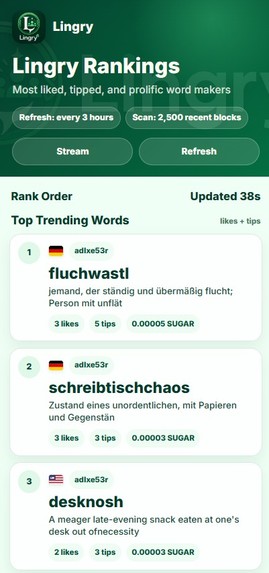
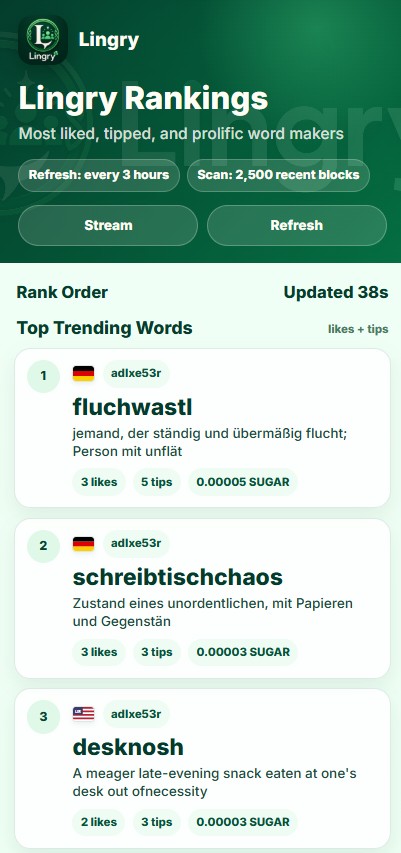
Explore Lingry’s top words and creators, then like favorites or tip contributors shaping its living dictionary.
-
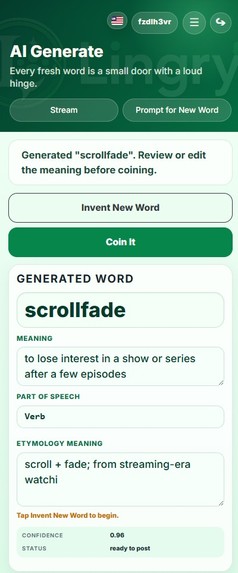
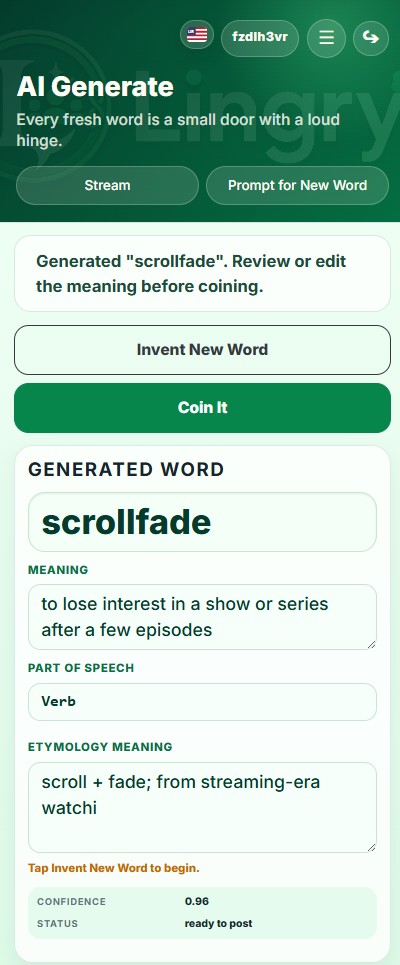
Generate a fresh word with AI, then refine its meaning, etymology, and details before coining it on Lingry.
-
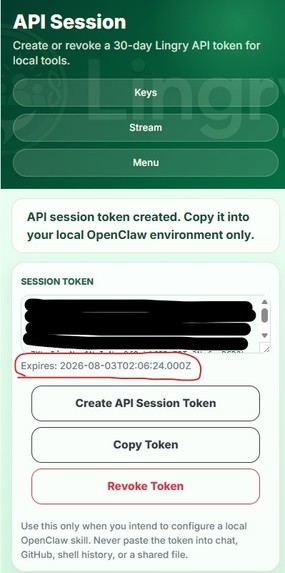
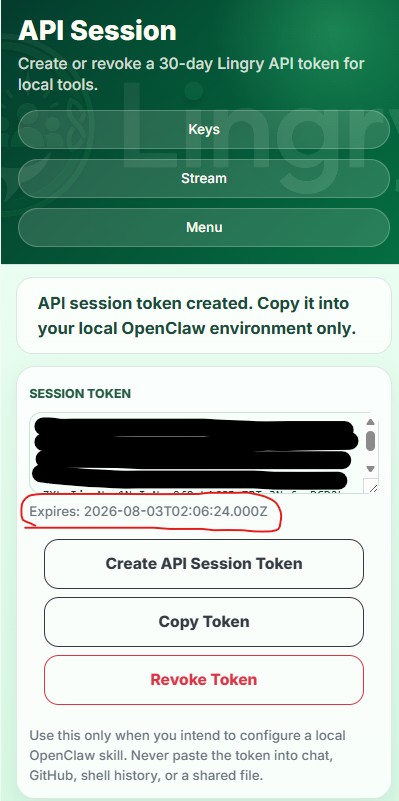
Create a Lingry API token for OpenClaw, save it privately, and refresh it when the 30-day session expires.
-
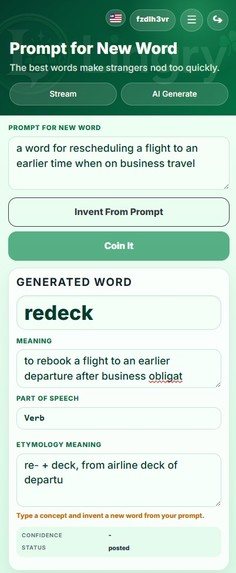
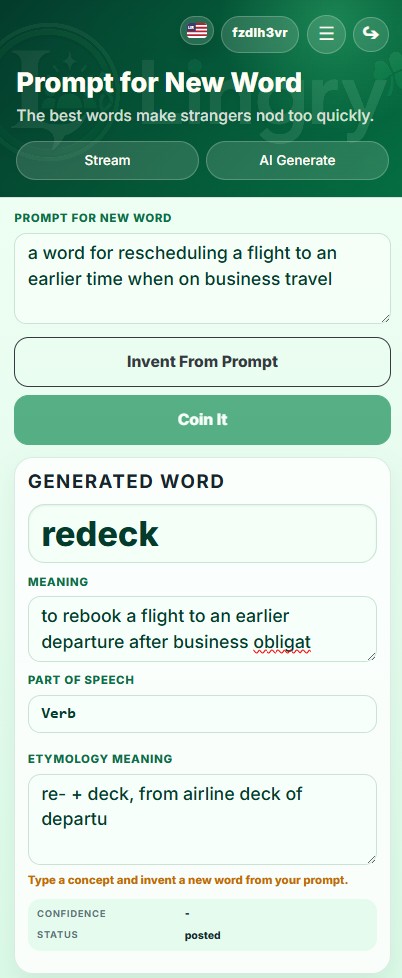
Describe an idea, and Lingry turns it into a new word with a meaning, part of speech, etymology, and confidence score.
-
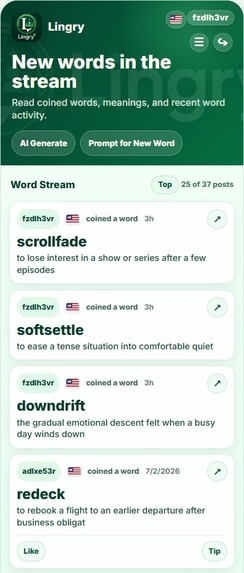
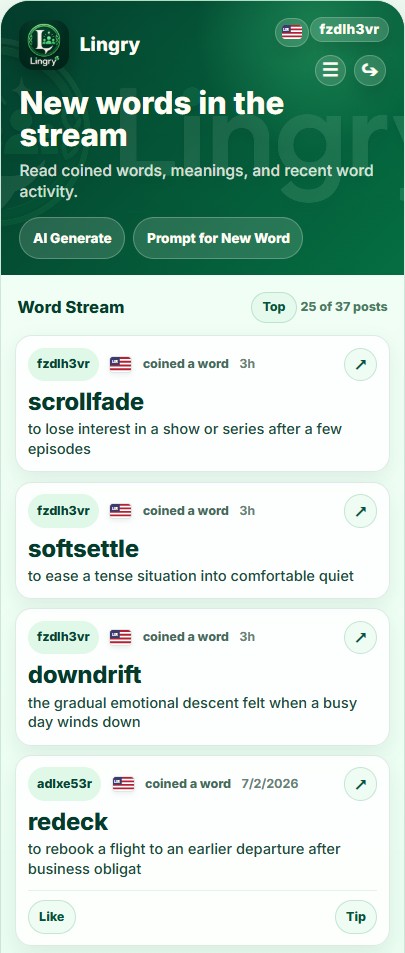
Browse Lingry’s Word Stream to discover newly coined words, meanings, creators, and community favorites.
Project Story
About Lingry
Lingry is an AI-powered platform that helps people invent new words for ideas, emotions, objects, and experiences that existing language does not describe well.
A user starts by explaining a concept in plain language. Lingry helps turn that idea into an original word with a definition, pronunciation, and example sentence. The finished word can then be published and added to a growing public collection.
I built Lingry to make language creation more accessible, collaborative, and fun. Instead of only using words created in the past, people can actively create words for new experiences, technologies, emotions, and cultural ideas.
Inspiration
Lingry began with a simple question:
What happens when someone has an idea, but no word exists to describe it?
Language evolves constantly, but there is no easy process for intentionally creating a new word, explaining its meaning, and sharing it with others.
I saw an opportunity to use AI as a creative language partner. Rather than using AI only to answer questions or summarize existing information, I wanted to use it to help people create something new.
My goal was to build a platform where anyone could describe an idea and receive help turning it into a word that feels memorable, pronounceable, and connected to its meaning.
How I Built It
I built Lingry as a solo developer, handling the product idea, interface, backend systems, AI workflow, testing, and deployment myself.
I started by designing the core user experience. I wanted the process of creating a word to feel simple:
- The user describes a concept.
- Lingry analyzes the description.
- The AI generates possible words.
- The user selects or refines a result.
- Lingry generates a definition, pronunciation, and usage example.
- The user publishes the completed word.
I designed the AI prompts to consider meaning, tone, sound, spelling, memorability, and pronunciation. I did not want Lingry to produce random combinations of letters. The goal was to generate words that could realistically be spoken and used.
I then built the web interface so users could create accounts, generate words, review results, and publish them through a straightforward workflow.
On the backend, I created the logic for user accounts, word records, publishing, search, public streams, profiles, and leaderboards. I also added validation to reduce duplicate or invalid submissions.
I built an API so Lingry could be accessed outside the main website. I also developed an AI-agent skill, allowing users and automated agents to interact with Lingry through simple commands.
Lingry includes wallet functionality and permanent publishing features, but I designed the interface so users do not need technical knowledge to use them. Complex operations happen behind the scenes while the user focuses on creating a word.
Because I built the entire project alone, I had to work across product design, frontend development, backend development, AI prompt engineering, security, infrastructure, documentation, and user testing.
Challenges I Faced
One of the most difficult challenges was generating words that felt natural.
A new word needs to be original, but it also needs to be pronounceable, memorable, and connected to its intended meaning. Early versions sometimes produced words that looked random or were difficult to say.
I improved the generation process by adding clearer linguistic constraints and evaluating words based on sound, spelling, emotional tone, and usability.
Another challenge was originality. Lingry needs to avoid generating common dictionary words, existing brand names, or words that have already been published on the platform. I added validation and duplicate-checking steps to reduce these conflicts.
Connecting all parts of the platform was also challenging. I had to make the AI generation system, authentication, publishing workflow, database, public stream, leaderboard, API, and agent skill work together as one product.
Security was another major consideration. Sensitive credentials, private keys, authentication tokens, and backend services cannot be exposed in frontend code or logs. I had to separate public-facing features from secure server-side operations.
Building alone also meant that every technical decision affected another part of the project. I had to balance adding features with maintaining reliability, simplicity, and security.
What I Learned
I learned that AI works best as a collaborator, not as a replacement for human creativity.
The user provides the original concept and decides what the word should communicate. AI helps explore possible sounds, spellings, definitions, and associations. The strongest results come from combining human intention with rapid AI-assisted iteration.
I also learned how subjective language can be. Two people can describe the same idea and prefer completely different words. Because of this, Lingry needs to offer multiple possibilities instead of treating one generated answer as correct.
From a technical perspective, I learned how to connect AI generation with a complete web product. Building a useful platform requires much more than a working prompt. It also requires authentication, storage, validation, onboarding, security, search, discovery, and reliability.
Working as a solo builder forced me to learn across many areas. I had to move between designing interfaces, debugging backend services, improving prompts, securing sensitive operations, writing documentation, and thinking about the overall user experience.
Accomplishments I Am Proud Of
I am proud that I turned an abstract idea into a working platform.
A user can begin with a concept that is difficult to explain and finish with a complete word that includes:
- An original name
- A clear definition
- A pronunciation
- A usage example
- A creator
- A publication record
- A place in a growing public dictionary
I am also proud that Lingry is not limited to one interface. It can be accessed through the main website, an API, and an AI-agent skill.
Most importantly, I built Lingry independently from the initial idea through implementation and deployment. The project required me to combine creativity, AI, software development, product design, and infrastructure into one working system.
What’s Next
My next goal is to improve the quality of generated words and make the community more involved in deciding which words become useful.
Future improvements may include:
- Community voting and feedback
- Alternate definitions
- Improved duplicate detection
- Themed word-creation challenges
- Better pronunciation tools
- Multilingual word creation
- Topic-based collections
- More AI-agent integrations
- Tools for tracking how words are used over time
My long-term vision is for Lingry to become a living record of emerging language—a place where people create the words needed to describe new technologies, cultures, emotions, and experiences.
Lingry is the dictionary for ideas the world has not named yet.
Built With
- assets
- cloudflare
- cron
- css3
- d1
- durable
- github
- html5
- javascript
- localstorage
- minimax
- node.js
- oauth
- objects
- openapi
- openclaw
- rest
- serverless
- static
- sugarchain
- triggers
- workers
- wrangler


Log in or sign up for Devpost to join the conversation.