Inspiration As a final-year Computer Science student, I regularly read complex research papers, dense documentation, and global textbooks. During my studies, I realized a striking inequality: over 80% of the world's high-end technical, scientific, and mathematical literature is published exclusively in English.
This creates a massive structural learning barrier for millions of students globally who process and conceptualize complex logic much more effectively in their primary local or international languages—whether that is Urdu, Sindhi, German, French, or Arabic. Traditional automated translation tools fail because they strip away technical context, ruin formatting, and cannot explain complex scientific jargon. I wanted to leverage generative AI to bridge this equity gap, creating an intelligent companion that doesn’t just translate words, but actually tutors students in their native tongue.
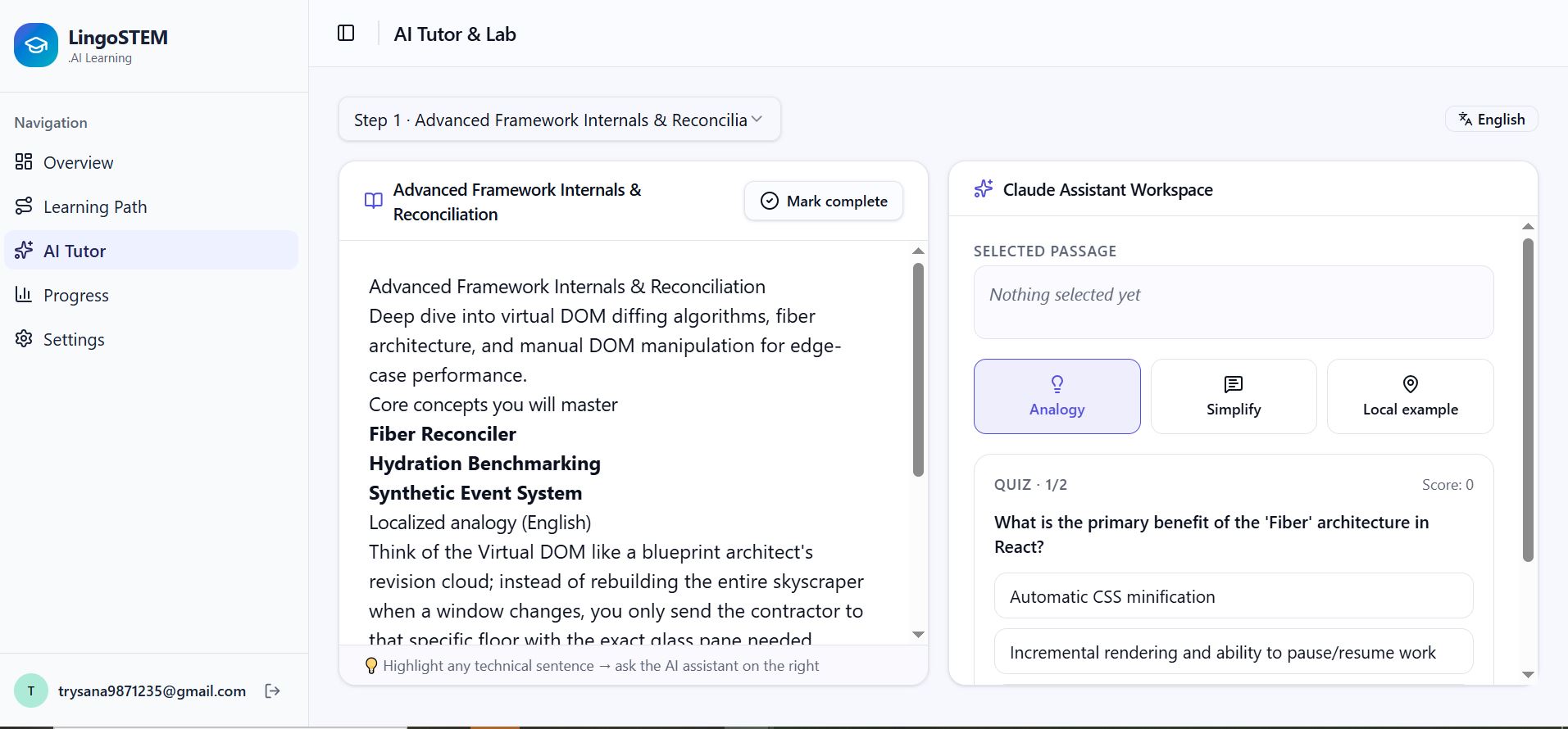
What it does LingoStudy.AI is an advanced, multilingual educational web application that transforms any dense English PDF textbook or research paper into an interactive, localized learning workspace.
When a student uploads a document and selects their preferred language (supporting 10+ major regional and global languages), the app dynamically generates:
An AI Executive Summary: An instant, comprehensive breakdown of the document in the target language.
A Contextual Smart Glossary: A side-by-side mapping of difficult English technical jargon translated and explained in the local language.
Interactive AI Flashcards: Automated study cards for active recall and spaced repetition.
An Automated Quiz Hub: 5 dynamic multiple-choice questions (MCQs) created directly from the text with an interactive "Explain Mode" that coaches students through wrong or right answers.
Voice-to-Voice Learning: Integrated Microphone (Speech-to-Text) and Speaker (Text-to-Speech) capabilities, allowing students to talk to the book and listen to explanations in their native language for better pronunciation and auditory comprehension.
How we built it The application was built using a decoupled, highly responsive full-stack architecture:
Frontend Interface: Developed using React.js, Vite, and Tailwind CSS to construct a premium, multi-panel dashboard layout featuring smooth transitions, clean component states, and dark/light mode toggles.
AI Knowledge Orchestration: Designed around Retrieval-Augmented Generation (RAG) pipeline concepts. The backend handles document text extraction, contextual parsing, and parses the relevant content tokens dynamically.
LLM Pipeline: Leveraged advanced Large Language Models via OpenAI (GPT-4o) and Google Gemini APIs. By deploying strict system prompt constraints, the models successfully generate all interactive summaries, glossaries, quizzes, and chat responses strictly in the selected target language.
Audio Engineering: Integrated the native browser Web Speech API to power low-latency Speech-to-Text (STT) transcription and natural Text-to-Speech (TTS) synthesis across international and regional voice profiles.
Challenges we ran into Linguistic Context Retention in STEM: Standard LLMs frequently lose the precise scientific meaning when translating specialized computer science or engineering jargon into regional languages. To solve this, I designed a Two-Pass Prompting Strategy: the first pass extracts and locks a technical glossary from the English context, and the second pass forces the model to synthesize the explanation using that glossary as an immutable structural anchor.
Handling Heavy UI Thread Blocks: Parsing massive amounts of text dynamically on the client side caused the web browser interface to briefly stutter. I resolved this by setting up modular rendering and asynchronous client-side state hooks in React, keeping the dashboard smooth and interactive at all times.
Accomplishments that we're proud of True Multimodal Accessibility: Successfully bridging a text-based RAG system with a fluid, bi-directional voice pipeline (Speech-to-Text and Text-to-Speech) that works seamlessly across varying language options.
High-Fidelity UI/UX: Designing a clean, professional, SaaS-grade educational dashboard within a tight timeline that feels native, intuitive, and ready for real-world student deployment.
Context-Aware Native Tutoring: Creating an evaluation loop where the AI doesn't just say an answer is "wrong" in a quiz, but adapts its language to explain why based purely on the uploaded document's context.
What we learned This project deeply advanced my practical engineering skills in deploying Large Language Models for complex, real-world social impact scenarios. I learned the nuances of fine-tuning multi-turn system prompts to control cross-lingual formatting, managing global states in a complex React environment, and simulating low-latency RAG architectures. Furthermore, I learned the power of rapid prototyping using modern full-stack AI development environments to bring an ambitious concept to life quickly.
What's next for LingoStudy.AI The immediate next step is to transition the frontend simulation into a live production backend by integrating an active, persistent vector database like ChromaDB or Pinecone for enterprise-grade document chunk caching. We also plan to integrate localized academic curriculum boards (such as local school or university syllabi) and explore edge-optimized, smaller open-source LLMs to allow the application to execute completely offline, making it accessible to students in remote areas with limited internet connectivity.
Built With
- api
- api-gemini
- api.ai
- css3
- html5
- javascript
- supbase
- typescript

Log in or sign up for Devpost to join the conversation.