-
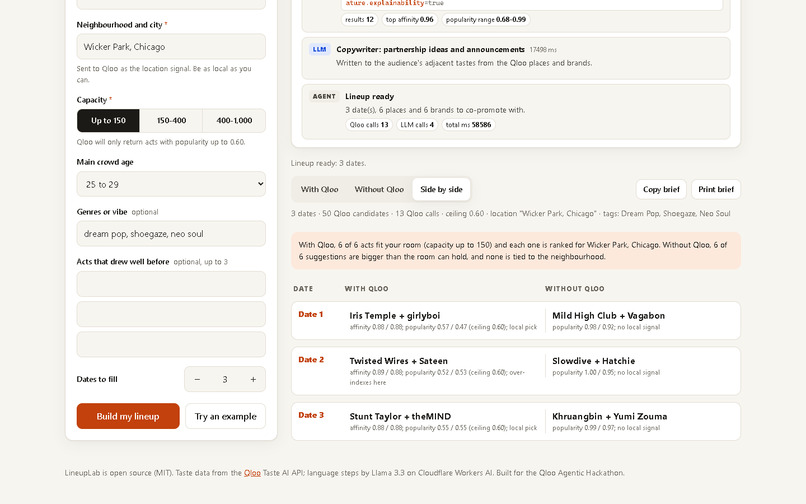
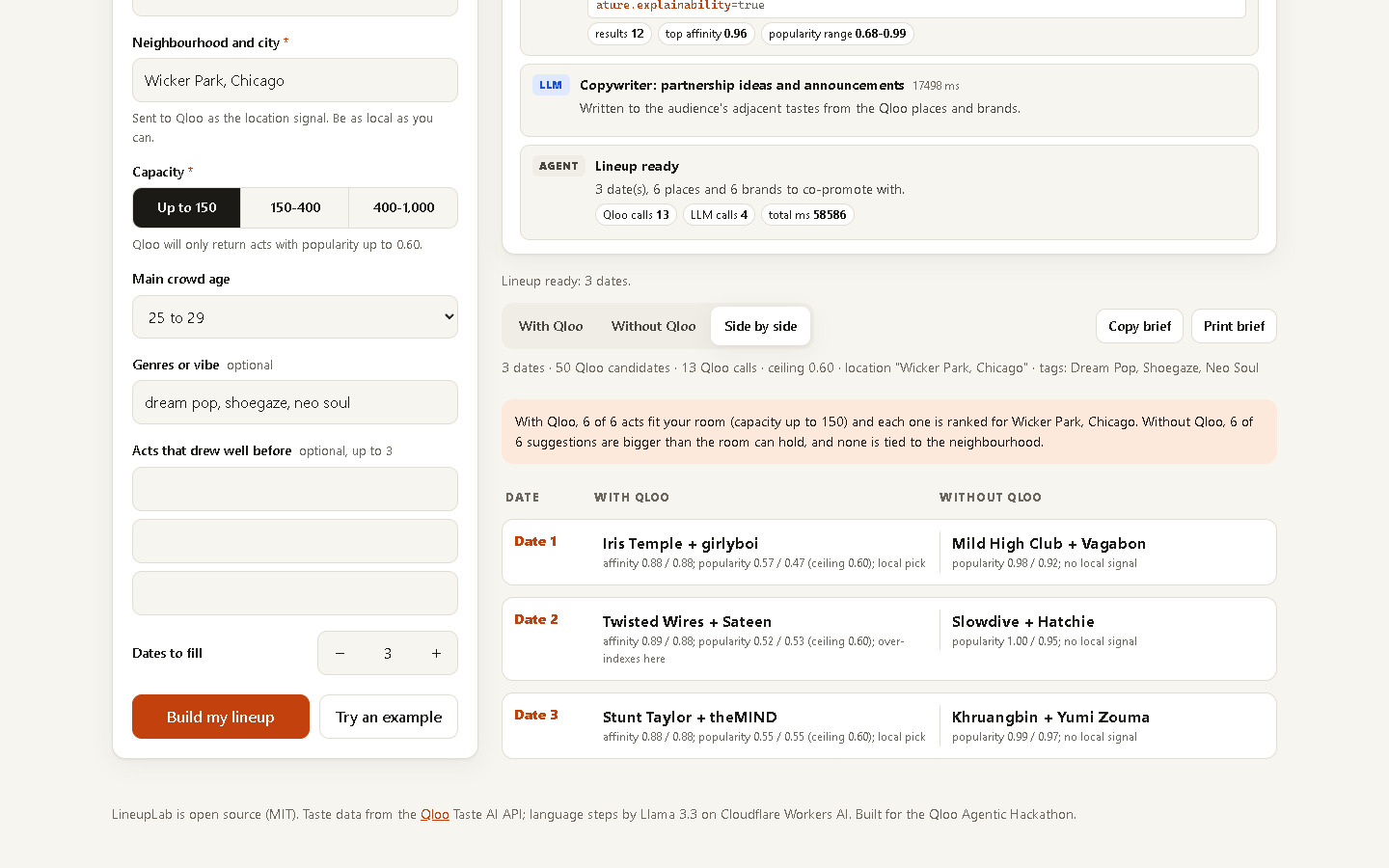
Live Qloo data: with Qloo all 6 acts fit a 150-cap Wicker Park room; the same model without Qloo picks 6 acts, all too big
-
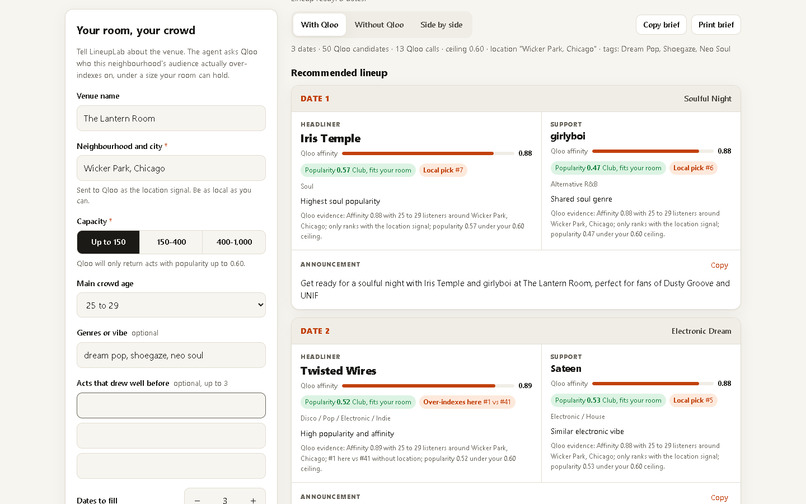
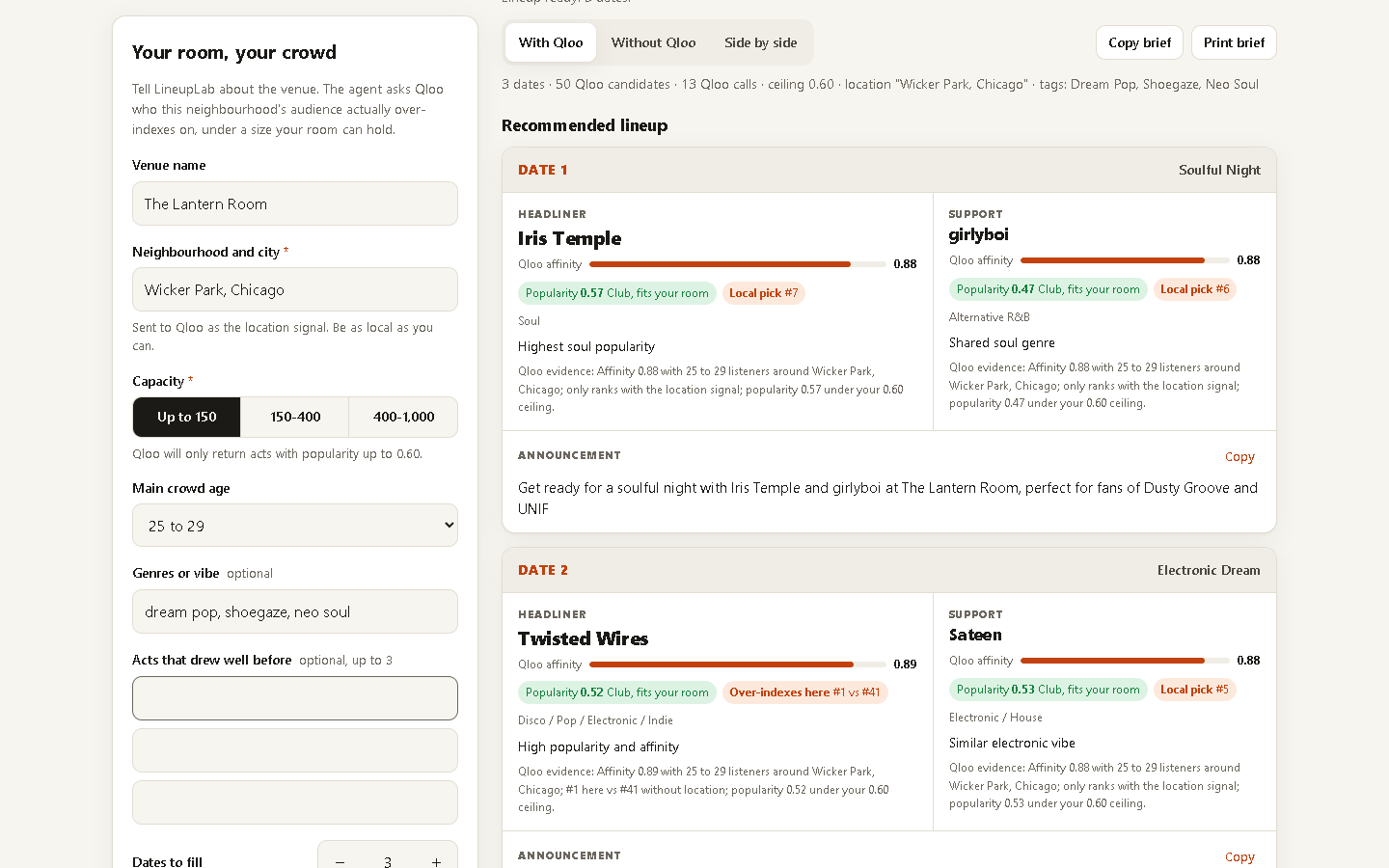
The lineup on live Qloo data: 3 dates for a 150-cap Wicker Park room, with affinity, popularity under the 0.60 ceiling, local rank
-
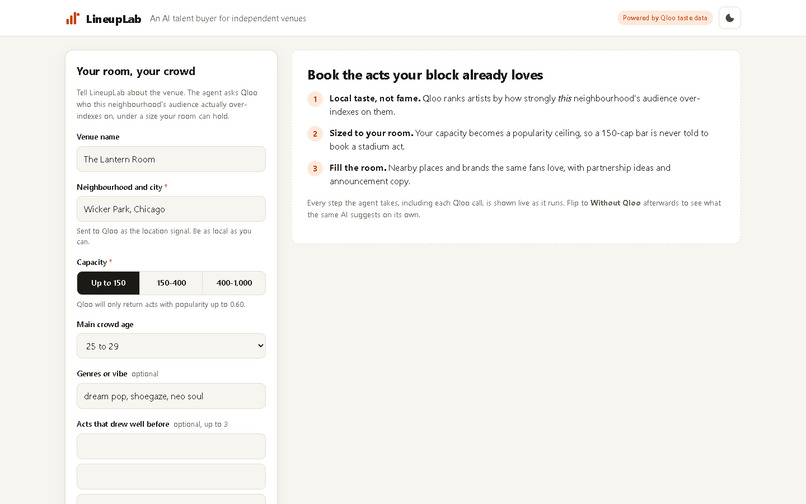
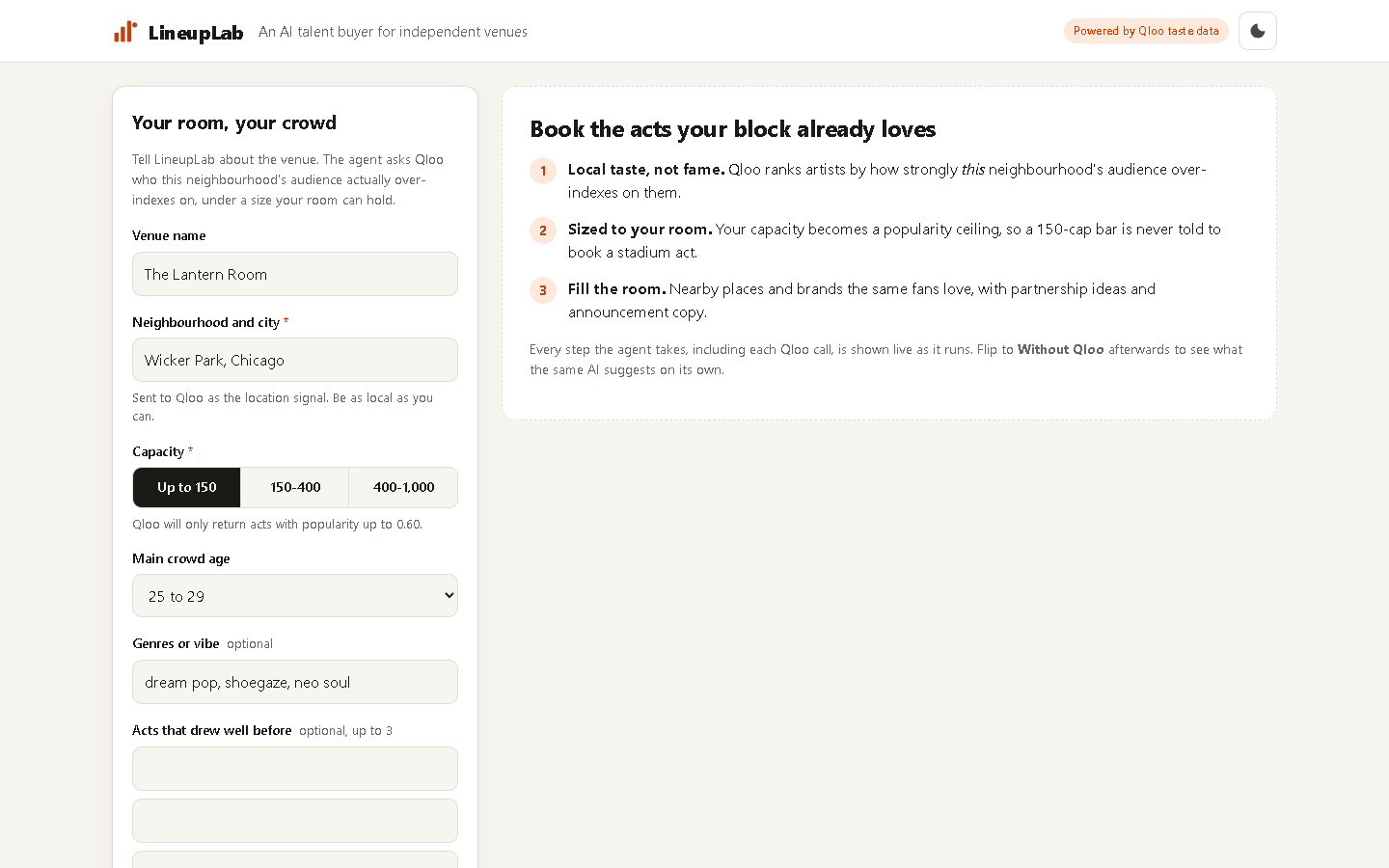
The brief: neighbourhood, capacity, crowd age, genres. This run made 13 live Qloo Taste API calls
Inspiration
Small venues keep music scenes alive, and most of them book by gut. The owner of a 150-cap bar has no data team and no agency. Ask a general-purpose AI who to book and it names the acts everybody has heard of, which are exactly the acts that bar cannot afford or fill. The answer the owner needs is local and size-aware: who does my neighbourhood's crowd over-index on, that is still small enough to book? That is a taste question, and taste across places and audiences is what Qloo models.
What it does
A venue enters its neighbourhood, capacity tier, main crowd age band, optional vibe and past acts that drew well, and how many dates to fill. LineupLab's agent then:
- asks Qloo which artists that neighbourhood and age band over-index on, with the room's capacity converted into a popularity ceiling so a 150-cap room is never told to book an arena act;
- re-runs the query without location and without trend bias to show, per act, whether it is a local favourite (and whether it is rising, when trend bias moves the ranks);
- builds one card per date (headliner + support) with the Qloo affinity, popularity band against the room, local and trend signals, and a one-line reason grounded in those numbers;
- finds nearby places and brands that the lineup's fans over-index on (Qloo cross-domain) and suggests a concrete co-promotion for each;
- writes a ready-to-post announcement per date, aimed at that audience's adjacent tastes;
- shows a Without Qloo view: the same LLM with the same brief and no Qloo, with each of its suggestions size-checked in Qloo. In our runs it names well-known acts far above the room's ceiling (East Nashville, 150-cap: 6 of 6 at Qloo popularity 0.92-0.99 against a 0.60 ceiling), with no tie to the neighbourhood.
Every step streams to the page as a live trace, including each Qloo request and its key numbers. The result exports as copyable text or a one-page printable booking brief.
How we built it
- Cloudflare Workers serves the static front end (Workers Static Assets) and a Server-Sent-Events API, so the agent's steps appear as they happen.
- Workers AI (Llama 3.3 70B) steers a deterministic tool pipeline. It turns the brief into Qloo inputs, picks and orders the lineup from Qloo's candidates, and writes partnership ideas and blurbs. Every LLM step asks for JSON, is parsed tolerantly, and has a deterministic fallback.
- Qloo Taste AI provides the three tools the agent calls:
qloo_search,qloo_tagsandqloo_insights. The key stays server-side. - Server-side caching (memory, optional KV, Workers Cache API) keyed on the normalised brief protects both API quotas, and a light per-IP limit protects the free tier.
- Vanilla JS front end, no framework or build step, light and dark themes, keyboard accessible, works on a phone.
- A demo mode with synthetic fixtures (invented names, real response shapes) runs the whole app offline and in tests, and announces itself with a banner.
The Qloo-powered part
Qloo is not an add-on to LineupLab; it is the product. The lineup comes from
/v2/insights with signal.location.query and signal.demographics.age (whose taste),
filter.popularity.max from the room's capacity (what the room can hold),
signal.interests.tags and signal.interests.entities from the venue's vibe and past
draws, and bias.trends (who is rising, when the key's trend data moves the ranks). LineupLab then uses Qloo as an instrument rather
than a list: it re-asks the same question without the location signal and without trend
bias, and the rank differences become the "local" (and, when trends move, "rising") evidence on every card.
Cross-domain /v2/insights calls for places (within 3 km of the venue) and brands, seeded
with the chosen artists, turn a lineup into a promotion plan. Finally, Qloo audits the LLM:
the Without Qloo tab looks up every act the model suggests on its own and shows how far
above the room's ceiling they sit. Take Qloo away and what remains is that generic,
wrong-sized answer.
Request to result (redacted)
One brief, start to finish. The key stays in a Worker secret; the browser never sees it.
- Brief: "East Nashville, Nashville, TN, small room (up to 150), age 25-29, indie rock, past draw: Snail Mail, 3 dates".
- Tag choice: the agent asks
/v2/tagsfor "indie rock" restricted to music genres (filter.tag.types=urn:tag:genre:music), so a same-named place or film tag cannot slip in; a keyword with no match is dropped and the trace says so. - Main ask:
GET /v2/insights?filter.type=urn:entity:artist&signal.location.query=Nashville, TN &signal.interests.tags=<indie-rock tag id>&signal.interests.entities=<Snail Mail id> &filter.popularity.max=<small-room ceiling>&bias.trends=medium - Two control asks: the same call without the location signal, and without trend bias. Rank gaps become the "local" badge on each card (and "rising", when trend bias moves a rank).
- Promotion asks:
/v2/insightsfor places within 3 km and for brands, seeded with the chosen acts. - Llama 3.3 picks dates and writes the pitch from Qloo candidates only; a name outside that set is rejected in code. A live run on the deployed app (Wicker Park, Chicago, 150-cap, 3 dates): 13 Qloo calls, 4 LLM calls, about 60 seconds under the key's 5-requests-a-second limit.
Try it from a clean machine
Live: https://lineuplab.s-n-psaradellis.workers.dev. Locally, with Node 20+:
git clone https://github.com/Stephen-Psaradellis/lineuplab && cd lineuplab
npm install
npx wrangler dev --env demo   # offline, no key, synthetic data, says so on screen
npm test                      # 49 tests, no network
For live data, put a hackathon key in .dev.vars as QLOO_API_KEY and run
npx wrangler dev.
Known limitations
- Qloo describes what audiences in a place tend to like, not what any one person will buy a ticket for. A high rank is a reason to make an offer, not a turnout forecast.
- Room size comes from Qloo popularity, not from an act's real fee or routing; a booker still checks availability and price.
- "Local" and "rising" are differences between two Qloo answers, so they inherit Qloo's
coverage: thin markets give thin signals, and the app says when a result came back empty.
On the hackathon key,
bias.trends(low, medium or high) returned the same ranks as no bias in every query we tried, so when it moves nothing the cards drop the trend chip and the trace says why, rather than calling every act "steady". - No personal data is sent to Qloo: only the venue's city, an age band, tags and act names.
Challenges we ran into
- Empty 200s. Qloo ignores parameters it does not understand and can answer an over-tight query with zero results instead of an error. The agent treats an empty result as a signal: it shows it in the trace and relaxes one constraint at a time (tags, seeds, ceiling, age) rather than silently showing nothing.
- Place names Qloo cannot match. An unmatched locality is the opposite case: a 400, not an empty 200. The agent walks from the planner's phrase to the user's words to the city ("Wicker Park, Chicago" -> "Chicago"), says so in the trace, and if nothing matches it drops the location signal for acts and skips nearby places instead of failing the run.
- Neighbourhoods Qloo knows but has no taste data for. "East Nashville, Nashville, TN" matches, yet returns zero artists with every optional signal relaxed, while "Nashville, TN" returns 50. When the whole relax ladder comes back empty, the agent starts over one locality up and says so in the trace, so a judge typing their own neighbourhood still gets a lineup.
- Keeping the LLM honest. Models like to name famous acts. The lineup picker only sees Qloo candidates, and any name it returns that is not in that set is rejected in code and replaced by a deterministic pick, with the rejection shown in the trace.
- Five requests a second. The hackathon key allows 5 calls per second
(
X-Second-RateLimit-*headers) and the agent fans out in parallel, so the first live run failed with 429s. Every Qloo call now takes a slot from a shared limiter (4 per rolling second) and a 429 waits for the reset the header names before retrying. - Making numbers mean something to a venue owner. A popularity percentile means little on its own, so each act is shown as a room size (Emerging, Club, Theatre, Arena) against the room's ceiling.
- Free-tier budgets. Caching on the normalised brief and on each Qloo call keeps repeat demos free for both APIs.
Accomplishments that we're proud of
- The comparison is visible, not claimed: one click shows the same model, without Qloo, recommending acts far above the room's size ceiling (6 of 6 in the Nashville run).
- The agent's reasoning is fully inspectable, down to each Qloo request string.
- Local (and trend) signals derived from Qloo itself (with/without comparisons), not from a second data source.
- A complete small product: empty, loading and error states, export, print, phone layout, dark mode, and tests that prove the API key never reaches the browser.
What we learned
Taste data is most useful when you ask it comparative questions. "Who is popular here" is a list; "who ranks higher here than everywhere else, and under this size" is a decision.
What's next
- Budget tiers alongside capacity, and calendar awareness (weeknight vs weekend).
- Booking-agent contact handoff and hold requests from the brief.
- Post-show feedback: feed actual turnout back as seeds so each venue's lineup sharpens.
- A promoter view across several rooms in one city, using Qloo's audience comparisons to avoid booking the same crowd twice in one week.
Built With
- cloudflare-workers
- javascript
- llama
- qloo
- server-sent-events
- workers-ai

Log in or sign up for Devpost to join the conversation.