Inspiration
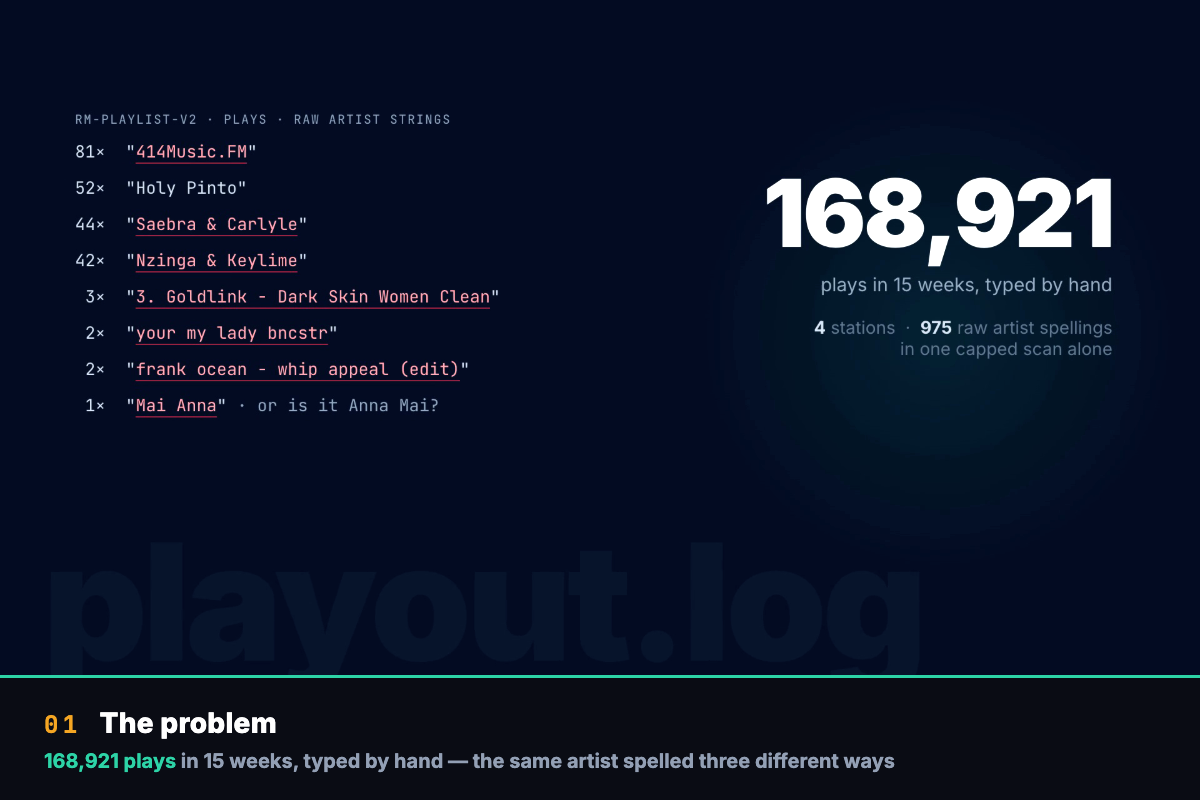
Radio Milwaukee's four stations log every song a DJ plays — 168,921 plays in fifteen weeks on the current playout platform, artist names typed live by DJs: typos, aliases, "feat." strings, duplicates.
"Erykah Badu", "Badu, Erykah", and "Erykah Badu feat. Common" are three different artists to the database. Nobody can answer "what have we actually played?" — and every station, podcast network, and music library has a version of this table. We wanted an agent to do the cleanup, with the governance visible: real checks, honest failures, and a receipt for every judgment call.
What it does
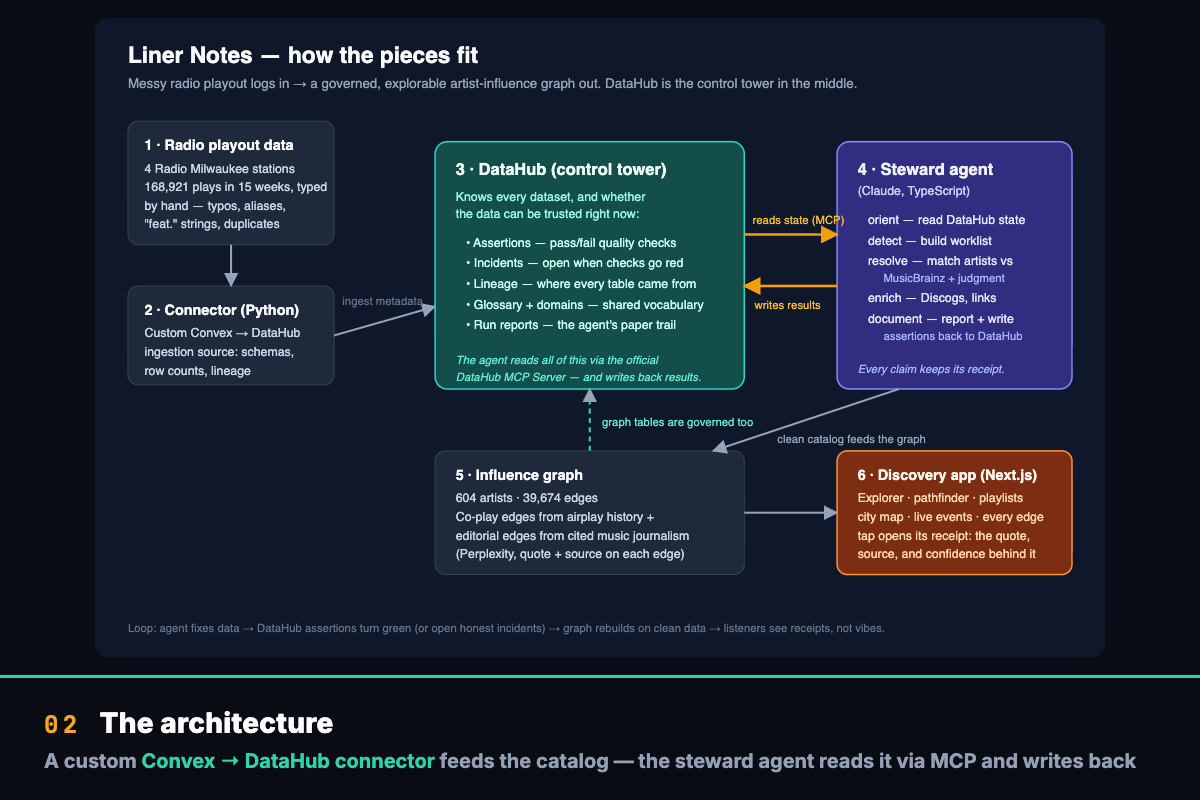
- A custom Convex → DataHub connector (Python, recipe-driven like official sources) ingests every table of the playout platform and the project's own deployment: schemas, exact row counts, containers, lineage.
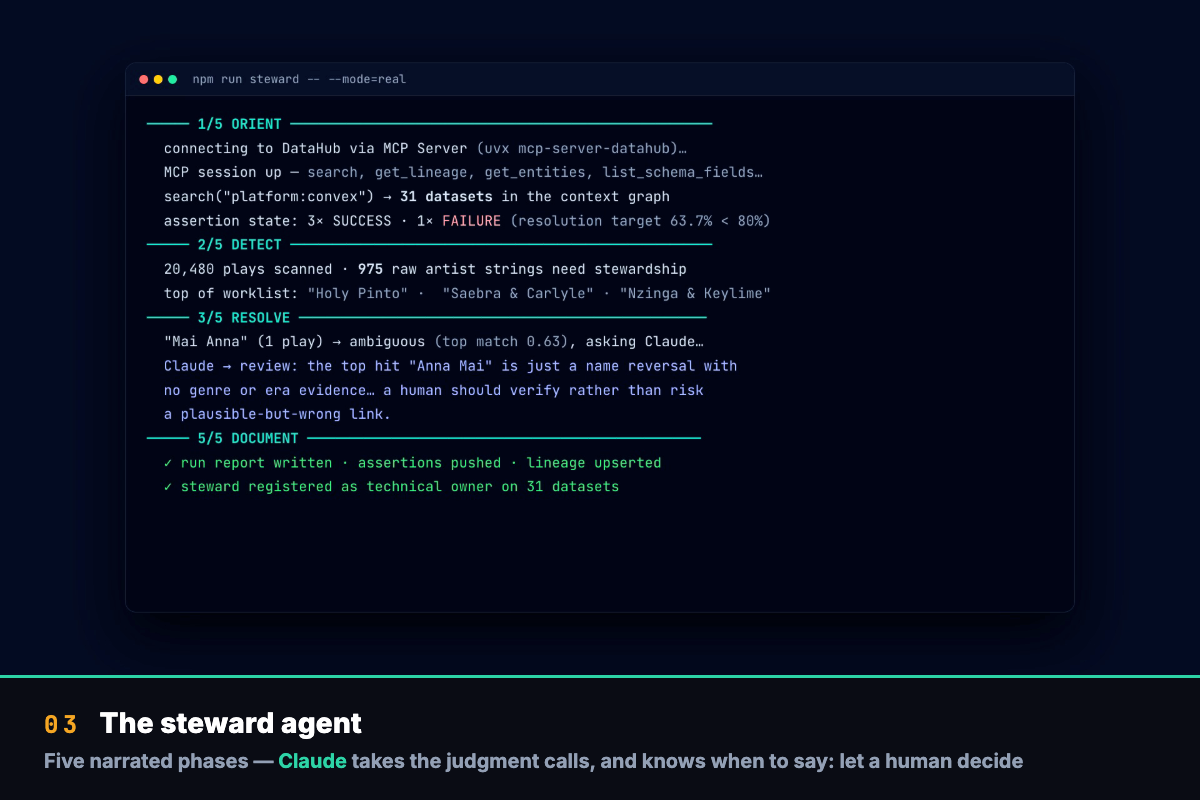
- An autonomous steward agent (TypeScript + Claude) runs narrated sessions: it orients by reading DataHub through the official MCP Server (schemas, assertion state, its own prior run reports), detects unresolved artist strings, resolves them against MusicBrainz with Claude adjudicating the ambiguous ones, enriches with Discogs and streaming links, then documents — writing run reports, assertion results, lineage, and ownership back into DataHub.
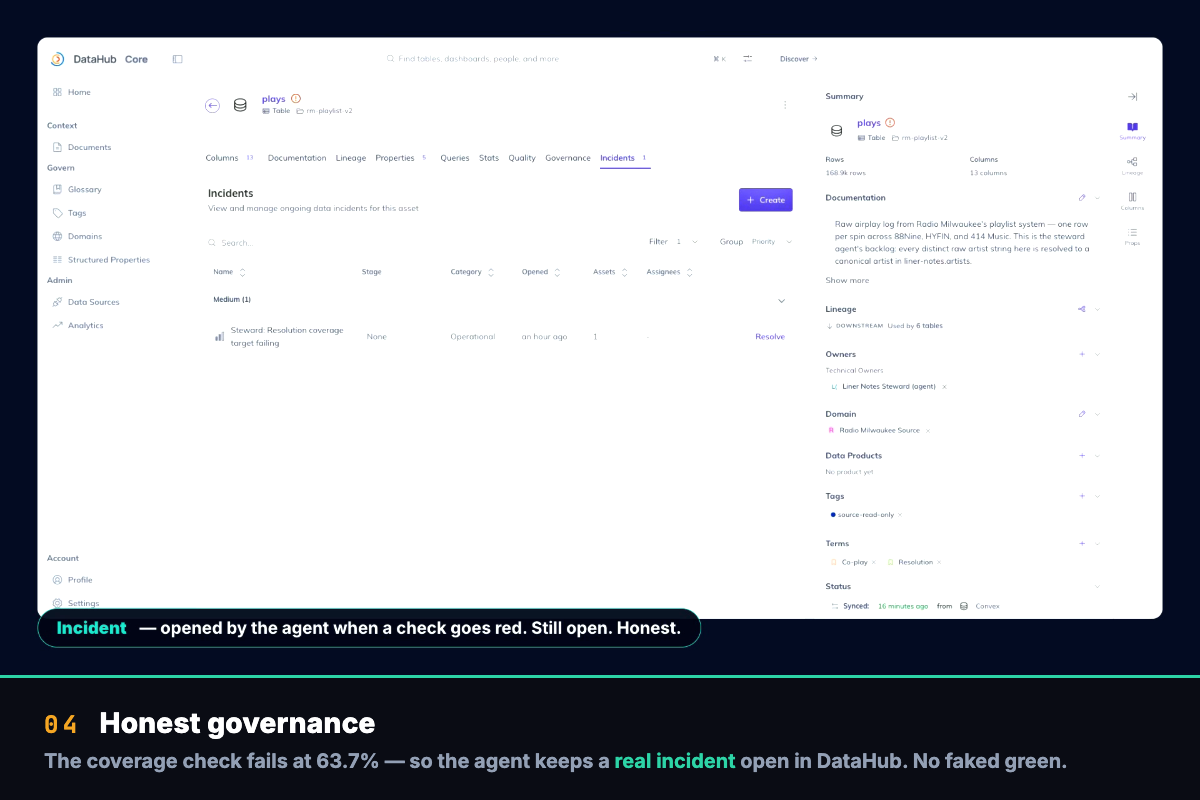
- A governance surface the agent maintains: 4 quality assertions on the backlog, domains, a glossary, tags, structured properties with live stats — and honest incidents: the resolution-coverage stretch target (80%) is genuinely failing at 63.6%, so a real ACTIVE incident sits on the dataset until triage catches up. No faked green.
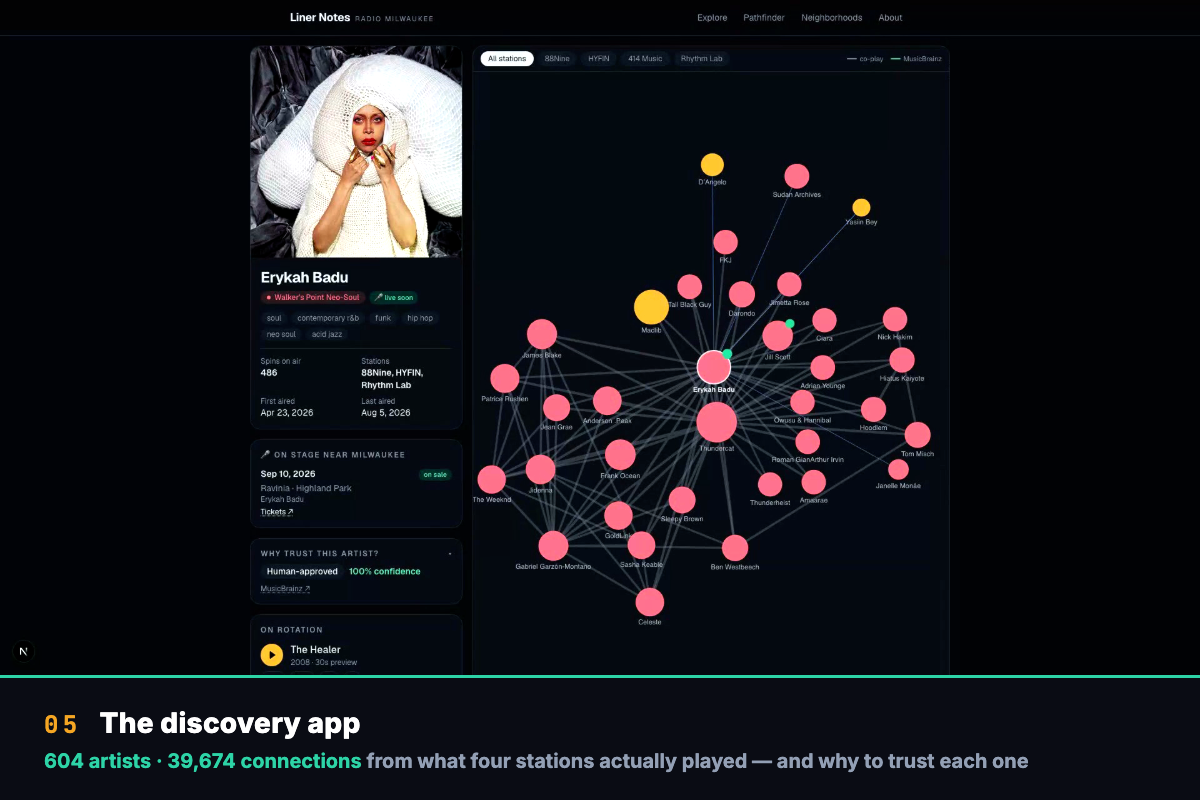
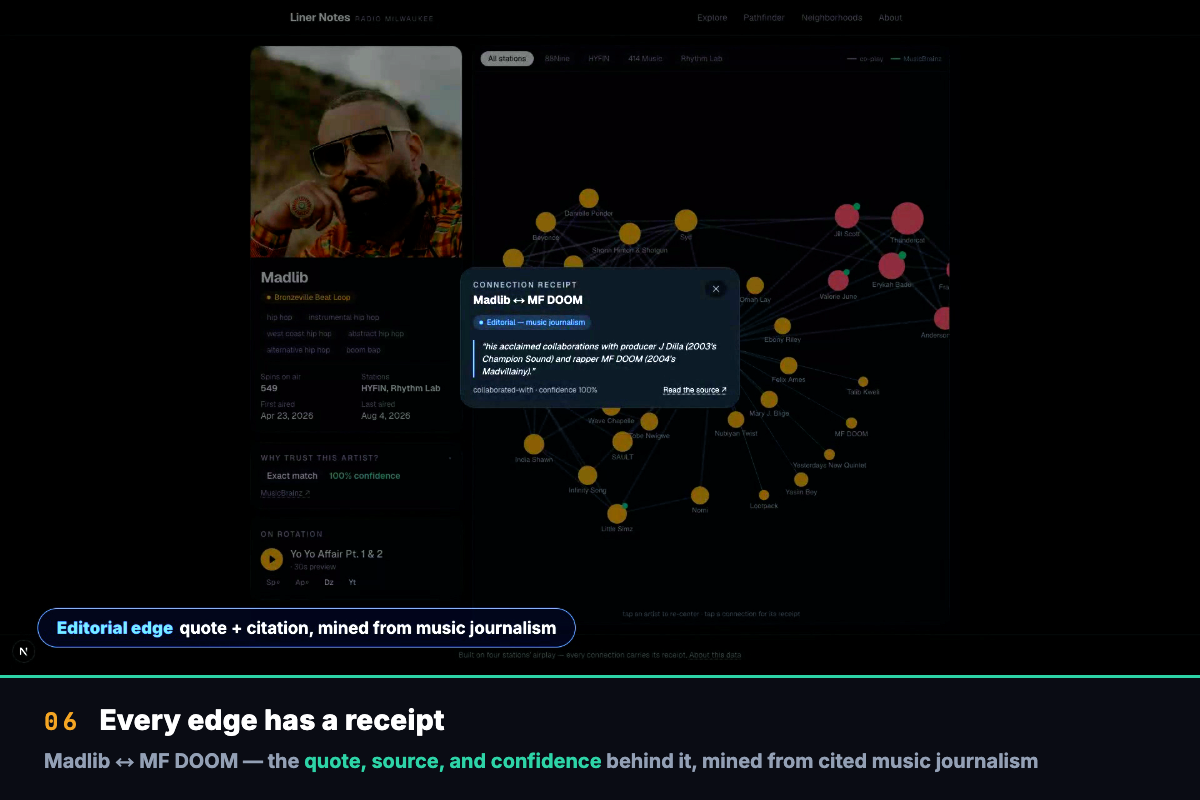
- An influence graph built from the cleaned catalog: 604 artists, 39,674 edges — co-play edges from what DJs actually played back-to-back, and editorial edges mined from cited music journalism (Perplexity, quote + citation + confidence stored on every edge).
- A listener app (Next.js): search, force-graph explorer, influence pathfinder, generated playlists, a "city map" of musical neighborhoods, live event cards. Tapping any connection opens its receipt.
How we addressed the judging criteria
Use of DataHub. The agent doesn't just read metadata — it lives in the context graph. It orients via the official DataHub MCP Server every session, and it contributes back: dataset documentation, four custom assertions with per-run results, operational incidents (raised and auto-resolved by threshold), lineage from raw plays through the resolved catalog to the graph tables, domains/glossary/tags/structured properties, and technical ownership on all 31 datasets. The catalog is the agent's memory and its conscience.
Technical execution. The full loop runs end-to-end and is reproducible in
judge mode with anonymized sample data (README quickstart). A clean-clone test
transcript is in docs/evidence/m5-clean-clone.txt — including the README gaps
it caught, which we fixed.
Originality. DataHub usually governs pipelines; here it governs an agent's judgment — every artist-identity decision carries confidence scores, evidence, and an audit trail, surfaced to listeners as receipts ("these two were played back-to-back 73 times", "this quote from a cited review"). We composed DataHub's shipped features (assertions, incidents, MCP, lineage, glossary) instead of rebuilding any of them.
Real-world usefulness. Every playout system rots the same way. The pattern — agent cleanup with DataHub as the control tower and honest quality gates — transfers to any org with a messy human-entered backlog. And the connector fills a real catalog gap: Convex backs many production apps with no DataHub integration until now.
How we built it
Convex (source platform + project database) · Python (acryl-datahub source
API) · TypeScript agent with Claude (Sonnet for adjudication and run reports) ·
official DataHub MCP Server (mcp-server-datahub) · MusicBrainz + Discogs +
Deezer for canonical identity and enrichment · Perplexity sonar-pro for cited
editorial retrieval (5-domain registry, $0.74 per 50-artist session) · Next.js
- react-force-graph for the app · DataHub v1.7.0 quickstart.
Challenges
- Honest governance is a feature. We wired incidents to assertions and let the stretch target fail publicly rather than tuning thresholds to look green.
- Entity resolution is a judgment problem. Scores alone misfire on reversed names and one-play local artists; Claude's adjudication with an explicit "send it to a human" option is what made auto-apply safe.
- Receipts all the way down. Editorial edges only ship with a quote, a citation from a registry of five music-journalism domains, and a confidence floor — 253 of 322 candidates were dropped for citing outside the registry or referencing unknown artists.
What's next
Track-level cleanup (the playlist titles still show the raw mess), human review UI throughput (305 items pending — the incident resolves itself at 80%), and upstreaming the connector past draft.
Built With
- datahub
- nextjs
Log in or sign up for Devpost to join the conversation.