Project Summary:
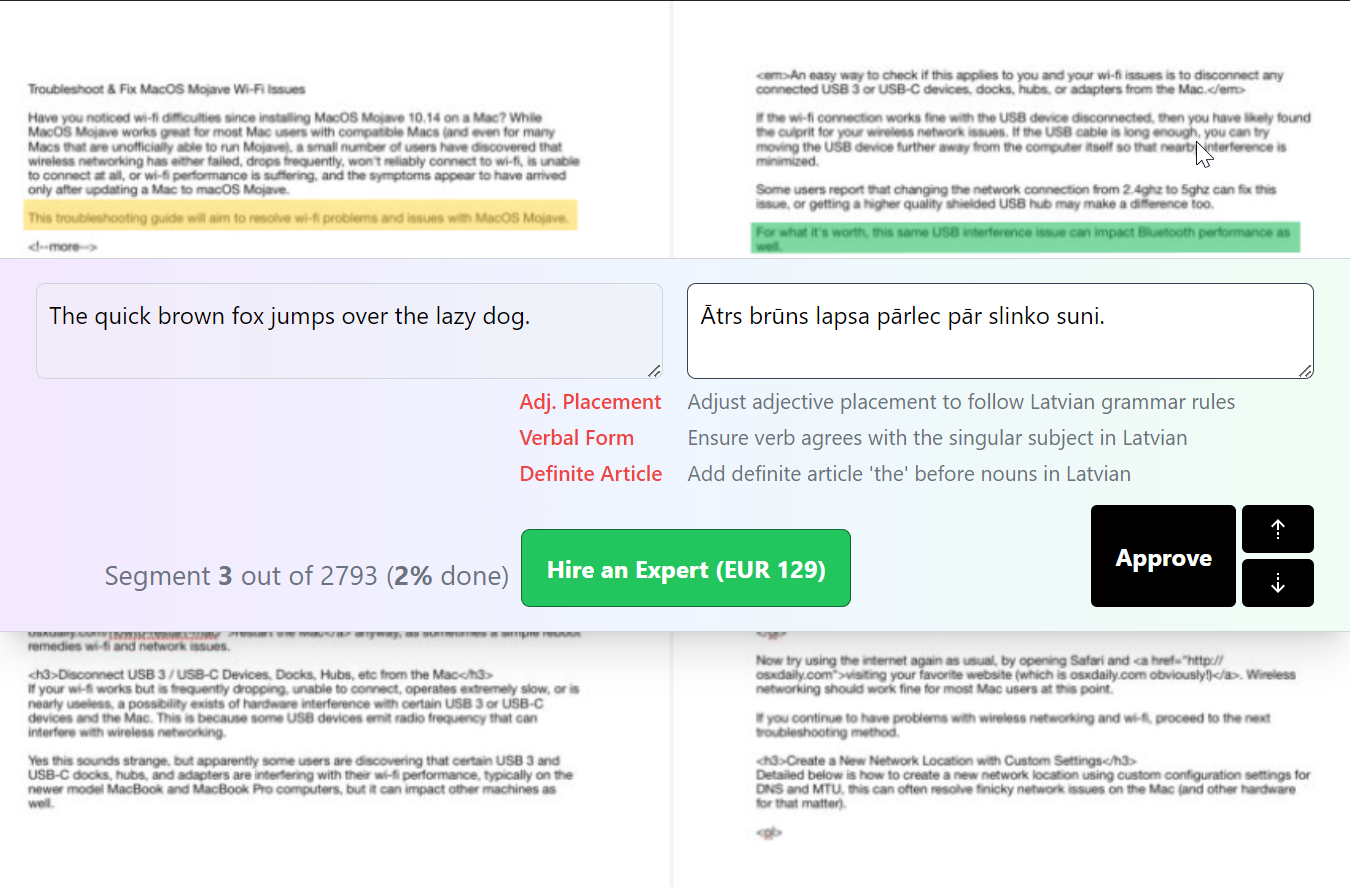
Linearis aims to revolutionise the translation and localisation industry through the deployment of an AI-powered Translation Quality Estimation tool. With over two decades of expertise in language solutions, our initiative responds to the urgent need for more efficient, accurate, and cost-effective translation processes that have long been bogged down by inefficiencies in identifying the accuracy of machine-translated texts.
Historically, the reliance on machine translation and post-editing has been a double-edged sword for Language Solution Providers (LSPs), offering significant cost savings over traditional human translation but lacking in reliability and necessitating comprehensive post-editing checks. The advent of neural machine translation engines has dramatically improved translation accuracy, yet the challenge of determining which parts of the translation are accurately rendered remains. This uncertainty leads to extensive, and often unnecessary, human editing—increasing both the time and costs involved in the translation process.
We aim to tackle this issue head-on by leveraging the LLMs combined with the Multidimensional Quality Metric (MQM) framework, which focuses on seven high-level dimensions critical to translation quality: Terminology, Accuracy, Linguistic conventions (Fluency), Style, Locale conventions, Audience appropriateness, Design, and Markup. By accurately identifying segments of text that meet predefined quality standards, our plans aim to significantly reduce the need for human post-editing, thereby streamlining the translation workflow and reducing operational costs.
Our vision is to minimise — and eventually eliminate — the need for human involvement in the translation process by not only estimating translation quality but also automatically refining translations in combination with Quality Estimation and the power of AI to match the quality of human work. This bold endeavour will not only enhance operational efficiency for LSPs but also promote inclusivity and understanding across global business activities, breaking down language barriers more effectively than ever before.
Currently, the project is in an early stage and idea concept and we are searching for a team of innovative developers, solution architects, and prompt engineers who are passionate about leveraging AI to redefine the standards of translation quality and efficiency. Together, we aim to deliver a solution that not only meets the current demands of the global communication market but also anticipates the future needs of an increasingly interconnected world.
Problem Statement
Despite advancements in machine translation, identifying the segments of text that require human editing remains a challenge. This uncertainty leads to inefficiencies, including unnecessary costs and extended turnaround times in the translation and localisation process.
Project Goals and Objectives
- Develop an AI-driven tool that can estimate the quality of machine translations based on the MQM error typology, encompassing various linguistic dimensions.
- Minimise human editing needs by accurately identifying translation segments that meet quality standards, thereby reducing post-editing workloads.
- Improve translation workflows by integrating AI to offer a faster, more cost-effective alternative to traditional human translation processes.
- Expand the tool’s capabilities to eventually edit translations autonomously, aiming to match or surpass the quality of human translations.
Expected Outcomes and Impact
- Improved efficiency: Drastically reduce the time and costs associated with translation and localisation processes.
- Improved Accuracy: Elevate the overall quality of translations by pinpointing and addressing inaccuracies.
- Market Disruption: Set a new industry standard for translation quality assessment and editing, promoting broader access to accurate localisation services.
Together, let's break language barriers and redefine the standards of the translation and localisation industry.
Built With
- api
- chatgpt
- claude
- figma
- retool
- sveltekit


Log in or sign up for Devpost to join the conversation.