ProofPay — Making Freelance Payments More Transparent and Trustworthy
The Problem: Getting Paid Shouldn't Come Down to Just Trust
Freelancing involves a lot of trust. A client trusts a developer to deliver what was promised, and the developer trusts the client to pay once the work is done. But things don't always go as smoothly as expected.
Consider a simple situation: a freelancer spends two weeks building a feature for a client. The work is submitted, but the client feels that something is missing. The freelancer believes they've completed everything that was agreed upon. Now both sides have different interpretations of the same agreement.
We've seen how easily this can happen when requirements are discussed through messages, acceptance criteria are never clearly defined, and there's no proper way to demonstrate that the work has actually been completed.
The problem isn't necessarily that either person is being dishonest. Sometimes, both genuinely believe they're right.
We started thinking about a simple question: What if there was a way to connect what was originally promised, what was actually delivered, and the evidence supporting it?
That's where ProofPay came in.
Introducing ProofPay
ProofPay is an AI-powered platform that brings milestone verification and payments together for freelance software projects.
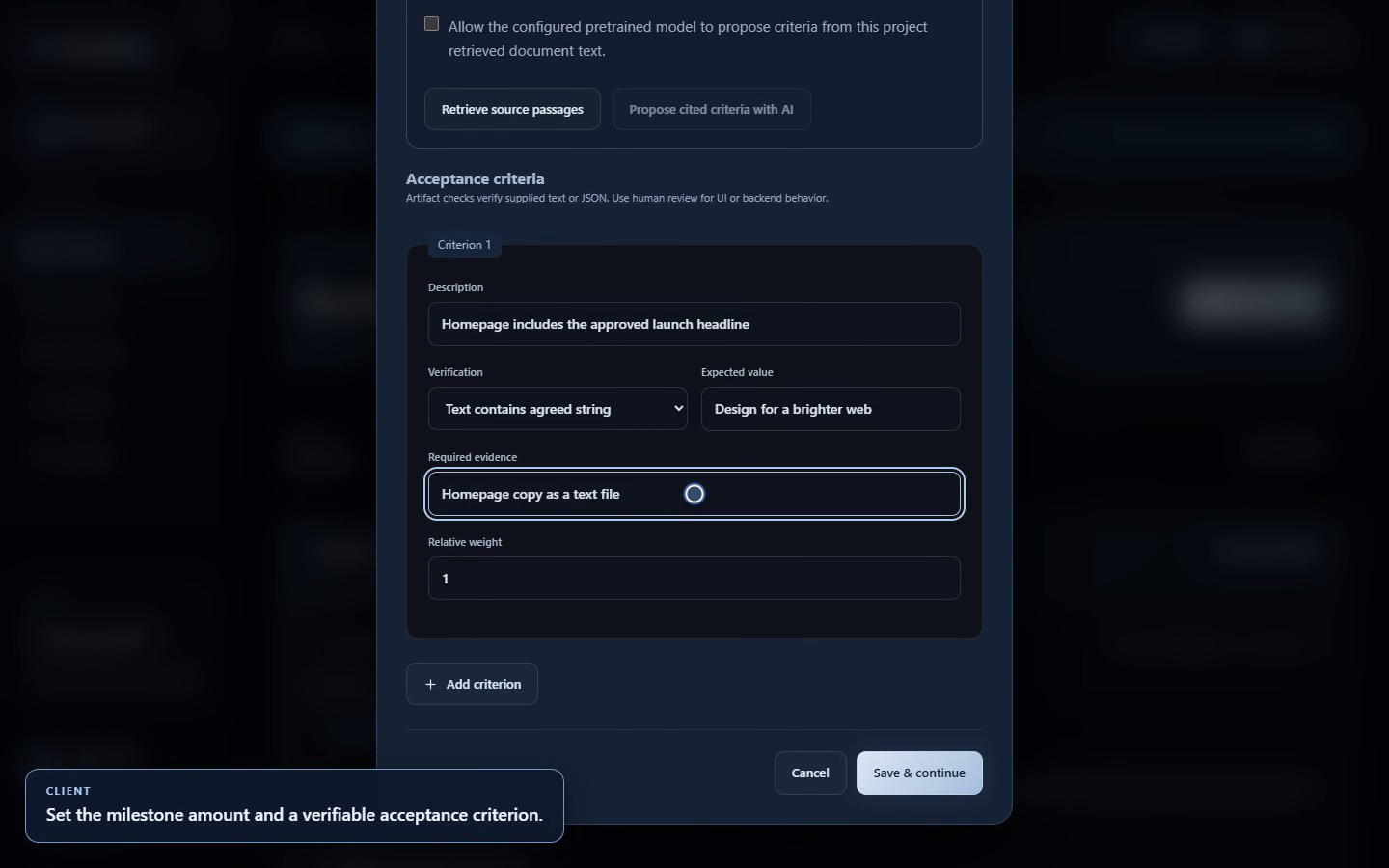
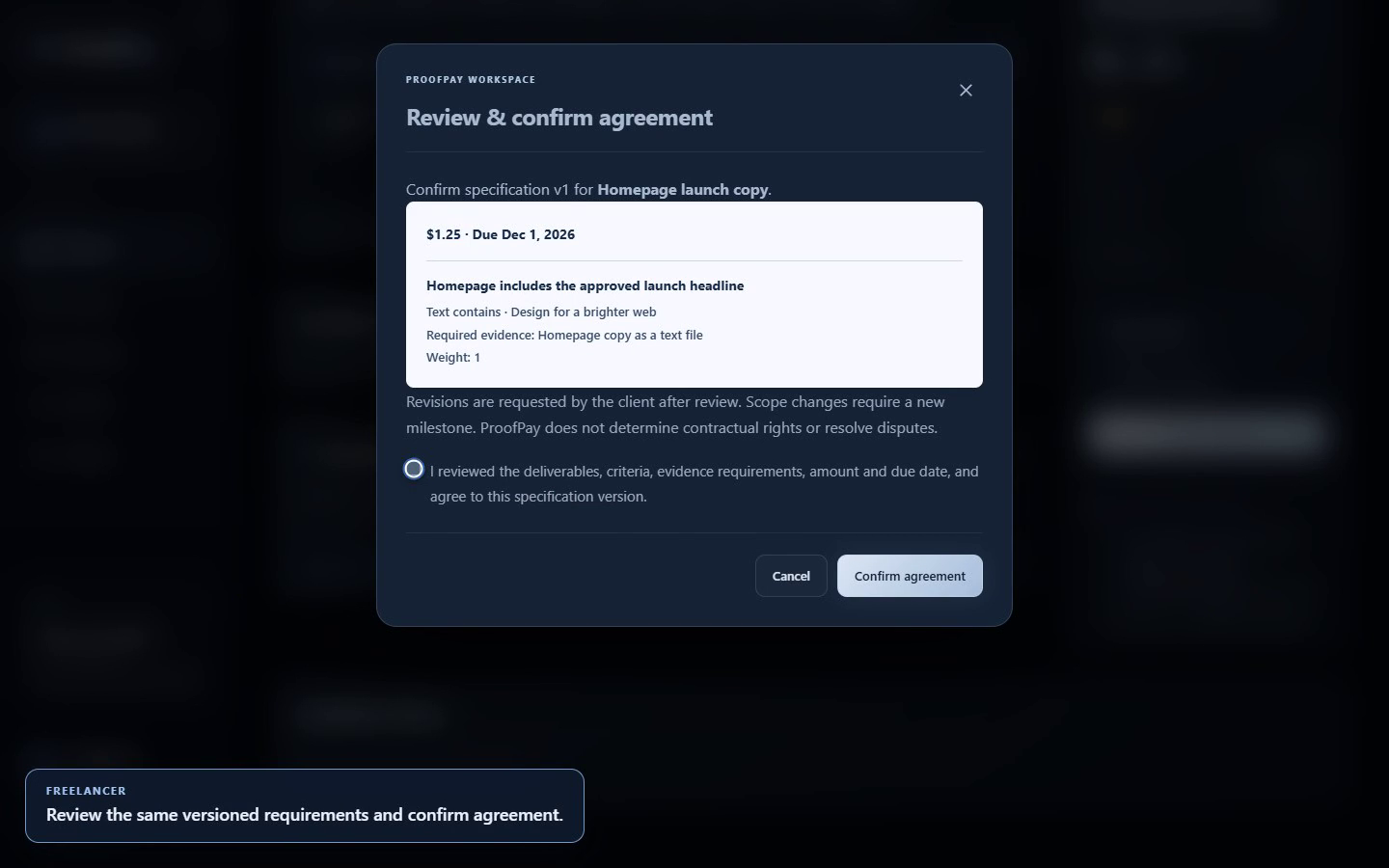
The idea is to make the entire process clearer for both clients and freelancers, from defining the work to getting paid.
Here's how we approach it:
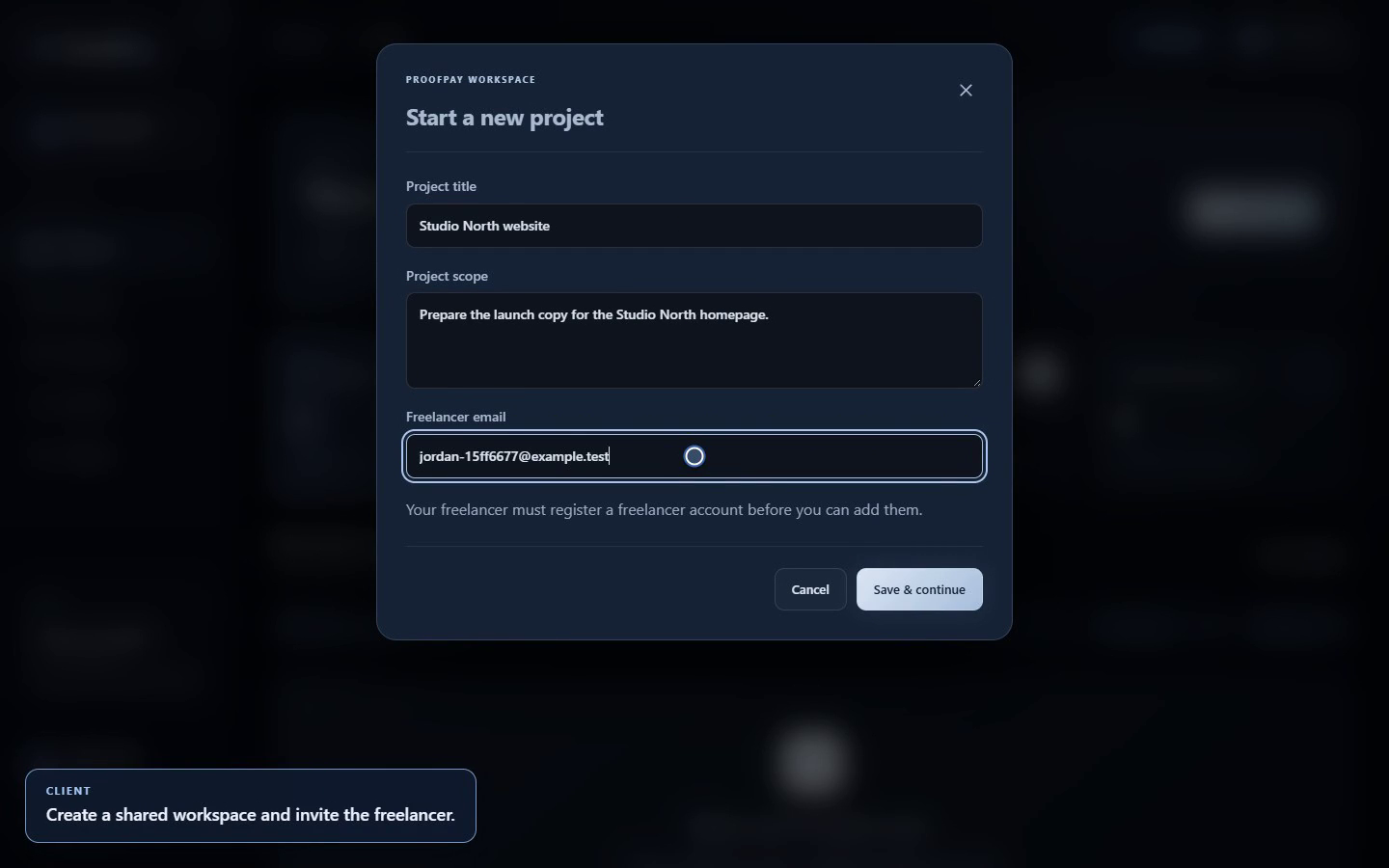
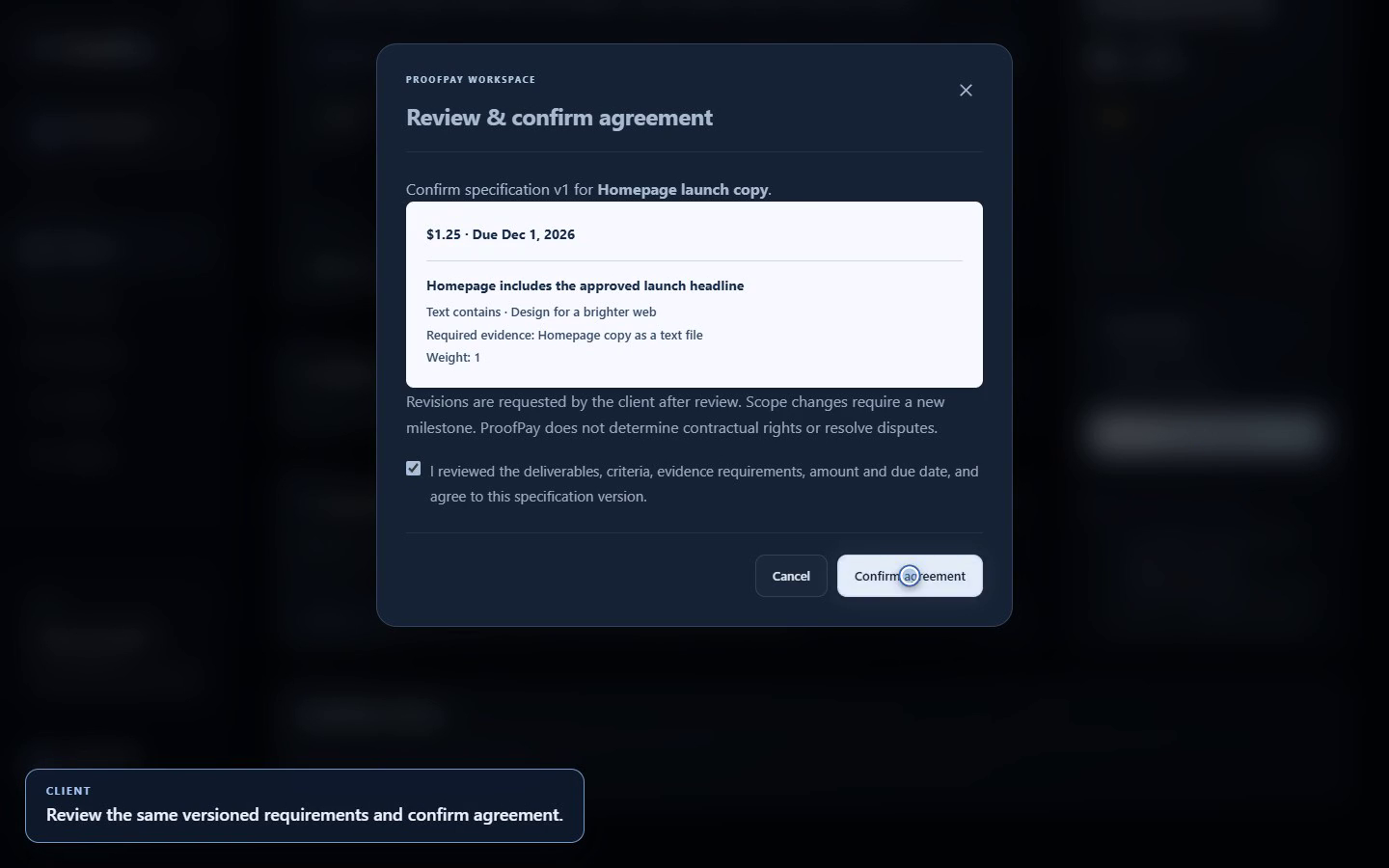
Start with clear requirements: The client describes what they expect from a milestone in natural language. AI helps break that description down into smaller, structured acceptance criteria so there's a clearer understanding of what needs to be delivered.
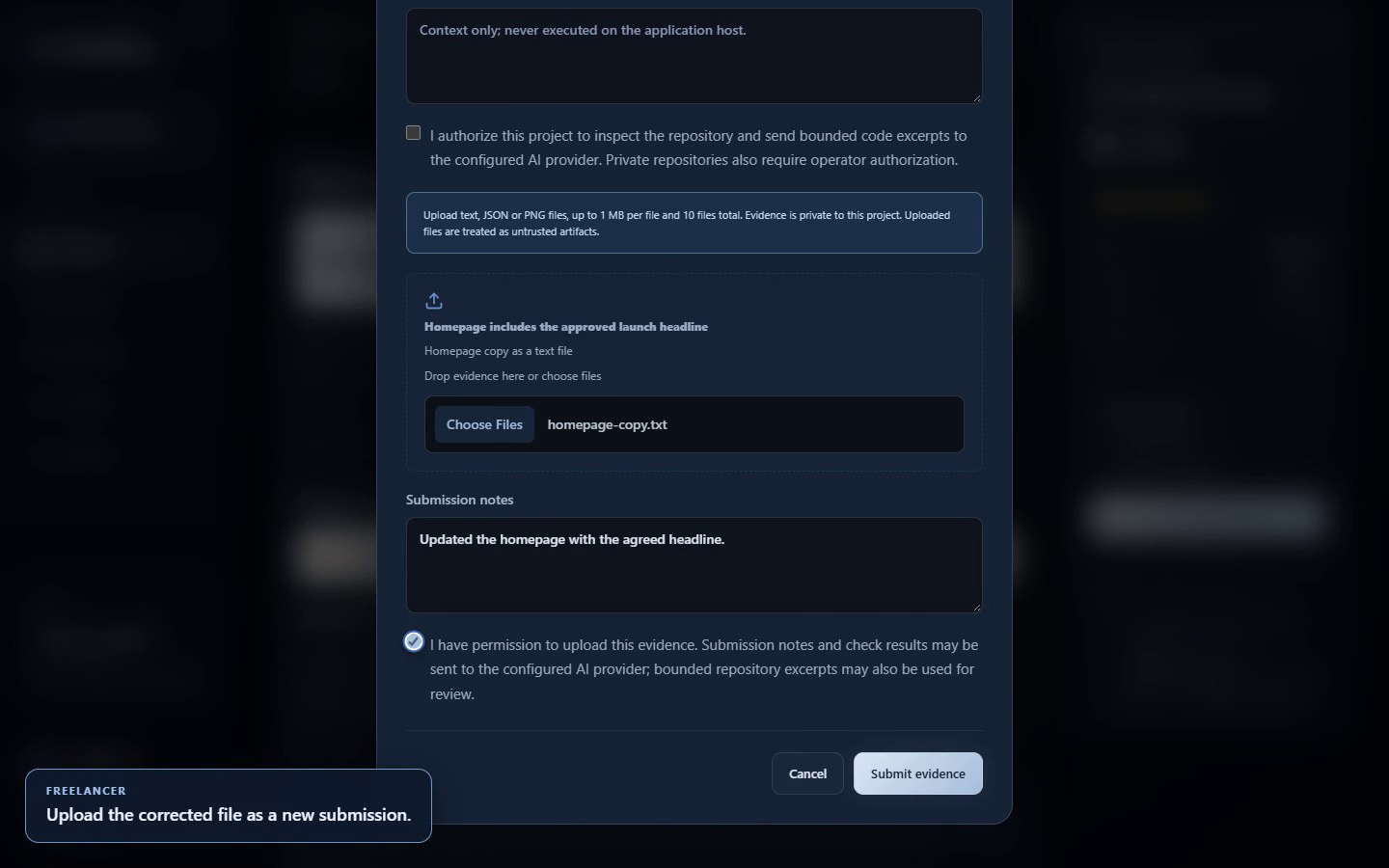
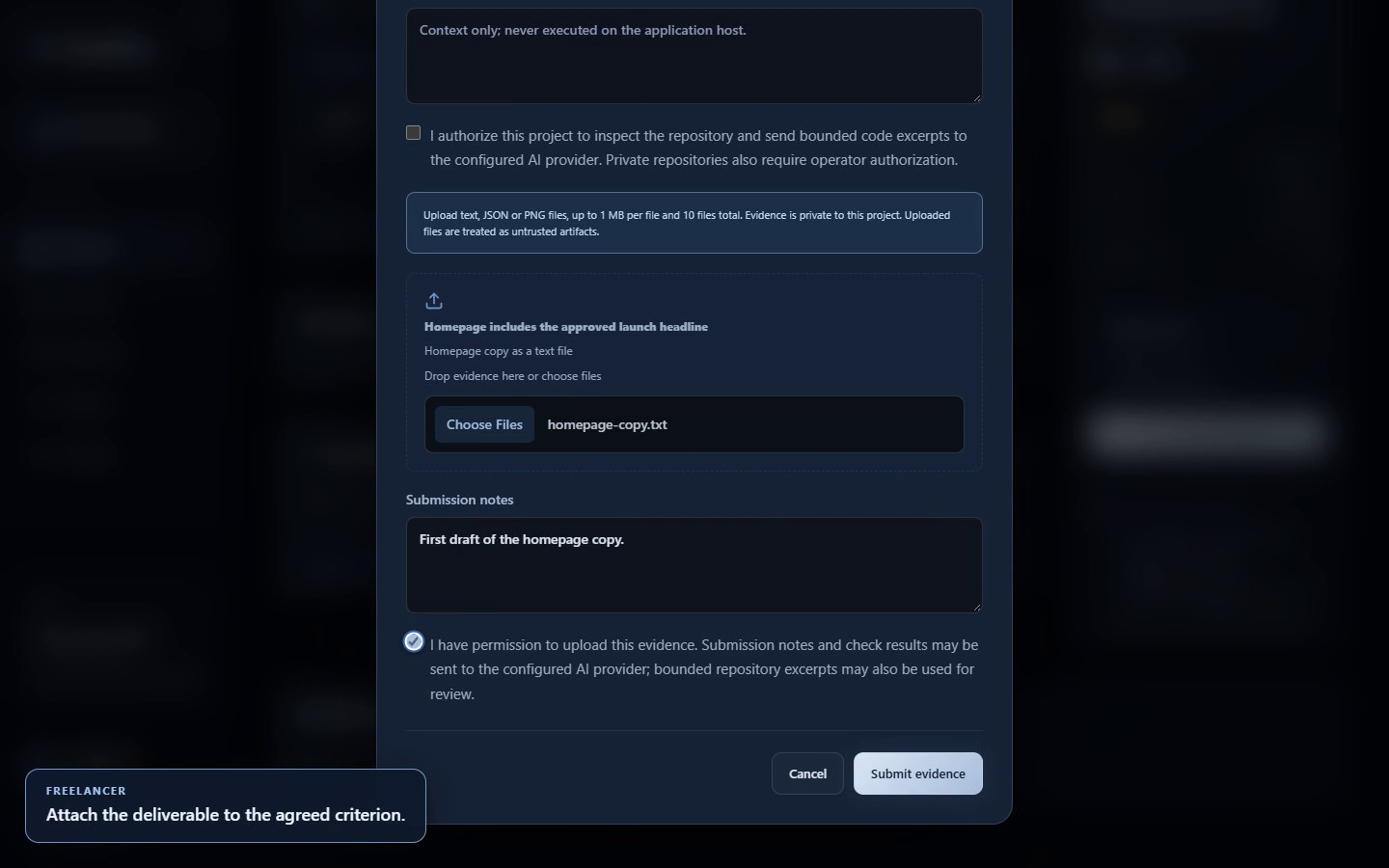
Submit the work: Once the freelancer completes the milestone, they can submit their deliverables along with relevant evidence, such as screenshots, repository links, test results, and other supporting materials.
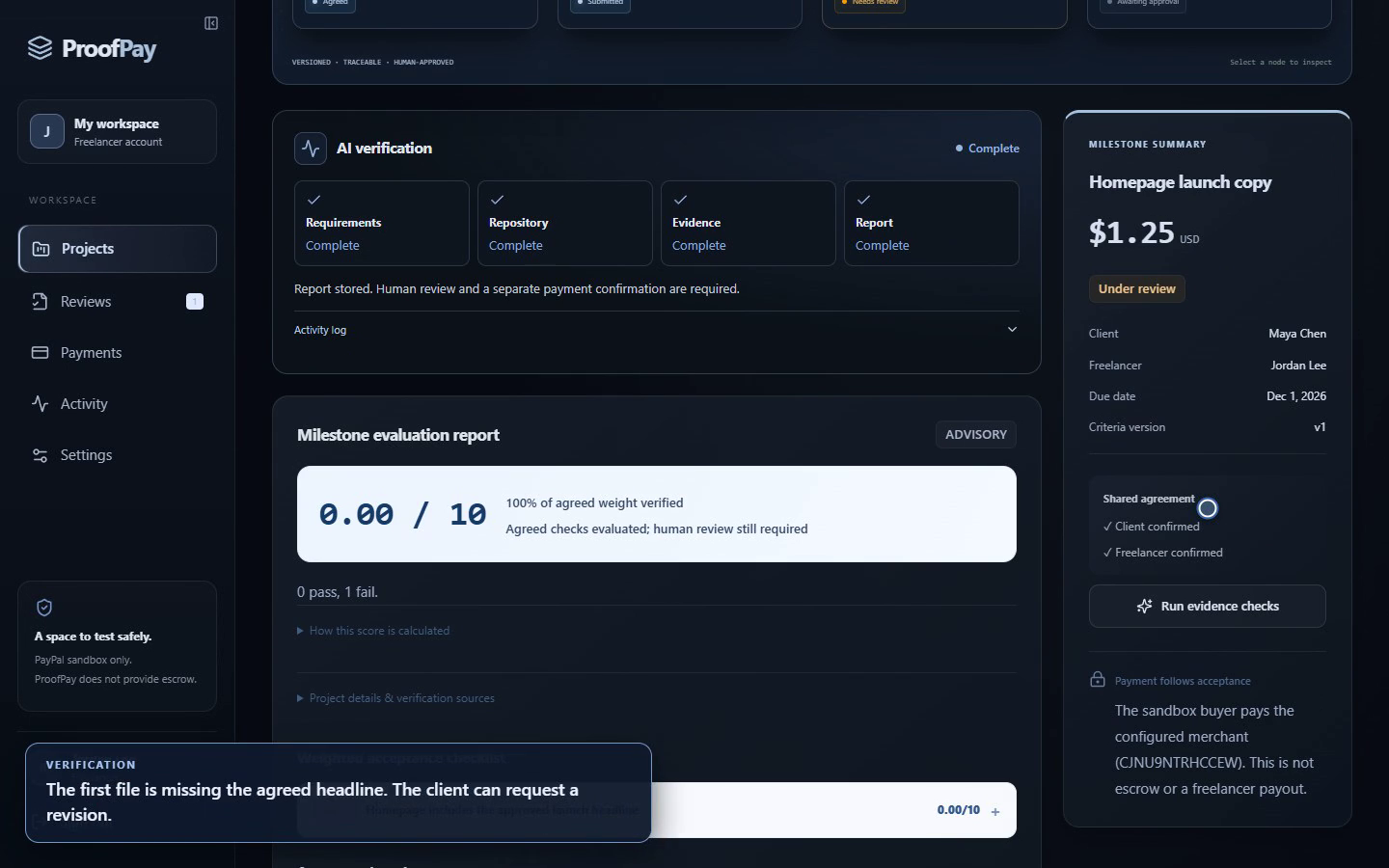
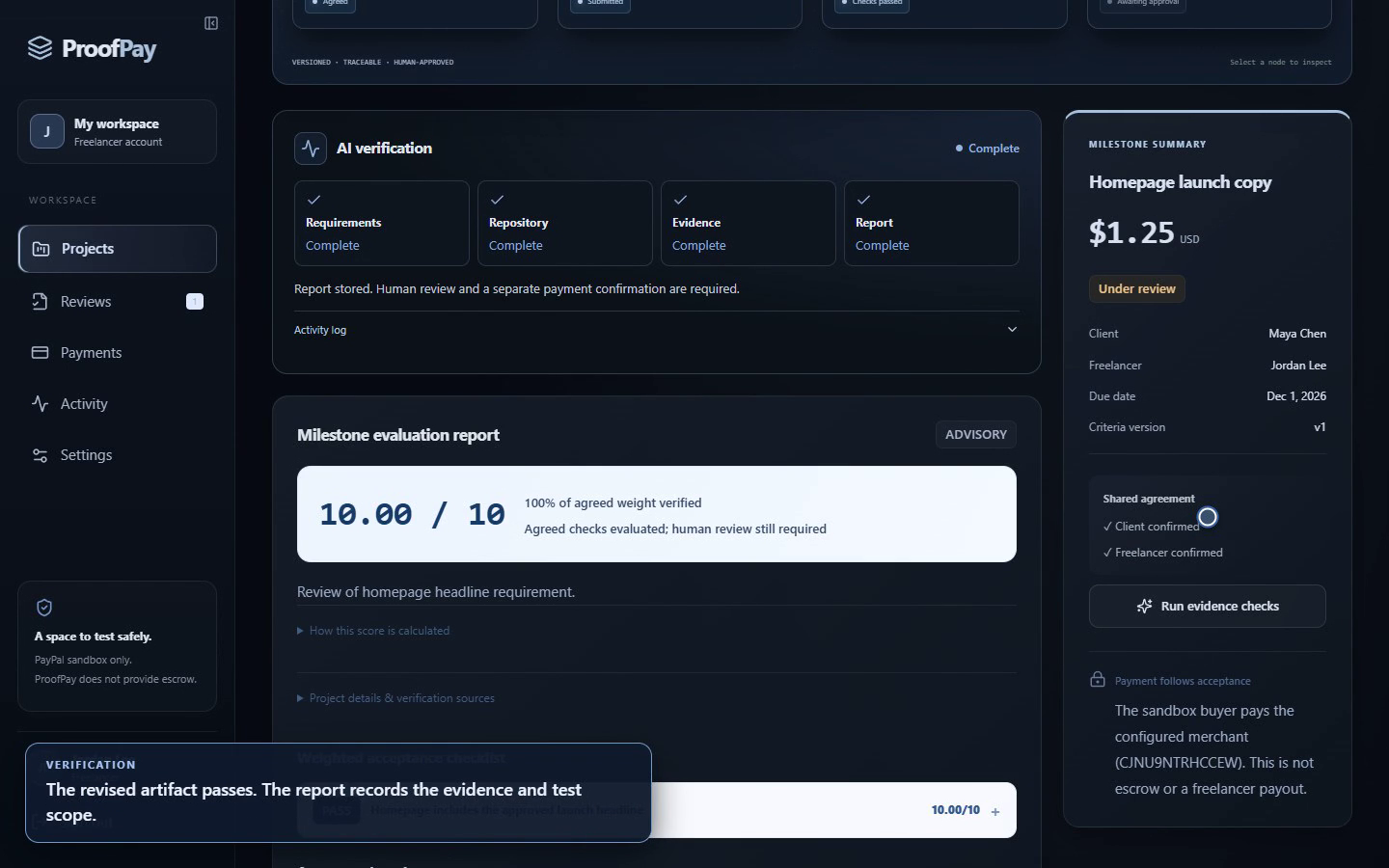
Let AI examine the evidence: ProofPay analyzes the submitted evidence against the original acceptance criteria. The intention is to understand not just what has been submitted, but whether it actually supports what was promised.
Understand what's completed: Each criterion gets a verification status, such as Verified, Needs Review, or Not Verified, along with the reasoning and supporting evidence.
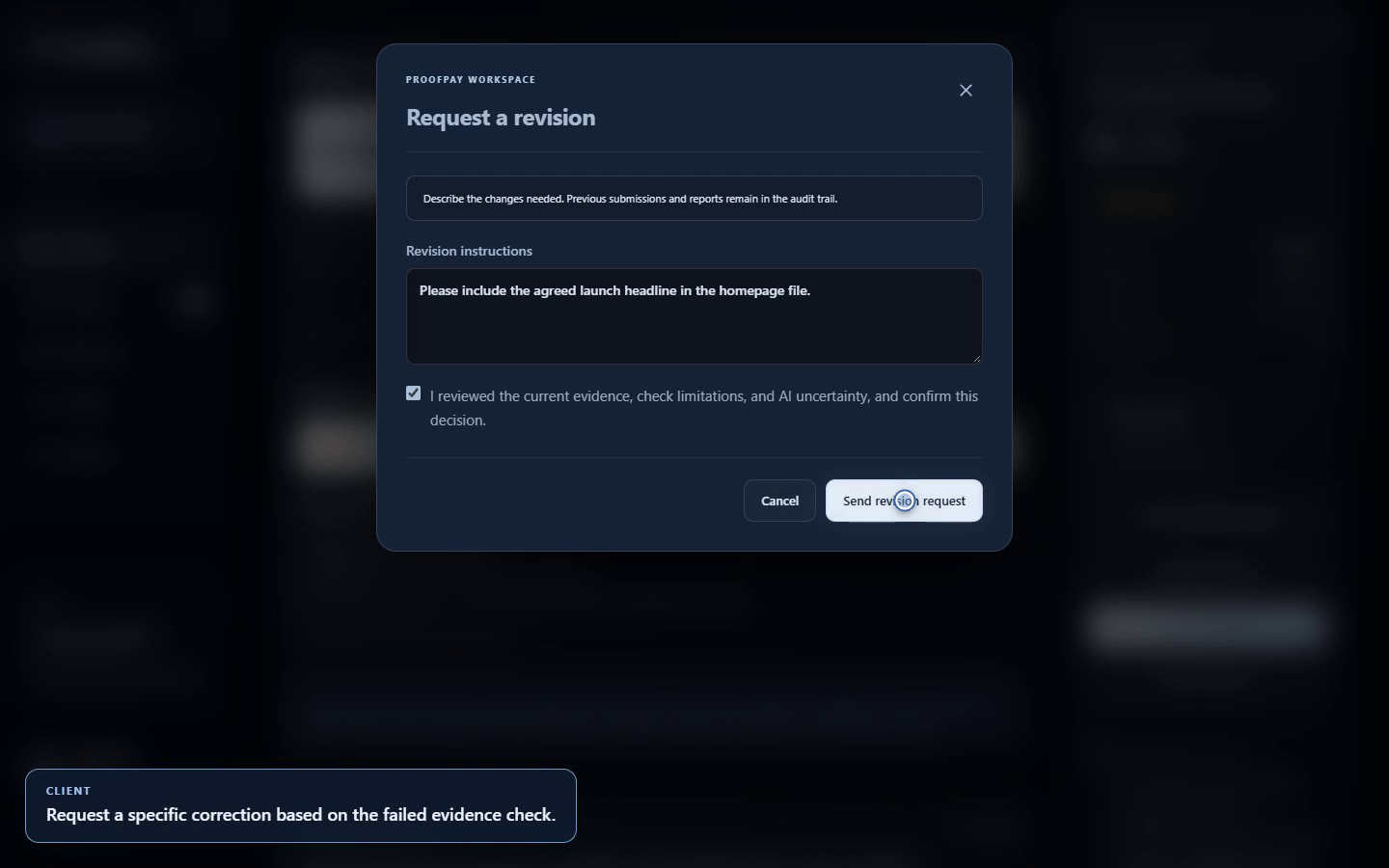
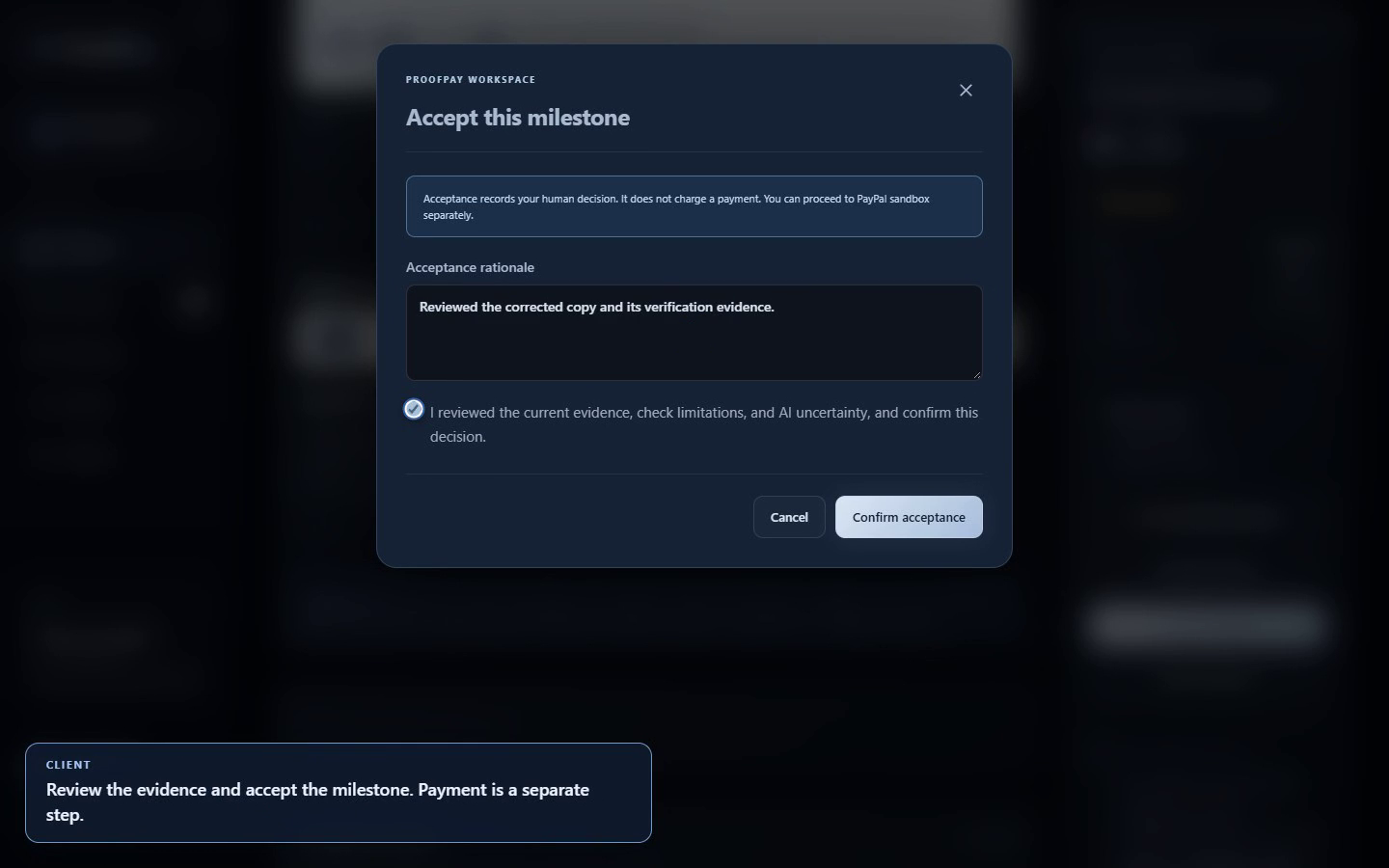
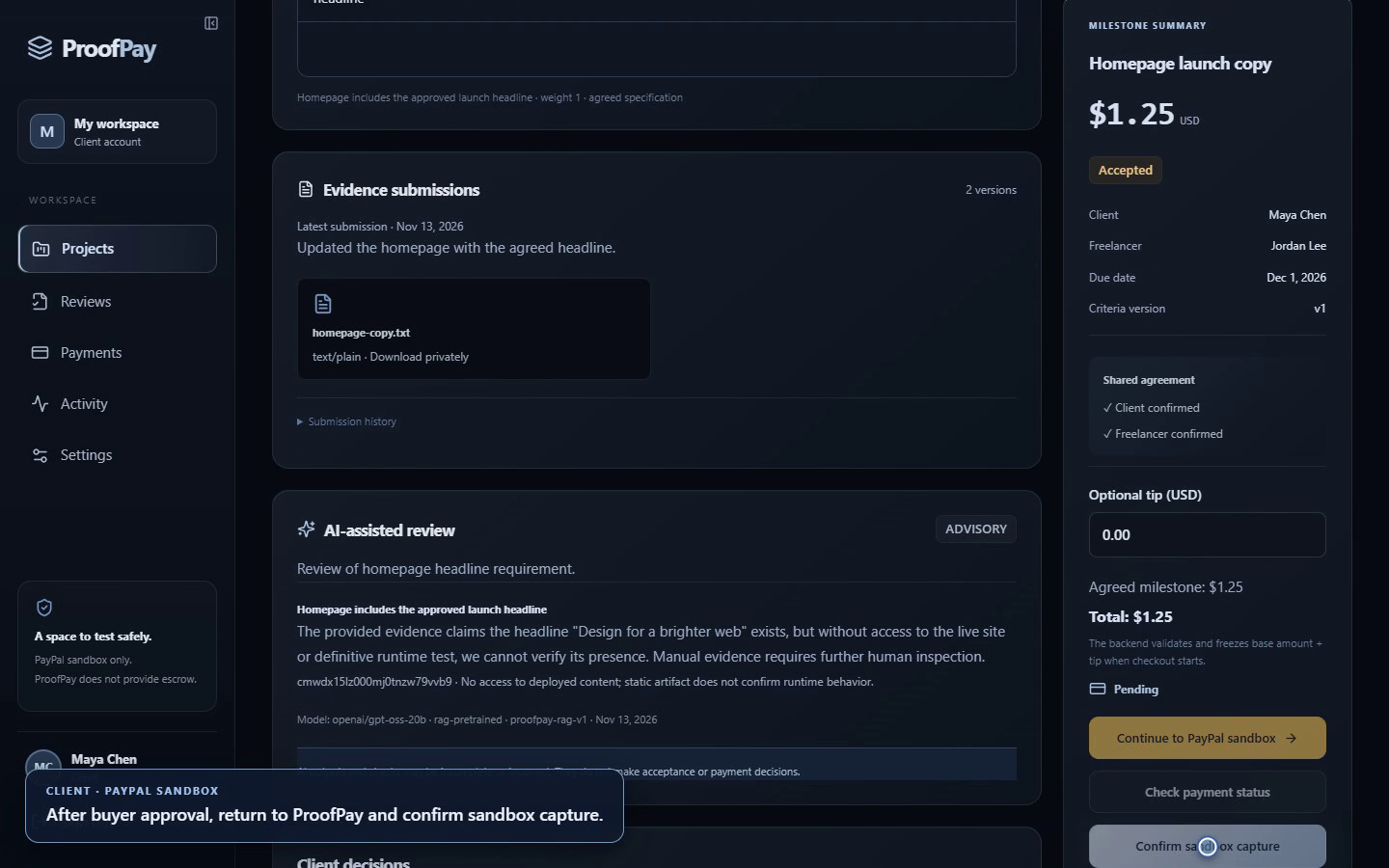
Keep the client in control: The client can review the results, accept the milestone, or request changes. AI assists with the evaluation, but the final decision remains with the client.
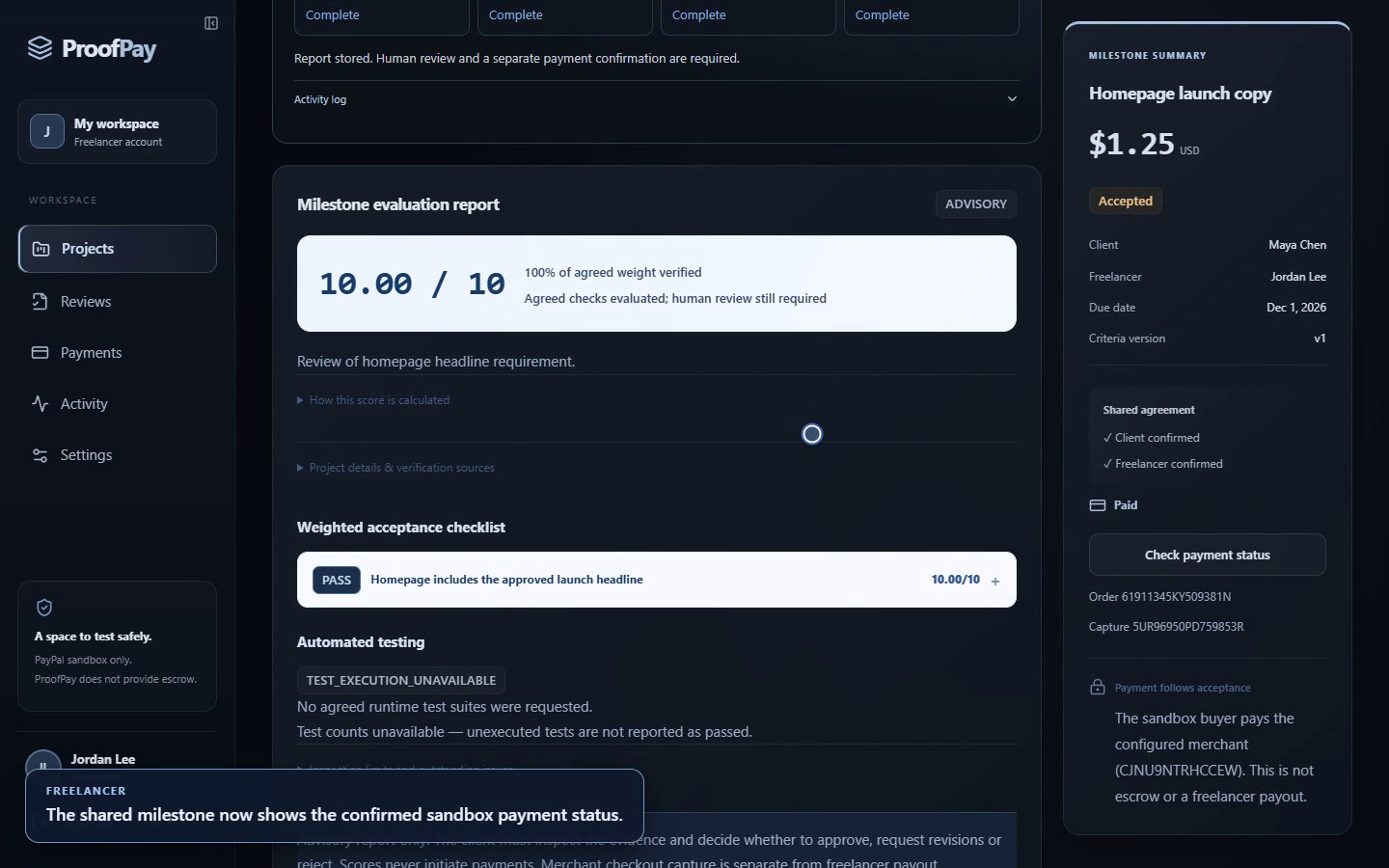
Complete the payment: Once the milestone is accepted, ProofPay facilitates the corresponding payment through PayPal.
We didn't want to build something where AI simply declares a milestone complete and automatically makes decisions on behalf of people. We wanted to build something that helps both sides understand why a milestone should or shouldn't be accepted.
The Idea We're Most Excited About: Acceptance Evidence Graph
One thing we really wanted was for ProofPay to have an identity of its own, something beyond the usual dashboards, cards, and payment status indicators.
This led us to the Acceptance Evidence Graph, which is at the heart of our product experience.
Think about it this way: a project has certain requirements. Each requirement needs some form of verification, and that verification needs evidence. Finally, someone needs to review the results and decide whether the work is acceptable.
We wanted to bring all of these relationships together in one place.
The graph connects:
Requirement → Verification Method → Evidence → Evaluation Result → Client Decision
Instead of showing users a single AI-generated score and asking them to trust it, the graph helps them understand how the evaluation was reached.
For example, if a freelancer submits a screenshot to demonstrate that a particular UI requirement has been completed, the graph can connect that screenshot to the relevant requirement and its evaluation result.
We also wanted the different verification states to be easy to understand at a glance:
- Green: The submitted evidence successfully verifies the requirement.
- Amber: Something needs further review or clarification.
- Grey: Verification is still pending or supporting evidence is missing.
This makes it easier to identify which parts of a milestone are complete and which ones still need attention.
For us, the Acceptance Evidence Graph isn't just another visualization. It's the part of ProofPay that brings the entire idea together. We want users to associate this graph with ProofPay in the same way they associate a familiar visual identity with a product.
And importantly, the graph supports the client's decision rather than making that decision for them.
How We Built It
Building ProofPay meant bringing together three things that don't always work neatly together: AI, evidence management, and payments.
We approached it as a full-stack web application, with an interactive frontend, backend business logic, and persistent data storage.
Some of the key parts of our implementation include:
AI-powered requirement generation: We use LLM-based structured outputs to help convert descriptions written in natural language into smaller, understandable acceptance criteria.
Evidence analysis: Submitted evidence is evaluated against the individual criteria rather than treating the entire milestone as one large task. This helps make the results more specific and easier to review.
Verification statuses: We distinguish between requirements that are verified, those that need additional review, and those for which sufficient evidence hasn't been provided.
Evidence organization: Each deliverable and its supporting evidence are associated with the relevant milestone and acceptance criteria.
Client approval workflow: We keep AI evaluation separate from the actual acceptance decision, allowing the client to review the results before proceeding.
PayPal integration: We use PayPal's payment infrastructure to facilitate payments after milestone acceptance.
One thing we paid particular attention to was the relationship between AI evaluation and payment execution. We didn't want an AI response to independently determine how much someone gets paid or trigger a payment without the appropriate approval.
Keeping these steps separate was important to the way we designed ProofPay.
Challenges We Faced
One of the most interesting challenges was figuring out how to make AI evaluations genuinely useful.
Software requirements aren't always straightforward. A screenshot might show that a particular interface exists, but it doesn't necessarily prove that the underlying functionality works. Similarly, a test passing doesn't automatically mean that an entire milestone has been completed.
This made us think carefully about how evidence should be evaluated and how much confidence should be placed in an AI-generated result.
We wanted the system to connect every evaluation to the actual evidence behind it, rather than simply producing a score and expecting users to accept it.
Another challenge was designing the overall workflow. Verification, client approval, and payment might seem like parts of the same process, but they serve very different purposes. We had to think about how these stages should interact without giving AI more control than it should have.
We also spent time thinking about the Acceptance Evidence Graph. Representing relationships between requirements, evidence, and verification results is one thing; making those relationships understandable to someone who isn't particularly technical is another.
Getting that balance right was an important part of the design process.
What We Learned
Working on ProofPay gave us a better understanding of what it actually takes to build an AI-powered product.
We learned that simply integrating an LLM isn't enough. The quality of the input, the structure of the output, the availability of supporting evidence, and the way results are presented all matter.
We also realized that AI works best when its limitations are acknowledged. There are situations where automated analysis can be helpful, and others where human judgment is still necessary.
On the technical side, working with payment workflows also made us think more carefully about application logic, approval mechanisms, and the importance of keeping financial actions separate from AI-generated recommendations.
Perhaps the biggest thing we took away from this project is that AI shouldn't just tell people what to believe. It should help them understand why.
What's Next?
ProofPay is something we'd like to take much further.
We see opportunities to integrate directly with development platforms, support automated test execution, accept a wider range of deliverables, and make the Acceptance Evidence Graph even more useful as projects become more complex.
We'd also like to explore how the same approach could work beyond software development, where milestone-based work and disagreements over deliverables are equally common.
Ultimately, we want to make it easier for people to work together without having to rely on assumptions about whether something has been completed.
Clear requirements. Verifiable work. Fairer payments.
That's what we're trying to achieve with ProofPay.
ProofPay — Because trust is stronger when it's backed by proof.
Built With
- next.js
- openai-api
- paypal-javascript-sdk
- paypal-rest-api
- playwright
- postgresql
- prisma-orm
- react
- tailwind-css
- typescript
