-
-
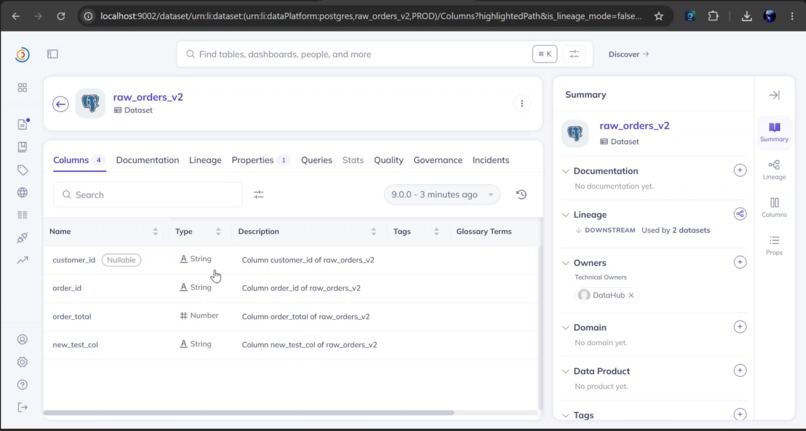
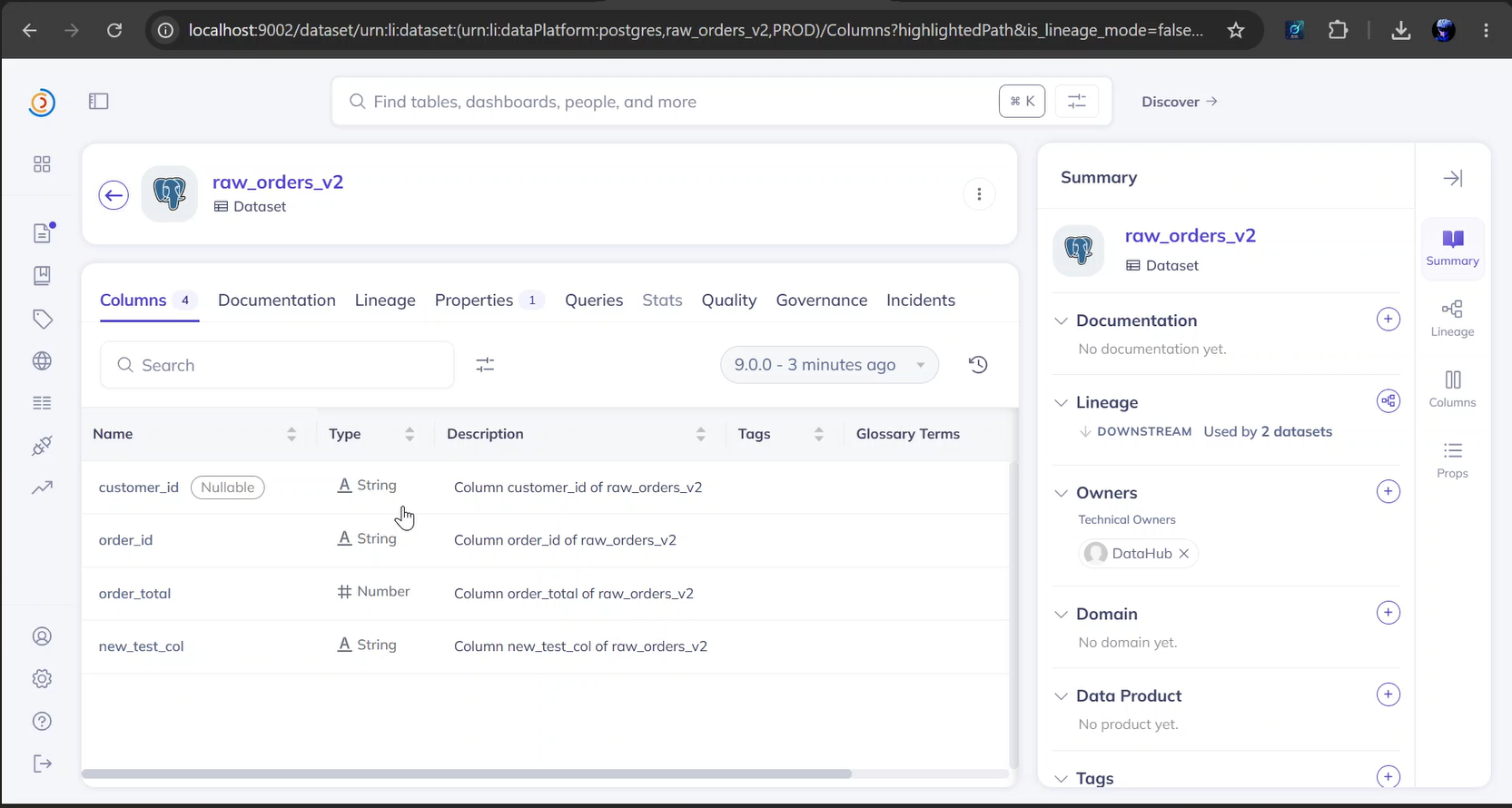
DataHub: raw_orders_v2 after the rename — customer_id replacing user_id
-
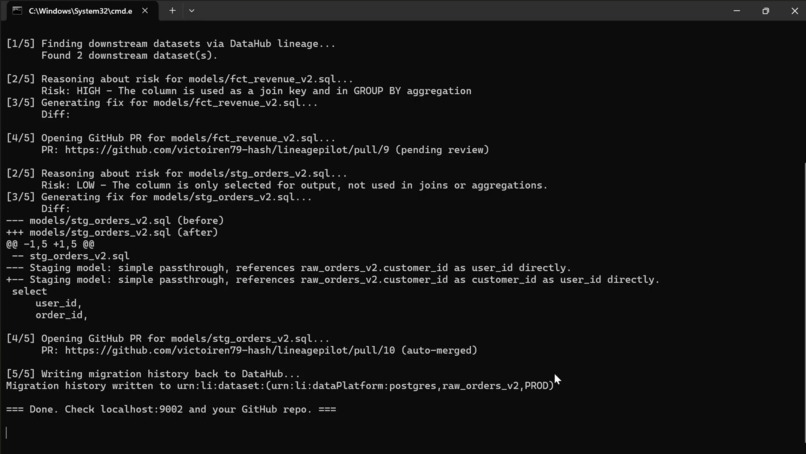
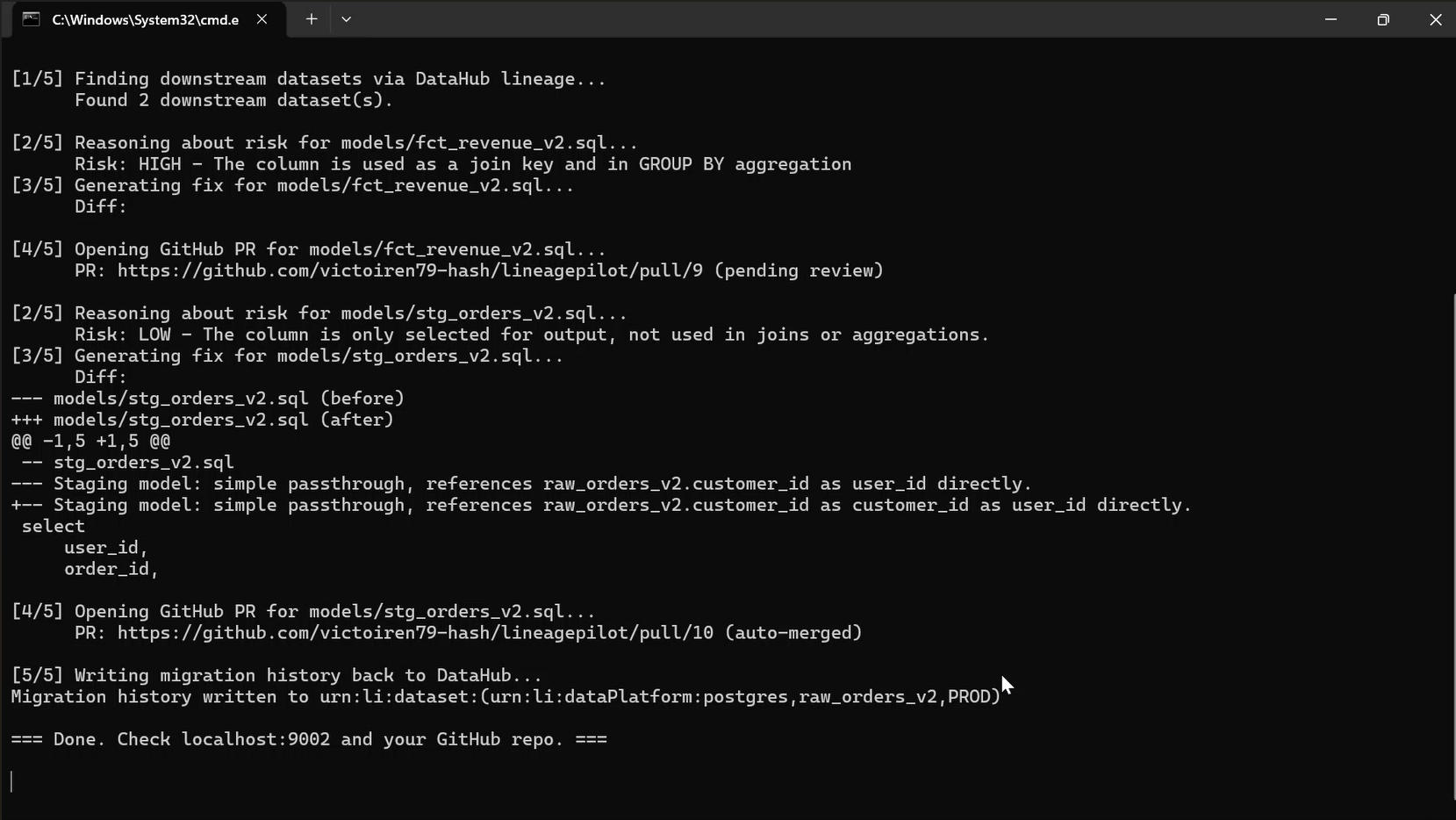
LineagePilot classifying risk differently per file and generating fixes
-
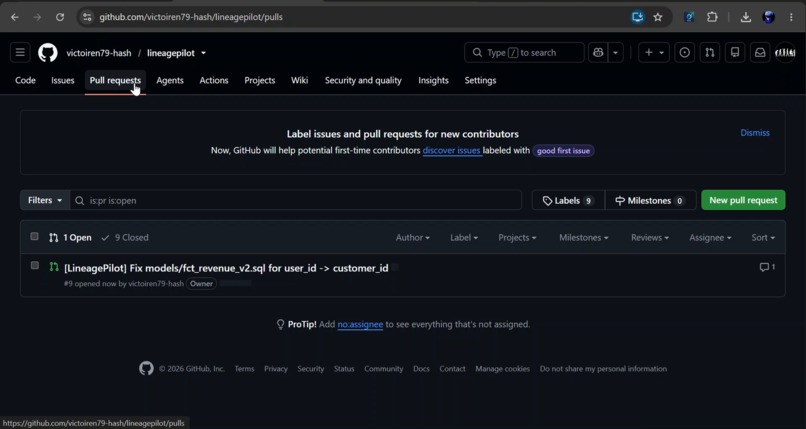
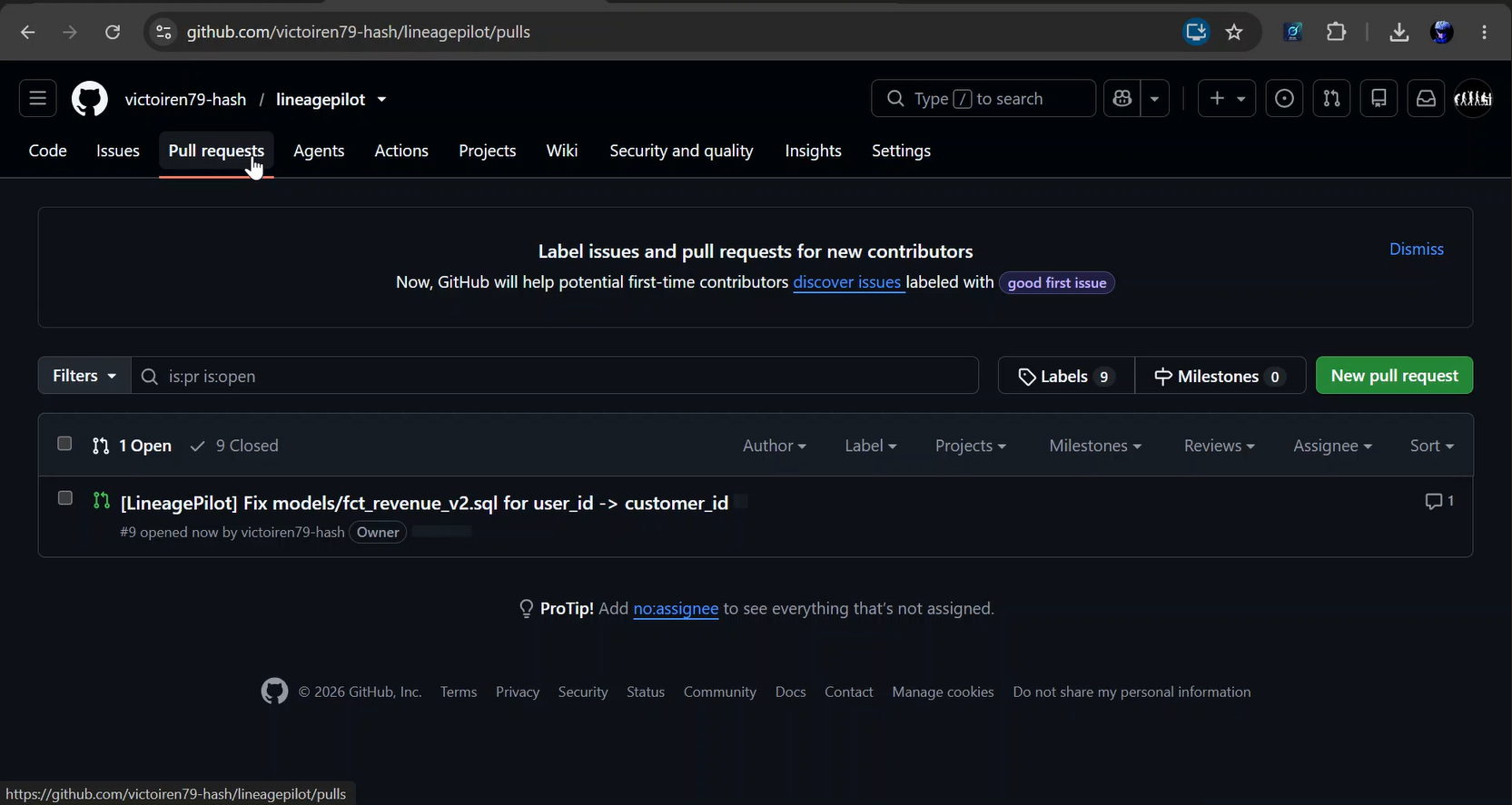
One high-risk PR held for review; nine previous runs already merged
-
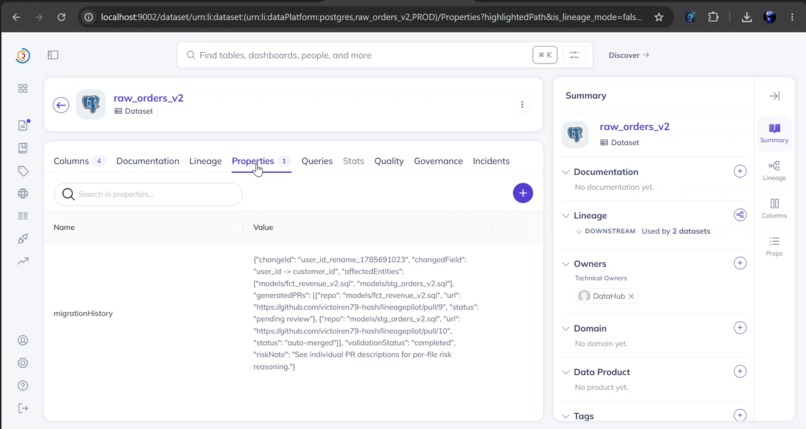
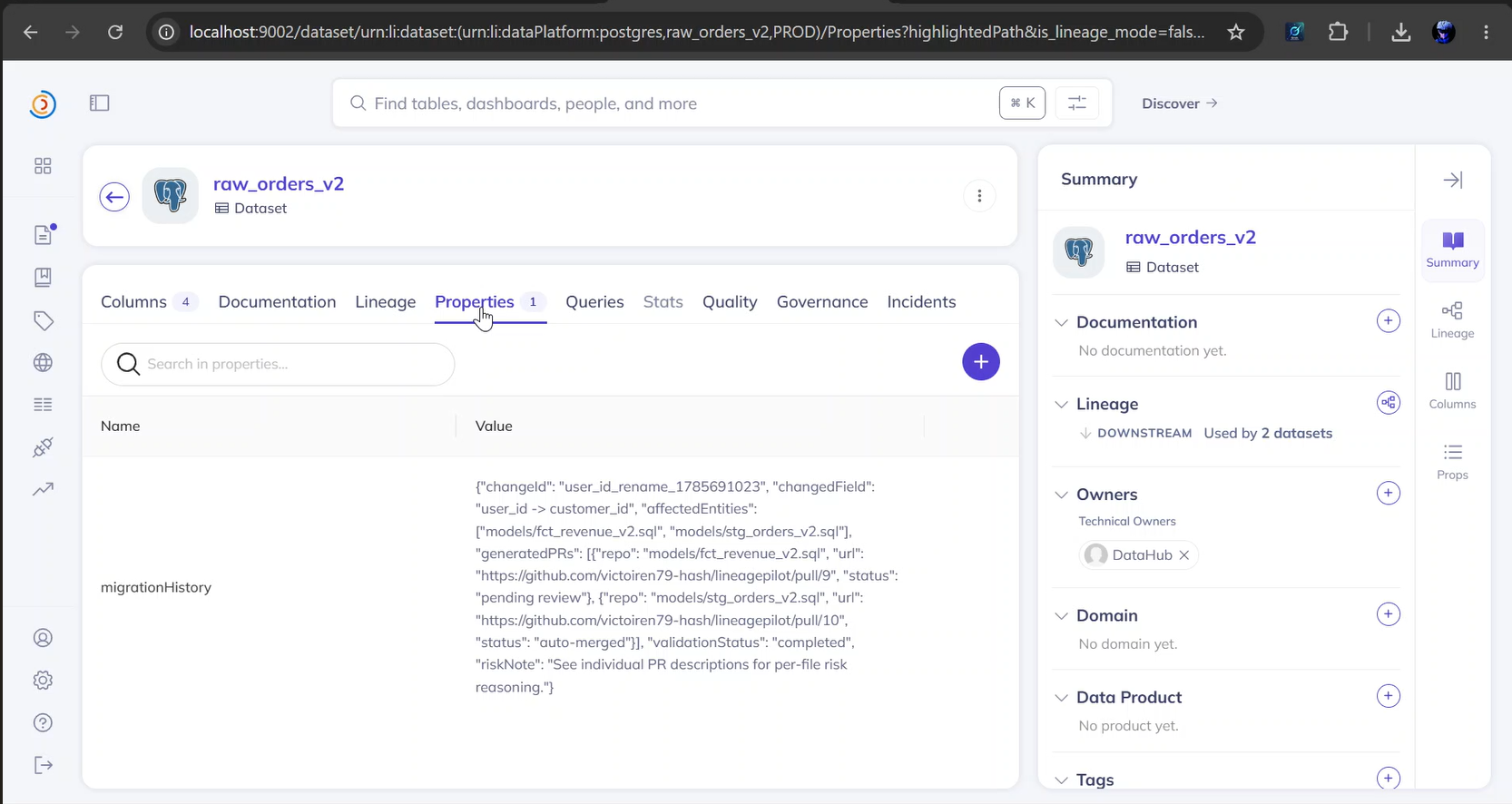
DataHub: migration history written back after the fix
Inspiration
DataHub already shows teams the blast radius of a schema change — which downstream tables, dashboards, and pipelines depend on a column. But knowing what breaks isn't the same as knowing why it breaks, or having it actually fixed. That gap between "here's a list of affected systems" and "here's a working fix, reviewed and ready to merge" is still closed by hand today, usually under time pressure, right when something's on fire. LineagePilot exists to close that gap automatically, using DataHub's own lineage graph as the source of truth.
What it does
LineagePilot watches a DataHub instance for schema changes — a column rename, in this demo. When one happens, it doesn't just find what breaks — it figures out how each downstream consumer depends on the changed column, and responds differently to each one.
In our test run, the same rename produced two different, independently justified outcomes: one file got a fix that was auto-merged immediately, the other got a fix that was flagged and held for human review — because the agent understood that one usage was a harmless display column and the other was a join key sitting inside a revenue calculation.
Concretely, LineagePilot:
- Detects the schema change the moment it happens, by consuming DataHub's own Kafka change-log stream directly — the same underlying event data DataHub's Actions Framework is built on top of
- Walks DataHub's column-level lineage to find every downstream consumer
- Reads each downstream file alongside its lineage context and reasons
about how that specific consumer depends on the changed column. Instead
of blindly replacing every reference to a renamed column, it distinguishes
a simple
SELECTreference — safe to alias automatically — from aJOINkey or an aggregation, which gets a higher risk score and is routed for human review instead. That distinction is the core of the project: the fix isn't templated, it's justified. - Generates the actual corrected code for each affected file
- Opens a real GitHub Pull Request per fix — low-risk fixes auto-merge immediately, high-risk fixes stay open for review with the reasoning written directly into the PR
- Writes a permanent migration history record back into the DataHub entity itself, so the next person or agent who looks at that table inherits the full story instead of starting from zero
How we built it
LineagePilot connects six systems into one loop: DataHub's schema-change event stream, its lineage graph, an LLM reading real downstream code, generated fixes, GitHub's PR workflow, and DataHub's own metadata store for the write-back. Detection runs off a Kafka consumer reading DataHub's raw change-log topic directly — the same underlying event data DataHub's own Actions Framework consumes, accessed here through a custom listener rather than that framework itself. Lineage traversal and the write-back both go through DataHub's own APIs — GraphQL for reading, the Python SDK emitter for writing. The only place an LLM is used is where genuine judgment is required: reading a downstream file's actual code next to its lineage context and deciding how much risk a given change carries there. Every other step — the lineage query, the diff generation, the PR routing, the write-back — is deterministic code, not model output. Fix generation and PR automation, including the auto-merge/review-required split, are driven directly off that one judgment call.
Challenges we ran into
The DataHub CLI's datapack loading command turned out to have a confirmed, open bug specific to Windows, which meant pivoting from the official sample dataset to a small hand-built demo dataset seeded directly through the Python SDK — which ended up giving tighter control over the exact lineage scenarios (a safe simple-reference case and a risky join-key case) needed to demonstrate the reasoning step clearly. Locally, getting the schema-change listener working correctly required tracking down the right Kafka topic name and the correct internal schema-registry URL DataHub actually uses (routed through GMS rather than a standalone service), since neither is obvious from a first read of the docs. Getting Docker itself running also required enabling virtualization support that wasn't on by default.
DataHub integration and why it matters
Without DataHub, an agent trying to do this would have to grep repositories for a column name, guess at which files are actually related, and miss any pipeline that isn't obviously named — the exact way these breakages happen in real teams today. With DataHub, the agent already has the dependency graph. It doesn't need to guess what's connected to what; it queries it.
DataHub isn't a passive data source here — it's the backbone the whole pipeline runs on. Detection is built on DataHub's own change-log event stream: schema changes are picked up the moment they happen, not on a polling schedule. Column-level lineage, queried through DataHub's GraphQL API, is what makes it possible to know exactly which downstream files are affected and how, rather than pattern-matching on names. And critically, the pipeline writes back into DataHub rather than only reading from it — each migration's full story is saved directly onto the entity as a structured record. That write-back is what turns DataHub from a static map of "what depends on what" into something that actually accumulates institutional knowledge over time — the next engineer, or the next agent, inherits real context instead of having to reconstruct it. In other words: DataHub provides the agent's memory and context, while LineagePilot provides the decision-making and execution.
Accomplishments that we're proud of
This connects six separate systems into a single working loop: DataHub's schema-change event stream, its lineage graph, an LLM reading and reasoning about real code, generated fixes, GitHub's PR workflow, and DataHub's own metadata store for the write-back. Getting all six wired together and running reliably, end to end, against a real DataHub instance is the actual achievement here — and the clearest proof it works is that the same rename produced two different, correctly justified outcomes in a single run: one auto-merged, one flagged for review, with no manual intervention deciding which was which.
What we learned
How much of DataHub's real power is in the parts that aren't visible from the UI alone — its underlying change-log event model, and just how much context column-level lineage carries once you can actually query it programmatically. Also a fair amount about the gap between "the docs say this should work" and what actually runs cleanly on a given OS.
What's next for LineagePilot
Expanding beyond dbt-style SQL to Airflow DAGs and raw pipeline scripts as first-class fix targets, broadening the risk model beyond join-keys and aggregations (test coverage, downstream metric definitions, ownership), and exploring meaningful open-source contributions back to DataHub itself around the schema-change event filtering patterns this project relies on.

Log in or sign up for Devpost to join the conversation.