-
-
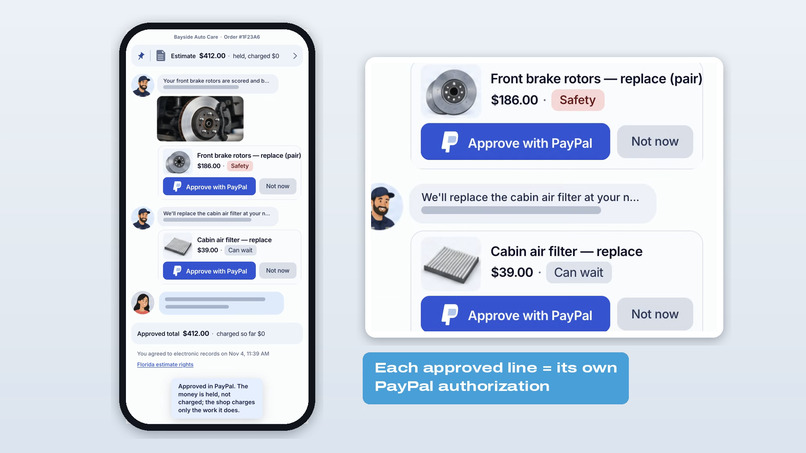
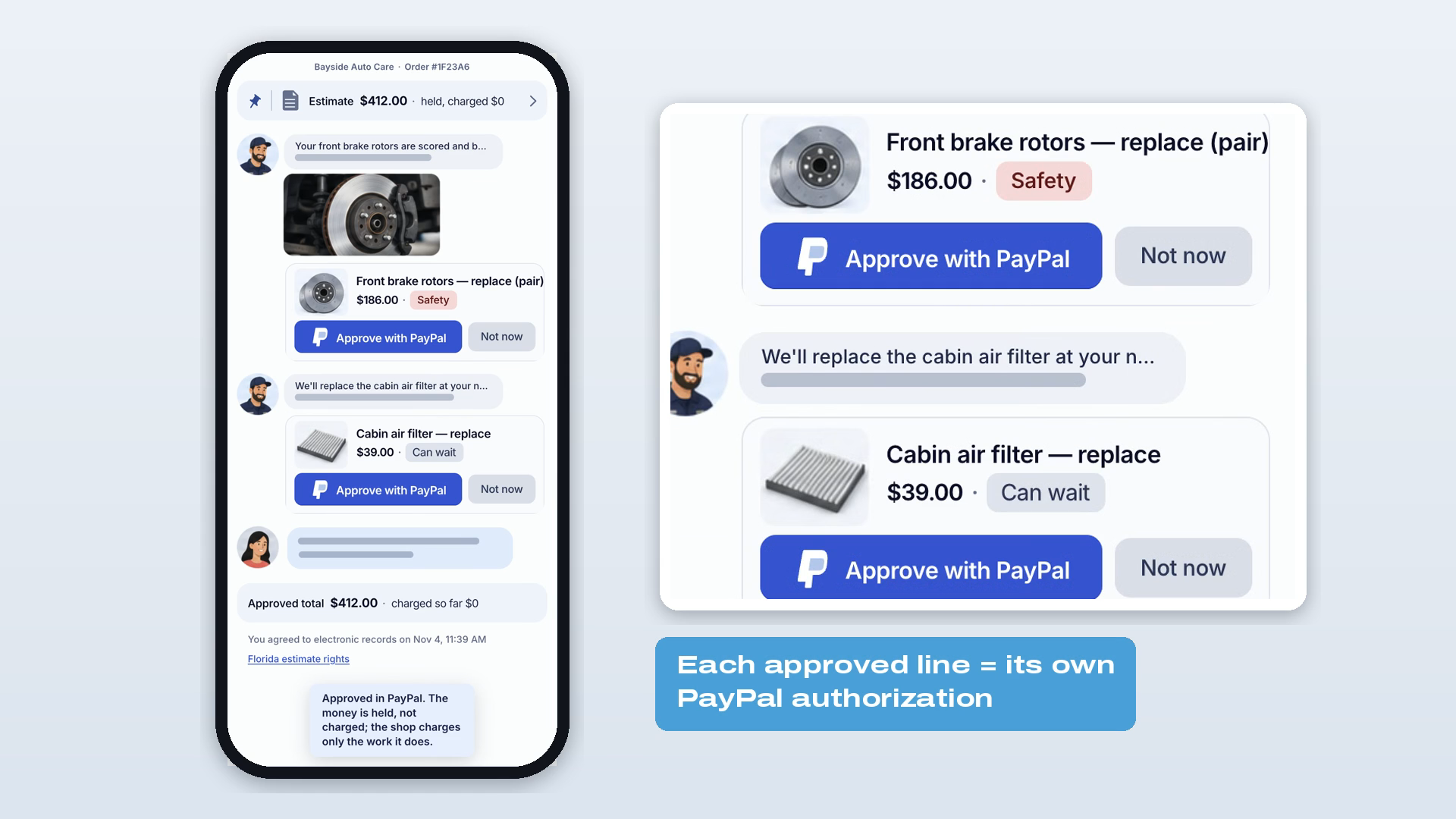
Each approved line becomes its own PayPal authorization
-
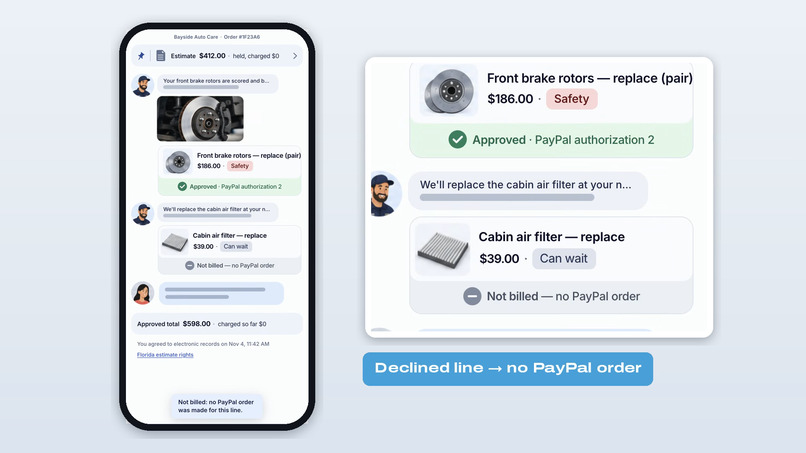
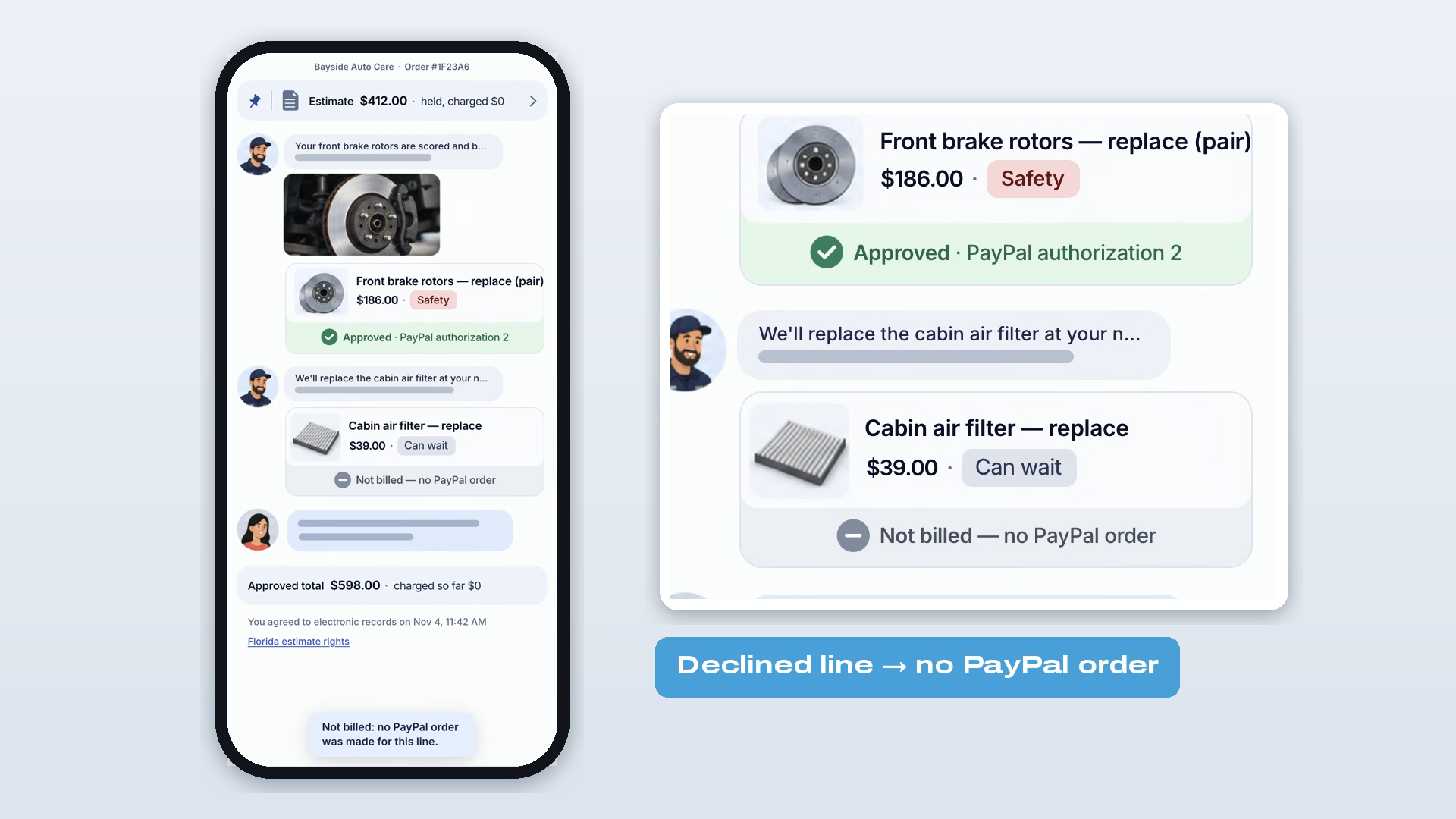
A declined line gets no PayPal order
-
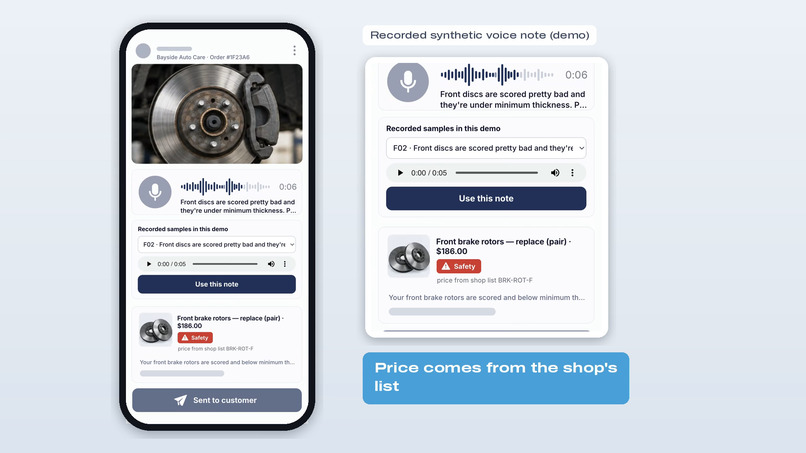
The mechanic's voice note becomes a line; the price comes from the shop's list
-
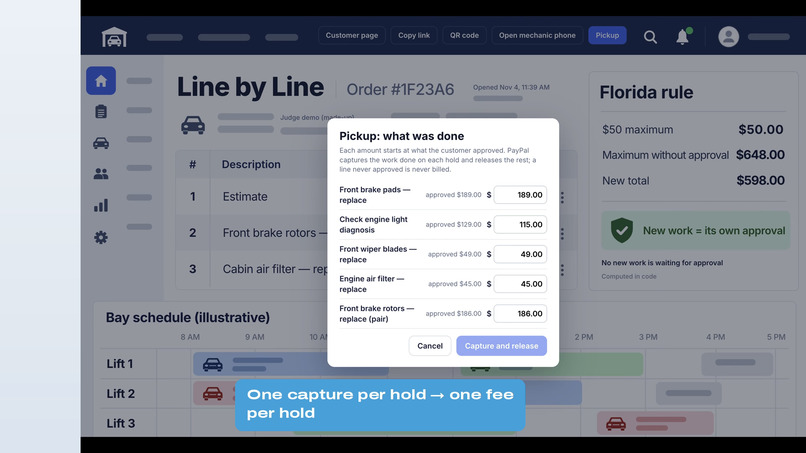
Pickup: one capture per hold, the rest is released
-
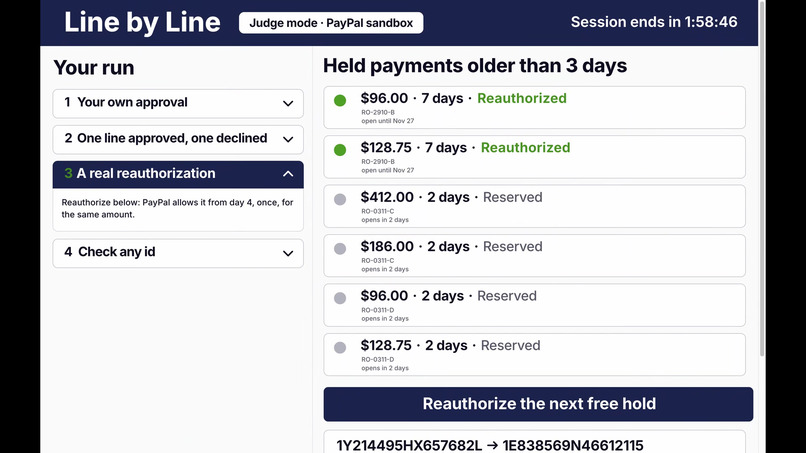
A real reauthorization on day 7, read back live at PayPal
-
Line by Line: approve the line, not the bill
Inspiration
At my last service visit the dealer gave me $801.05 of recommended work. I needed about $391 of it: I declined four lines and paid $391.51. Cox Automotive found that 45% of vehicle owners are dissatisfied with dealership service, "primarily due to unexpected costs and poor communication" (Service Industry Study, November 2025, 1,974 owners).
Who it's for
Service desks of auto repair shops, and the car owners they have to reach about extra work. In a MOTOR survey of 14 top-performing service shops around Philadelphia (August 2026), the most common communication issues were customers not answering calls or messages (85%) and delays in getting approval (71%). Line by Line puts each new line on the car owner's phone with its own button, and each approved line is held in PayPal until pickup, when the shop captures what the job came to.
Try it: open https://linebyline.retailbox-automation.com (PayPal sandbox), press "Start a demo repair order" and approve as your own sandbox buyer. Send two lines from the mechanic's phone, approve one and tap "Not now" on the other, then run pickup at the desk: it shows each capture, its fee and what was released, from PayPal's answer.
What it does
The service desk opens a repair order with a written estimate, and the customer approves the estimate in PayPal as an authorization, a hold on that amount. When the mechanic finds something else, the customer gets each new line on their phone with its own button. On the customer page every approved line becomes a separate PayPal authorization (the API also takes several lines in one approval). A line they decline gets no PayPal order at all.
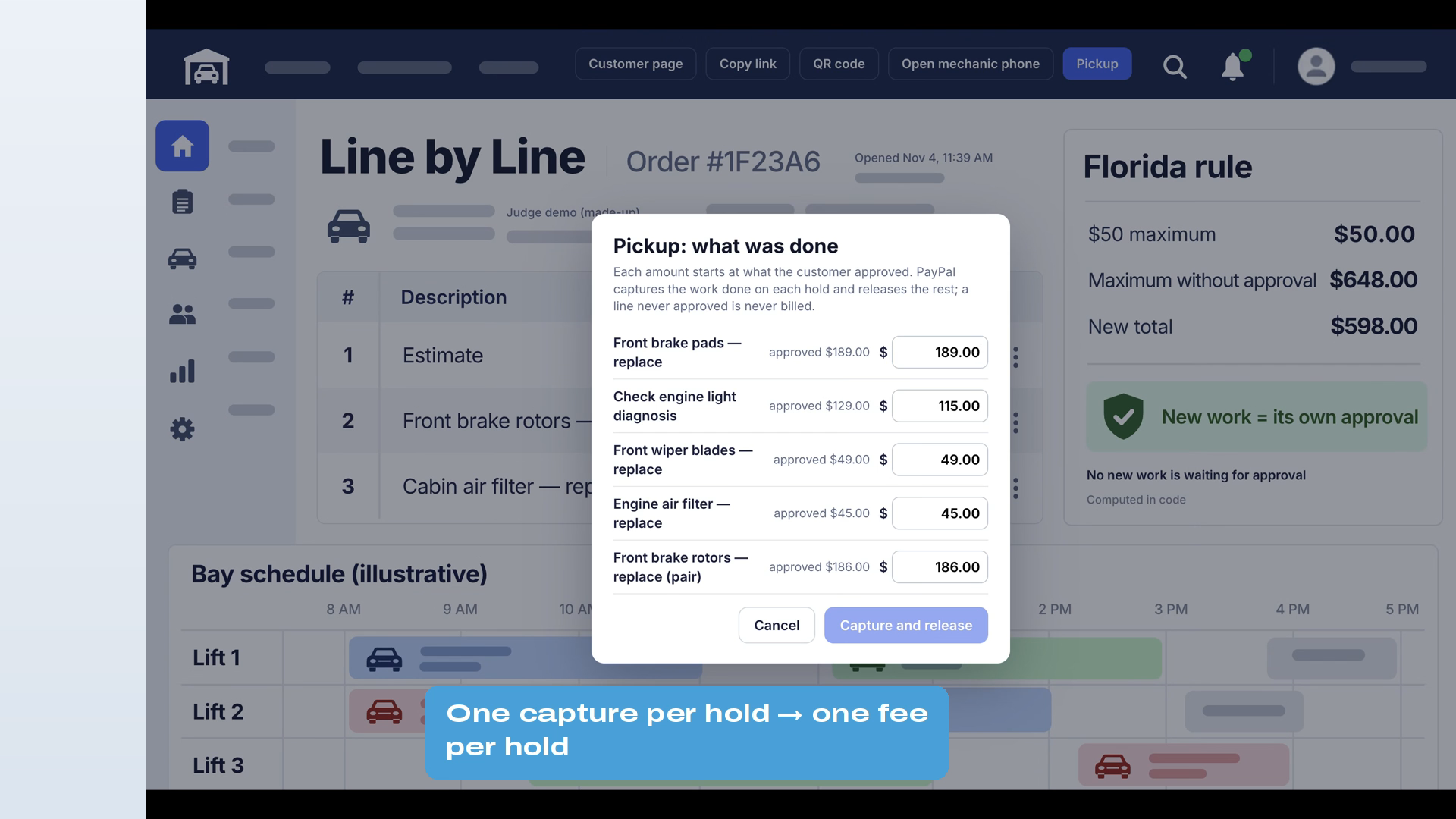
At pickup the shop enters the final amount of each approved job. That amount is captured from the job's hold, and whatever the job didn't use stays with the customer. If parts take longer, a hold paid from a PayPal wallet can be reauthorized from day 4, for the same amount.
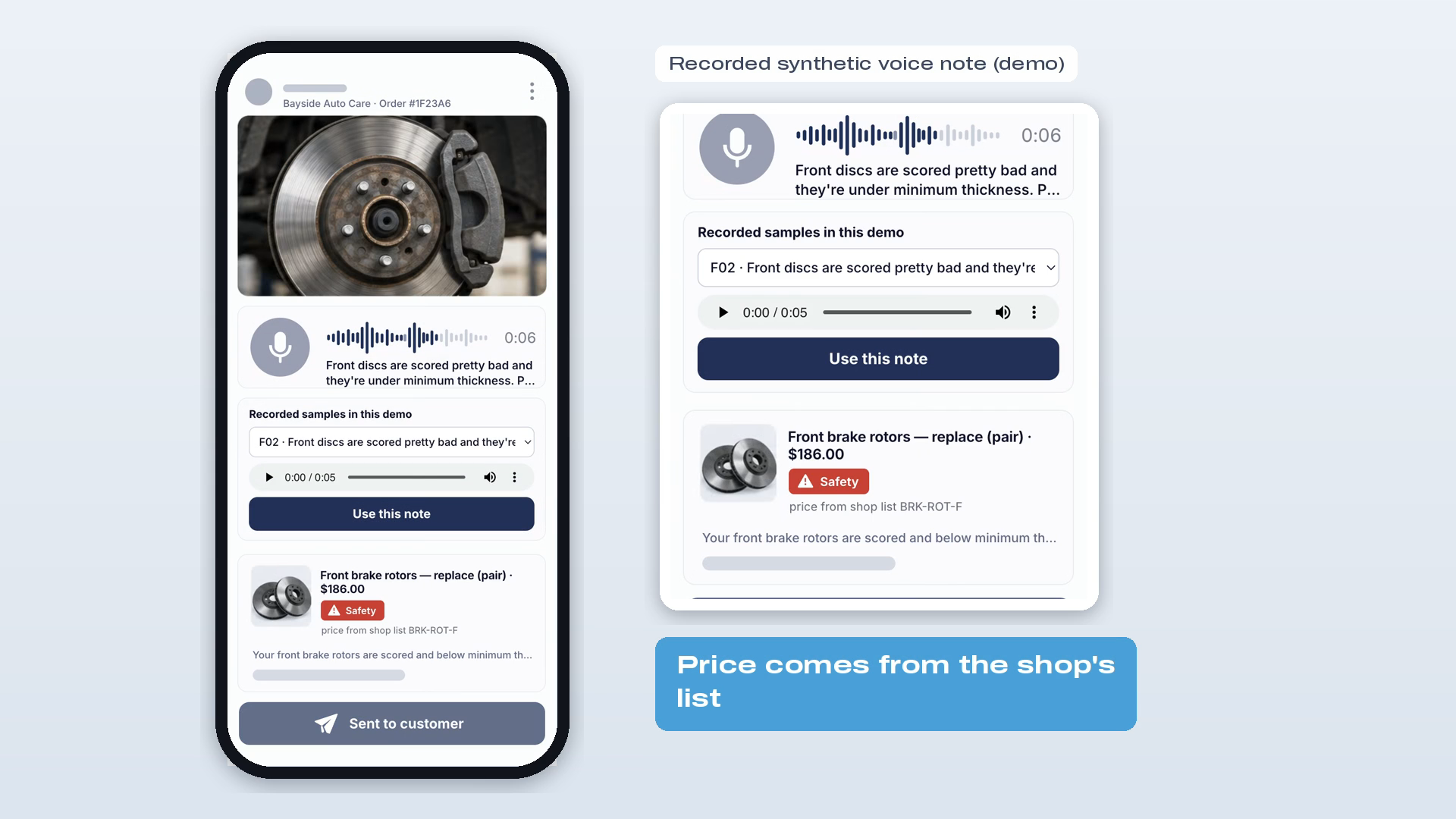
The mechanic doesn't type the lines. They record a short voice note (the demo uses 32 recorded notes), and the app drafts the line from the shop's price list: the part, how urgent it is, and a plain sentence for the customer. The price always comes from the list, and the mechanic confirms the line before it goes out.
Florida's repair law is in the code. Before the first approval the customer sees the written-estimate statement of Fla. Stat. 559.905(2) and agrees to electronic records, and the desk shows the 559.909 tolerance. The app is stricter than the statute: new work always needs its own approval.
Checked in the PayPal sandbox
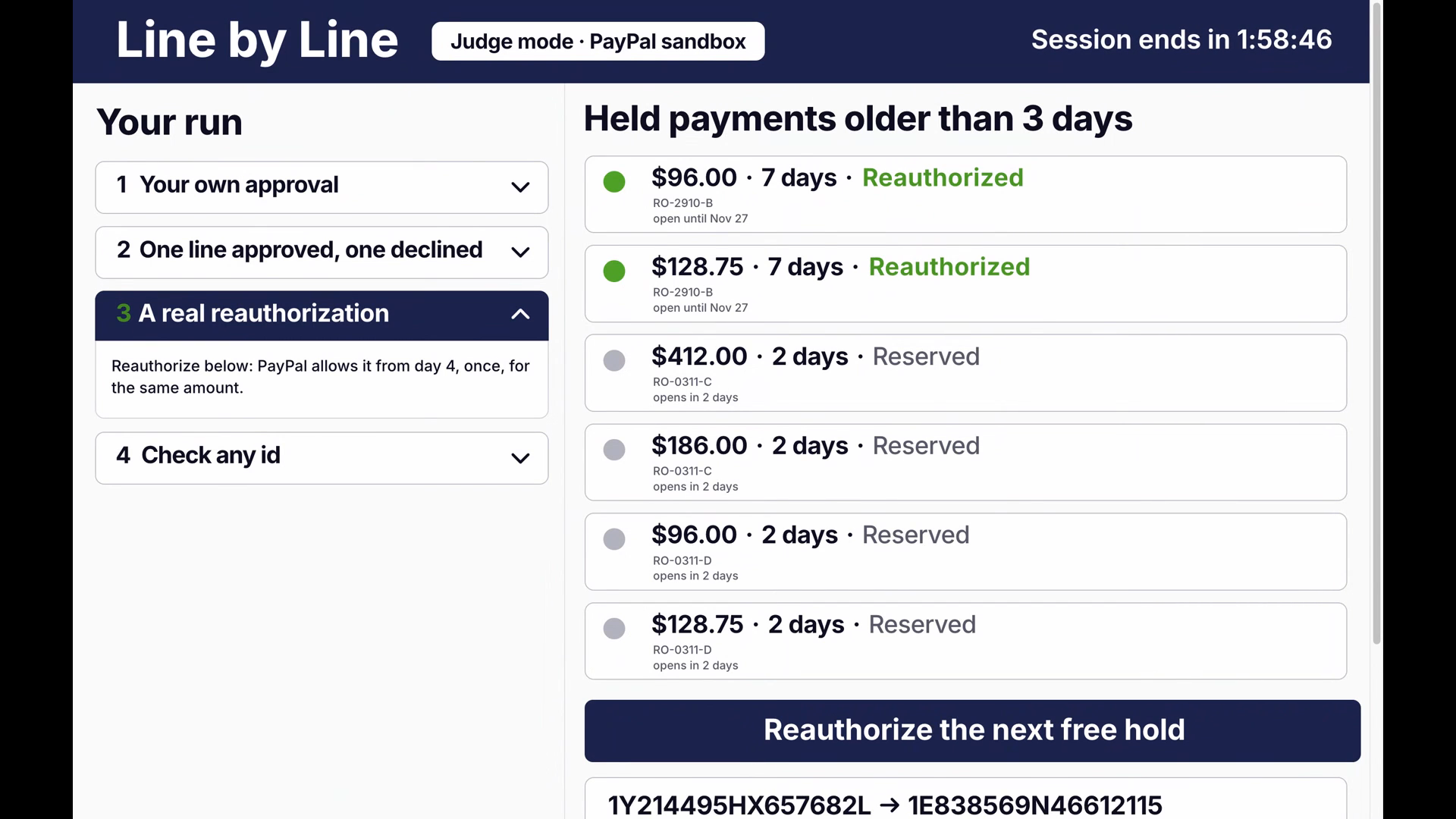
Every id here is a PayPal sandbox id, read back afterwards with a separate GET. On the hosted demo the $412 estimate became order 1SB68118SA4622349 and the approved $186 rotor line its own order 8TD78129F1542400U; the declined $39 cabin filter line has no order. At pickup $398 was captured from the estimate hold and the unused $14 voided, and the rotor hold was captured in full. On day 7 we reauthorized two holds approved on October 29 through the hosted judge page: 1CM060836C119894N became 9ET49300M3905934C ($96.00) and 1Y214495HX657682L became 1E838569N46612115 ($128.75), same amounts, expiry still on the original date. A buyer from another developer's sandbox approved order 3CU42758521717259, a $412.00 hold. On 48 harder, noisier voice notes gpt-oss-120b gets 37/48 exactly right after speech recognition, keyword matching 8/48. 430 automated tests, none on the network.
How we built it
- Node 22 and TypeScript, Hono for the API, Postgres. A small PayPal REST client on
fetch, no SDK. - PayPal Orders v2 with
intent: AUTHORIZE, one order per approval; Payments v2 to capture (final_capture: false, then a void of the rest, or one full capture), void and reauthorize; webhooks with signature verification as a second layer; aPayPal-Request-Idon every POST that creates an order or moves money. - Voice: speech recognition with a local model (parakeet), recorded ahead for the 32 sample notes (the hosted demo has no live microphone), then
openai/gpt-oss-120bon Groq drafts the lines against the price list with a strict JSON schema (zero data retention on). Answers for the 32 recorded samples are cached; typed text goes to the model live, within a daily ceiling. - A benchmark of 32 synthetic voice notes, labeled by us. Keyword matching without a model gets 16/32 notes exactly right on the text and 12/32 after speech recognition. gpt-oss-120b gets 32/32 on both, with no invented codes and the urgency right on 25 of 33 lines after speech recognition; gpt-oss-20b also 32/32, urgency 19/33. Since the models no longer differed on codes, we added 48 harder, noisier notes (several jobs in one note, work already done or declined, shop slang, self-corrections, louder shop noise), labeled blind by two labelers. After speech recognition gpt-oss-120b gets 37/48, gpt-oss-20b 32/48 and keyword matching 8/48; five of the 48 transcripts are noise, so 43 is the ceiling. On the clean note text gpt-oss-20b gets 47/48, so most of its misses come from the noisy transcript.
- The sandbox runs are recorded with their ids in the repo.
- Hosted on Zeabur. Secrets are injected when the app starts and never sit in the host's settings.
Challenges we ran into
- A reauthorized hold keeps the original expiry. Reauthorizing on day 4 gives a new id, but the 29 days still count from the first authorization.
- The new id from a reauthorization can't be voided; the void has to go to the original id, and it releases both.
- PayPal's hosted sandbox MCP server has no tools for authorize, capture of an authorization, void or reauthorize, and on 2026-10-29
get_orderfailed there as a normal result. Our money path is plain REST. - Webhooks can arrive late, so the screens poll and the webhook only confirms.
- Each capture pays its own fee (3.49% + $0.49 in the sandbox). One capture per hold at pickup keeps that to one fee per approval.
Accomplishments that we're proud of
- The video shows the day-7 reauthorization above, with the judge page's live read of each new id. From mid-November the judge page hands out holds that are four or more days old, so a judge can reauthorize one and read the new id at PayPal.
- Since a buyer from another sandbox could approve, judges can use their own sandbox accounts.
- Each row of the README's "Judge it in 90 seconds" table points to sandbox ids recorded with their statuses; the judge page reads the holds of your own run and of the pool live at PayPal.
What we learned
Each capture carries its own fee, so the design settled on one capture per approved hold at pickup. A reauthorization gives a new id but keeps the original expiry, so a shop waiting a week for parts has to plan around day 29. Car owners decide line by line: that is how I handled my own $801 estimate, and the app is built around it.
What's next for Line by Line
- A larger benchmark: on the 48 harder notes most misses come from the noisy transcript.
- We only tested reauthorization on holds paid from a PayPal wallet; for card holds the customer will be asked to approve again.
- Estimate rules of other states.
Built With
- gpt-oss-120b
- groq
- hono
- node.js
- parakeet
- paypal-orders-api
- paypal-payments-api
- paypal-webhooks
- postgresql
- typescript
- zeabur
