-
-
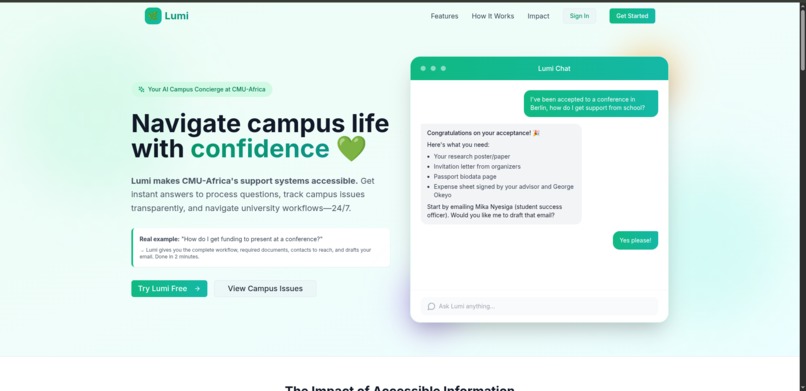
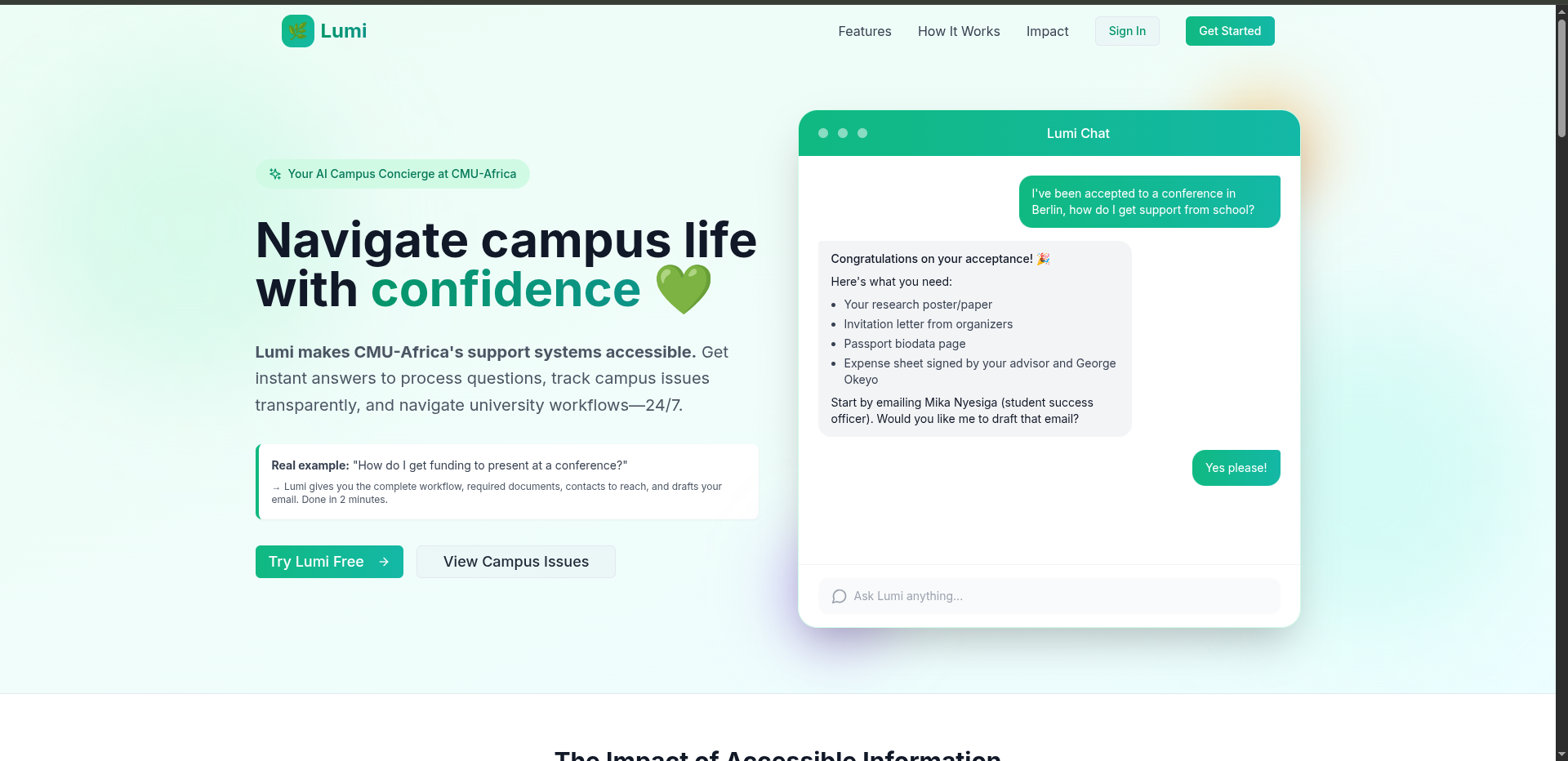
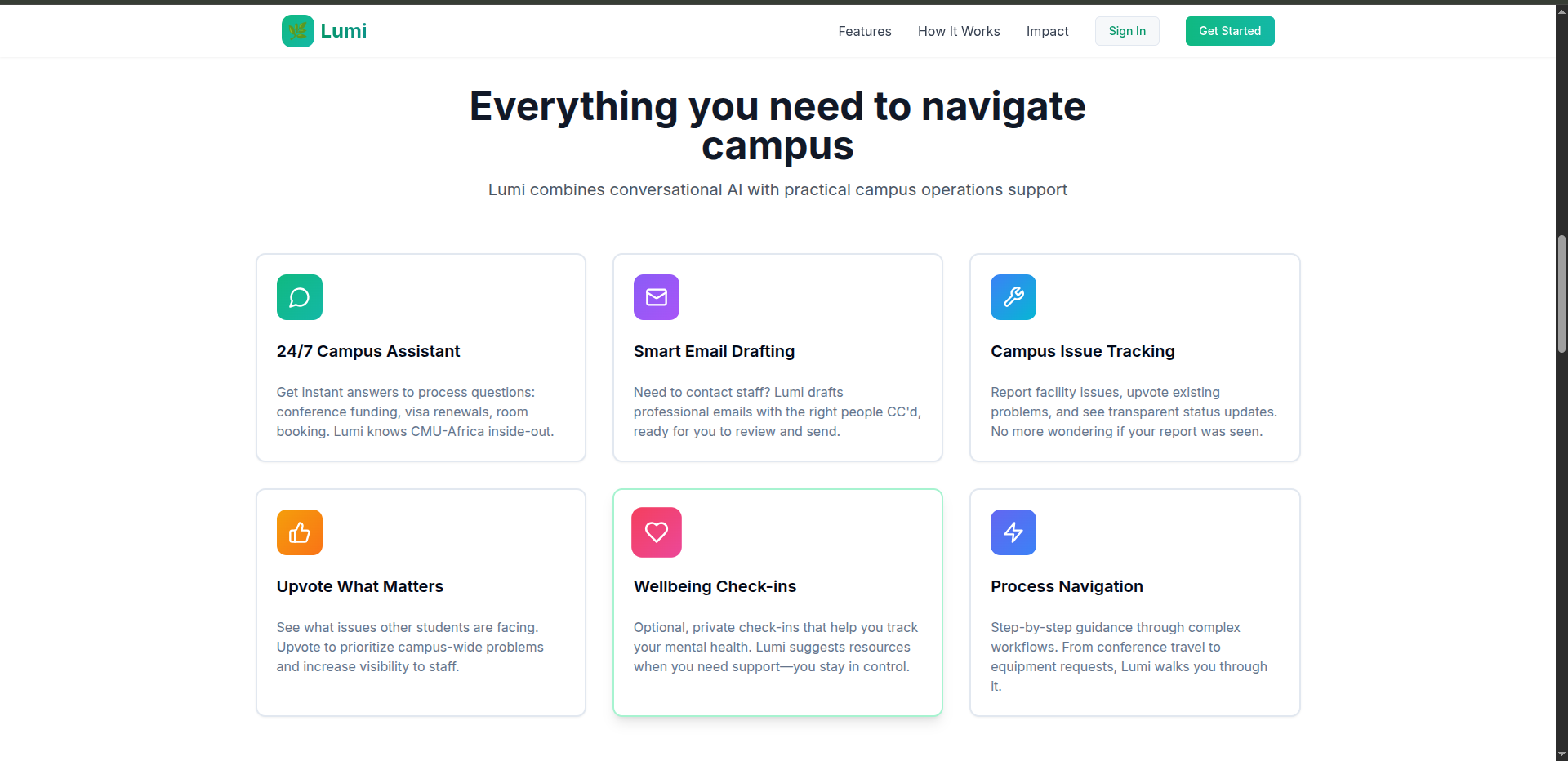
Welcome Page Lumi
-
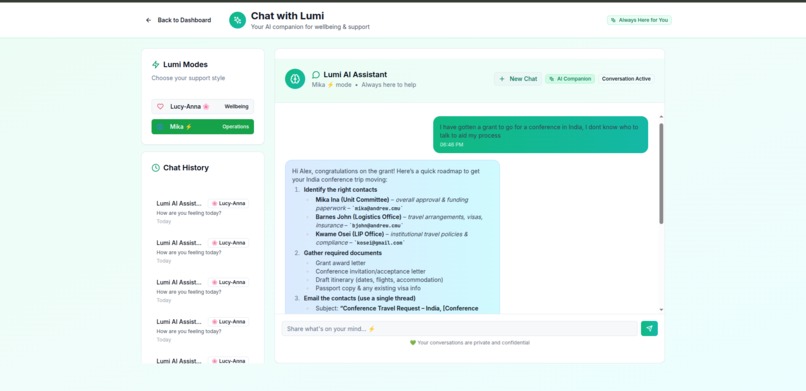
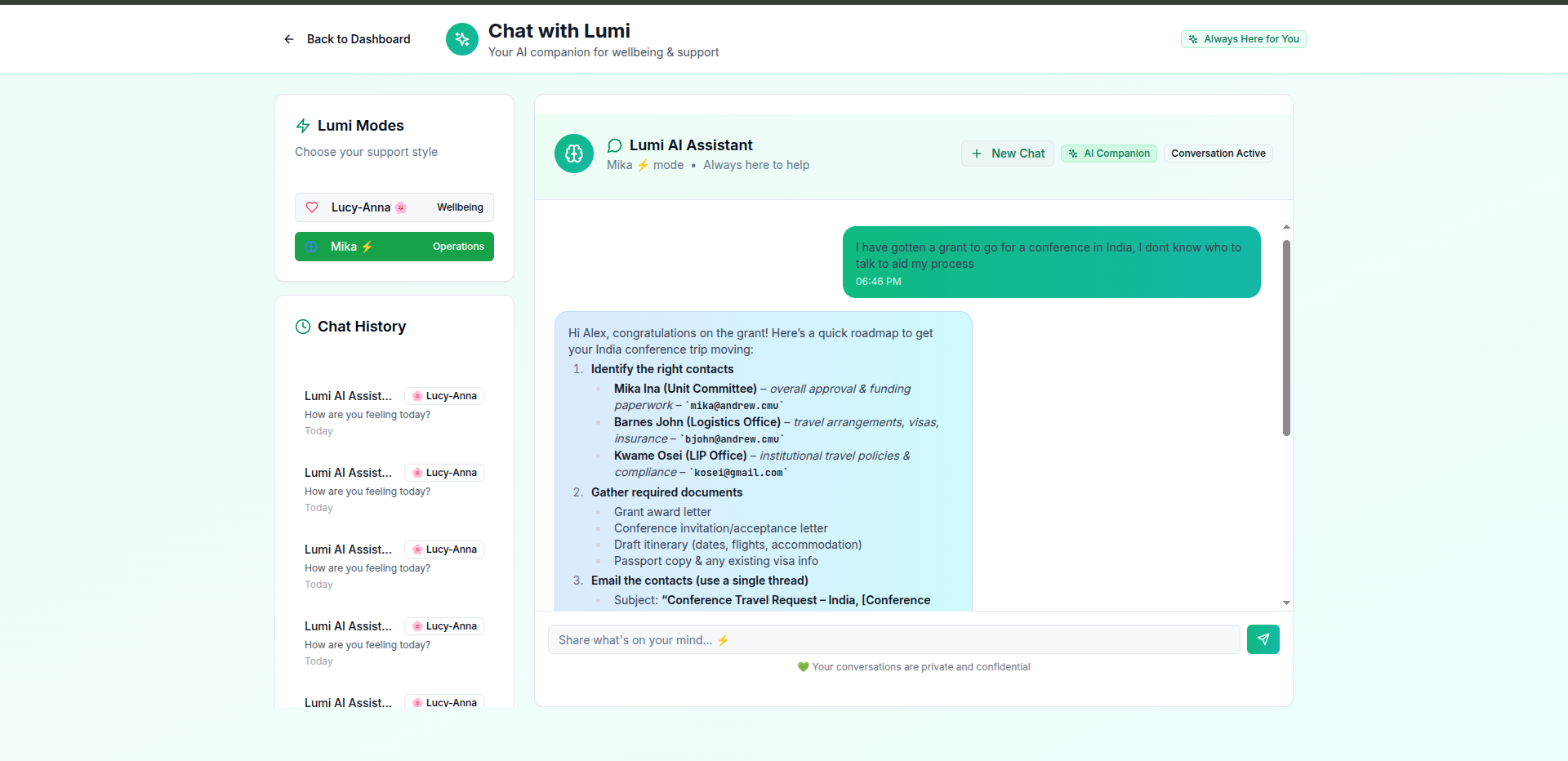
Lumi Chat interface
-
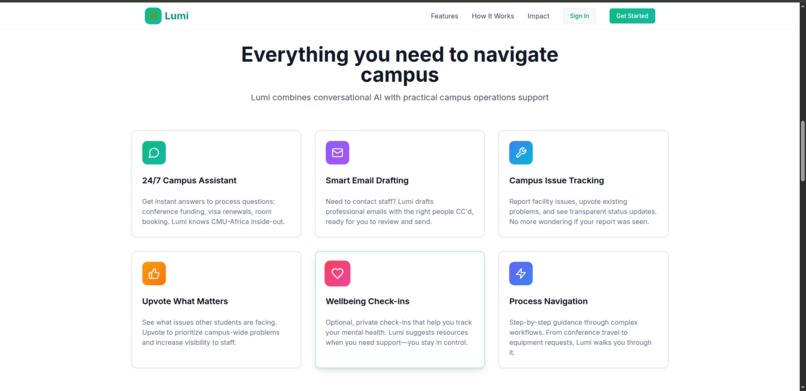
More info about Lumi
-
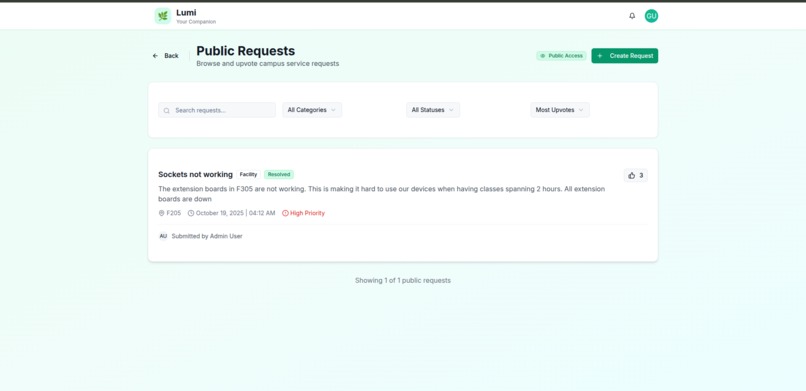
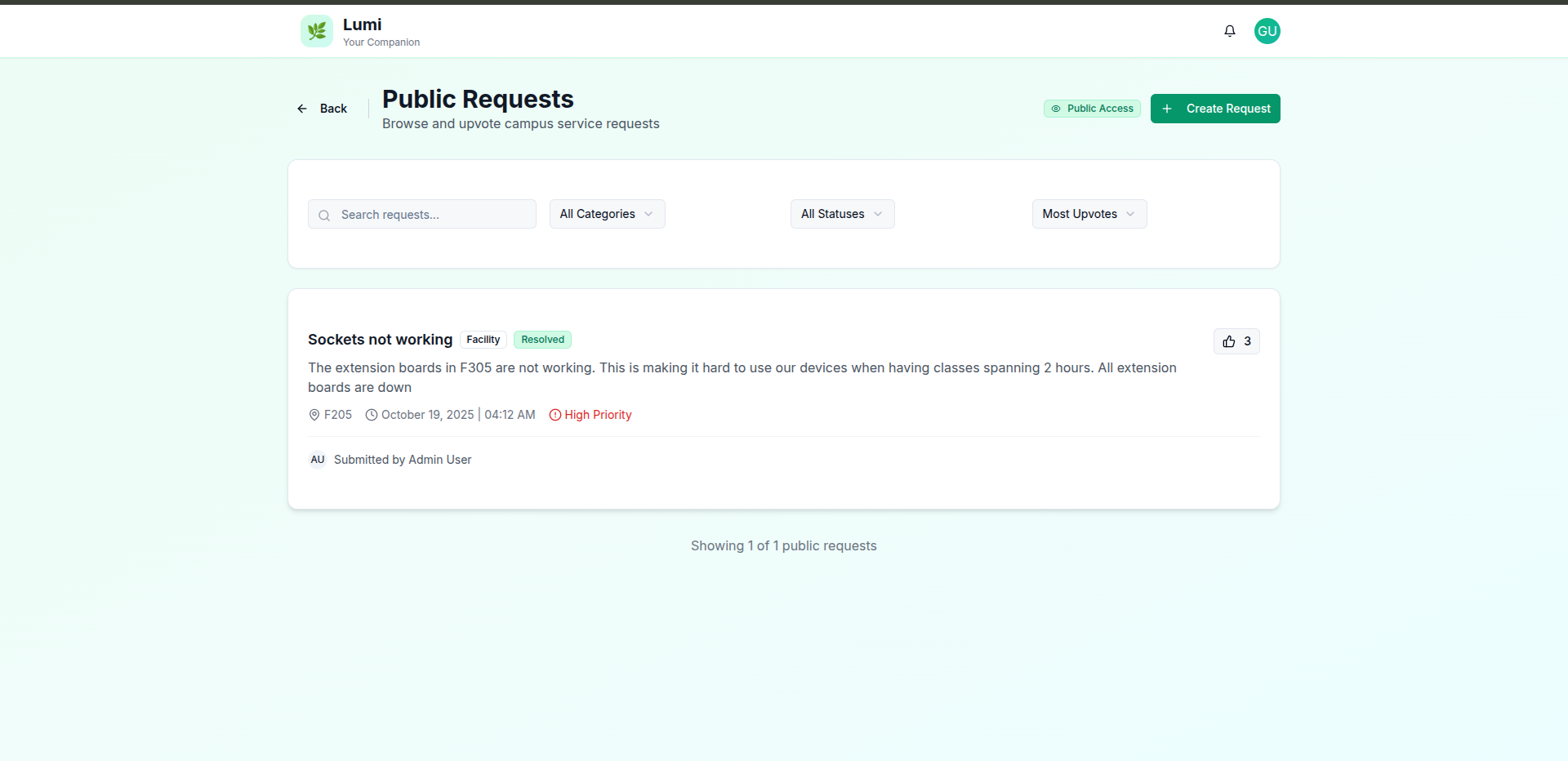
Community Requests
-
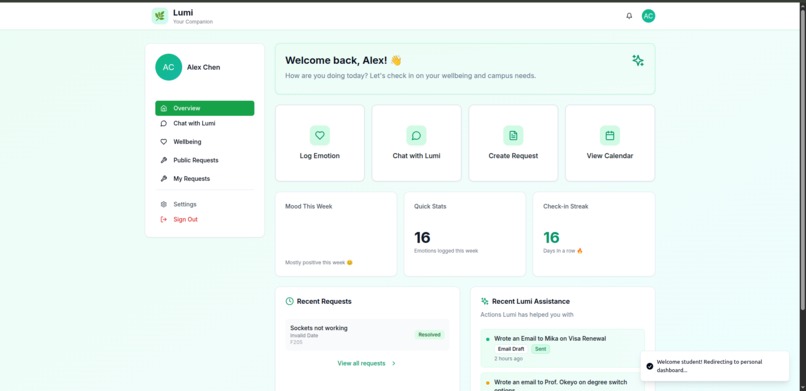
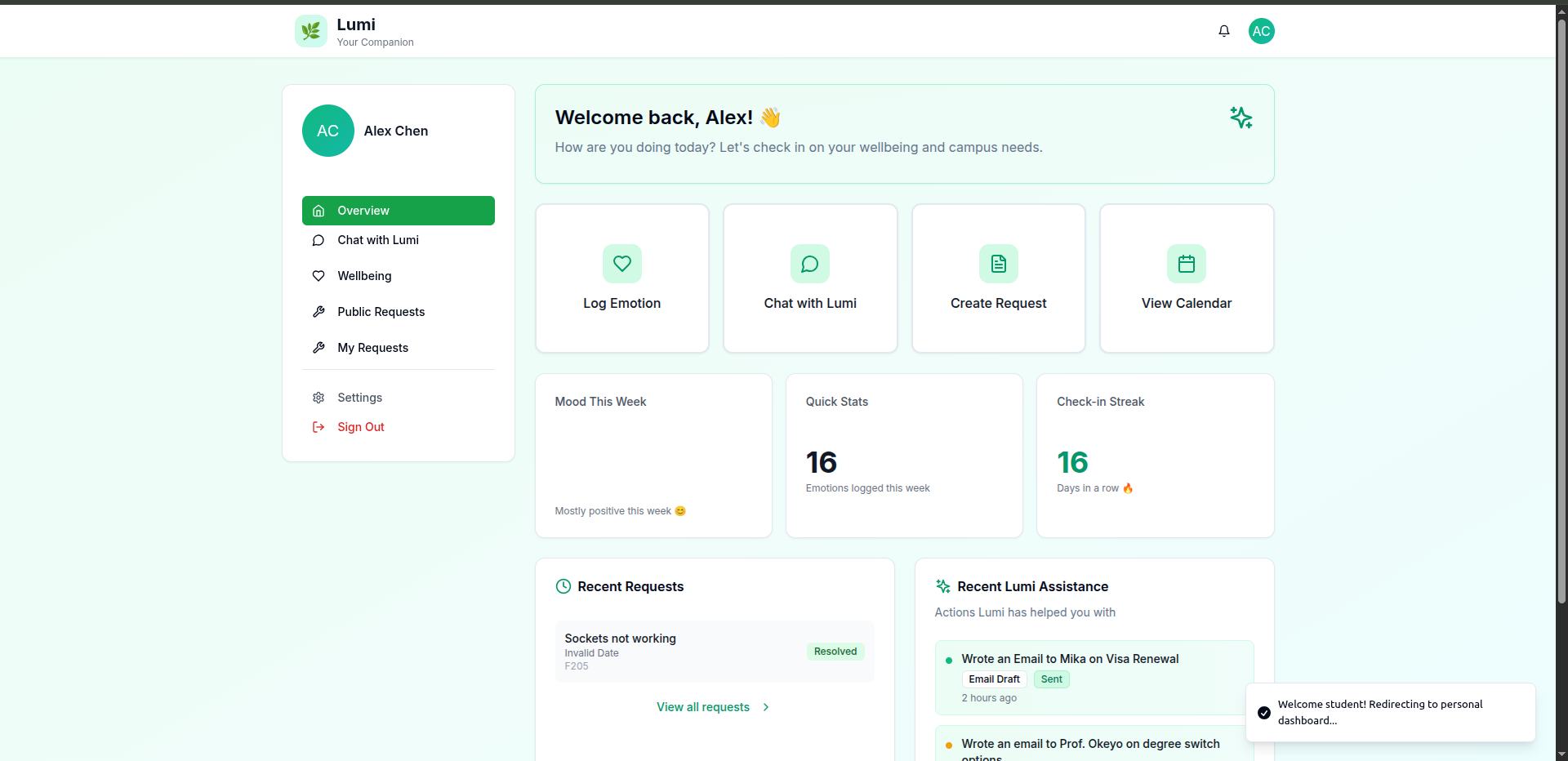
Personal Area
-
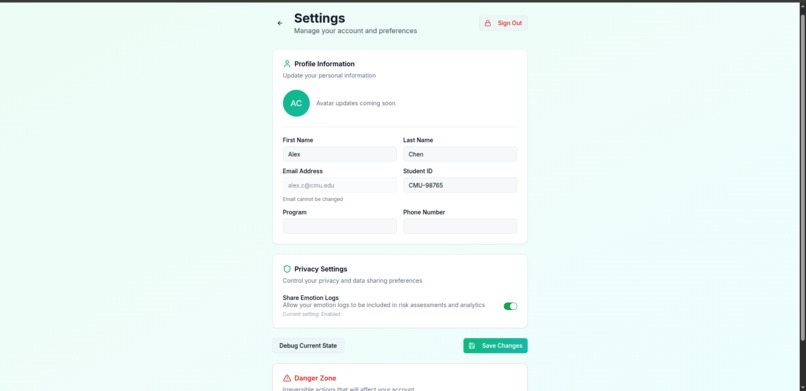
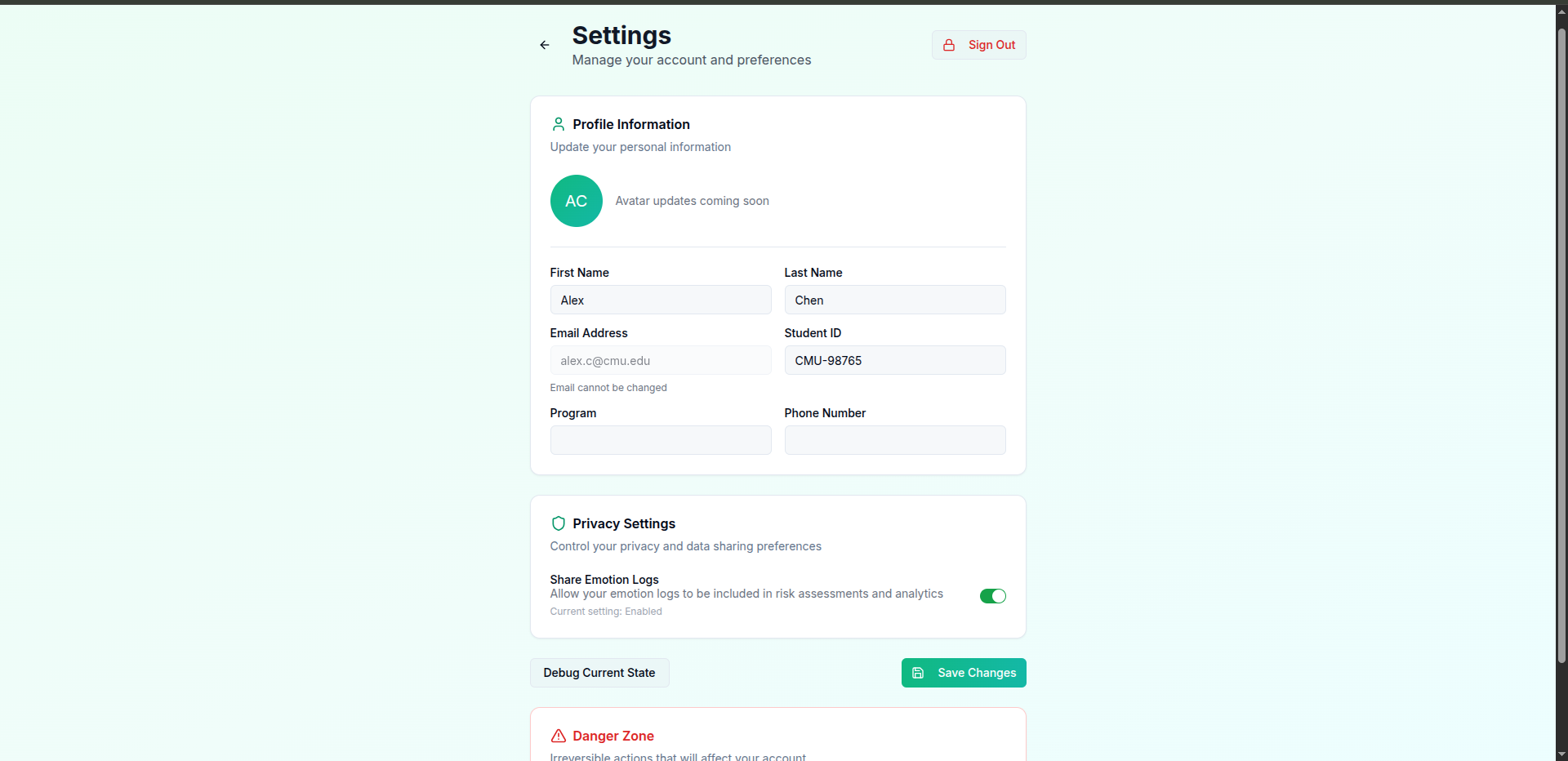
Profile Settings
Lumi: Your CMU-Africa Campus Concierge
Inspiration
At CMU-Africa, students balance demanding academics, personal wellbeing, and daily operational needs. While the university provides strong support systems through dedicated staff, accessing this support efficiently remains a challenge. Students often spend days navigating scattered information to answer simple questions: "Who do I contact about visa renewals?" "How do I request conference funding?" "Is the printer in F203 working?"
We were inspired by two real figures on campus: Mika, who ensures smooth campus operations, Lucy-Anna, who nurtures student wellbeing and success, and. We wondered: What if students had instant, 24/7 access to the knowledge and guidance these incredible staff members provide?
That question gave birth to Lumi—an AI-powered campus concierge that makes CMU-Africa's support systems more accessible, helping every student navigate campus life confidently while reducing routine operational friction for staff.
What It Does
Lumi is a web-based AI companion that serves as your personal guide to CMU-Africa, combining conversational intelligence with practical campus operations support.
Core Features:
1. Conversational Campus Assistant (Mika Persona)
- Answers process questions instantly: "How do I get funding to present at a conference?"
- Provides complete workflows with required documents, contacts, and timelines
- Offers context-aware guidance: "You'll need signatures from your advisor and the Director of Academics"
- Drafts emails to relevant staff members, ready for you to review and send
Example Flow:
Student: "I've been accepted to a conference in Berlin, how do I get support from school?"
Lumi: "Congratulations on your acceptance! CMU-Africa can support you through the conference travel process. Here's what you need:
- Your research poster/paper that was accepted
- Invitation letter from conference organizers
- Passport biodata page
- Expense sheet signed by your faculty advisor and George Okeyo (Director of Academics)
Start by emailing Mika Inamahoro (Student Success Officer) at [email]. Would you like me to draft that email for you?"
2. Campus Resource Tracker
- Log facility issues with specific locations (e.g., "Printer F203 - paper jam")
- Upvote existing issues to signal campus-wide problems and increase visibility
- Track issue status: reported → acknowledged → in progress → resolved
- See transparency in what's being addressed across campus
3. Staff Admin Dashboard
- Aggregated view of campus issues ranked by upvotes and urgency
- Update issue status and communicate resolutions to students
- Identify patterns (recurring problems that need attention)
- Reduce time spent on duplicate reports
4. Wellbeing Check-in (Lightweight)
- Optional periodic check-ins: "How are you feeling this week?"
- Privacy-first: your responses stay private, no third-party access
- Smart referrals: If you could benefit from additional support, Lumi suggests connecting with Solid Minds and provides their contact information
- You control if and when to seek further support.
How We Built It
We built Lumi as a full-stack web application combining conversational AI with campus operations management.
Tech Stack:
- Frontend: Next.js + Tailwind CSS for an intuitive, responsive chat interface
- Backend: FastAPI for handling API requests and business logic
- Database: Firebase Firestore for real-time, scalable data storage
- AI Integration: OpenAI GPT-4-turbo fine-tuned with CMU-Africa context (processes, contacts, common scenarios)
- Authentication: Google OAuth for secure CMU login (simulated for demo)
Architecture:
Conversational Pipeline:
- Student sends message to Lumi
- Intent extraction: Is this a process question, facility issue, or wellbeing check-in?
- Context retrieval: Pull relevant CMU-Africa process data, contact information, or previous conversation history
- GPT-4 generates contextually appropriate response using CMU-Africa knowledge base
- If actionable (e.g., "draft email"), Lumi generates structured output ready for student review
Resource Tracking System:
- Student logs issue with location/room specification
- Issue stored in Firestore with timestamp, upvote count, status
- Real-time updates visible to all students (public transparency)
- Staff dashboard displays prioritized queue
- Status updates propagate back to student view
Key Design Decisions:
- Privacy-first wellbeing: No third-party access to emotional check-in data
- Transparent operations: Public issue tracker builds trust and reduces duplicate reports
- Email drafting, not sending: Students review and maintain control before communication goes out
- CMU-Africa context training: We trained on actual campus processes, contacts, and common student scenarios
Challenges We Ran Into
1. Tone Calibration Making Lumi sound supportive and human while maintaining professionalism required extensive prompt engineering. We didn't want generic chatbot responses. We wanted Lumi to feel like talking to a knowledgeable, caring campus staff member.
2. Context Accuracy Ensuring Lumi provided accurate CMU-Africa-specific information (correct contact emails, actual processes, real room numbers) required building a comprehensive knowledge base and testing across unique scenarios.
3. Privacy Balance Designing the wellbeing feature to be supportive without being invasive was critical. We settled on a lightweight, opt-in approach where students maintain full control and privacy.
4. Scope Management With two engineers and one week, we had to prioritize. We focused on one complete end-to-end flow (conference funding) rather than building many half-finished features for our MVP.
5. Integration Complexity Connecting the chat interface, resource tracker, and staff dashboard into a cohesive system within the hackathon timeline required careful API design and efficient state management.
Accomplishments That We're Proud Of
✅ Built a functional, working prototype in 1 week that demonstrates real value for CMU-Africa students and staff
✅ Created a contextually intelligent chatbot that provides accurate, CMU-Africa-specific guidance.
✅ Designed a dual-purpose system that serves both operational efficiency (Mika) and wellbeing support (Lucy-Anna) without compromising either
✅ Demonstrated agentic capabilities (email drafting, process navigation) that show how AI can actively help and improve efficiency.
✅ Built transparency into operations through the public resource tracker, helping students see institutional responsiveness to their issues.
✅ Maintained privacy and ethics in our wellbeing feature design, ensuring student control and data protection
What We Learned
Technical:
- How to prompt engineer for specific institutional contexts (CMU-Africa processes and tone)
- Building secure, scalable AI systems with real-world privacy considerations
- Integrating multiple systems (chat, tracking, dashboard) with clean API boundaries
- Real-time data synchronization across users with Firebase
Product:
- The importance of scoping. Doing one thing excellently beats doing five things poorly
- How to balance AI automation with human control (email drafting vs. auto-sending)
- Privacy-first design is non-negotiable when dealing with personal wellbeing data
- Users need transparency in operations. Seeing issues tracked builds trust
Human-Centered Design:
- Technology for wellbeing works best when it promotes connection, not just automation
- Students want efficiency, but they also want to feel heard and supported. This improves relationship between students and administration.
- Making institutional knowledge accessible democratizes the campus experience
What's Next for Lumi
Immediate Next Steps (Post-Hackathon):
- Expand knowledge base: Add more campus processes (room booking, career services, academic advising workflows)
- User testing: Deploy beta with 20-30 CMU-Africa students to gather feedback
- Staff onboarding: Train operations staff to use the admin dashboard effectively
- Analytics implementation: Track which processes students ask about most to identify documentation gaps
Medium-Term Vision:
- Mobile app (Android & iOS) for convenient on-the-go access
- WhatsApp integration: Meet students where they already communicate
- Real email integration: With proper authorization and agentic AI capabilities, enable Lumi to send emails on behalf of students
- Enhanced analytics dashboard: Help staff identify trends, recurring issues, and areas for process improvement
Long-Term Vision:
- Multilingual support (English, French, Kinyarwanda) to serve CMU-Africa's diverse community
- Peer knowledge sharing: Allow students to contribute tips and insights to Lumi's knowledge base. Make it open-source and also improve learning through building.
- Expand to other African universities: Many institutions face similar accessibility challenges with support systems
- Integration with university systems: Connect with actual campus databases (room booking, event calendars, course info)
The Impact We're Building Toward
For Students:
- Save 3-5 hours per week previously spent searching for process information and waiting for feedback on various issues
- Gain confidence navigating campus systems independently
- Feel heard and supported, both operationally and emotionally
For Staff:
- Reduce 40-50% of routine inquiry emails through self-service information access
- Gain data-driven insights into campus operations
- Focus time on complex issues that truly need human attention
For CMU-Africa:
- Create a more accessible, transparent campus experience
- Improve operational efficiency without adding staff overhead
- Build a model for how AI can enhance university support systems across Africa
Why Lumi Matters
CMU-Africa already has incredible support systems and dedicated staff. Lumi doesn't replace them but rather, it makes them more accessible. By breaking down information silos, streamlining communication, and providing 24/7 guidance, Lumi ensures every student can navigate campus life confidently, regardless of how long they've been at CMU or who they know.
This is technology that serves people, not the other way around.
Built With
- Next.js
- Tailwind CSS
- FastAPI
- Firebase Firestore
- OpenAI GPT-OSS
- Google OAuth
- Python
- TypeScript
- React
Built With
- drizzle
- fastapi
- javascript
- nextjs
- python
- shadcn
- sqlite


Log in or sign up for Devpost to join the conversation.