-
-
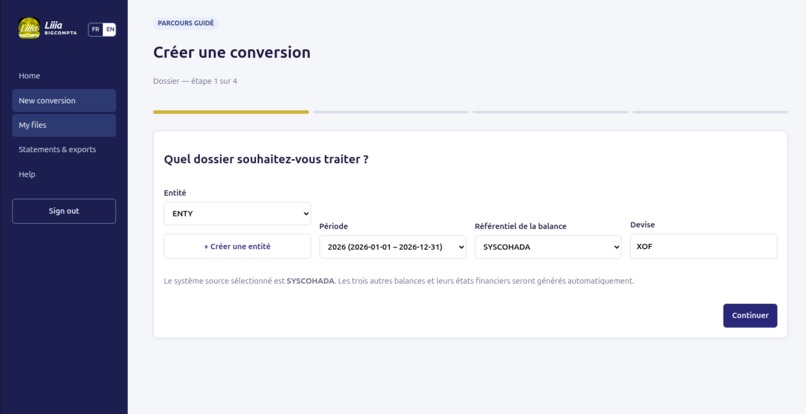
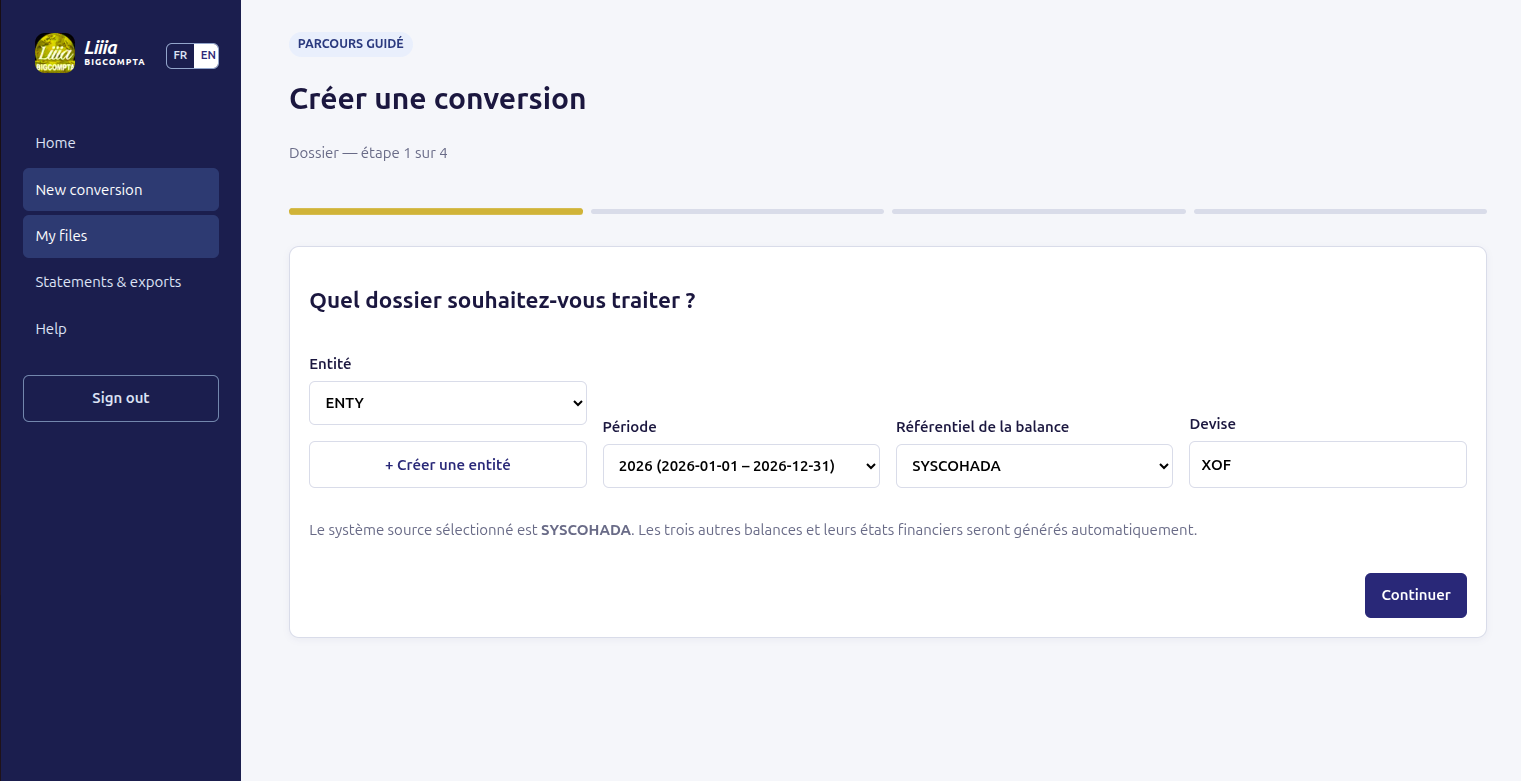
New conversion
-
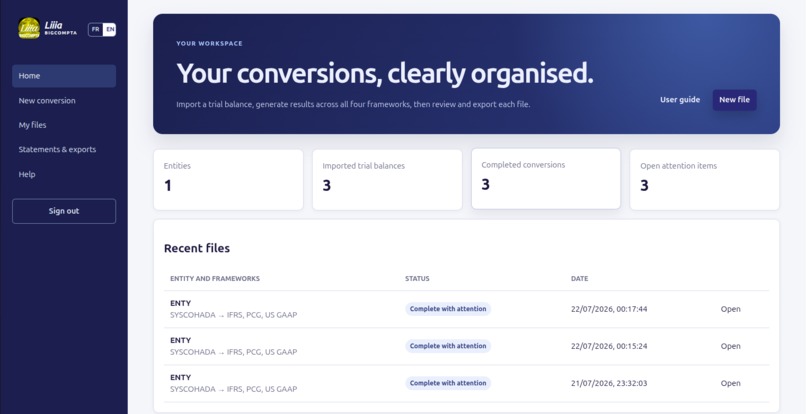
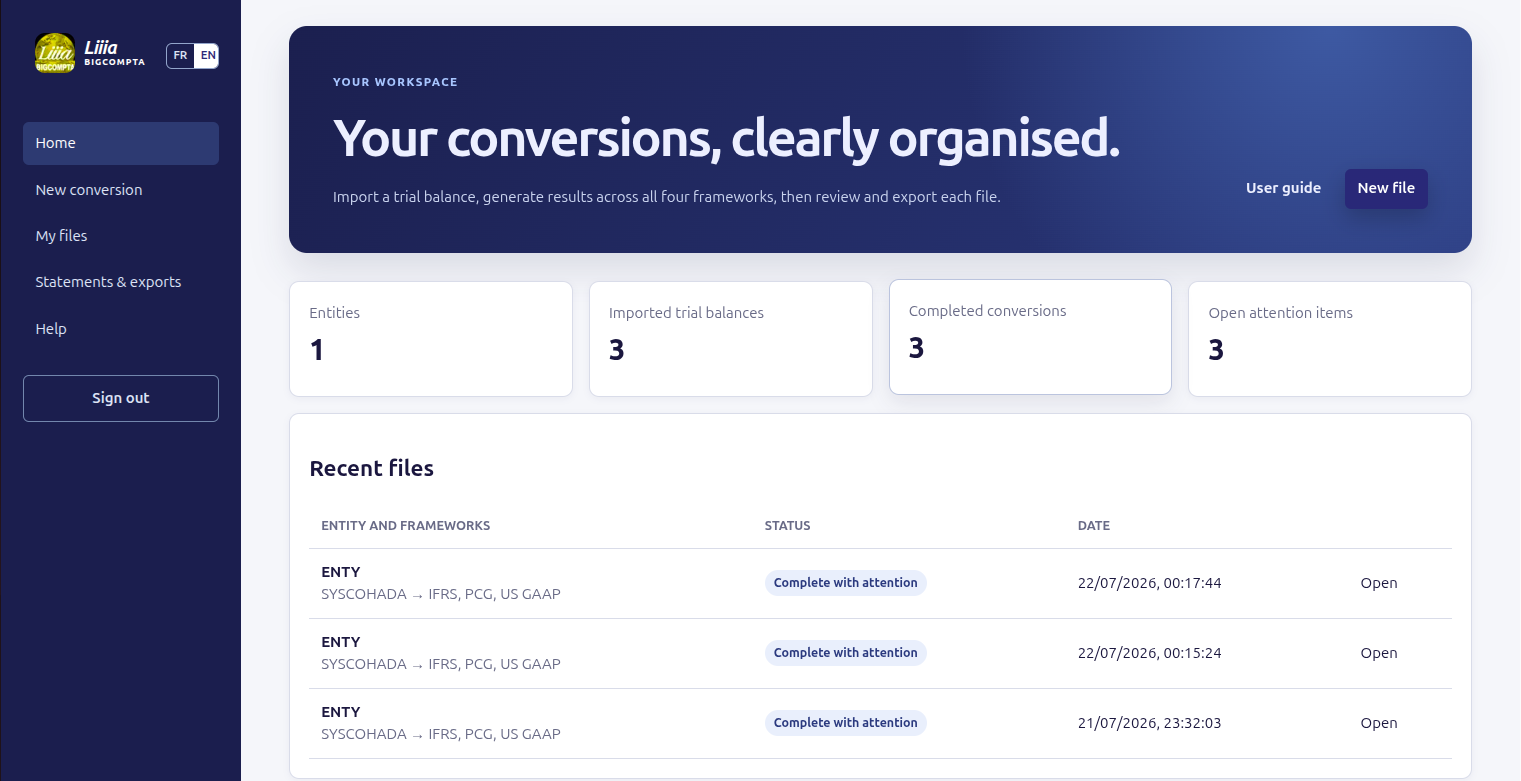
Workspace
-
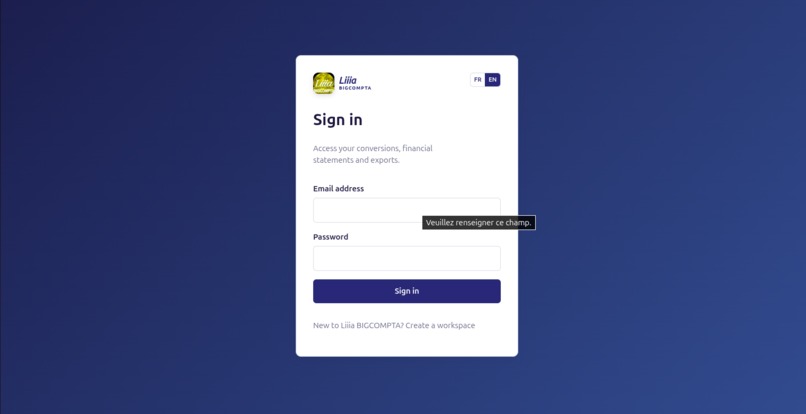
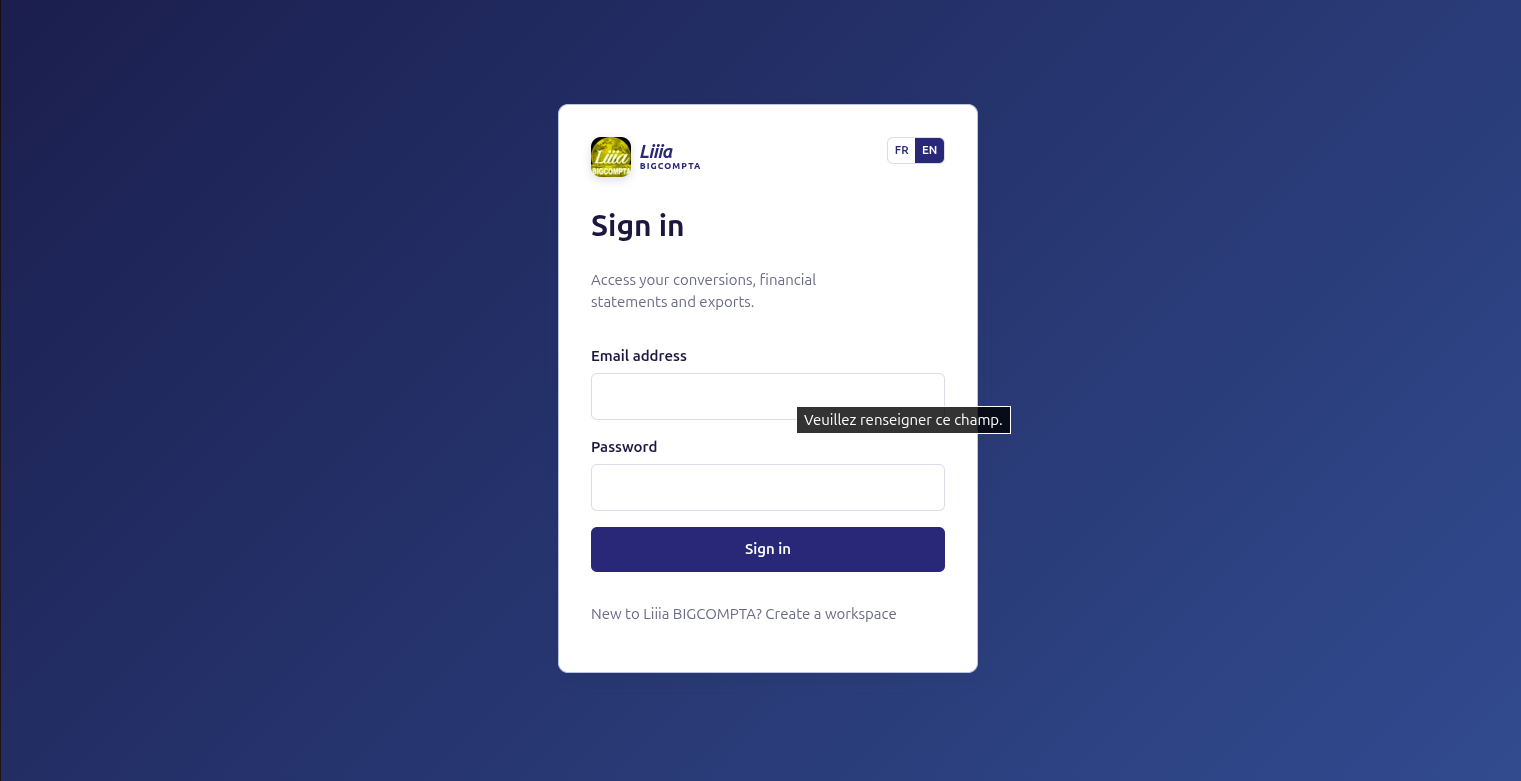
Signin Page
-
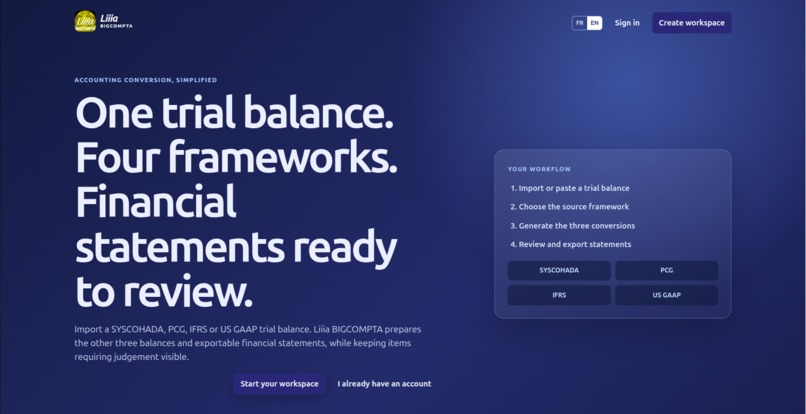
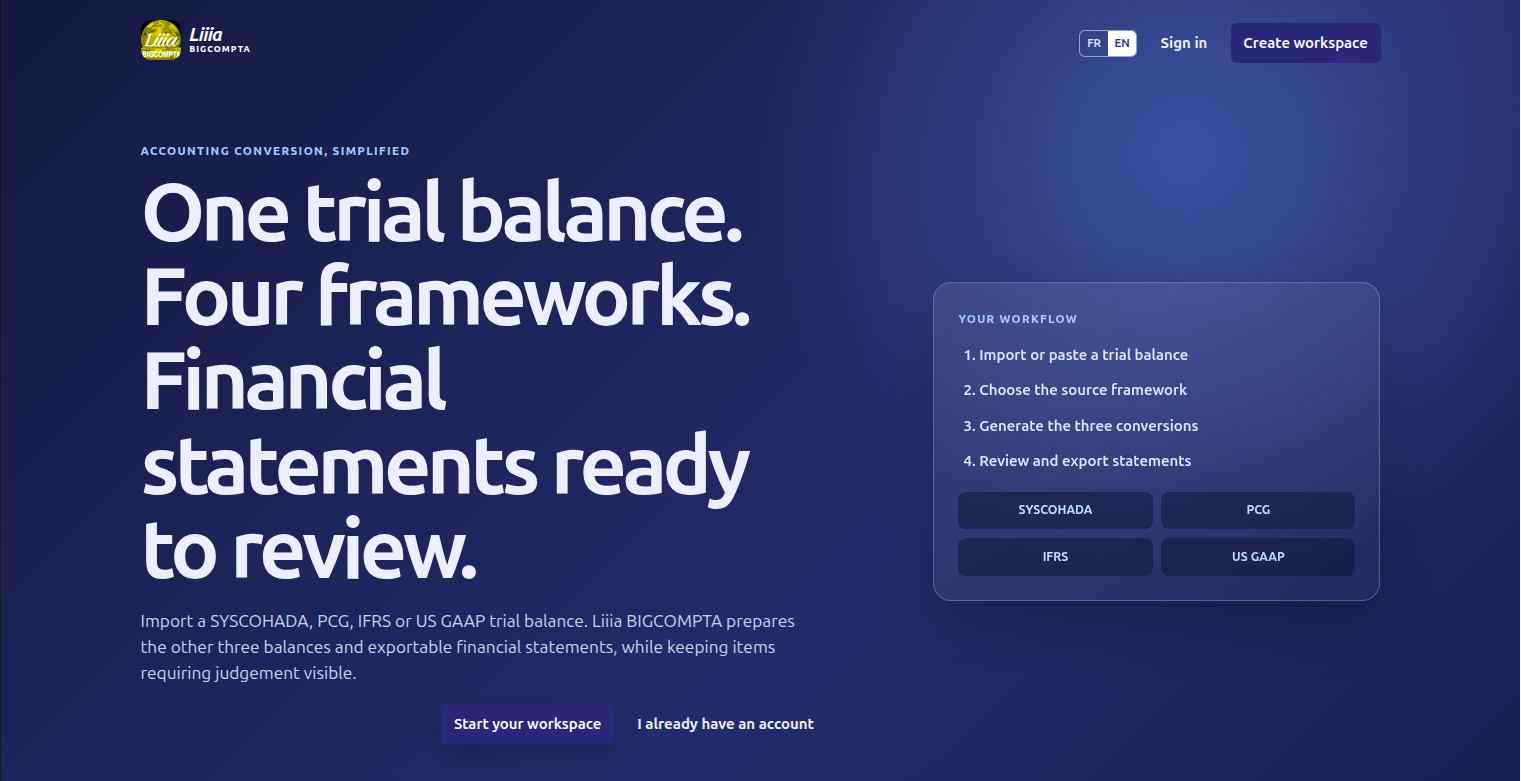
Landing Page
Inspiration
Accounting teams often work across multiple reporting frameworks, especially in international groups, audit firms, consulting practices, and companies operating in different jurisdictions.
A trial balance prepared under SYSCOHADA may later need to be converted into PCG, IFRS, or US GAAP. In practice, this usually requires manual account mapping, framework-specific reclassifications, professional judgment, repeated spreadsheet work, and the reconstruction of financial statements for each target framework.
This process is time-consuming, difficult to audit, and highly exposed to inconsistencies.
We created Liiia BIGCOMPTA to simplify that work. Our goal was to make multi-framework accounting conversion accessible through one clear workflow: import one trial balance, generate the three corresponding target balances, produce the related financial statements, and surface any points requiring professional attention at the end.
What it does
Liiia BIGCOMPTA is a multi-framework accounting platform supporting:
- SYSCOHADA
- PCG
- IFRS
- US GAAP
A user can sign up, create an accounting workspace, select the source framework, and import a trial balance from Excel or CSV. The platform is also designed to support manual entry and data pasted from a spreadsheet.
The system reads account codes, labels, opening balances, debit and credit movements, and closing balances. It then validates the source data and applies framework-specific mapping and transformation rules.
From one source trial balance, Liiia BIGCOMPTA generates equivalent trial balances under the other three frameworks.
The platform is designed to preserve accounting amounts, document assumptions, apply deterministic mappings where possible, and continue processing when information is uncertain. Instead of stopping the entire workflow, it records points of attention for later review.
It also generates financial statements for the relevant frameworks, including balance sheets, income statements, cash flow statements, statements of changes in equity, and applicable disclosures.
Results can be reviewed in the interface and exported to Excel or PDF. The platform also maintains an audit trail connecting generated figures to the source balance, mapping rules, assumptions, and adjustments.
How we built it
We built Liiia BIGCOMPTA as a full-stack application.
The backend uses Django and Django REST Framework to manage:
- authentication
- organizations and entities
- accounting periods
- trial balance imports
- framework versions
- account mappings
- transformation rules
- multi-framework conversions
- assumptions and points of attention
- financial statement generation
- audit trails
- Excel and PDF exports
The frontend uses Next.js to provide a guided workflow that helps users move from account creation to import, conversion, review, and export.
We designed a canonical accounting layer to connect accounts from different frameworks through shared economic concepts. This makes it possible to map one source account to one or several target accounts while keeping a trace of the rules applied.
We also created a rule engine for framework-specific adjustments, including provisions, deferred taxes, leases, inventory adjustments, grants, credit losses, development costs, and current or non-current classifications.
Codex worked directly across the repository and helped us:
- inspect the existing architecture
- implement backend services
- create database migrations
- connect frontend pages to the API
- improve the conversion workflow
- generate Excel and PDF exports
- write automated tests
- identify and correct integration problems
GPT-5.6 was used as our main reasoning partner. It helped us:
- analyze accounting requirements
- review the architecture
- identify risks in mapping logic
- improve fallback strategies
- redesign the non-blocking review philosophy
- structure the financial statement generation system
- evaluate the implementation against the original product objective
We remained responsible for the accounting decisions, product direction, validation priorities, and final implementation choices.
Challenges we ran into
The first major challenge was that accounting frameworks are not simple translations of one another.
A source account may have:
- no exact equivalent
- several possible target accounts
- a different recognition rule
- a different measurement basis
- a different presentation requirement
- additional data requirements
A trial balance alone does not always contain all the information needed for a complete conversion. For example, it may not contain lease schedules, tax bases, expected credit loss data, maturity details, useful lives, fair values, or disclosure information.
Another challenge was deciding how the system should behave when information is incomplete.
An early version of the platform stopped the conversion whenever a parameter was missing or an accounting treatment required judgment. This made the workflow technically cautious but difficult to use.
We changed that philosophy. The system should complete as much of the process as possible, apply documented assumptions where appropriate, and present unresolved matters as points of attention at the end.
We also faced challenges involving:
- deterministic rule selection
- avoiding conflicts between exact and prefix mappings
- preserving all debit and credit components
- preventing lost amounts
- generating three target frameworks from any source framework
- keeping financial statements linked to the correct source data
- producing exports that remain readable and auditable
- simplifying a technically complex interface
Accomplishments that we're proud of
We are proud that Liiia BIGCOMPTA brings several complex accounting operations into one unified workflow.
The platform can model conversions between four major accounting frameworks and generate three target balances from one source balance.
We also built:
- a canonical accounting concept layer
- multi-framework mapping sets
- transformation rule sets
- typed conversion parameters
- non-blocking points of attention
- quality and reconciliation controls
- multi-framework conversion projects
- audit trails
- financial statement packages
- Excel and PDF exports
- automated backend tests
We are especially proud of the user experience we are building around a complex professional process.
The long-term objective is not to remove professional judgment, but to automate the deterministic work, document assumptions, and help accountants focus on the issues that truly require expertise.
What we learned
We learned that reliable accounting automation requires much more than matching account labels.
A good conversion engine must understand:
- account nature
- debit and credit behavior
- economic substance
- framework-specific recognition rules
- measurement differences
- presentation requirements
- materiality
- dependencies between balances and financial statements
We also learned that an overly defensive system can become unusable. Blocking every uncertain item may look safe, but it prevents users from reaching a meaningful result.
A better approach is to distinguish clearly between:
- technical errors that make calculation impossible
- accounting uncertainties that can be documented
- missing information that can be requested later
- professional judgments that require review
We also learned the importance of testing the complete journey, not only individual functions. A large number of unit tests does not prove that a user can actually sign up, import a file, run three conversions, generate four sets of financial statements, and export them successfully.
Finally, working with Codex and GPT-5.6 showed us how AI can accelerate both implementation and architectural review when human domain expertise remains in control.
What's next for Liiia BIGCOMPTA
Our next priorities are to deepen the accounting and regulatory coverage of the platform.
We plan to:
- expand and validate mappings for all four frameworks
- improve framework-specific transformation rules
- strengthen financial statement templates and disclosures
- support more entity types and industries
- improve comparative reporting
- add more detailed cash flow and equity movement analysis
- enhance professional review and approval workflows
- provide richer explanations for each conversion
- improve performance for large trial balances
- strengthen security and production deployment
- extend XBRL capabilities where official taxonomies apply
- add collaborative review features for accounting firms and finance teams
Our vision is for Liiia BIGCOMPTA to become a trusted multi-framework accounting workspace that helps professionals move from one trial balance to multiple reporting standards through a simple, transparent, and auditable process.
Built With
- codex
- css3
- django
- html5
- javascript
- nextjs
- postgresql
- python


Log in or sign up for Devpost to join the conversation.