-
-
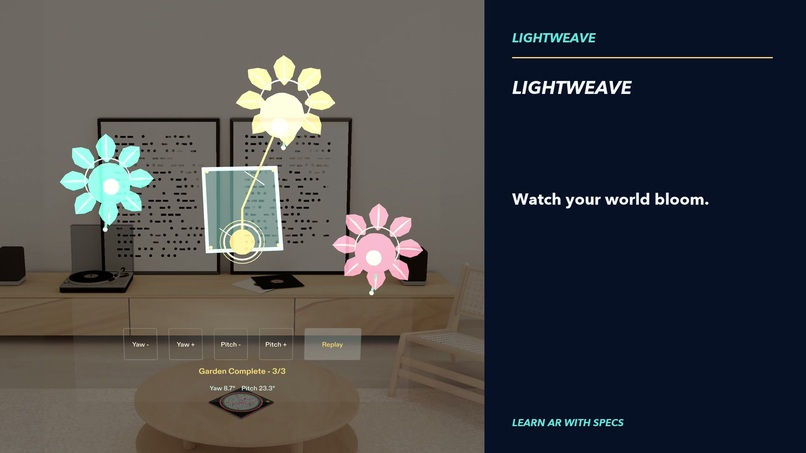
All three flowers in bloom after guiding the golden beam with one mirror — captured in Lens Studio Preview.
Inspiration
We wanted to turn reflection into a moment of discovery. In LightWeave, one mirror transforms a golden ray into a growing garden: each successful connection becomes an eight-petal bloom.
The experience is designed for curious learners and first-time spatial puzzle players. Its core idea is simple: turn the mirror, shape the light, and watch the result.
What it does
Your mission is to make all three flowers bloom. The golden orb is the light source, the rectangular object is the mirror, and the coral, teal, and gold buds are the target flowers.
Pinch and drag the mirror to aim the beam at a flower’s center. Four fine-angle controls adjust yaw or pitch by two degrees. A receiving flower brightens and pulses, then opens into an eight-petal bloom. Earned flowers stay open while you guide the light toward the next target.
The three flowers occupy different heights, so a new viewpoint reveals a new relationship between mirror, beam, and target. Complete the garden, choose Replay, and begin again.
How we built it
We began with the Devpost Learn planning skill to define the spatial moment, interaction flow, and concrete success criteria. We then used CLAD’s Lens Studio skills and native Lens Studio MCP tools to build, inspect, and refine the project in Lens Studio 5.23.2.
A TypeScript optical core calculates finite-mirror intersection, reflection, and receiver hits. The returned geometry drives the visible beam, and an actual geometric hit earns each bloom. Spectacles Interaction Kit connects pinch-and-drag input to mirror rotation; UIKit provides the four fine-angle controls and Replay.
We created original faceted models for the flowers, mirror, source, and beam, with coordinated petal and highlight animations. Six original synthesized audio assets cover interaction, individual blooms, completion, and ambience.
Challenges we ran into
Our central design challenge was to make the relationship between action and result immediately clear. We combined a golden beam, distinct target colors, mirror hover and selection feedback, and a pulsing live receiver. Open petals preserve earned progress as the player moves on.
The demonstration opens with the goal, identifies the light source and mirror, and shows the first real flower bloom. These short visual cues introduce the complete interaction before the wider spatial tour.
Accomplishments that we’re proud of
We brought direct mirror interaction, a calculated light path, three animated flowers, and Replay together in a complete Lens experience.
The independent optical core passed 40 numerical and state tests across five suites. Five automated LEAF scenarios also passed in Lens Studio desktop Preview, covering initial controls, continuous drag and retention, target connections and cue events, repeated runs with Replay, and pending-cue cancellation.
A continuous native Preview recording captured two complete three-flower runs and Replay. Actual player-view captures at 25 cm to either side show the elevated beam, all flowers, and the complete controls panel. Our 2:05 demonstration presents the journey from the first mirror turn to the final garden in bloom.
The validation report includes the exact test scope, measured results, and recording evidence: https://github.com/FENGJIA666/lightweave/blob/main/docs/validation.md
What we learned
We learned to lead with the player’s goal and make each object’s role visible. A single clear action connects the experience: mirror movement shapes the light path, advances the challenge, and produces a visible reward.
Building from explicit spatial and interaction criteria also kept the planning, implementation, and demonstration focused on the same complete experience.
What’s next for LightWeave
Our next creative direction is a collection of light gardens, each with its own spatial arrangement, color palette, and path to discover.
Shape the light. Watch your world bloom.
Built With
- clad
- javascript
- leaf
- lens-studio
- model-context-protocol
- node.js
- python
- spectacles-interaction-kit
- spectacles-ui-kit
- typescript
