Inspiration
A photograph captures one lighting setup, but creative ideas rarely stop there. What would the same subject look like in a different environment, with a stronger highlight, or under a more dramatic lighting arrangement?
Exploring those possibilities can require another shoot, specialized equipment, or a complicated editing workflow. We built LightTry to make lighting exploration more accessible: a photo relighting studio where people can describe an idea, adjust a lighting recipe, and compare visual alternatives.
What it does
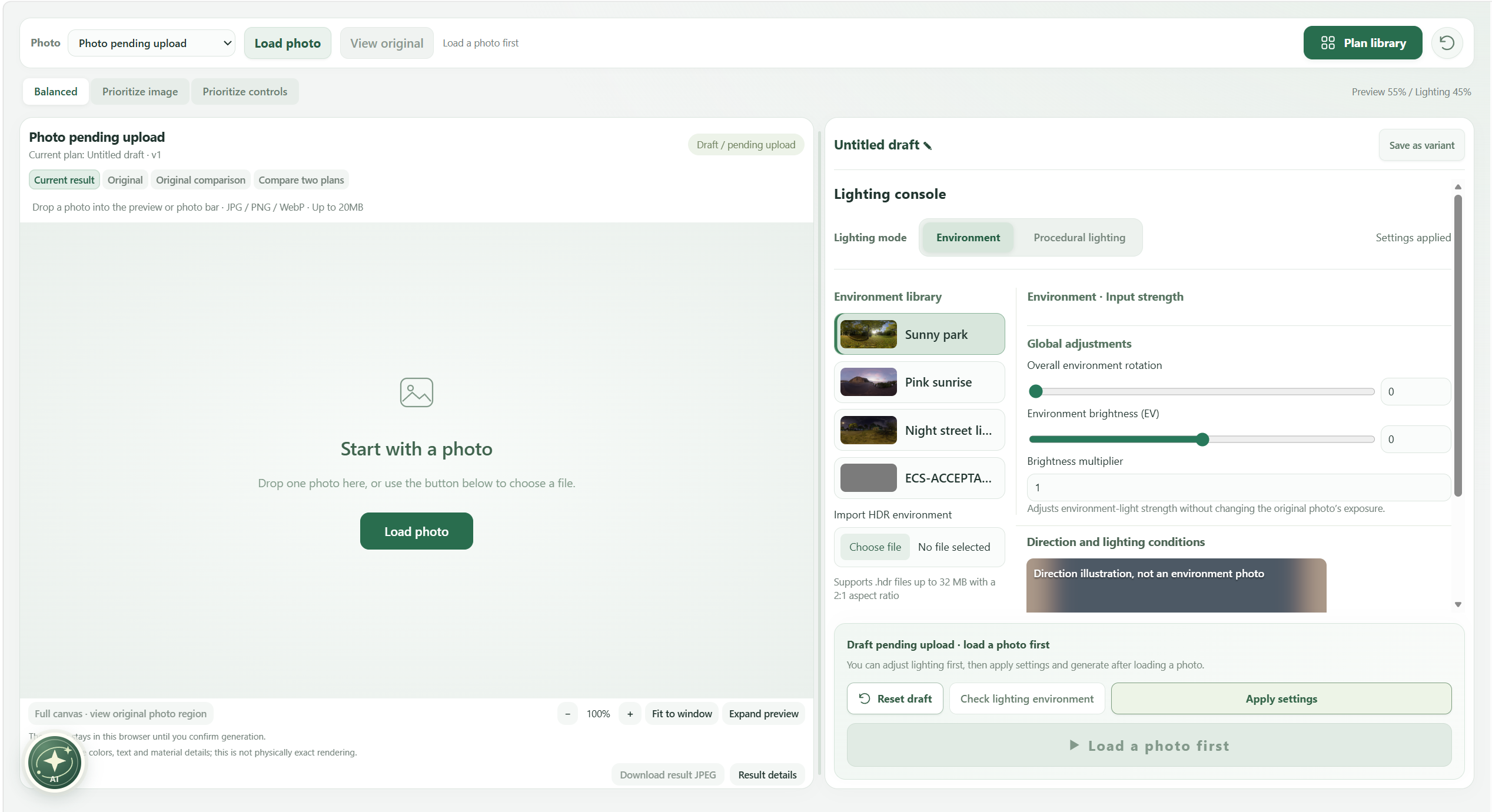
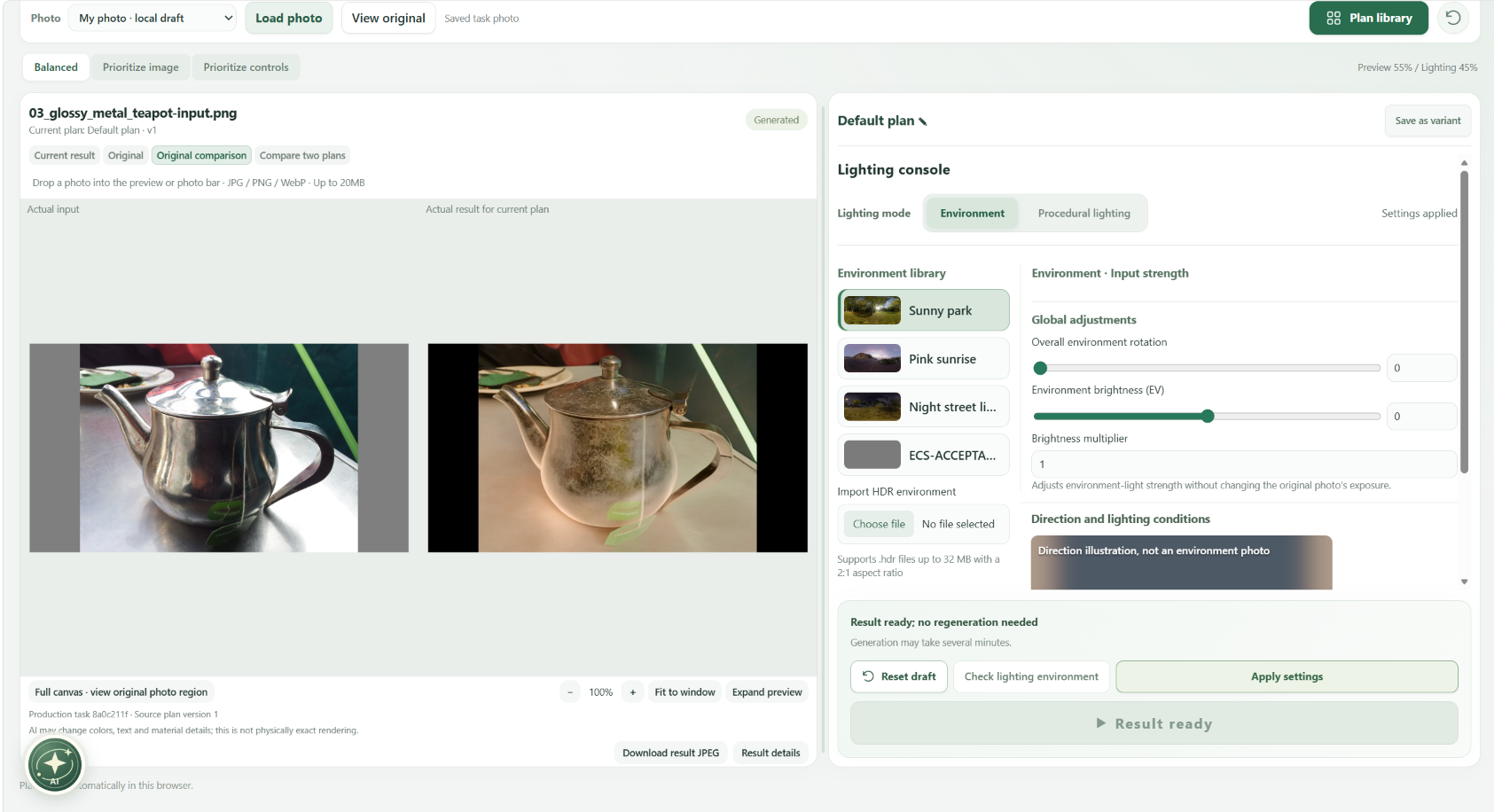
LightTry combines a parameterized lighting workbench, an AI assistant, and a versioned comparison workflow.
- Explore HDR environments: choose an environment, import a supported HDR file, rotate it, and adjust its input exposure.
- Build custom lighting recipes: create procedural far-field light zones with adjustable direction, intensity, color, and angular size.
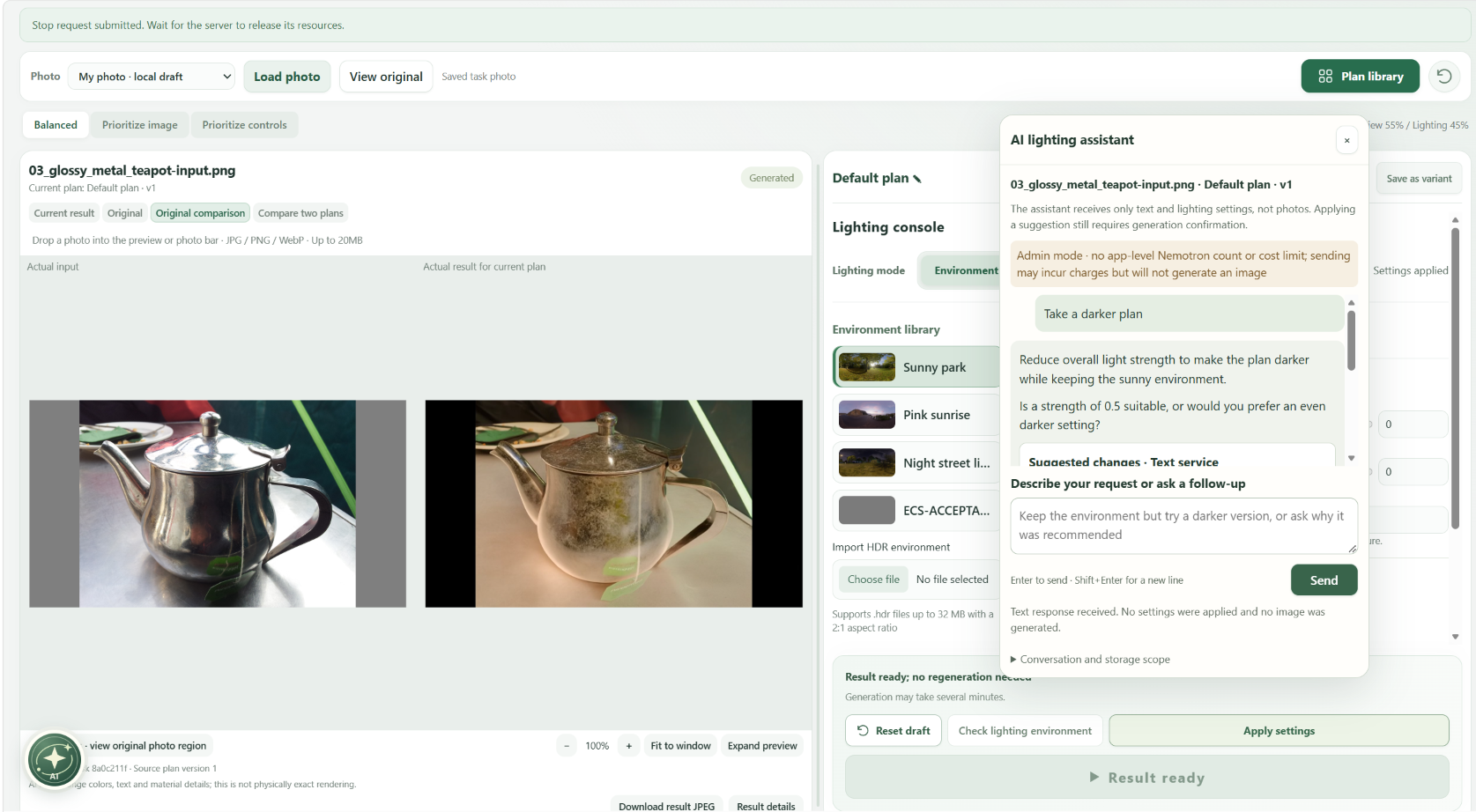
- Describe ideas in natural language: the Nemotron integration translates written lighting requests into structured recipe suggestions for review and editing.
- Keep creative control: applying a suggestion, saving a scheme, and submitting a generation are separate actions.
- Compare and revisit alternatives: preserve scheme versions, compare available results against the input or another scheme, and download generated images.
- Work in English or Chinese: the studio provides a bilingual interface.
LightTry is built for creative lighting previews, rather than physically calibrated rendering. Generated images may change colors, text, or material details, so users can inspect the original alongside the result.
How we built it
NVIDIA models for image relighting
Our image pipeline builds on NVIDIA DiffusionRenderer and Cosmos Tokenizer, using PyTorch and CUDA on Nebius NVIDIA L40S infrastructure.
The inverse stage predicts five G-buffer channels: base color, normals, depth, roughness, and metallic. The forward stage uses these intermediate representations and an HDR lighting condition to produce a relit image. Compatible intermediate results can be reused when exploring additional lighting schemes.
Nemotron for editable lighting suggestions
We integrated NVIDIA Nemotron through Nebius Token Factory as a text-based lighting assistant. It works with written requests and lighting configuration, without receiving photograph pixels.
Suggestions pass through structured validation before they can be applied. The assistant does not directly trigger GPU generation, giving users a chance to inspect and refine each proposed change.
Always-available UI, on-demand GPU computation
The Docker-based web application runs on an Alibaba Cloud CPU server, using Python, JavaScript, HTML, CSS, and Nginx. Nebius provides the GPU computation separately.
This architecture keeps the interface available without requiring the GPU to run continuously. Task tracking, explicit execution windows, and a separate guard process support GPU lifecycle management and shutdown verification.
Challenges we ran into
The biggest challenge was turning a research pipeline into a coherent user workflow.
Model initialization, reusable intermediate results, asynchronous execution, and interrupted connections all affect the experience. We built explicit task identities and recovery logic so that an uncertain response does not automatically trigger duplicate computation.
Another challenge was keeping the interface honest. A lighting-condition visualization is not a generated photograph, and an earlier result does not represent newly edited parameters. LightTry keeps drafts, applied recipes, and generated results distinct.
Accomplishments we're proud of
We moved beyond a fixed-preset demo to a configurable lighting studio with custom HDR inputs, procedural light zones, editable AI suggestions, and scheme comparison.
Our contribution is the application around the models: the lighting controls, recipe validation, versioned workflow, intermediate-result reuse, and CPU/GPU deployment orchestration. Earlier controlled experiments produced all five G-buffer channels and relit images under multiple HDR environments, providing a foundation for the product.
What we learned
Useful AI applications need more than a powerful model. They need controls people can understand, clear relationships between settings and outputs, and careful handling of expensive computation.
We also learned that natural-language interaction becomes more useful when it produces inspectable, editable parameters. Instead of hiding the lighting recipe behind a prompt, LightTry makes that recipe part of the creative process.
What's next for LightTry
We plan to improve generation reliability and first-result latency, evaluate more photographs and lighting recipes, and refine the connection between natural-language suggestions and manual controls.
Our goal is a dependable studio for answering a practical creative question: “What if we tried this light?”

Log in or sign up for Devpost to join the conversation.