-
-
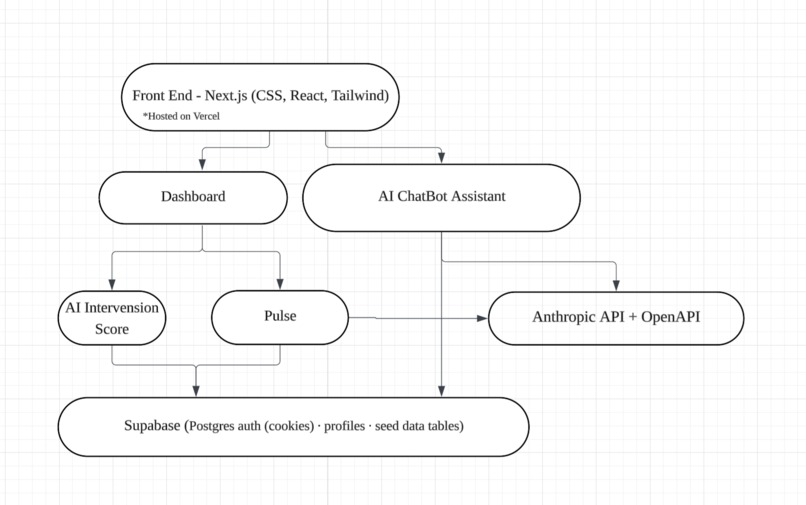
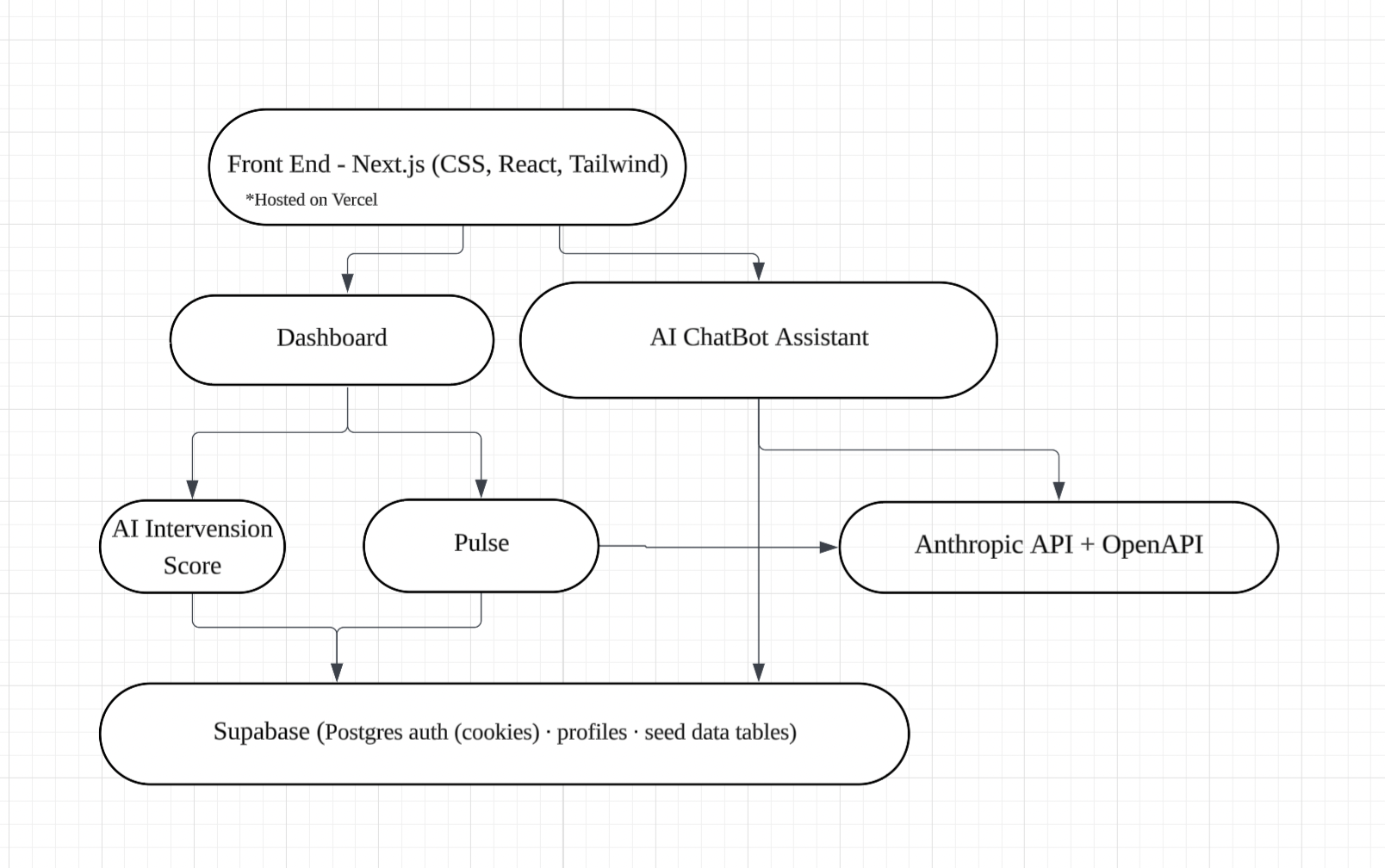
System Architecture Diagram
LIGHTHOUSE
AI Career Navigator for Singapore Computing Students A personalised dashboard that helps Singapore computing students and early-career tech workers understand how AI is reshaping the roles they’re aiming for.
Introduction
30th November, 2022. To most, this might seem like any other date. But, this happens to be the day a then not-so-famous Sam Altman launched ChatGPT into the everyday world. Multiple teams had been working on artificial intelligence around the same time, but to most people, this was the day it all began. Initially, the public simply enjoyed the automation it offered — high-school assignments and detailed spreadsheets could be generated in seconds, with barely any effort from the user. Fast forward almost four years, and the world has completely transformed. What once felt like a hack or a shortcut is now a source of excessive stress and anxiety. In a self-initiated survey of 30 Singaporean technology students, all of them cited worrying about AI’s impact on their future job role with 19 of them saying they think about the problem often.
The Problem
Computing students in Singapore currently have no personalised, real-time view of how the job market around them is shifting. AI is rapidly redefining how job roles are changing from a day-to-day basis, but students have no credible way to track these changes as they happen. This leaves many confused and unguided about the roles and skills they wish to pursue.
The guidance that does exist tends to come from professors and industry professionals, and while well-intentioned, it is often outdated relative to how roles are changing or shaped by the particular pre-AI path that the advisor chose for themselves.
Current Solutions
Students currently piece together career direction from three main sources, each with a structural gap: MyCareersFuture and Seniors: MyCareersFuture primarily lists job openings, while seniors tend to offer informal, experience-based advice. However, neither really helps students understand how a job role is evolving over time; instead, they focus on what worked for them or what is happening at that specific moment.
Social Media (LinkedIn, Reddit etc.): These sources could provide the students a signal, but it is also buried under a lot of noise. None of it is personalised to the student and separating opinions or trends from factual information takes time. Professors and Industry Professionals: Probably the most trusted source, but also most prone to biasedness. Their frame of reference is often a pre-AI world where jobs probably did not evolve as quickly.
The common problem amongst all these is fragmentation. Each source only gives a slice of the picture to the student, is mostly not personalised and are often not in-pace with how quickly AI is changing the modern world.
Target Audience
Lighthouse is built for computing undergraduates, postgraduates, and early-career workers who are actively seeking internships or navigating the early stages of a tech career in Singapore — regardless of whether they already have an industry network to lean on.
Improvement from Current Solutions
Lighthouse is a starting point, not a career advisor or prediction engine. It brings information and a framework but the final call stays with the student. It completely solves the fragmentation problem:
A centralised dashboard that explains how AI is changing the market in the simplest terms. It consists of two sections: how AI is changing the industry at large and how its affecting job roles personalised to you.
An AI Intervention score, instead of providing you with opinions and biases, quantifies how far AI has been adapted into a given role giving a concrete read to the students.
A chatbot whose only job is to explain anything and everything available on the web application. Instead of citing multiple sources that might not be trustworthy, the agent only works with information that has been approved on the website.
What makes everything credible though than scrolling through social media or asking a professor is that both pieces are sourced and can be authenticated. The dashboard cites where the claim comes from and the Intervention score runs on a benchmark algorithm working on research-backed methodology.
Feature
Onboarding What it does: Asks the student’s desired roles and skills once, up front Replaces: MyCareersFuture + asking seniors what to apply for
Pulse Digest What it does: An AI-personalised digest of the most recent changes, split into a General and a Personalised section, tailored to the student’s desired roles and skills Replaces: Reddit, Hacker News, tech Twitter — non-personalised noise
AI Intervention Score What it does: Shows how much AI involvement exists in a job role and how the role’s skills are evolving, with a graph of that role’s intervention trend over the past week/month/year Replaces: Professors — whose industry perspective can be outdated
AI Chat Assistant What it does: Presents reasoning for intervention scores and technology related articles in succinct and personalised manner. Advices based on data present on the website and does not force decision Replaces: Replaces common AI agents that could give untrustworthy sources
The Intervention score is built on published evidence from Anthropic, specifically focused on Singapore. Claude is one of the most widely used AI agents in Singapore, being used `5.56 times more than expected. As a result, data from this source provides a reliable reflection of broader AI usage patterns. The score summarises current, publicly cited data that is visible to every user of the web application. It captures how AI is changing the way a skill is used, rather than whether the skill is worth learning.
Tools, AI, Workplaces & APIs
Lighthouse uses two AI providers to perform different tasks. Anthropic’s Claude (model claude-sonnet-4-6, via the Anthropic SDK) handles generation, summarisation, and conversation, while OpenAI’s text-embedding-3-small handles semantic similarity for personalisation.
Three workflows function together to bring everything together:
Pulse Digest Generation: Live RSS feeds (The Straits Times, MIT Technology Review, Ars Technica) are pulled via rss-parser and run through a keyword classifier that sorts incoming articles into an “AI & Industry” bucket or a “CS Career” bucket. Claude then rewrites each selected article into a structured headline, summary, and relevance note for the General section, and then reframed specifically for the student’s profile for the Personalised section. The personalisation step is where embeddings come in: the student’s skills, target roles, and interests are embedded alongside candidate articles, and cosine similarity dictates which articles are most relevant before Claude rewrites them. Results are cached per student per week in Supabase so the same digest isn’t regenerated on every page load.
AI Intervention Score. The score is grounded in Anthropic’s published Economic Index data — global occupational exposure figures and Singapore-specific Claude.ai collaboration-pattern data — cross-referenced against the O*NET 29.2 task taxonomy by occupation code. The formula is score = 100 × coverage × (0.6 × augmentation share + 1.0 × automation share), where coverage is the share of that occupation’s O*NET tasks showing measurable Claude usage: the automation/augmentation split is adjusted by seniority (junior/mid/senior). Historical Singapore-specific data points are kept visibly distinct from the two earliest, worldwide-only data releases to offer a transparent overview. Every generated score ships with a plain-English reasoning string and an explicit source citation. Scores are updated every 2-3 months when Anthropic releases their new official datasets.
Lighthouse AI chat assistant. A Claude-powered chat layer sits on top of the score and the week’s digest, but it is system-prompted with hard constraints: it explains what the Intervention Score means and contextualises news for the student’s role, but is explicitly instructed never to recommend a specific company, job, or salary, never to tell the student what to prioritise, and to close substantive answers with neutral language.
Each feature (Pulse, Job, Risk, Onboarding) owns its own Next.js API route, and a single route acts as the aggregator calling each underlying route and combining the results into one instance. Supabase handles authentication and Postgres storage underneath all of this, with row-level security policies ensuring a student can only ever read their own cached data.
Tech Stack
Layer: Framework Tool: Next.js (App Router)
Layer: Language Tool: TypeScript (strict mode)
Layer: Styling Tool: Tailwind CSS v4
Layer: UI components Tool: shadcn/ui, built on Radix UI primitives
Layer: Data fetching & state Tool: TanStack Query
Layer: Forms & validation Tool: React Hook Form + Zod
Layer: Charts Tool: Recharts (Intervention Score trend graphs)
Layer: Database, auth & access control Tool: Supabase (Postgres + Row-Level Security)
Layer: LLM Topic: Anthropic Claude API (claude-sonnet-4-6)
Layer: Embeddings Tool: OpenAI text-embedding-3-small
Layer: News ingestion Tool: rss-parser against live RSS feeds
Layer: Icons Tool: lucide-react
Layer: Dates Tool: date-fns
Layer: Hosting & deployment Tool: Vercel, auto-deploying the main branch on every push
Conclusion
Lighthouse hinges on the idea that students do not need another opinion telling them what to do. What they actually need is a credible and personalised environment that shows them what’s changing and helps them decide for themselves. References
Anthropic, Anthropic Economic Index, https://www.anthropic.com/economic-index National Centre for O*Net Development, O*Net, https://www.onetonline.org/
Built With
- anthropicclaudeapi
- date-fns
- lucide-react
- next.js
- openai
- reacthookform+zod
- recharts
- rss-parser
- shadcn/ui
- supabase
- tailwindcssv4
- tanstackquery
- typescript
- vercel


Log in or sign up for Devpost to join the conversation.