-
-
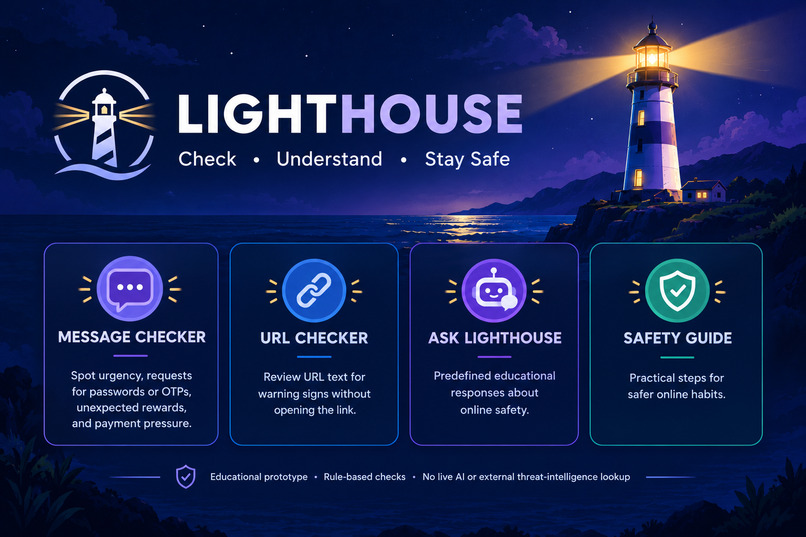
Spot suspicious messages and links with LIGHTHOUSE . Understand risks. Stay safe online!
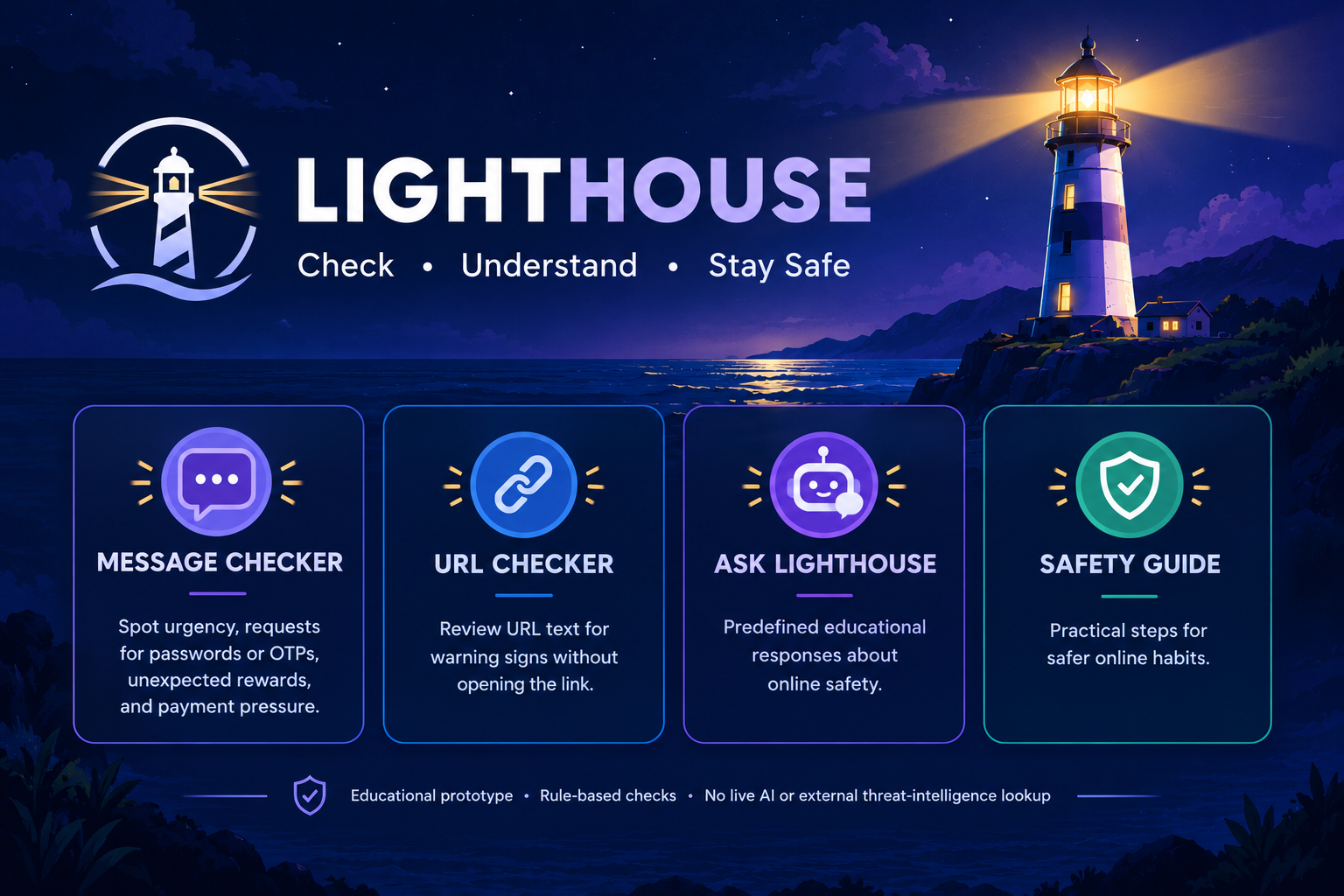
Inspiration : Online scams often use urgent messages, suspicious links, and fear to pressure people into acting quickly. We wanted to explore how technology could help people recognize these warning signs and understand why a message might be suspicious.
This inspired us to create LIGHTHOUSE, an explainable security assistant that aims to make online safety easier to understand. Just as a lighthouse guides ships through darkness, our project aims to guide people toward safer decisions online.
What it does:LIGHTHOUSE is designed to help users examine suspicious messages and URLs and understand potential security risks.
Our planned core features include:
Detect Risks: Identify possible warning signs, such as urgent language and suspicious links.
Explain Why: Provide understandable explanations of the warning signs instead of simply displaying a risk label.
Learn Safer: Offer practical guidance on what users can do next to protect themselves.
LIGHTHOUSE is intended to support security awareness, not guarantee that a message or link is safe or malicious.
How we built it:We are developing LIGHTHOUSE as a web-based prototype using HTML, CSS, and JavaScript. Our approach is to begin with a simple, accessible interface and implement transparent, rule-based checks for common warning signs.
We are focusing on making the results easy to understand, with clear explanations and safe next-step recommendations. As the prototype develops, we plan to test the interactions, fix issues, and improve the experience based on feedback.
Challenges we ran into:As beginners building a complete web product, one of our main challenges is turning an idea into a working application while learning new technologies.
We also need to make security explanations useful without making exaggerated claims about detection accuracy. Another challenge is coordinating tasks as a team, connecting different parts of the project, and keeping the first version focused on its most important features.
We are addressing these challenges by breaking the work into smaller tasks, testing features individually, and prioritizing clarity and responsible guidance.
Accomplishments that we're proud of:We are proud to have transformed an online-safety problem into a concrete project idea with a clear purpose. LIGHTHOUSE gives us an opportunity to combine web development, problem-solving, and cybersecurity awareness in one product.
What we learned:This project is teaching us that building a useful product involves more than writing code. We need to understand the problem, prioritize essential features, design for real users, test our work, and communicate limitations honestly.
We are also learning how HTML, CSS, and JavaScript work together to create an interactive web experience, while developing our teamwork, debugging, and product-building skills.
What's next for LIGHTHOUSE : Our next step is to complete and test the core prototype so users can submit sample suspicious messages and receive understandable explanations of potential warning signs.
Future improvements could include:
A clearer risk assessment with explanations for each warning sign.
More examples of phishing messages and online scams.
Improved accessibility and support for additional languages.
User feedback to help us make the guidance more useful.
Further research into safe ways to incorporate threat-intelligence sources.
Our long-term vision is to make LIGHTHOUSE a trustworthy learning companion that helps people pause, check, understand, and make safer decisions online.

Log in or sign up for Devpost to join the conversation.