

Inspiration
Everyone has someone they worry about. A parent who forwards every "you've won a prize" email. A grandparent who almost wired money to a stranger who said he was from the bank. As memory fades, the instincts that keep us safe online fade with it, and scammers know exactly who to look for. Older adults lose billions of dollars to online fraud every year, and most of it never gets reported because the people it happens to feel ashamed.
The usual fixes do not fit. You cannot sit beside your mother's inbox all day. Locking her out of her own accounts takes away her independence and her dignity. We wanted something gentler: a quiet helper that stays in the background, steps in only when it should, and keeps the family in the loop without taking over a person's life.
What it does
Lighthouse is an AI safety net for the digital life of someone who needs a little help, with their family standing behind it. It watches the incoming flow of a person's digital life and decides, case by case, what to do.
It runs on one rule: safe and reversible means it acts, risky and irreversible means it asks. Every time.
- A phishing email is safe to handle, so Lighthouse quarantines it on its own, before it is ever seen.
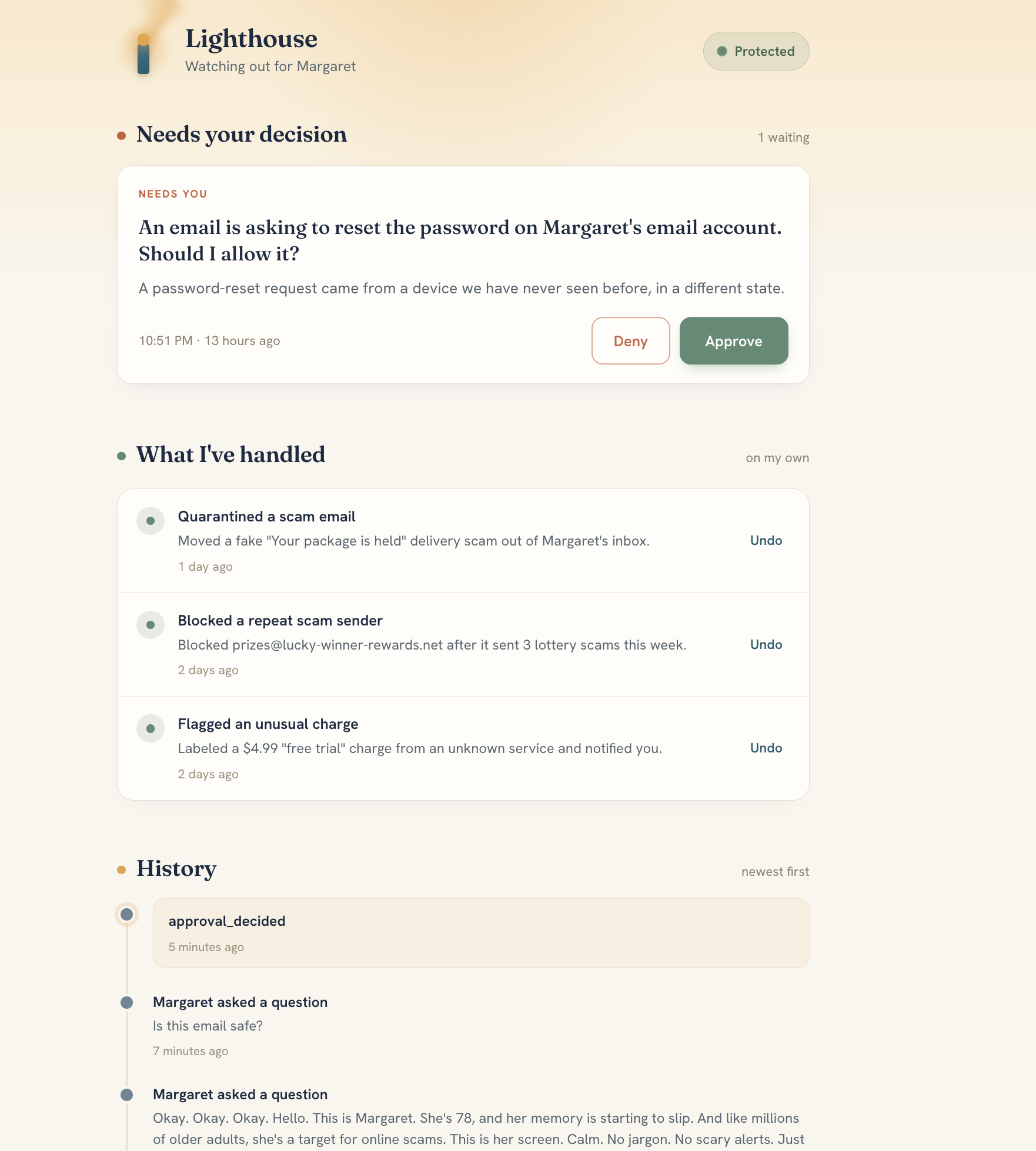
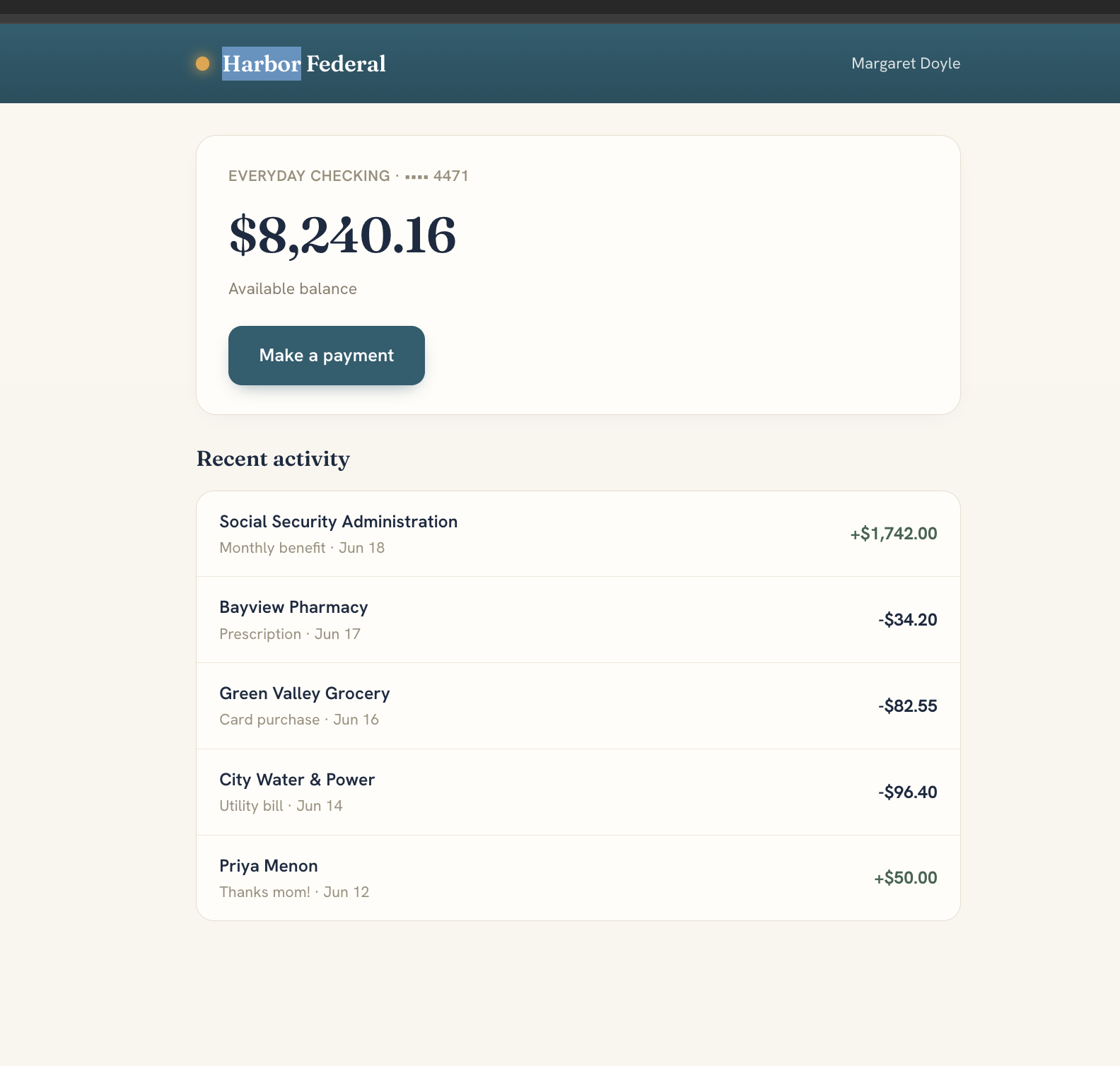
- A demand to "pay $200 to unlock your account" is high stakes, so Lighthouse refuses to act alone. It holds the request and asks a family member, in plain language, to approve or deny it.
The person being protected sees a calm, reassuring screen. No jargon, no alarms, and no off switch, because only family can change the protection. They can even ask Lighthouse a question out loud and hear a gentle answer back. The family sees a dashboard with three things: what needs a decision, what Lighthouse already handled on its own, and a complete history of everything it has done.
How we built it
Lighthouse is a small team of cooperating agents, each with one job. A Watcher reads an incoming signal and classifies the threat. A Guardian proposes a single response, chosen only from a fixed registry of allowed actions, so it can never invent something dangerous. A deterministic safety gate routes that proposal: act, ask, or just watch. An Escalation agent turns a risky proposal into a plain question for the family and waits for the answer. An Executor carries out approved actions on real web pages the way a person would, by clicking and typing in a live browser.
The agents talk to each other over Fetch.ai's uAgents and are reachable through the ASI:One chat protocol, so the whole system can be driven by an ordinary conversation. Claude does the reasoning behind the Watcher and Guardian. The Executor uses Browserbase and Stagehand to operate a real inbox and a real banking page. A FastAPI and Postgres service holds the shared state, the approval bridge between the agents and the dashboard, and an append-only, tamper-evident ledger. The family dashboard, the protected person's screen, and the mock inbox and bank are a React app. We traced and scored the agents' decisions with Arize Phoenix, and used Sentry to catch failures in the parts that touch the real world.
Challenges we ran into
Drawing the line between act and ask so it stays predictable instead of a model's guess. We solved it with a deterministic gate and a frozen list of allowed actions, so the model proposes but the rules decide. Getting four moving parts, the agents, the gate, the backend, and the web app, to behave as one system without a single broken piece taking down the demo. We built every external call with a fallback and a demo mode, so bad wifi or a missing key never stops the story. And keeping the protected person's screen genuinely calm, with no control anywhere that could undo their safety, which took real restraint to design.
Multi-agent system on Fetch.ai & ASI:One
Lighthouse runs as a team of cooperating Fetch.ai uAgents, published on Agentverse and reachable through the ASI:One Chat Protocol. You can talk to the coordinator in plain language and watch the pipeline (classify, propose, gate, act) play out.
Live ASI:One chat session: https://asi1.ai/shared-chat/6f328aeb-7e9c-4f34-9f62-f7ecc7e117b3
Agent profiles on Agentverse:
Sponsors & integrations
- Claude (Anthropic) - reasoning behind the Watcher (threat classification) and Guardian (action choice).
- Fetch.ai / ASI:One - multi-agent orchestration over the Chat Protocol; agents published on Agentverse.
- ASI:One chat: https://asi1.ai/shared-chat/6f328aeb-7e9c-4f34-9f62-f7ecc7e117b3
- Agents: coordinator · watcher · guardian · executor
- Arize Phoenix - tracing + an LLM-as-judge evaluator. The Watcher improved from 86.7% to 93.3% on our hard adversarial email set after acting on the eval's explanations.
- Browserbase + Stagehand - the Executor operates the inbox and bank in a real browser.
- Deepgram - voice helper on Margaret's screen (speech to text + text to speech).
- Sentry - error capture on the data service (verified via /sentry-test).
Accomplishments that we're proud of
- It works end to end. Both demo scenarios run start to finish over a real agent chat protocol with real Claude reasoning: a phishing email gets quarantined automatically, and a payment scam is held until a family member denies it.
- Safety is built in, not bolted on. A deterministic gate, a frozen action registry, reversible actions with undo, and a human in the loop for anything high stakes mean the system cannot quietly do harm.
- Every decision is accountable. Each action, request, and decision is written to a tamper-evident ledger the family can audit.
- Independence and protection coexist. The person keeps a calm, dignified screen with no way to disable their own safety, and the family keeps control without taking over.
- A real, integrated stack. Fetch.ai agents, Claude, Browserbase, Arize, and Sentry all working together, with a demo mode so nothing on stage depends on perfect conditions.
What we learned
The hard part of an agent that touches the real world is not making it capable. It is making it know when to stop. Constraints, reversibility, and a human in the loop are not limits on the product. They are the product. Trust is the feature people actually need.
What's next for Lighthouse: a safety net for a loved one's digital life
Real email and bank connections, more kinds of signals like texts and phone calls, a fully voice-first experience for the protected person, which we have already prototyped with Deepgram, and a shareable trust report so the whole family stays informed. Lighthouse is not about replacing a person's judgment. It is about giving a worried family a way to protect someone they love without taking away that person's independence. Smart enough to act, safe enough to ask.
Built With
- anthropic-claude
- arize-phoenix
- asi-one
- browserbase
- deepgram
- docker
- fastapi
- fetch.ai
- javascript
- postgresql
- python
- react
- react-router
- sentry
- stagehand
- tailwind-css
- uagents
- vite

Log in or sign up for Devpost to join the conversation.